Introduction
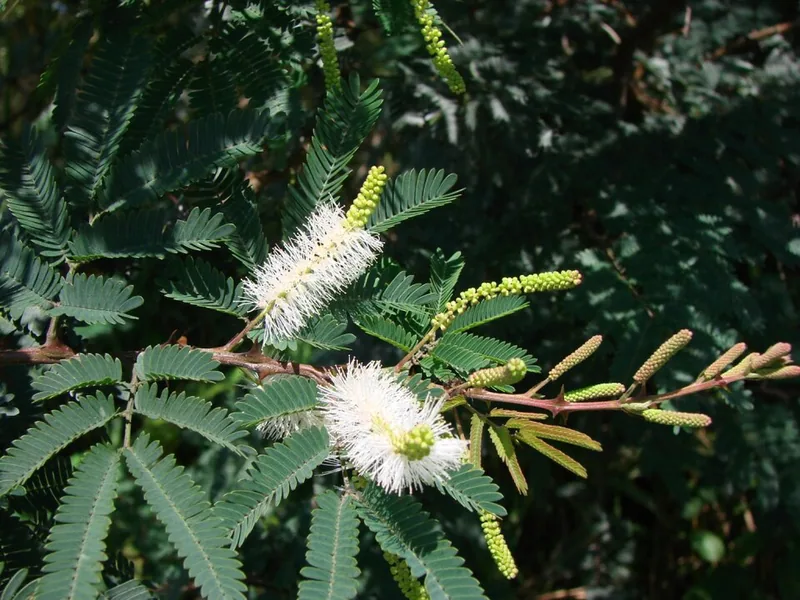
Jurema-preta, Mimosa tenuiflora, is a thorny tree of the dry Caatinga of north-eastern Brazil, also found in Mexico and Central America. Its root bark makes the sacred jurema drink of the Indigenous Northeast — toré, Ouricuri, Catimbó — first recorded in Pernambuco mission documents of 1739, and its rites remain distinct and partly secret among the Xukurú, Pankararu, Kariri-Xocó and other peoples. DMT was found in the root in 1959; how the traditional drink became active by mouth is unresolved. Taken with an MAO-inhibiting plant, as in modern juremahuasca, its effects are essentially those of DMT.
All sections
| Botanical name | Mimosa tenuiflora |
|---|---|
| Taxa | Fabaceae · Fabales |
| Traditional names | Jurema · Jurema-preta · Tepezcohuite |
| Regions | Disjunct: southern Mexico (Oaxaca, Chiapas) through Central America (Guatemala–Panama), Colombia, Venezuela, and the Brazilian Caatinga (Bahia, Pernambuco, Paraíba, Rio Grande do Norte, Ceará). |
| Ethnographic entheogenic use | Jurema is the sacred drink of the Indigenous Northeast of Brazil and of the wider Jurema field — toré, Ouricuri, Catimbó — first recorded in Pernambuco mission documents of 1739. Its rites remain distinct, and partly secret, among the Xukurú, Pankararu, Kariri-Xocó and other peoples (Wadsworth, 2006; Mota, 1997; Grünewald, 2018). |
01Ethnobotany of Mimosa tenuiflora
Botanical Info
| Accepted name | Mimosa tenuiflora (Willd.) Poir., 1810 |
|---|---|
| Synonyms | Mimosa hostilis (C. Mart.) Benth. — still dominant in psychedelic commerce; Acacia tenuiflora Willd.; Acacia hostilis Mart.; Acacia jurema Mart. (Kew Science, 2026; Camargo-Ricalde, 2000) |
| Family | Fabaceae (Leguminosae), mimosoid clade, subfamily Caesalpinioideae — older literature: Mimosaceae/Mimosoideae |
| Order | Fabales |
| Geographic range | Disjunct: southern Mexico (Oaxaca, Chiapas) through Central America (Guatemala–Panama), Colombia, Venezuela, and the Brazilian Caatinga (Bahia, Pernambuco, Paraíba, Rio Grande do Norte, Ceará). Sea level to ~1,100 m. |
| Local names |
|
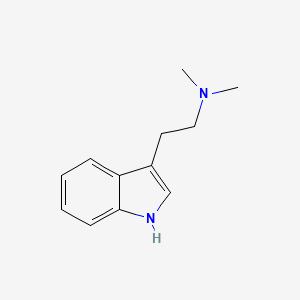
| Entheogenic compounds | DMT (bark, esp. root) · N-methyltryptamine · trace β-carboline-like compounds |
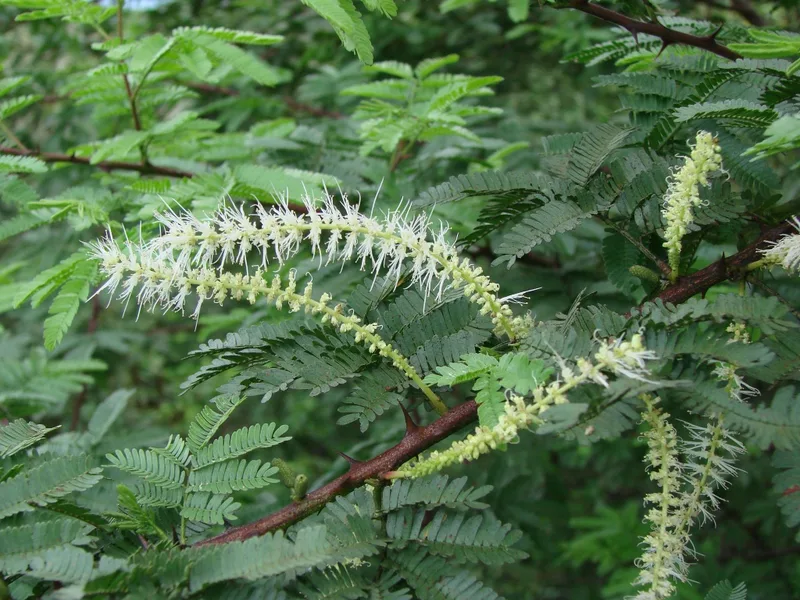
| Morphology | Branched, deciduous, prickly shrub or small tree, 4–6 m (to ~8 m). Bipinnate leaves 3–6 cm; fragrant whitish spikes 4–8 cm; brittle segmented pods.
|
Territories
- 1Xukurú · rites distinct and partly secret among the Xukurú, Pankararu, Kariri-Xocó and others (Wadsworth, 2006; Mota, 1997; Grünewald, 2018)
- 2Pankararu of the Rio São Francisco · the jurema drink they call ajucá (Ott, 2001)
- 3Kariri-Xocó · rites distinct and partly secret (Mota, 1997; Grünewald, 2018)
Deep Time
- 1739Pernambuco Council of Missions, Paraíba: the first record of jurema.
- 1806First collected, in Venezuela, and described as Acacia tenuiflora.
- 1959DMT found in the root of the plant behind vinho da jurema.
A precolonial origin is probable; the documentary record begins in 1739.
Collections and names
The tree entered botany outside Brazil. It was first collected in Venezuela in 1806 and described as Acacia tenuiflora Willd.; a Colombian collection of 1863 became Mimosa cabrera Karst., after its local name cabrera or cují cabrera; the first Brazilian collection, in 1823, was named Acacia hostilis Mart., which Bentham moved into Mimosa — the “hostilis” of the trade name. Botanical studies by Barneby and Grether agree that jurema-preta is not a Caatinga endemic but a species of disjunct populations from Bahia north to at least Oaxaca (Barneby, 1991; Grether, 1988, cited in Ott, 2001, pp. 69–70). In Brazilian folk taxonomy its boundary with Anadenanthera is loose: little distinction is made between jurema and angico, and Mimosa species are called angiquinho, “little angicos” (Ott, 2001, p. 70).
02Chemistry
DMT
revised 2015
Yuremamine
trace
N-methyltryptamine & β-carbolines
alkaloid
Non-alkaloid constituents
Pharmacological open questions
DMT is normally MAO-metabolised and unreliable as a psychedelic when swallowed alone. Unlike ayahuasca, traditional jurema has no consistently demonstrated B. caapi-like source of adequate MAO inhibition — this is a live, unsolved problem.
- Unresolved
How historical vinho da jurema achieved oral activity — candidates include undisclosed admixtures, fermentation chemistry, very concentrated dosing, uncharacterised trace β-carbolines, individual metabolic variance, or entactogenic effects from fasting/dance/tobacco/expectation alongside DMT.
- Contested
Yuremamine is widely claimed online to inhibit MAO. Isolation and structural revision have yet to show physiologically effective MAO-A inhibition — the claim remains unproven.
- Preclinical only
Antidepressant-, anxiolytic- and sedative-like signals (5-HT₂A/2C, proposed GABAergic/serotonergic pathways) are mouse and zebrafish data — hypothesis-generating, ahead of any clinical evidence (Duarte-Filho et al., 2022; Feitosa de Araújo et al., 2025).
- Unresolved
Juremahuasca (with Peganum harmala) is pharmacologically distinct from unadulterated traditional jurema, and a modern formula; 18th-century preparations need their own explanation.
Measured and varying
DMT was first shown in jurema in 1959, when Pachter’s group, working on Anadenanthera colubrina seed, also found it in the root of the plant behind vinho da jurema, then called M. hostilis (Pachter et al., 1959, cited in Ott, 2001, p. 27). The stem bark used in Mexican tepescohuite holds only 0.3–3% of the DMT content of the root bark used in vinho da jurema (Meckes-Lozoya et al., 1990, cited in Ott, 2001, p. 71). Over twenty-four months of bimonthly collections at Petrolina, Pernambuco, DMT fell as radiation and temperature rose but did not follow rainfall, while phenolic compounds, flavonoids especially, tracked water stress, radiation and temperature (de Souza et al., 2025). A 2025 study comparing root and stem bark proposed the stem bark as a source of DMT for standardised pharmaceutical formulations in psychedelic-assisted psychotherapy (de Oliveira et al., 2025).
Livestock and toxicology
In the Brazilian semi-arid the tree is browsed by livestock and has long been held responsible for malformed young. A review of twenty-four studies from 1990–2020 found M. tenuiflora embryotoxic, fetotoxic and abortive in farm animals, especially sheep and goats — a recognised loss to farmers — and named DMT among the likely causes (Lima Bezerra, Vieira Pinheiro and Barbosa Lucena, 2021). Pregnant rats fed leaf and seed material, their extracts, or purified N-methyltryptamines bore more pups with cleft palate and skeletal malformations (Gardner et al., 2014). An ethanolic extract of the root bark caused no deaths in mice at the levels tested, but altered blood chemistry and kidney weight and produced changes in heart, liver and kidney tissue (de Sousa et al., 2024).
03Tradition, ritual & cultural use
| Oldest evidenced / proposed use | No secure archaeobotanical residue or dated preparation exists specifically for M. tenuiflora. Earliest secure written record: September 1739, Pernambuco Council of Missions, Mamanguape villages; spread among Panaty, Jacoca, Pega, Corema peoples reported 1743 (Wadsworth, 2006). Probable precolonial origin — Documented from 1739 only. |
|---|---|
| Peoples & traditions | Xukurú, Pankararu, Atikum, Kariri-Xocó, Xocó, Fulni-ô, Potiguara, Truká, Tuxá, Kambiwá, Pankararé — each with its own rites; some communities preserve significant secrecy (Mota, 1997; Grünewald, 2018). |
Ritual complexes
Jurema is several overlapping, historically layered formations, more than a single "Jurema religion."
Toré
Collective circle/processional dance — sung toantes, maracás, tobacco, invocation or embodiment of encantados. Simultaneously sacred practice, public identity, and political affirmation.
Ouricuri
More restricted sacred-forest complex, esp. Kariri-Xocó, Xocó, Fulni-ô. May include initiation, healing, ancestral relations, and knowledge levels undisclosed to outsiders.
Catimbó / Jurema Sagrada
Urban and rural northeastern field combining Indigenous masters and caboclos, Catholic saints and prayer, Afro-Brazilian mediumship, smoke curing, divination, popular medicine.
Contemporary juremahuasca
Metropolitan formations combining ayahuasca-style brewing with Peganum harmala, New Age cosmology, psychotherapy, global psychedelic culture (Grünewald, Savoldi and Collins, 2022).
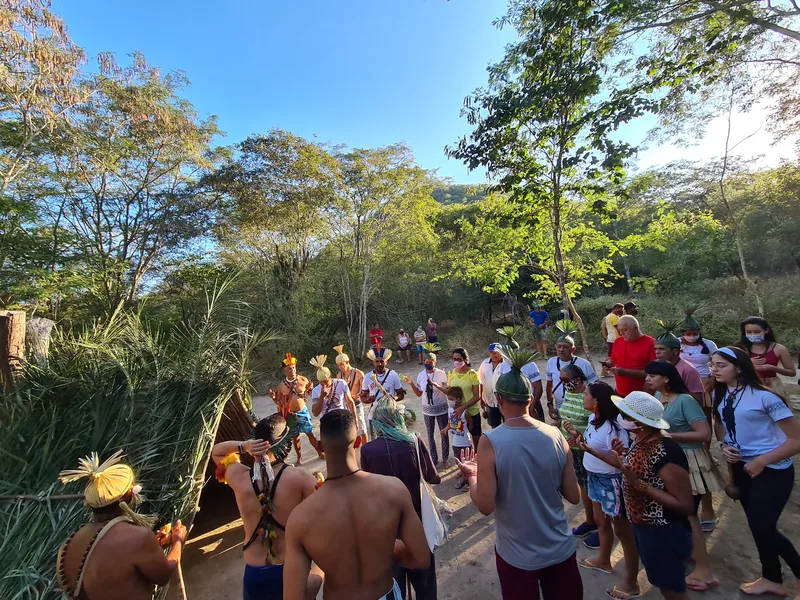
| Role in shamanism | Mestre de jurema (also pajé, healer, medium) prepares and administers the drink, uses tobacco and prayer, calls spirits through song, diagnoses, divines, and regulates encounters with powerful beings. In Catimbó/Jurema Sagrada the emphasis often shifts to incorporation — masters and caboclos speak through mediums — where vision is one criterion of efficacy among others (Wadsworth, 2006). |
|---|---|
| Role in physical & cultural healing | Healing is ceremonial and communal, far wider than DMT pharmacology. Ritual, song and sacred woodland have also functioned as cultural survival infrastructure for peoples that colonial and later state classifications declared assimilated or extinct (Mota, 1997). |
Juremas, angicos and the Ouricuri
Jurema-preta is the “black” jurema. Beside it Ott counts at least eleven juremas brancas, “white” juremas — all but one of them legumes of Acacia, Mimosa, Piptadenia and Pithecellobium, the exception being Vitex agnus-castus (Ott, 2001, pp. 25, 69, 71). The Pankararu of the Rio São Francisco call the jurema drink ajucá (Ott, 2001, p. 33).
Among the Kariri-Xocó near the mouth of the São Francisco, Clarice Novaes da Mota found two angicos, cebil and an unidentified relative, used as medicine, chiefly for bronchial complaints. In the Kariri system angico do campo is female, like jurema-preta, while angico is male and has a “secret name”. In a sacred grove on a river island the trees are “perceived as trees of great science or of great prestige” (da Mota and de Barros, 1990, cited in Ott, 2001, p. 26); a cold-water bark infusion of angico is “taken during the Ouricuri feast, but for spiritual purposes”, and people gather under an angico tree “for penance and to perform spiritual ‘work’” (Ott, 2001, p. 26).
Jurema also appears in unexpected places. Eighteenth- and nineteenth-century reports placed it in western Amazonia: among the Amanajós of the Rio Negro in 1843, a drink made from the roots of the jurema tree, and among many tribes according to a Jesuit missionary. Schultes dismissed them as “most certainly erroneous and confused”, asking “where could these Indians have found jurema roots in their new and very different environment?” — the Amanajós had come from north-eastern Brazil at the end of the eighteenth century (Schultes, 1978, cited in Ott, 2001, p. 69). Ott proposes two answers: the tree’s disjunct range reaches interior Venezuela and northern Colombia, and the name may have passed to Anadenanthera roots, since folk taxonomy hardly separates jurema from angico. He found no sacred aura about the tree in northern South America or Mesoamerica; in Mexico, as tepescohuite, from the Nahuatl for “ravine tree”, it is a prosaic medicine and cosmetic (Ott, 2001, pp. 69–71).
04Cosmology & key terms
"Jurema" can denote the plant, the drink, an enchanted female power, a sacred territory or city, and the wider religious tradition at once — so an ethnographic mention of jurema leaves the species open until M. tenuiflora is identified.
- Encantados
- More than "ghosts" — some ancestors, others beings who became enchanted instead of dying ordinarily. Inhabit sacred forests, trees, stones, waters, invisible cities.
- Cities of Jurema
- Cosmological places — where curing power and legitimate ritual authority originate; songs call their inhabitants into the ceremonial world.
- Jurema (gendered)
- Addressed in many accounts as a female presence, mother, queen or cabocla who teaches, tests and protects — in tension with "MHRB" as standardised commodity.
- Jurema branca
- “White” jurema: at least eleven other plants under the name, all but one legumes (Ott, 2001, pp. 25, 69).
- Angico
- The common Brazilian name for Anadenanthera; barely separated from jurema in folk taxonomy, and in the Kariri system the male counterpart of the female angico do campo (Ott, 2001, pp. 26, 70).
- Ajucá
- The Pankararu name for the jurema drink (Ott, 2001, p. 33).
- Ciência
- A field of ritual knowledge transmitted through masters, distinct from biomedical or pharmacological "knowledge" and untranslatable into it.
05Visionary phenomenology
Phenomenological profile
The profile lists effects the sources report, for each preparation separately, grouped by domain. Each row gives the grade, how often the sources say the effect occurs (only where they say so; most do not) and the kinds of source behind it. A chip naming a compound, such as “Trial · psilocybin”, means the evidence comes from studies of that compound rather than of the preparation itself; “partial” means the route, purity or dose differs from the traditional preparation, so the row cannot be graded above supported. The line under each preparation says which domains have evidence entered here. A domain with nothing entered has not yet been assessed in this profile; that is not a finding that the literature is silent, and the article may discuss it. Open a row for the note and the sources.
Jurema drinkunanalysed, in ritual
Evidence entered for 1 of 8 domains. Not yet entered: visual, other senses, body, affect, cognition, relation to other beings, states of consciousness.
No controlled study exists for traditional, chemically analysed jurema. Its DMT is not ordinarily active by mouth without an MAO inhibitor (Carbonaro and Gatch, 2016), and how traditional preparations act is not settled.
Self and unity
Ego dissolutionLoosening or loss of the sense of being a bounded self.UnresolvedSurvey
In an observational study of 26 participants, jurema-associated ego dissolution was linked to religious quality, unity and the perceived subjectivity of surrounding things; the jurema was drunk after ayahuasca, and neither drink was analysed, so the attribution is unresolved (Savoldi et al., 2023).
Unitive experienceThe sense that self and world, or all things, are one or interconnected.UnresolvedSurvey
Unity was among the features linked to jurema-associated ego dissolution in the same study, after ayahuasca (Savoldi et al., 2023).
With an MAOI plantjurema with a β-carboline source
Evidence entered for 6 of 8 domains. Not yet entered: other senses, states of consciousness.
The inner root bark carries DMT, in amounts that vary by tissue and provenance (Gaujac et al., 2012). Taken with an MAO-inhibiting plant, the DMT becomes active by mouth, so the drink acts essentially as DMT does in ayahuasca. Trials and surveys of ayahuasca, and a study of Acacia DMT given with harmala alkaloids, correspond in full; inhaled or injected DMT counts at partial weight. No study has yet measured a jurema drink taken with an MAOI.
Visual
Geometric patterningLattices, spirals, tunnels and other repeating forms seen with eyes closed or overlaid on the visual field.SupportedSurvey · dmt, partial
Fractals, shapes and patterns were described in 32.6% of 3,778 inhaled-DMT reports, and vivid colours in 25.2% (Lawrence et al., 2022). Inhaled DMT acts within minutes and briefly, so this counts at partial weight.
Immersive realmsCoherent places or events that surround the experiencer, who seems to be located in them rather than looking at images.SupportedSurvey · dmt, partial
All 36 reports in a field study of inhaled DMT described emerging into other worlds (Michael, Luke and Robinson, 2021); alternate or higher dimensions appeared in a quarter of online reports (Lawrence et al., 2022). Inhaled DMT acts within minutes and briefly, so this counts at partial weight. Read about the phenomenology of immersive realms →
Body
Nausea and purgingNausea, vomiting or diarrhoea during the acute state.SupportedTrial · dmtSurvey · dmt
Nausea or vomiting dominated the acute physical effects in a survey of 8,216 ayahuasca drinkers, 69.9% reporting at least one (Bouso et al., 2022). Nausea was the commonest physical adverse event when DMT from another plant, Acacia, was given by mouth with harmala alkaloids (Bonomo et al., 2025).
Altered bodily sensationTingling, vibration, heat, cold, heaviness, pressure or internal movement felt in the body.SupportedTrial · dmt
Under controlled dosing of ayahuasca, somaesthesia rose even at the lowest dose; volunteers described an “electric / tingling feeling” and feeling hot or cold (Riba et al., 2001).
Tremor and motor slowingTrembling, impaired coordination or slowed movement.SupportedTrial · dmt
Controlled administration of ayahuasca records impaired coordination (Riba et al., 2003).
Raised blood pressureA measured rise in arterial blood pressure during the acute state.SupportedTrial · dmt
The higher standardised dose of ayahuasca raised mean diastolic pressure by about 9 mmHg at 75 minutes (Riba et al., 2003). A measured sign rather than an experience.
Self and unity
Ego dissolutionLoosening or loss of the sense of being a bounded self.SupportedSurvey · dmt
Ceremony attendants scored a mean of 60 on the Ego Dissolution Inventory after ayahuasca (Uthaug et al., 2018); the finding was replicated with 73 attendants (van Oorsouw et al., 2021).
Unitive experienceThe sense that self and world, or all things, are one or interconnected.SupportedExperience
Participants describe the sense that “all is one” within limitless expansive states (Kjellgren, Eriksson and Norlander, 2009).
Death and rebirthExperiencing one’s own death, and a return or renewal.SupportedExperienceTrial · dmt, partial
Written ceremony accounts include death and reincarnation (Kjellgren, Eriksson and Norlander, 2009); near-death features rose significantly after intravenous DMT against placebo (Timmermann et al., 2018). DMT was injected, briefer and faster than the drink, so this counts at partial weight.
Affect
Fear and dreadFear, panic, chaos or a sense of threat during the experience.SupportedExperienceTrial · dmt, partial
Written ceremony accounts place vomiting at the peak of fear (Kjellgren, Eriksson and Norlander, 2009); after intravenous DMT, euphoria alternated or coexisted with anxiety (Strassman et al., 1994). DMT was injected, briefer and faster than the drink, so this counts at partial weight.
Bliss and euphoriaIntense joy, beauty, love or wellbeing.SupportedExperienceTrial · dmt
Bliss, beauty and love follow the turn from fear (Kjellgren, Eriksson and Norlander, 2009); under controlled dosing of ayahuasca the euphoria scale rose at the two higher doses (Riba et al., 2001).
Cognition
IneffabilityThe experience resists description in words.SupportedExperience
Many participants found the experience hard to put into words (Kjellgren, Eriksson and Norlander, 2009).
Loss of ordinary awarenessOrdinary sense, orientation or self-control is lost or overwhelmed.SupportedTrial · dmt, partial
Intravenous DMT brought a “loss of control” with an overwhelming “rush”, leading to a dissociated state (Strassman et al., 1994). DMT was injected, briefer and faster than the drink, so this counts at partial weight.
Relation to other beings
Autonomous entitiesBeings experienced as acting, communicating or observing independently of the experiencer’s will.SupportedSurvey · dmt, partial
Entities were met in 34 of 36 field-study experiences (Michael, Luke and Robinson, 2021) and in 45.5% of 3,778 online reports (Lawrence et al., 2022). Inhaled DMT acts within minutes and briefly, so this counts at partial weight. Read about the phenomenology of autonomous entities →
Duration
No controlled pharmacokinetic study exists for traditional, chemically analysed jurema. Duration depends entirely on which preparation is meant, so "jurema" as such has no honest single figure.
| Preparation | Duration | Caveat |
|---|---|---|
| Traditional, unanalysed jurema | Unknown / highly variable | Accounts range from minimal overt intoxication to deep trance |
| Contemporary juremahuasca (+MAOI) | Broadly ayahuasca-like, several hours | Pharmacologically distinct formulation |
| Inhaled isolated DMT | ~10–30 min | Duration of other preparations; traditional jurema is unmeasured (Carbonaro and Gatch, 2016) |
| 2023 holistic ceremony | ~6 hours | Ayahuasca administered first — timing reflects both drinks (Savoldi et al., 2023) |
Intensity
Ranges from subtle teaching or wakeful mediumistic presence, with no obvious visions, to severe disorientation, purging, collapse-like trance and loss of ordinary world-awareness. The 2023 observational study (n=26, beverage administered after ayahuasca, neither chemically quantified) linked jurema-associated ego-dissolution to religious quality, unity, and perceived subjectivity of surrounding things — suggestive phenomenology, mixed pharmacology.
Recurring visionary motifs
- Sky or hidden world opening
- Palaces, churches, enchanted cities
- Ancestors, the dead, masters, caboclos
- Animated colour of plants, walls, body
- A presence speaking through another participant
- Noetic instruction — knowledge received, as distinct from reasoned
- Purging, bodily heaviness, appearing "as if dead"
- Teaching without imagery
Traditional phenomenology resists reduction to "DMT entities" — the culturally salient question is often who came, what relationship was established, what knowledge or healing was delivered.
"…palaces, paintings, and churches … the sky open and the dead arise to sit next to them" 1743 Capuchin missionary report, quoted in Wadsworth (2006, p. 149) — an early, visually specific account, but a hostile colonial paraphrase, not a first-person Indigenous transcript.
06Contemporary status
| Conservation | Globally Least Concern (BGCI and IUCN, 2019) — widespread, drought-tolerant, disturbance-adapted. Least Concern does not mean every population is secure:
|
|---|---|
| Local & global economies | Fuelwood, charcoal, fence posts, fodder, apiculture, tannin/leather/dye, traditional medicine, Caatinga restoration (Brazil); tepezcohuite wound-care and cosmetic markets (Mexico) — a controlled study found improved venous ulcer healing with standardised topical extract; broader "anti-ageing" claims lie outside its findings (Rivera-Arce et al., 2007). No trustworthy figures separate dye/cosmetic/DMT-precursor trade globally. |
Legality
| Jurisdiction | Status |
|---|---|
| International | DMT is Schedule I, 1971 Convention on Psychotropic Substances — the convention schedules the chemical, and DMT-containing plants are left to national law (United Nations, 1971). |
| United Kingdom | DMT is Class A. Bark/extracts/preparations treated variably depending on whether they constitute a DMT-containing preparation and evidence of intended extraction (Home Office, 2025). |
| United States | DMT Schedule I federally. The living tree has no separate scheduling; processed bark, import, and preparations may attract enforcement where DMT content/intent is established. Religious exemptions are narrow and case-specific. |
| Brazil | M. tenuiflora generally unprohibited as a plant; DMT is controlled. Ayahuasca's religious-practice framework covers ayahuasca; jurema preparation and sale fall outside it unless shown otherwise. |
| Singapore | Official guidance explicitly prohibits M. tenuiflora, its derivatives, and other DMT-containing plants (Central Narcotics Bureau, 2026). |
Legality should never be inferred from vendor language like "natural dye" or "not for human consumption."
Commercial appropriation & patents
Patents target extracts, processes and applications; the species itself lies outside them:
- WO2007072233A2 (Lozoya Legorreta, Chavez Soto and Rivera Arce, 2007) — improved M. tenuiflora extracts for ulcer treatment
- FR3083450A1 (Lemoine and Mendes, 2020) — oily bark extract for antioxidant/anti-ageing/hair-care use
A patent protects a claimed technical invention; clinical efficacy is a separate matter. These filings convert tepezcohuite/jurema knowledge into proprietary wound-care and cosmetic technology, raising access-and-benefit-sharing questions — prior art, attribution, community consent, and who profits from biocultural knowledge.
Open questions on this entry
Safety and law
07Cross-correlations
| Family | Fabaceae, mimosoid clade ↳ shared with Anadenanthera colubrina, Anadenanthera peregrina and the wattles of Acacia |
|---|---|
| Compounds | DMT ↳ shared with Psychotria viridis, Diplopterys cabrerana, Anadenanthera peregrina, A. colubrina, Virola theiodora, Acacia spp., Phalaris — the grasses it displaced as the DMT source of anahuasca |
| Region | NE Brazil (Caatinga) · S. Mexico–Panama |
| Cultural complexes | Brazilian Ayahuasca–Jurema Syncretic Religions · Pangaean Entheobotanical Renewal · Psychonautic DMT Complex FILED IN |
| Sacrament complex | Vinho da jurema — contrasts with ayahuasca — MAOI mechanism solved (B. caapi) vs. unresolved in jurema |
08Bibliography
How to read the labels on each source
- Source type
- What kind of work it is: journal article, book, legislation, patent application, database record and so on. A word after the dot (ethnography, protologue, primary source) keeps the genre the entry was first filed under. “Unclassified” means the citation does not say enough to tell.
- Peer review
- Recorded for each work separately, and only where it has been confirmed for that work. It is never inferred from a DOI, a publisher or a journal, since journals also publish editorials, letters and commentaries. Where it has not been confirmed, the entry records it as not established. It does not apply to legislation, court decisions, treaties, patents, datasets, database and collection records, historical texts, films, talks, press releases or web pages.
- Check
- What was checked when the entry was added. DOI checked: the DOI’s registry record (Crossref) matched the citation’s title, first author and year. Verified: the record itself was opened and matched the citation: a library catalogue record for a book, or the page itself for a database entry, law, patent or archive document. “Verified (abstract)” and “(summary)” mean only the abstract or a summary was read. Located: a record was found but not fully matched. Bibliographic record and Stable record (in essays): a catalogue or stable web record exists; what was checked against it is not recorded. Unverified: no check is recorded. No locator found: a search found no record. Secondary: read through another source.
- What the labels do not say
- None of them means the source supports a particular sentence. Where a sentence is graded, its evidence note names its sources and whether each supports it, disputes it or gives context. Dates and reviewers of checks are not recorded for each entry; the version note at the foot of a graded page dates its last review.