Mirante, D. (ed.) (2026) Circum-Amazonian Snuff Complex. Entheocene, version 1.0. Available at: https://entheocene.com/complex-snuff.html (Accessed: 17 October 2026).
DOI: not yet minted.
Introduction
Across the tropical forests and savannahs of South America, the Caribbean and the Andean highlands, Indigenous peoples have developed a remarkable variety of ritual practices involving psychoactive plant snuffs. Among the best known are yopo and cohoba, prepared from the seeds of Anadenanthera peregrina; vilca and cebil, associated with its southern relative A. colubrina; and epená, yakee and yãkoana, made from the resinous bark of certain Virola trees. Tobacco and other aromatic plants also occupy important places within these traditions, sometimes as ingredients in compound preparations and sometimes as powerful medicines in their own right. Although they share certain techniques of preparation and administration, these practices belong to distinct cultural worlds, each with its own specialists, ceremonies, cosmologies and relationships with the plant kingdom. Snuffs may be administered in healing rituals, divination, hunting magic, encounters with ancestral or spirit beings, and ceremonies concerned with the wellbeing of communities and their territories. Among the Taíno, cohoba was associated with communication with the cemíes; among the Yanomami, yãkoana enables shamans to engage with the xapiri, the spirit beings central to their cosmology. Together, these traditions reveal an extensive and historically interconnected, though culturally diverse, field of Indigenous ethnobotanical knowledge in which plants, breath, bodily experience and relations with the invisible world have played enduring roles (Schultes, 1967; Wilbert, 1987; Rodd and Sumabila, 2011; Kopenawa and Albert, 2013).
Contents
01Constituents & preparation
Deep Time
PROBABLEEarliest Anadenanthera associationnorth-west Argentina, c. 2100–1200 BCE
DOCUMENTEDSnuff apparatusnorth Chile, c. 1000–800 BCE
Four large cards mark the principal seed, forest-exudate and tobacco anchors. Smaller cards distinguish aromatic admixtures, additional regional species and alkaline materials whose role is chemical, physical and cosmological.
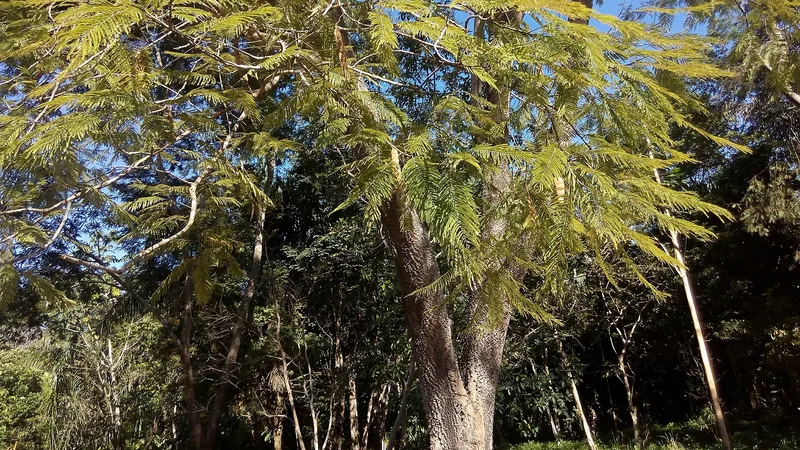
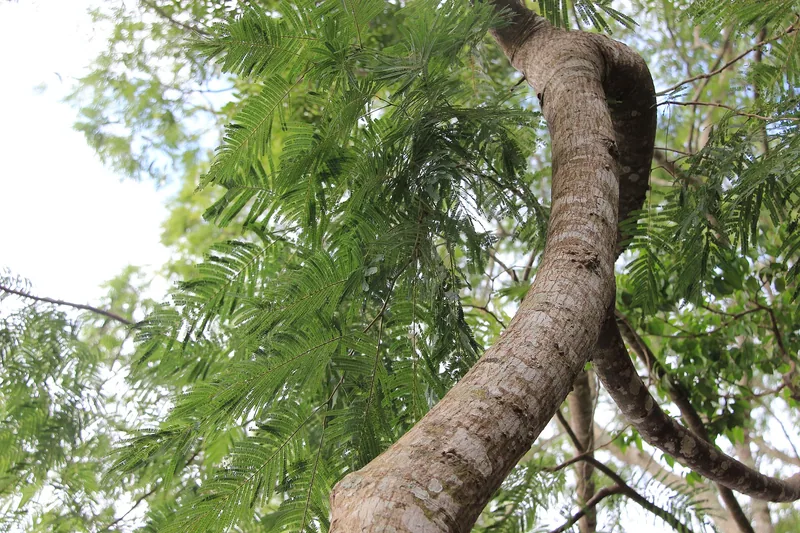
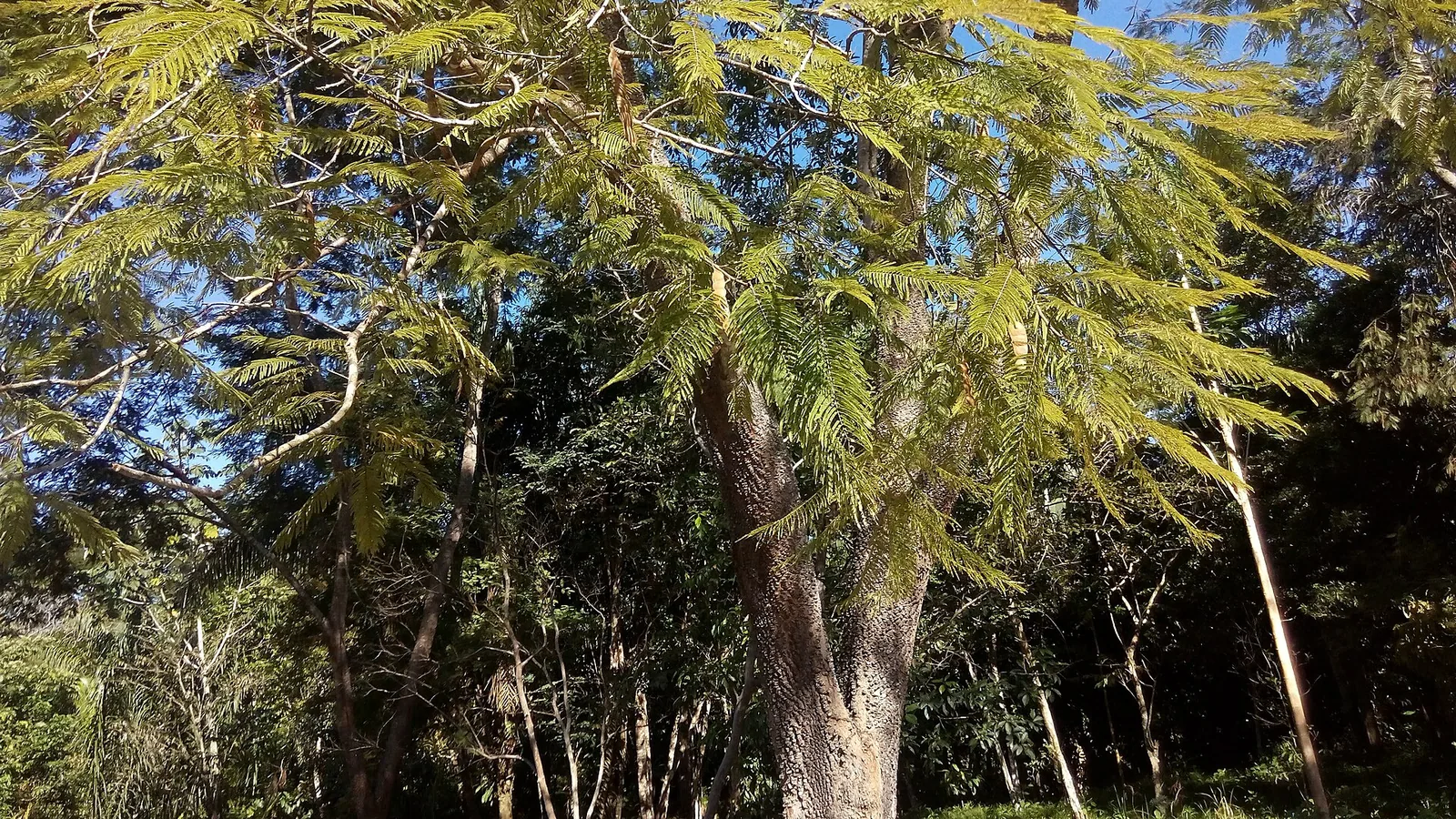
The defining tree of the Orinoco–Llanos and Caribbean seed-snuff field. Its ritual history includes healing, divination, hunting knowledge, chiefly counsel and relations with beings whose names and status vary across Wothïha/Piaroa, Cuiva and Taíno worlds.
Plant material
Seeds · transformed into ceremonial powder
Main alkaloid
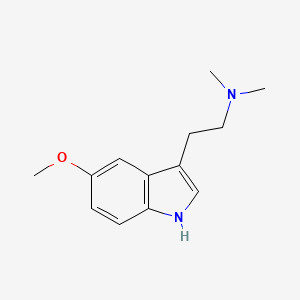
Bufotenine (5-HO-DMT), with other indoles variable or minor
Territory
Orinoco basin · northern South America · precolonial Caribbean circulation
The southern congener anchors the Andean–Chaco field and the deepest archaeological sequence associated with specialised snuff apparatus. Var. cebil remains important in both archaeological identification and contemporary plant relations.
Plant material
Seeds · seed powder
Main alkaloid
Bufotenine-dominant profiles are common
Territory
South-central Andes · Gran Chaco · north-west Argentina · Bolivia and adjacent dry forests
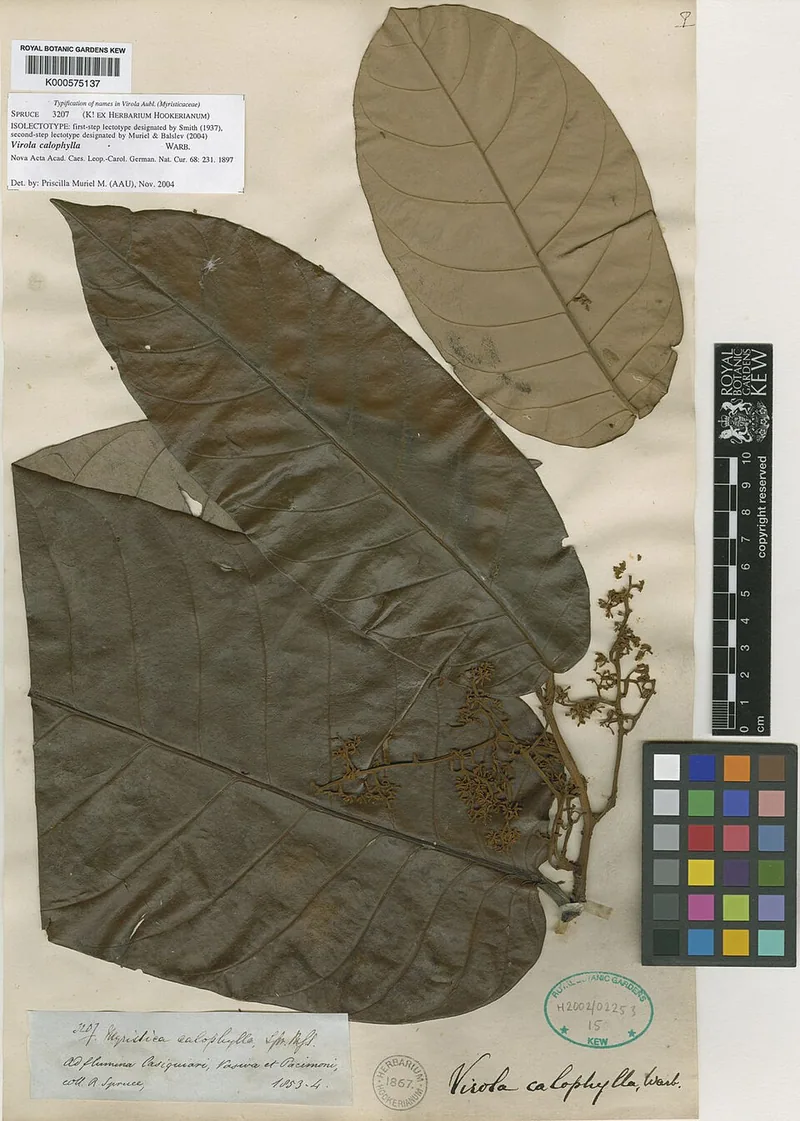
Several resin-bearing forest trees enter preparations grouped under Virola names. Species identity, vernacular category and chemical profile align only loosely; the ritual object is an exudate, admixture system and social relation.
Principal taxa
V. theiodora · V. elongata · V. calophylla and relatives
Compounds
DMT and/or 5-MeO-DMT in species- and specimen-dependent ratios
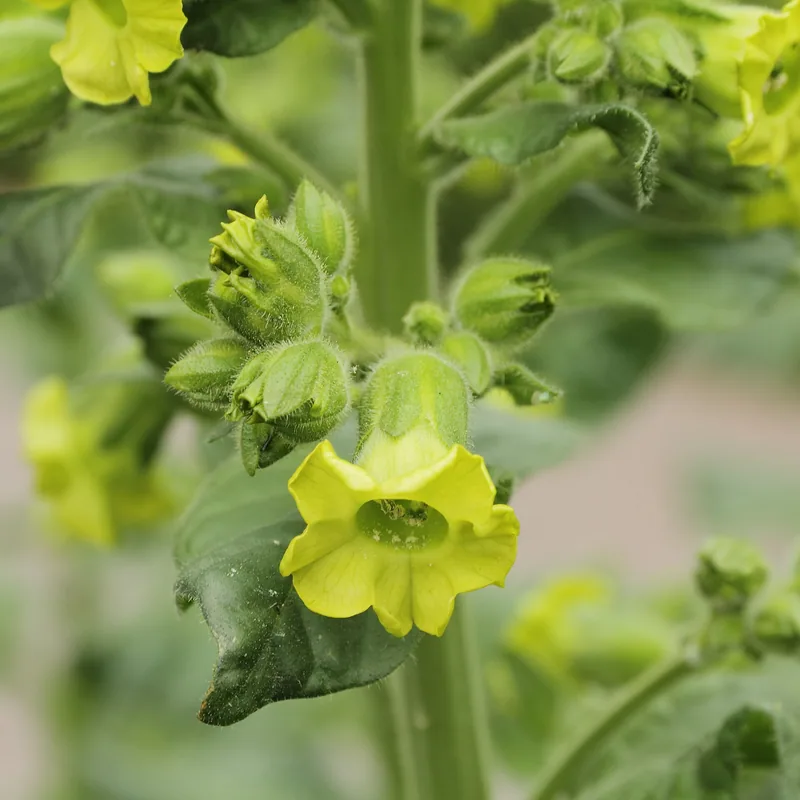
A major strong-tobacco anchor whose powders are complete medicines in their own right. Tobacco may also accompany other snuffs, carry prayer, protect the specialist or contribute ash, alongside its autonomous ceremonial worlds.
Plant material
Cured leaf · powder · smoke or ash in associated practices
Main alkaloid
Nicotine, with nornicotine and other tobacco alkaloids
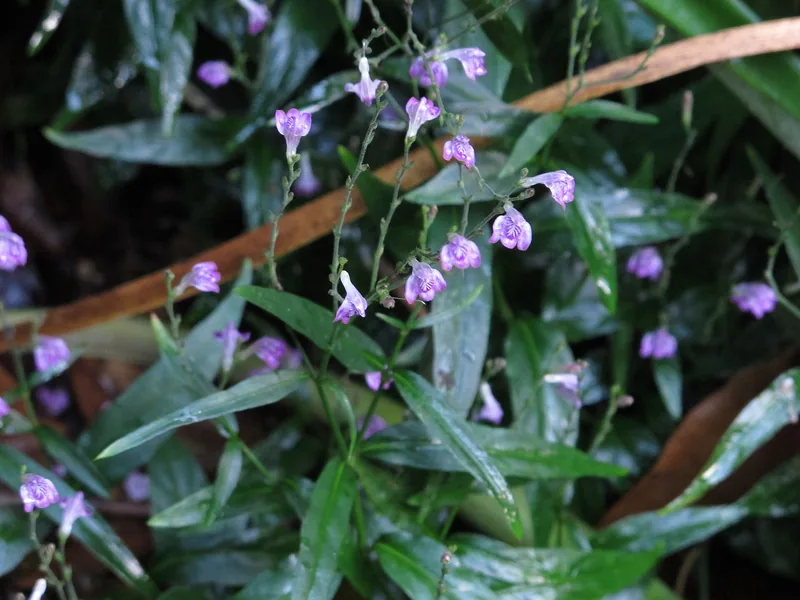
Especially documented with Yanomami-associated Virola material. Coumarin, umbelliferone and aroma are better established than independent psychedelic action.
The genus contains numerous narrow-range and recently revised taxa. Historical synonymy and incomplete vouchers make species-level certainty uneven.
Activator · carrier · culturally specified ash
Alkaline plant ashes
sources vary by people, territory and preparation
Ash may raise pH, dry and carry the powder, alter texture and embody relations with a selected tree. “Activator” names only part of its work.
Non-botanical alkaline component
Lime and shell-derived ash
mineral or calcined material
Documented in parts of the wider seed-snuff field. It belongs in the constituent map because the technology exceeds plants; each ash has its own source and properties.
Card scale marks structural importance within the comparative complex; psychoactive potency is another measure. Ash, tobacco and Justicia can be decisive without being the principal tryptamine source, while the same vernacular snuff name may conceal different species and preparations.
A family of nasal sacramental technologies in which a psychoactive plant powder or dried exudate is administered through breath, frequently with an alkaline mineral or plant ash. The complex is defined by relations among plant, ash, tube, breath, specialist and cosmology; recipes vary.
Geographic envelope
Greater Amazonia and adjacent regions: the Orinoco and Llanos, Rio Negro–Vaupés, Guiana Shield, western and south-western Amazonia, Caribbean, Gran Chaco and the south-central Andes. “Circum-Amazonian” therefore marks circulation around and through Amazonia; several traditions lie outside it in the narrow ecological sense.
Taxonomic caution
Vernacular names are loose botanical labels. Epená, paricá, yãkoana and related terms may name preparations, plants or ritual categories, and their referents vary by language, place and recorder. “Mapacho” likewise denotes strong cultivated tobacco and its preparations more often than a single securely vouchered species.
Sub-tradition 01 · seed / bufotenine
Anadenanthera snuffs
yopo · vilca · cebil · cohoba/cojoba
Anadenanthera peregrina anchors northern Orinoco–Caribbean yopo/cohoba; A. colubrina var. cebil anchors the southern Andean–Chaco vilca/cebil field (POWO, 2026a; POWO, 2026b).
Seeds are the characteristic source; bufotenine (5-HO-DMT) is usually dominant, with DMT and 5-MeO-DMT minor, variable or absent in analysed material (Torres et al., 1991; Miller et al., 2019).
Orinoco ethnography documents socially restricted and socially changing uses among Wothïha/Piaroa and Cuiva, including healing, diagnosis, hunting knowledge and mythic instruction (Rodd, 2002; Rodd and Sumabila, 2011).
Sub-tradition 02 · bark exudate / tryptamines
Virola snuffs
epená/ebena · yakee/nyakwana · yãkoana
Prepared from the inner-bark exudate of several Virola species, especially taxa recorded as V. elongata, V. theiodora, V. calophylla and V. calophylloidea (Schultes, 1979).
DMT and/or 5-MeO-DMT predominate according to species, tree, tissue and preparation; a vernacular name alone is a poor guide to chemical profile (Agurell et al., 1969).
Justicia pectoralis var. stenophylla is the principal documented aromatic admixture, especially in Yanomami-associated material. Coumarin and umbelliferone are better established than claims that Justicia is independently psychedelic (MacRae and Towers, 1984a).
Sub-tradition 03 · leaf / nicotine / ash
Nicotiana snuffs
mapacho · rapé/hapé · tobacco snuffs
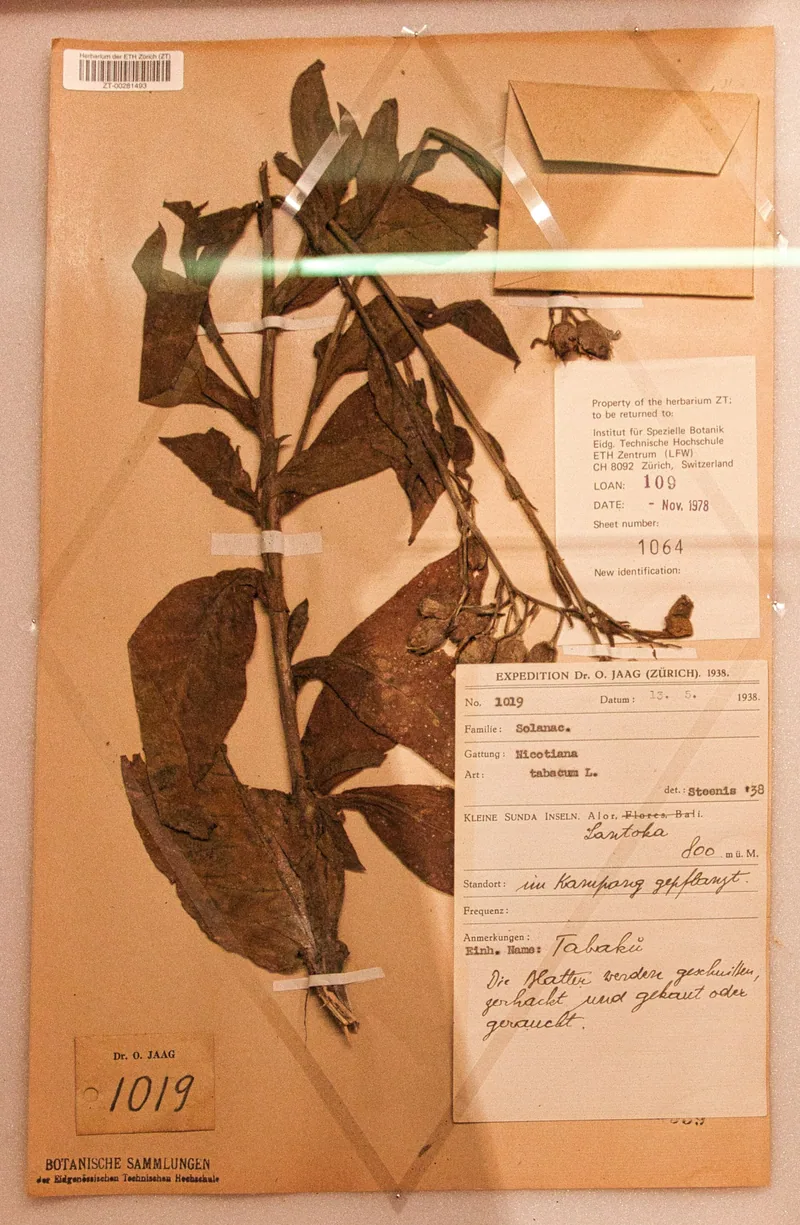
Nicotiana rustica is a major strong-tobacco anchor, with N. tabacum and local cultivars also involved. Tobacco may be a complete sacrament in its own right (Wilbert, 1987).
Independent tobacco snuffs serve hunting, curing, divination, focus, protection and social exchange; contemporary rapé/hapé is a broad, heterogeneous and largely recent category.
Tobacco or tobacco ash can accompany other snuffs, but “activator ash” is often from other plants: alkaline ashes of many kinds are common and raise the fraction of absorbable, un-ionised alkaloid (Stanfill et al., 2015).
Botanical anchors
Sub-tradition
Principal taxa
Family / order
Habit and range
Anadenanthera
A. peregrina; A. colubrina var. cebil
Fabaceae / Fabales
Deciduous trees of seasonally dry tropical forest, savanna and woodland from the Caribbean and northern South America to Bolivia, Brazil, Paraguay and north-west Argentina (POWO, 2026a; POWO, 2026b).
Virola
V. elongata, V. theiodora, V. calophylla and related spp.
Myristicaceae / Magnoliales
Evergreen, latex- or resin-bearing wet-tropical trees centred in Amazonia and the Guiana Shield; ritual species identification remains partly entangled with historical synonymy and uneven voucher practice (Schultes, 1979; Santamaría-Aguilar and Lagomarsino, 2022).
Justicia admixture
Dianthera pectoralis (syn. Justicia pectoralis; var. stenophylla now synonymised)
Acanthaceae / Lamiales
Aromatic herb or subshrub from Mexico to tropical South America; a culturally significant preparation component, while the tryptamines come from the Virola itself. The older name remains dominant in ethnographic and phytochemical literature (MacRae and Towers, 1984a; POWO, 2026c).
Nicotiana
N. rustica, N. tabacum, local cultivars
Solanaceae / Solanales
Annual or short-lived cultivated herbs dispersed far beyond their South American origins through long Indigenous domestication and later global commodity exchange (Wilbert, 1987; POWO, 2026d).
/div>
div class="wrap">
Associated compounds
“Snuff” names a route and ritual technology spanning several pharmacologies. The complex joins a serotonergic seed tradition, a serotonergic bark-resin tradition and a nicotinic tobacco tradition. Ash can alter pH, drying, texture and storage, and its cultural role exceeds a laboratory account of “bioavailability.”
Sub-tradition
Principal entheogenic compounds
Admixture / transformation
Pharmacological emphasis
Anadenanthera
Bufotenine (5-HO-DMT) usually dominant; DMT, 5-MeO-DMT and related indoles variable/minor.
Alkaline ash or lime raises pH and can increase the unprotonated fraction; heating and storage also change the chemical profile.
Bufotenine acts at serotonergic receptors including 5-HT2A; nasal activity is rapid, intensely somatic and visually active (Ott, 2001a; Miller et al., 2019).
Virola
DMT and 5-MeO-DMT in species- and specimen-dependent ratios; minor tryptamines and β-carbolines reported.
Justicia pectoralis contributes coumarin and umbelliferone plus aroma; other documented admixtures include ashes and plant materials selected by community.
DMT is strongly 5-HT2A-mediated; 5-MeO-DMT has substantial 5-HT1A as well as 5-HT2A activity. Mixtures behave as mixtures (Agurell et al., 1969; MacRae and Towers, 1984a).
Nicotiana
Nicotine, with nornicotine and other minor tobacco alkaloids; toxicant profiles vary with curing and combustion/ash.
Alkaline plant ash can markedly increase un-ionised nicotine. Analysed commercial and handmade rapés also contained variable tobacco-specific nitrosamines and polycyclic aromatic hydrocarbons.
Agonism at nicotinic acetylcholine receptors produces stimulation, autonomic stress and, at high exposure, poisoning; “visionary” tobacco states differ pharmacologically from serotonergic psychedelic states (Stanfill et al., 2015).
The idea that a β-carboline makes a tryptamine active, now called the “ayahuasca effect”, was first proposed by Holmstedt and Lindgren in 1967 for the visionary snuffs, not for ayahuasca (Ott, 2001b, p. 12). The snuffs bear it out unevenly: a Piaroa paricá held bufotenine, DMT and significant harmine, and a Surára epena held harmine, tetrahydroharmine and harmaline with none of the tryptamines — the alkaloids of Banisteriopsis caapi, whose stems the Piaroa chew while taking yopo (Ott, 2001b, pp. 17, 30–31).
Traditional preparation: ash, breath and apparatus
CHEMICAL
In analysed rapé, the highest calculated free-nicotine values occurred in alkaline handmade products containing ash (Stanfill et al., 2015). The same acid–base principle is relevant to tryptamine salts, although historic ashes also function as desiccants, carriers and culturally specified substances.
RITUAL
Paired blowing tubes, bifurcated self-applicators and specialist-to-recipient insufflation transform another person’s breath into the vehicle of administration. Contemporary Portuguese-market terms such as tepi and kuripe belong to that market; older and non-Brazilian apparatus traditions have their own names.
CAUTION
“Activation” is useful shorthand but an incomplete theory. It can imply that Indigenous ash knowledge is merely an accidental precursor to pH chemistry, or that every ash has the same source and purpose. The ethnographic record shows deliberate knowledge and many kinds of ash.
02Culture
Peoples and territories
The complex crosses many ecological and linguistic worlds, each with its own people. Its northern axis joins the Llanos and tributaries of the Orinoco to the Caribbean; its forest axis follows the Upper Orinoco, Rio Negro–Vaupés and Guiana Shield; its southern axis reaches the dry intermontane forests, puna caravan routes and oasis settlements of the central Andes. Plants, decorated tubes, specialist knowledge and names travelled, but each people naturalised them inside its own relations of kinship, gender, hunting, political authority and nonhuman personhood.
Yopo institutions range from specialist knowledge and curing to more socially distributed use. Piaroa practice may join yopo to Banisteriopsis caapi, mythic learning and an ethic of mastery; Cuiva histories show different boundaries of ethnicity and participation (Rodd, 2002; Rodd and Sumabila, 2011).
Upper Orinoco, Guianas and north-west Amazon
Yanomami · Tukanoan and Arawakan-speaking peoples · neighbours
Virola-centred preparations named epená, ebena, yakee, nyakwana or yãkoana differ in botany and ritual ownership. Among Yanomami, yãkoana is inseparable from xapiri images, apprenticeship, collective protection and forest politics (Schultes, 1979; Kopenawa and Albert, 2013).
Caribbean archipelago
Taíno and other precolonial Caribbean societies
Cohoba linked behiques, caciques, cemí beings, communal houses and highly finished bifurcated tubes, spatulas and stands. Colonial violence fractured transmission, while archaeology and museum collections retain a material record that must be read through histories of looting and displacement (Pagán-Jiménez and Carlson, 2014; Ostapkowicz, 2020).
South-central Andes and Gran Chaco margins
Atacameño / Lickanantay worlds · Tiwanaku networks · communities of north-west Argentina and Bolivia
Vilca/cebil entered long-distance circuits of wood, minerals, textiles, iconography and ritual authority. Contemporary Andean continuities include protection, healing, veterinary medicine and relations with particular trees, in places where nasal use has lapsed as well (Torres et al., 1991; Lema, 2024).
Yanomami shamanism, in which yãkoana snuff is the shaman’s plant, is treated alongside other Indigenous Amazonian traditions in Indigenous Amazonian Shamanisms.
History and evidence
The deepest archaeological sequence belongs to Anadenanthera. Pipes associated with seeds at Inca Cueva and Huachichocana in north-west Argentina have been dated approximately to 2100–1200 BCE, while trays and tubes in northern Chile provide clearer evidence for a specialised snuff technology by c. 1000–800 BCE. Plant, residue and implement are seldom found together, so early “hallucinogenic use” is an inference of varying strength (Torres, 1998; Lema, 2024). Direct microscopic identification of A. colubrina var. cebil in an Argentine archaeological powder and chemical identification of tryptamines in Atacama snuffs make later parts of the sequence firmer (Pochettino, Cortella and Ruiz, 1999; Torres et al., 1991).
In the Caribbean, starch grains consistent with A. peregrina on a Puerto Rican grinding implement dated c. CE 1150–1250 provide direct evidence of cohoba processing. A carved bifurcated tube from St Vincent—probably made in the Lower Orinoco and stylistically placed around 100 BCE–500 CE—suggests much earlier traffic in apparatus and ritual knowledge, although its excavation context is lost (Pagán-Jiménez and Carlson, 2014; Ostapkowicz, 2020). Ramón Pané’s 1490s testimony and early-sixteenth-century chronicles then describe consultation with cemíes, chiefly prophecy, healing and the bodily drama of cohoba, but always through Christian-colonial translation.
Ott quotes, in English, Columbus’s description from his second voyage: “Inside this house they have a finely wrought table, round like a scimitar, in which is some powder that they place on the heads of these zemies… then with a cane having two branches that they insert in their nostrils they snuff this powder up. The words they say none of our people understand. With these powders they go crazy and become as though inebriated” (Ott, 2001b, p. 11). The Taíno word tabaco appears to have named the forked tube, and the two practices were long confounded: cohoba was taken for tobacco until William E. Safford identified it in 1916 as the seed of Piptadenia, now Anadenanthera, peregrina (Ott, 2001b, pp. 11, 15–16).
There is no comparably deep, chemically confirmed archaeological chronology for Virola snuff. Nineteenth- and twentieth-century botanical and ethnographic collections are foundational but taxonomically uneven and inseparable from colonial extraction. Tobacco itself has an ancient pan-American history, yet “tobacco snuff” must be demonstrated route by route. The archive therefore has three clocks: deep Anadenanthera archaeology; colonial and modern witness; and living knowledge that is older than its first written record.
Ritual practice
No single sequence belongs to all three traditions, yet several operations recur: botanical material is transformed into a powder or dried exudate; ash or lime may alter its texture and alkalinity; a tube directs it; another person’s breath can become the force of administration; acute bodily disruption marks a threshold; and a knowledgeable community decides what the resulting images, speech, vomiting, silence or collapse mean. A modern observer sees “delivery.” Participants may encounter an exchange of force, an opening of hearing, an ordeal of mastery or the arrival of beings.
Selection and transformation
Seeds may be toasted or otherwise treated and ground; Virola exudate is collected from inner bark, dried and powdered; tobacco is cured and reduced with culturally selected ashes or aromatic plants. Recipes and rights to make them are local knowledge.
Preparation of persons and place
Fasting, sexual restraint, tobacco, song, seclusion, forest gathering, a communal house or a specialist’s work may frame the event. Readiness is moral and relational as well as physiological (Wilbert, 1987; Rodd, 2002).
Breath through apparatus
Self-administration may use a bifurcated tube; paired insufflation lets one person blow medicine into another. The direction, number and force of breaths can encode authority, care, aggression or reciprocity. Historic apparatus names are kept here alongside the contemporary market terms kuripe and tepi.
Ordeal, vision and action
Burning, tears, mucus, vertigo, emesis, tremor and prostration have meaning in many ritual readings: they may be purification, proof of potency or the bodily price of seeing. The session can then turn to chant, diagnosis, hunting, counsel, collective defence or the narration of images.
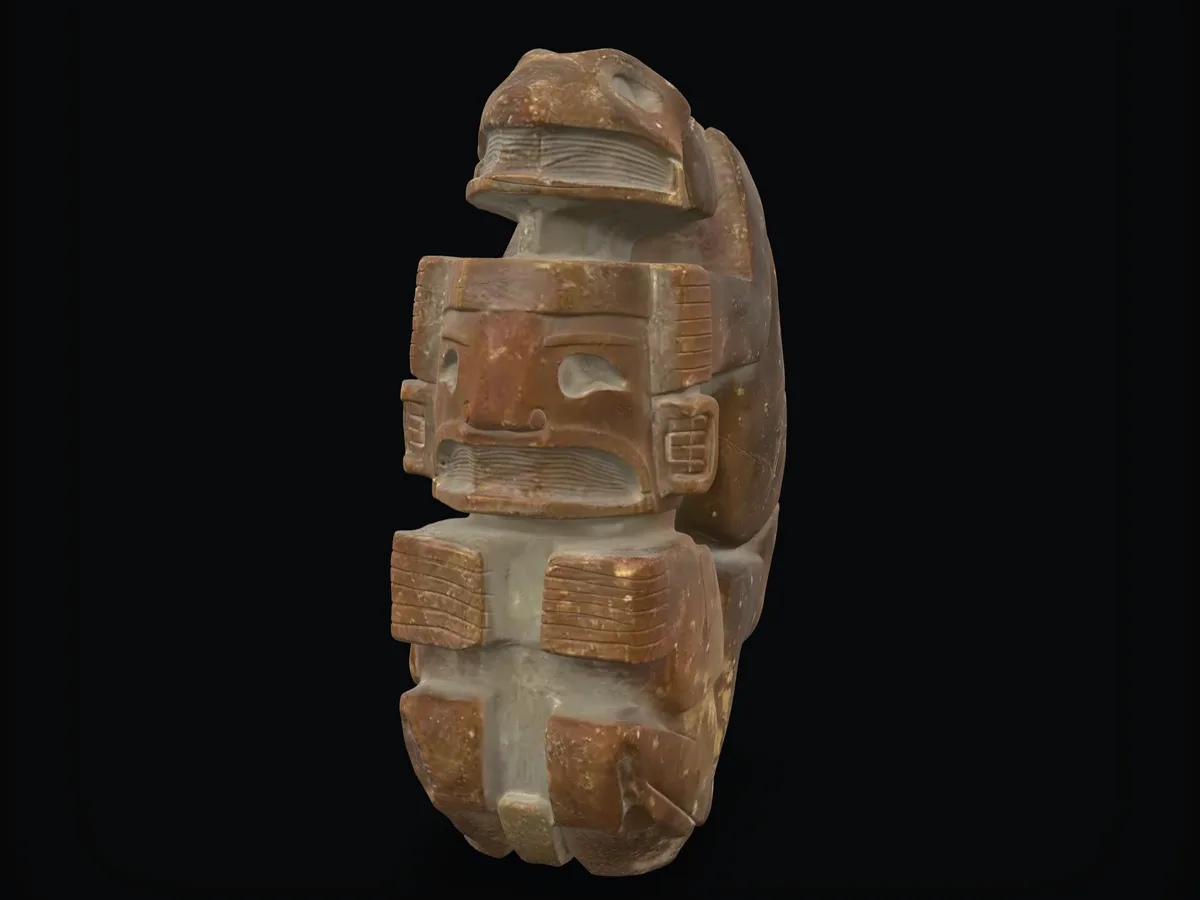
Plate 02 · jaguar and anthropomorphic figure, Rio Trombetas · three-dimensional view
Drag to turn · scroll or pinch to magnify
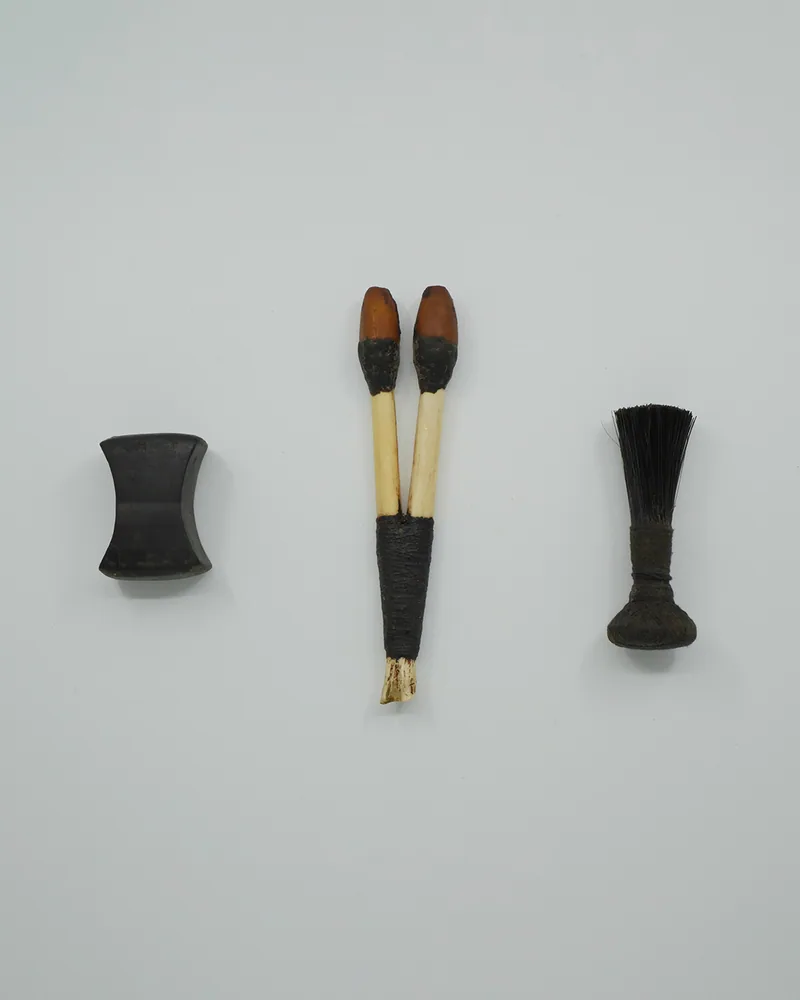
Snuff-related paraphernalia attributed to the Rio Trombetas region of Brazil. Stone item depicting a jaguar surmounting an anthropomorphic figure. H: 183mm; National Museums of World Culture, Göteborg 25.12.1. 3D model generated from photographs.
The nose is the defining route, not the only one. The same seeds and barks were smoked, given as enemas, held in the mouth and given to hunting dogs, and some peoples took one plant by several routes (Ott, 2001b, pp. 18, 21–22).
Smoke
Eighteenth-century Abipón burned cebil pods and seeds in closed huts and inhaled the smoke “with their mouth, nose and entire body”; the Mbayá snuffed the powdered seed individually and smoked it collectively; Wichí specialists now mainly smoke hatáj with tobacco (Dobritzhoffer, 1822, cited in Ott, 2001b, p. 22; Ott, 2001b, pp. 22–23).
Enema
The Omagua took their curupá leaf preparation both as snuff and as enema; the Maué, Cocama and Katawishi likewise used Anadenanthera preparations by both routes (Ott, 2001b, pp. 18, 22).
Mouth
Allentiac and Millcayac people were described in 1703 as carrying cibil in the mouth; the Piro both snuffed and ate the seeds; Witoto, Bora and Muinane once swallowed pellets of Virola resin (Ott, 2001b, pp. 21–22, 38–39).
Hounds
The Piro gave their snuff to hunting dogs, and the Katawishi their enema, to sharpen the animals’ perception; Quijos Quichua placed drops of myristicaceous sap, mixed with Brugmansia and Tabernaemontana, on the noses of dogs so that they “[would] make them better hunters” (Farabee, 1922, cited in Ott, 2001b, p. 22; Bennett and Alarcón, 1994, cited in Ott, 2001b, p. 39).
Arrow
Sanamá Waiká stored their Virola snuff chiefly as resin on arrow points, scraping it off when needed (Prance, 1970, cited in Ott, 2001b, p. 36).
Mythology and cosmology
Yanomami yãkoana is inseparable from the xapiri: luminous spirit-images whose dance shamans learn to see and sustain. In Davi Kopenawa’s account, this work also holds up a living forest-world threatened by extractive outsiders; treating yãkoana as simply “Amazonian DMT” removes the political and cosmological centre of the practice (Kopenawa and Albert, 2013).
Piaroa yopo participates in an ethics of controlled knowledge. Myth warns against undisciplined excess while specialists use yopo to remember creation narratives, diagnose conflict and work on possible futures (Rodd, 2002; Rodd and Sumabila, 2011). Taíno cohoba was offered to and consumed in relation with cemíes—ancestral and other-than-human powers materialised in stones, wood and sculpted stands. Consultation concerned war, harvest, health and political fate; the powder was part of an institution of counsel (Ostapkowicz, 2020).
Tobacco, across diverse South American cosmologies, can appear as primordial person, food of spirits, protective breath, projectile or shamanic double. Its power lies as much in mastery of a dangerous plant as in “intoxication” (Wilbert, 1987). Across these worlds, plants modify relations among persons whose category can include animals, ancestors, owner-beings, images and places.
Shamanism and healing
Specialist formation. Yanomami shamans learn over time to recognise, house and sustain xapiri images; Piaroa specialists discipline perception through myth, song and plant knowledge; Taíno behiques mediated between cemíes and political communities. “Shaman” is comparative shorthand for three distinct offices.
Diagnostic work. Snuff may disclose a pathogenic object, an absent person, a sorcerous attack, an animal master or the intentions of neighbours. Curing can involve sucking, blowing, smoke, chant, massage, emesis and counteraction. The image is valued for the work it enables.
Collective consequence. In Kopenawa’s account the xapiri dance to protect human and nonhuman communities and help prevent the sky from falling. Healing therefore extends from a suffering body to epidemics, mining, forest destruction and cosmological stability (Kopenawa and Albert, 2013; Uchôa, 2026).
The complex repeatedly binds knowledge to disciplined bodily ordeal. Snuff may clear, fortify or open perception; carry a specialist’s breath; diagnose intrusion; attract game; disclose distant events; enable communication with masters, ancestors or spirit-images; and protect a collective. Access can be specialist-restricted, gendered, age-graded or more communal, and ethnographies show these boundaries changing through missionisation, wage labour, state schooling and intercultural exchange (Rodd and Sumabila, 2011).
Art and material culture
Andean trays and tubes. The dry Atacama preserves one of the world’s densest archaeological corpora of snuff paraphernalia: shallow wooden tablets, inhaling tubes, spatulas, mortars, pouches and containers. Many are plain; others carry Tiwanaku-style standing figures, trophy heads, felines, camelids, birds and human–animal transformations. Imported woods and skilled joinery show these were valued objects moving through long-distance networks. Iconography may have made a traveller’s cosmology portable, though the powder once held in a tray has to be identified by other means (Torres, 1987; Niemeyer et al., 2013; Niemeyer et al., 2015).
An unbroken series. Torres’s survey of snuffing equipment — trays of shell, whalebone, gold, copper, stone and wood, with spoons, tubes, spatulas, leather pouches of powder, and whole kits carried in woven bags like those still used for coca — runs from Huaca Prieta in northern Peru, c. 1200 BCE, to north-west Argentina, c. 1000–1480 CE, and from central Colombia to La Rioja. The southernmost trays coincide with the southern limit of Anadenanthera colubrina itself, in Córdoba province (Ott, 2001b, pp. 20–21).
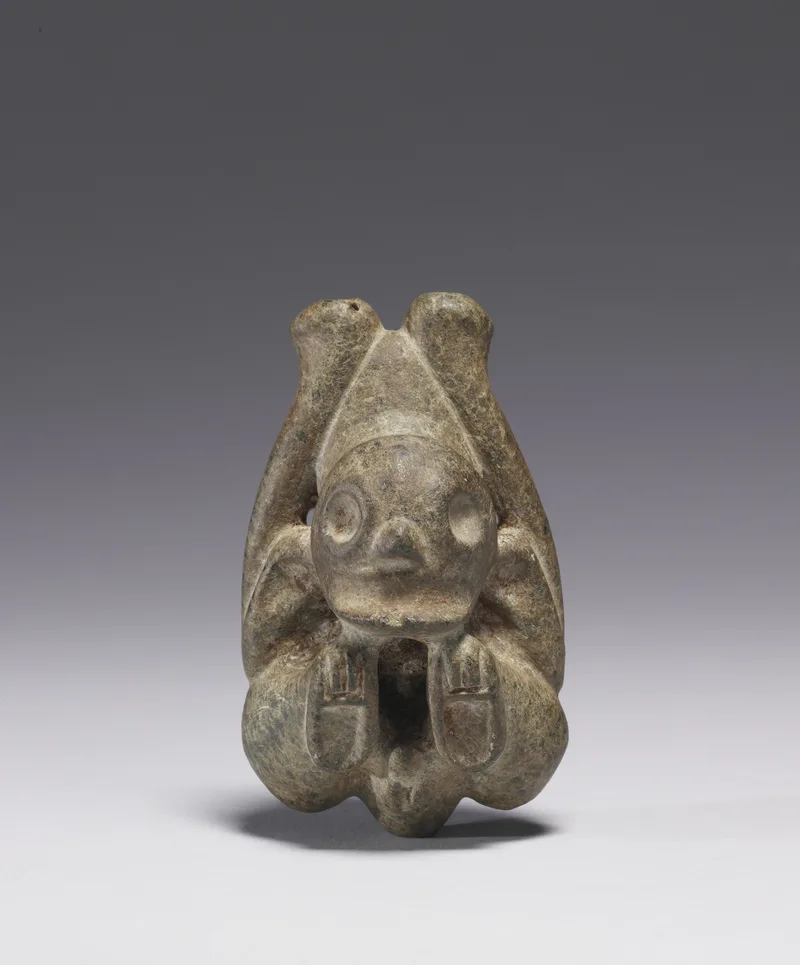
Caribbean conduits. Cohoba apparatus binds anatomy to sculpture: bifurcated arms terminate at the nostrils, while bird, bat, monkey, turtle and anthropomorphic forms make the conduit itself a cosmological actor. Cannel coal, shell, wood and stone objects moved between the Lower Orinoco and islands. Museum survival often depends on colonial collecting and looting, so formal beauty must be read beside broken provenance (Ostapkowicz, 2020).
Plate 03 · Taíno cohoba inhaler · deep view
Cohoba inhaler carved as a seated figure, stone, Taíno, 1000–1500 · Walters Art Museum · public domain ↗
Yanomami image-making. Xapiri are already “images” in a Yanomami sense before they enter paper or photography. Claudia Andujar’s long-exposure photographs, Davi Kopenawa’s words and drawings by artists such as Joseca Yanomami have produced a contemporary visual field in which shimmer, multiplication and dance contest the frozen ethnographic portrait. These works mediate political testimony, forest knowledge and the problem of making invisible presences perceptible to outsiders (Schefer, 2020; Bonchristiano, 2025).
03Visionary phenomenology
Published descriptions mix observation, Indigenous interpretation, colonial judgement and self-experiment. The phenomenology is unusually inseparable from the mechanics of administration: impact, burning, tears, mucus, breathlessness, vertigo and vomiting arrive before any tidy category of “vision.” Material identity, ash, force of insufflation, repetition, co-use, training and ritual setting all shift the course. The durations below are qualitative envelopes for orientation only; this is no dosing guidance.
Accounts
Taíno cohoba · colonial witness under caution
An early-sixteenth-century account describes a house that appears to turn upside down before the participant reports counsel from a cemí concerning war, harvest, plague or health. Its hostile vocabulary—madness, stupor, frenzy—belongs to the coloniser; the underlying structure is authorised consultation followed by public speech (Ostapkowicz, 2020).
Piaroa yopo · trained knowledge
Rodd’s ethnography places visions inside narrative and ethical expertise. Images of animals, powers and dangerous transformation need interpreting: the specialist’s command of myths, songs and social history converts intensity into diagnosis and possible action (Rodd, 2002).
Yanomami yãkoana · image-beings
For Kopenawa, xapiri are minute, brilliant, innumerable images arriving on shining paths, ornamented and singing. Their dance enlarges thought and continues in dreams. “Spirit encounter” is still too static: the salient form is choreography, multiplicity and sustained relation (Kopenawa and Albert, 2013; Uchôa, 2026).
Only the xapiri truly make us wise.Davi Kopenawa, on dream, dance and expanded thought (Kopenawa and Albert, 2013; quoted in Uchôa, 2026)
Duration, intensity and visionary descriptions
Sub-tradition
Temporal profile
Intensity and bodily signature
Visionary descriptions
Anadenanthera snuffs
Onset commonly within minutes; an intense core often tens of minutes, with somatic and interpretive after-effects extending beyond it.
Sharp nasal pain and pressure, tears, salivation, nausea/vomiting, muscular heaviness, autonomic change and possible loss of ordinary coordination. Purified bufotenine self-reports differ from communal yopo (Ott, 2001a).
Rapid coloured patterning, arabesques, tunnels or fields; transformations into or encounters with powerful beings; remote seeing, mythic landscapes and knowledge interpreted through local cosmology (Rodd, 2002).
Virola snuffs
Usually very rapid onset and short peak; ethnographic sessions may continue through repeated songs, blows and social action.
Forceful nasal and respiratory sensation, tremor, agitation or collapse, vocalisation, nausea and marked alteration of body-boundaries. DMT-dominant and 5-MeO-DMT-dominant materials feel different.
Brilliant pattern, accelerated motion, animal or humanoid presences and spirit travel; in Yanomami accounts, the decisive event is the arrival and dance of xapiri images (Schultes, 1979; Kopenawa and Albert, 2013).
Nicotiana snuffs
Autonomic effects begin quickly and may resolve over minutes to hours; ritual concentration, dreams and after-effects can last longer.
Burning, tearing, dizziness, sweating, salivation, nausea/vomiting, tremor and prostration. The boundary between sacramental ordeal and acute nicotine poisoning can be medically narrow (Stanfill et al., 2015).
Heightened vigilance, clearing or silence of thought, hunting images, dream intensification and spirit contact are reported within ritual frames. Tobacco phenomenology is often less pictorial than tryptamine snuffs and more concerned with force, cleansing, breath and command (Wilbert, 1987).
Impact
Powder and breath announce themselves as force: percussion in the head, burning passages, streaming eyes, interruption of speech and abrupt loss of ordinary bodily ease.
Disassembly
Vertigo, nausea, heaviness, tremor or collapse can loosen bodily boundaries. With DMT-rich material the visual field may accelerate into saturated geometry and populated space; strongly 5-MeO-DMT-weighted states can instead diminish differentiated imagery and self-world structure.
Arrival
What psychopharmacology calls imagery may be recognised locally as arrival: cemí counsel, animal transformation, xapiri dance, distant sight, an owner’s instruction or the disclosure of a pathogenic relation.
Interpretive return
The acute peak may be brief, but song, narration, dream and communal decision extend the event. A vision becomes knowledge only through a tradition capable of judging its source, danger and obligation.
04Contemporary transformations
Contemporary expressions and transformations
The contemporary field moves in several directions at once. Yanomami shamanic work continues while Yanomami artists, writers and organisations translate xapiri knowledge into books, drawings, film, exhibitions and territorial campaigns. Piaroa and Cuiva yopo institutions respond differently to schooling, missionisation, urban travel and ethnic politics. In Argentina and Bolivia, vilca/cebil persists in healing, protection and plant–place relations even where archaeologists once narrated it as an extinguished pre-Hispanic cult (Rodd and Sumabila, 2011; Kopenawa and Albert, 2013; Lema, 2024).
At the same time, rapé/hapé has become the most portable global form of the complex. It appears before or during ayahuasca ceremonies, in yoga and breathwork communities, at festivals, in online shops and in self-administration. Contemporary exchange can support Indigenous producers, language visibility and political alliances; it can also detach a blend from its maker, replace a people’s name with a brand, standardise heterogeneous rites into a short “grounding medicine” script and normalise frequent nicotine exposure. “Traditional” and “neo-shamanic” therefore name contested relations of authorship, income, authority and risk.
Cultural and biological threat / conservation
Selected flagship trees—Anadenanthera peregrina, Virola elongata and V. theiodora—are globally assessed as Least Concern; the complex as a whole has no single conservation category (BGCI and IUCN SSC Global Tree Specialist Group, 2019a; BGCI and IUCN SSC Global Tree Specialist Group, 2019b; IUCN SSC Global Tree Specialist Group and BGCI, 2021). The genus Virola contains narrow-range species assessed as threatened, and wet-forest taxa face logging, mining, fire and deforestation; bark removal can also injure individual trees. Cultivated tobacco is globally abundant. Across all three traditions, loss of land, language, specialist transmission and political autonomy may be more immediate than global extinction of the best-known plants (Santamaría-Aguilar and Lagomarsino, 2022).
For Yanomami communities, illegal mining, mercury contamination, epidemic disease and violence belong inside the entheogenic complex. They are precisely the destructive forces against which xapiri knowledge and shamanic protection are articulated. Conservation must therefore include territorial sovereignty and the continued right to decide which knowledge, images, plants and practices circulate. Ex situ seed banking without cultural governance preserves organisms while abandoning relations.
Local and global economies
Yopo, vilca, Virola materials and especially branded rapé/hapé now circulate through online ethnobotanical shops, retreat centres, festivals and urban neo-shamanic networks. This can generate Indigenous income and intercultural visibility, but origin labels, botanical identity and benefit sharing are often opaque. No credible global market-size estimate isolates these products. Tobacco snuff also sits uneasily between sacrament and addictive commodity: laboratory analysis found wide variation in nicotine, un-ionised nicotine, tobacco-specific nitrosamines and PAHs, including unexpectedly high free-nicotine exposure in some ash-rich handmade rapés (Stanfill et al., 2015).
Legality
Layer
Status and interpretive limit
International
DMT is listed in Schedule I of the 1971 Convention on Psychotropic Substances; that listing alone does not make 5-MeO-DMT and bufotenine universally illegal, although both are controlled in multiple domestic systems. The Convention schedules compounds, and domestic law may expressly control plants, preparations or extraction (UN, 1971; Tupper and Labate, 2012).
United States
DMT, 5-MeO-DMT and bufotenine are expressly listed as federal Schedule I substances in 21 CFR §1308.11. Whether unprocessed plant material is prosecuted can turn on chemistry, preparation and intent; the narrow religious exemptions established for particular ayahuasca organisations cover those organisations alone (Electronic Code of Federal Regulations, 2026).
United Kingdom
DMT, 5-MeO-DMT and bufotenine fall within Class A/Schedule 1 controls. Producing a preparation containing a controlled tryptamine is legally distinct from merely possessing a botanical specimen; the Psychoactive Substances Act may add supply-related risk. Tobacco/nicotine is separately regulated (UK Government, 2025).
Brazil / Amazonian states
Brazil’s national controlled-substances list includes DMT and 5-MeO-DMT, while tobacco products are separately regulated and Indigenous practices exist within distinct constitutional and cultural-rights frameworks (ANVISA, 2025). Controls and enforcement elsewhere in the region vary; “traditional” confers no commercial licence.
This is a research summary, not legal advice. Plant, powder, alkaloid extract and tobacco product can occupy different legal categories in the same jurisdiction.
Patents, ownership and law
The plants, nasal route and long-known alkaloids are prior art. Patent activity instead targets salts, crystalline forms, dry powders, nasal devices, dosing regimens and therapeutic claims. Recent applications include intranasal 5-MeO-DMT formulations and devices (for example WO2025153822A1) and nano/micro-formulations intended to stabilise bufotenine (US20240226005A1). These claims leave yãkoana and yopo as traditions untouched, but they expose an asymmetry: pharmaceutical nasal psychedelics can be rendered proprietary while Indigenous nasal technologies are treated as an unowned ethnographic commons.
The deeper issue is therefore wider than formal patent novelty. Branded products can appropriate people’s names, designs, plant knowledge and reputational value while bypassing authority and the access-and-benefit-sharing principles of the Convention on Biological Diversity and Nagoya Protocol. A defensible programme requires vouchered botany, traceable provenance, community governance, mutually agreed benefits and protection of knowledge communities do not wish to disclose.
Scientific research: current frontier
2024
Lema’s contemporary ethnobotany shows that vilca/cebil persists after conquest in Andean healing, ritual and material practices, revising narratives built mainly from archaeology (Lema, 2024).
2024
A preclinical toxicity study of Virola elongata hydroethanolic bark extract found limited toxicity in its specific assays; ceremonial snuff, DMT/5-MeO-DMT phenomenology and human safety were outside its scope (de Carvalho et al., 2024).
2022–26
Modern Virola revision continues to describe previously unrecognised species, some with narrow ranges. This makes historical ethnographic names and unvouchered commercial material a live taxonomic and conservation problem (Santamaría-Aguilar and Lagomarsino, 2022).
2025
Human 5-MeO-DMT work linked radical self-disruption and content-poor wakeful awareness to distinctive changes in cortical dynamics, while a 2024 Phase I study characterised rapid absorption and elimination of an intranasal pharmaceutical formulation (Rucker et al., 2024; Timmermann et al., 2025). These studies bear on one possible Virola constituent; yãkoana and epená themselves remain unstudied.
2025–26
Research and exhibitions increasingly treat Yanomami dream and image practices as epistemology and political thought. Current work also scrutinises how museum specimens and Amazonian artefacts were detached from Indigenous labour, territory and authority (Bonchristiano, 2025; Uchôa, 2026).
GAP
There are no modern controlled human studies of whole yopo, whole Virola snuff or Indigenous tobacco snuff that preserve ritual context. Current neuroscience of isolated bufotenine, DMT, 5-MeO-DMT and nicotine can clarify receptors and risk; the relational event is known through ethnography.
05Linked species
These are botanical anchors. Vernacular preparation names can cross species, and a single species may enter several culturally distinct preparations. Linked monographs should therefore return to vouchered identity, range, chemistry and the local names that generated each record.
45 sources in 7 threads · 40 with a working locator · Harvard (Cite Them Right) · status and kind are recorded per source, not assumed
How to read the labels on each source
Source type
What kind of work it is: journal article, book, legislation, patent application, database record and so on. A word after the dot (ethnography, protologue, primary source) keeps the genre the entry was first filed under. “Unclassified” means the citation does not say enough to tell.
Peer review
Recorded for each work separately, and only where it has been confirmed for that work. It is never inferred from a DOI, a publisher or a journal, since journals also publish editorials, letters and commentaries. Where it has not been confirmed, the entry records it as not established. It does not apply to legislation, court decisions, treaties, patents, datasets, database and collection records, historical texts, films, talks, press releases or web pages.
Check
What was checked when the entry was added. DOI checked: the DOI’s registry record (Crossref) matched the citation’s title, first author and year. Verified: the record itself was opened and matched the citation: a library catalogue record for a book, or the page itself for a database entry, law, patent or archive document. “Verified (abstract)” and “(summary)” mean only the abstract or a summary was read. Located: a record was found but not fully matched. Bibliographic record and Stable record (in essays): a catalogue or stable web record exists; what was checked against it is not recorded. Unverified: no check is recorded. No locator found: a search found no record. Secondary: read through another source.
What the labels do not say
None of them means the source supports a particular sentence. Where a sentence is graded, its evidence note names its sources and whether each supports it, disputes it or gives context. Dates and reviewers of checks are not recorded for each entry; the version note at the foot of a graded page dates its last review.
Botany & taxonomy
Royal Botanic Gardens, Kew (POWO) (2026a) 'Anadenanthera peregrina (L.) Speg.', Plants of the World Online. Available at: POWO record (Accessed: 29 July 2026).
UnverifiedDatabase recordPeer review not applicableOpen record ↗
Royal Botanic Gardens, Kew (POWO) (2026b) 'Anadenanthera colubrina (Vell.) Brenan', Plants of the World Online. Available at: POWO record (Accessed: 29 July 2026).
UnverifiedDatabase recordPeer review not applicableOpen record ↗
Royal Botanic Gardens, Kew (POWO) (2026c) 'Dianthera pectoralis (Jacq.) Murray', Plants of the World Online. Available at: POWO record (Accessed: 29 July 2026).
UnverifiedDatabase recordPeer review not applicableOpen record ↗
Royal Botanic Gardens, Kew (POWO) (2026d) 'Nicotiana rustica L.', Plants of the World Online. Available at: POWO record (Accessed: 29 July 2026).
UnverifiedDatabase recordPeer review not applicableOpen record ↗
Royal Botanic Gardens, Kew (POWO) (2026e) 'Virola theiodora (Spruce ex Benth.) Warb.', Plants of the World Online. Available at: POWO record (Accessed: 29 July 2026).
UnverifiedDatabase recordPeer review not applicableOpen record ↗
Santamaría-Aguilar, D. and Lagomarsino, L.P. (2022) 'New species of Virola (Myristicaceae) from South America', PhytoKeys, 197, pp. 81–148.
UnverifiedJournal articlePeer review not establishedOpen record ↗cited 3× in this record
Archaeology & ethnohistory
Torres, C.M., Repke, D.B., Chan, K., McKenna, D., Llagostera, A. and Schultes, R.E. (1991) 'Snuff powders from pre-Hispanic San Pedro de Atacama: chemical and contextual analysis', Current Anthropology, 32(5), pp. 640–649.
UnverifiedJournal articlePeer review not establishedOpen record ↗cited 3× in this record
Torres, C.M. (1998) 'Archaeological evidence for the antiquity of psychoactive plant use in the central Andes', Eleusis, 1, pp. 12–44.
UnverifiedJournal articlePeer review not establishedcited 1× in this record
Torres, C.M. (1987) 'The iconography of the prehispanic snuff trays from San Pedro de Atacama, northern Chile', Andean Past, 1, pp. 191–254. Available at: institutional record (Accessed: 29 July 2026).
UnverifiedJournal articlePeer review not establishedOpen record ↗cited 1× in this record
Pochettino, M.L., Cortella, A.R. and Ruiz, M. (1999) 'Hallucinogenic snuff from northwestern Argentina: microscopical identification of Anadenanthera colubrina var. cebil (Fabaceae) in powdered archaeological material', Economic Botany, 53(2), pp. 127–132.
UnverifiedJournal articlePeer review not establishedOpen record ↗cited 1× in this record
Pagán-Jiménez, J.R. and Carlson, L.A. (2014) 'Recent archaeobotanical findings of the hallucinogenic snuff cojoba (Anadenanthera peregrina (L.) Speg.) in precolonial Puerto Rico', Latin American Antiquity, 25(1), pp. 101–116.
UnverifiedJournal articlePeer review not establishedOpen record ↗cited 2× in this record
Miller, M.J., Albarracin-Jordan, J., Moore, C. and Capriles, J.M. (2019) 'Chemical evidence for the use of multiple psychotropic plants in a 1,000-year-old ritual bundle from South America', Proceedings of the National Academy of Sciences, 116(23), pp. 11207–11212.
UnverifiedJournal articlePeer review not establishedOpen record ↗cited 2× in this record
Niemeyer, H.M., Zapata, V., Cantillana, P., Missene, A., Aguilera, J. and Torres, A. (2013) 'Computed tomography study of snuff trays from San Pedro de Atacama (northern Chile)', Journal of Archaeological Science, 40(4), pp. 2036–2044. Available at: https://doi.org/10.1016/j.jas.2012.12.014.
DOI checkedJournal articlePeer review not establishedOpen record ↗cited 1× in this record
Niemeyer, H.M., Salazar, D., Horta Tricallotis, H. and Peña-Gómez, F.T. (2015) 'New insights into the Tiwanaku style of snuff trays from San Pedro de Atacama, northern Chile', Latin American Antiquity, 26(1), pp. 120–136. Available at: https://doi.org/10.7183/1045-6635.26.1.120.
DOI checkedJournal articlePeer review not establishedOpen record ↗cited 1× in this record
Ostapkowicz, J. (2020) 'Conduits to the supernatural: bifurcated snuff tubes in the pre-Columbian Caribbean', Journal of Caribbean Archaeology, 20, pp. 45–67. Available at: journal PDF (Accessed: 29 July 2026).
UnverifiedJournal articlePeer review not establishedOpen record ↗cited 5× in this record
Lema, V.S. (2024) 'Contemporary uses of vilca (Anadenanthera colubrina var. cebil): a major ritual plant in the Andes', Plants, 13(17), 2398.
UnverifiedJournal articlePeer review not establishedOpen record ↗cited 4× in this record
Ethnography, ritual & cosmology
Ott, J. (2001b) Shamanic Snuffs or Entheogenic Errhines. Solothurn: Entheobotanica.
VerifiedBookPeer review not establishedOpen record ↗cited 13× in this record
Schultes, R.E. (1967) 'The botanical origins of South American snuffs', in Efron, D.H., Holmstedt, B. and Kline, N.S. (eds.) Ethnopharmacologic Search for Psychoactive Drugs. Washington, DC: U.S. Government Printing Office, pp. 291–306.
UnverifiedBook chapterPeer review not established
Schultes, R.E. (1979) 'Evolution of the identification of the myristicaceous hallucinogens of South America', Journal of Ethnopharmacology, 1(3), pp. 211–239.
UnverifiedJournal articlePeer review not establishedOpen record ↗cited 4× in this record
Wilbert, J. (1987) Tobacco and Shamanism in South America. New Haven, CT: Yale University Press.
VerifiedBookPeer review not establishedOpen record ↗cited 5× in this record
Rodd, R. (2002) 'Snuff synergy: preparation, use and pharmacology of yopo and Banisteriopsis caapi among the Piaroa of southern Venezuela', Journal of Psychoactive Drugs, 34(3), pp. 273–279.
UnverifiedJournal articlePeer review not establishedOpen record ↗cited 6× in this record
Rodd, R. and Sumabila, A. (2011) 'Yopo, ethnicity and social change: a comparative analysis of Piaroa and Cuiva yopo use', Journal of Psychoactive Drugs, 43(1), pp. 36–45.
UnverifiedJournal articlePeer review not establishedOpen record ↗cited 5× in this record
Kopenawa, D. and Albert, B. (2013) The Falling Sky: Words of a Yanomami Shaman. Translated by N. Elliott and A. Dundy. Cambridge, MA: Belknap Press of Harvard University Press.
UnverifiedBookPeer review not establishedcited 7× in this record
Schefer, R. (2020) 'Making the xapiri dance: photography and shamanism in the exhibition Claudia Andujar: The Yanomami Struggle', NECSUS: European Journal of Media Studies, 9(1), pp. 339–350. Available at: journal record (Accessed: 29 July 2026).
UnverifiedJournal articlePeer review not establishedOpen record ↗cited 1× in this record
Bonchristiano, P.A. (2025) 'Claudia Andujar and the Yanomami: photography and activism in the changing light of the Amazon forest', Journal of Latin American Cultural Studies, 33(4), pp. 569–595. Available at: https://doi.org/10.1080/13569325.2024.2431005.
DOI checkedJournal articlePeer review not establishedOpen record ↗cited 2× in this record
Uchôa, R. (2026) 'Amazonian cosmologies, plant–human relations and the colonial entanglements of Indigenous artifacts', History of Science, OnlineFirst. Available at: https://doi.org/10.1177/00732753261423335.
DOI checkedJournal articlePeer review not establishedOpen record ↗cited 3× in this record
Chemistry & pharmacology
Agurell, S., Holmstedt, B., Lindgren, J.-E. and Schultes, R.E. (1969) 'Alkaloids in certain species of Virola and other South American plants of ethnopharmacologic interest', Acta Chemica Scandinavica, 23, pp. 903–916.
UnverifiedJournal articlePeer review not establishedOpen record ↗cited 2× in this record
MacRae, W.D. and Towers, G.H.N. (1984a) 'Justicia pectoralis: a study of the basis for its use as a hallucinogenic snuff ingredient', Journal of Ethnopharmacology, 12(1), pp. 93–111.
UnverifiedJournal articlePeer review not establishedOpen record ↗
MacRae, W.D. and Towers, G.H.N. (1984b) 'An ethnopharmacological examination of Virola elongata bark: a South American arrow poison', Journal of Ethnopharmacology, 12(1), pp. 75–92.
UnverifiedJournal articlePeer review not establishedOpen record ↗
Ott, J. (2001a) ‘Pharmañopo—psychonautics: human intranasal, sublingual, intrarectal, pulmonary and oral pharmacology of bufotenine’, Journal of Psychoactive Drugs, 33(3), pp. 273–281. Available at: https://doi.org/10.1080/02791072.2001.10400574.
DOI checkedJournal articlePeer review not establishedOpen record ↗cited 2× in this record
Stanfill, S.B., Oliveira da Silva, A.L., Lisko, J.G., Lawler, T.S., Kuklenyik, P., Tyx, R.E. and Watson, C.H. (2015) 'Comprehensive chemical characterization of rapé tobacco products: nicotine, un-ionized nicotine, tobacco-specific N′-nitrosamines, polycyclic aromatic hydrocarbons, and flavor constituents', Food and Chemical Toxicology, 82, pp. 50–58.
UnverifiedJournal articlePeer review not establishedOpen record ↗cited 5× in this record
Rucker, J.J. et al. (2024) 'Phase 1, placebo-controlled, single ascending dose trial to evaluate the safety, pharmacokinetics and effect on altered states of consciousness of intranasal BPL-003 (5-methoxy-N,N-dimethyltryptamine benzoate) in healthy participants', Journal of Psychopharmacology, 38(8), pp. 712–723. Available at: https://doi.org/10.1177/02698811241246857.
DOI checkedJournal articlePeer review not establishedOpen record ↗cited 1× in this record
Timmermann, C. et al. (2025) 'Exploring 5-MeO-DMT as a pharmacological model for deconstructed consciousness', Neuroscience of Consciousness, 2025(1), niaf007. Available at: https://doi.org/10.1093/nc/niaf007.
DOI checkedJournal articlePeer review not establishedOpen record ↗cited 1× in this record
Toxicology & safety
de Carvalho, M.S., de Almeida, G.V.B., Arunachalam, K., Colodel, E.M., Olaya, C.E.B. and Martins, D.T.O. (2024) 'Evaluation of the toxicity of the hydroethanolic extract of the stem bark of Virola elongata (Benth.) Warb. in in vitro and in vivo models', Journal of Ethnopharmacology, 319, 117171.
UnverifiedJournal articlePeer review not establishedOpen record ↗
Conservation
Botanic Gardens Conservation International (BGCI) and IUCN SSC Global Tree Specialist Group (2019a) 'Anadenanthera peregrina', The IUCN Red List of Threatened Species 2019: e.T144262459A149021134.
UnverifiedDatabase recordPeer review not applicableOpen record ↗
Botanic Gardens Conservation International (BGCI) and IUCN SSC Global Tree Specialist Group (2019b) 'Virola elongata', The IUCN Red List of Threatened Species 2019: e.T61903350A145670411.
UnverifiedDatabase recordPeer review not applicableOpen record ↗
IUCN SSC Global Tree Specialist Group and Botanic Gardens Conservation International (BGCI) (2021) 'Virola theiodora', The IUCN Red List of Threatened Species 2021: e.T194009682A194009684.
UnverifiedDatabase recordPeer review not applicableOpen record ↗
Law, policy & knowledge governance
United Nations (1971) Convention on Psychotropic Substances, 1971. Vienna: United Nations. Available at: UNODC record (Accessed: 29 July 2026).
UnverifiedTreaty or conventionPeer review not applicableOpen record ↗
Tupper, K.W. and Labate, B.C. (2012) 'Plants, psychoactive substances and the International Narcotics Control Board: the control of nature and the nature of control', Human Rights and Drugs, 2(1), pp. 17–28.
UnverifiedJournal articlePeer review not establishedcited 1× in this record
Electronic Code of Federal Regulations (2026) '21 CFR §1308.11: Schedule I'. Available at: eCFR record (Accessed: 29 July 2026).
UnverifiedLegislation or regulationPeer review not applicableOpen record ↗
Agência Nacional de Vigilância Sanitária (ANVISA) (2025) RDC no. 999/2025: listas de substâncias sujeitas a controle especial. Available at: ANVISA record (Accessed: 29 July 2026).
UnverifiedLegislation or regulationPeer review not applicableOpen record ↗cited 1× in this record
UK Government (2025) 'List of most commonly encountered drugs currently controlled under the misuse of drugs legislation'. Available at: GOV.UK record (Accessed: 29 July 2026).
UnverifiedInstitutional report or publicationPeer review not establishedOpen record ↗
Beckley Psytech Ltd (2025) '5-Methoxy-N,N-dimethyltryptamine (5-MeO-DMT) powder formulation', patent application WO2025153822A1. Available at: patent record (Accessed: 29 July 2026).
UnverifiedPatent applicationPeer review not applicableOpen record ↗
Huxley Health Inc. (2024) 'Nano- and micro-formulations', patent application US20240226005A1. Available at: patent record (Accessed: 29 July 2026).
UnverifiedPatent applicationPeer review not applicableOpen record ↗