Mirante, D. (ed.) (2026) Brazilian Ayahuasca–Jurema Syncretic Religions Complex. Entheocene, version 1.0. Available at: https://entheocene.com/complex-brazilian-ayahuasca-jurema-syncretic-religions.html (Accessed: 17 October 2026).
DOI: not yet minted.
Introduction
Brazilian ayahuasca and Jurema traditions constitute an historically interconnected but institutionally differentiated religious field. Santo Daime, Barquinha and União do Vegetal emerged in twentieth-century Amazonian frontier settings; Jurema Sagrada and Catimbó-Jurema developed through Indigenous and Afro-Indigenous histories in northeastern Brazil. Later encounters with Umbanda, selected Candomblé-derived forms, Kardecism, esoteric Christianity, New Age networks and transnational psychedelic culture generated further formations, including Umbandaime and varied neo-ayahuasca churches. Across this field, sacramental plants are organised through distinct institutions, liturgies, ranks, spirit taxonomies, material arts, founder narratives, regimes of preparation and legal strategies. “Syncretism” is used here in its anthropological sense of historically situated religious synthesis and translation, with attention to differences in authority, cosmology and ritual practice (Goulart, 2008; Labate and MacRae, 2010; Dawson, 2012; Capone, 2010; Grünewald, Savoldi and Collins, 2022).
The botanical overlap is real, but the social unit is a lineage-specific preparation made through collective labour, authorised language and ritual custody.
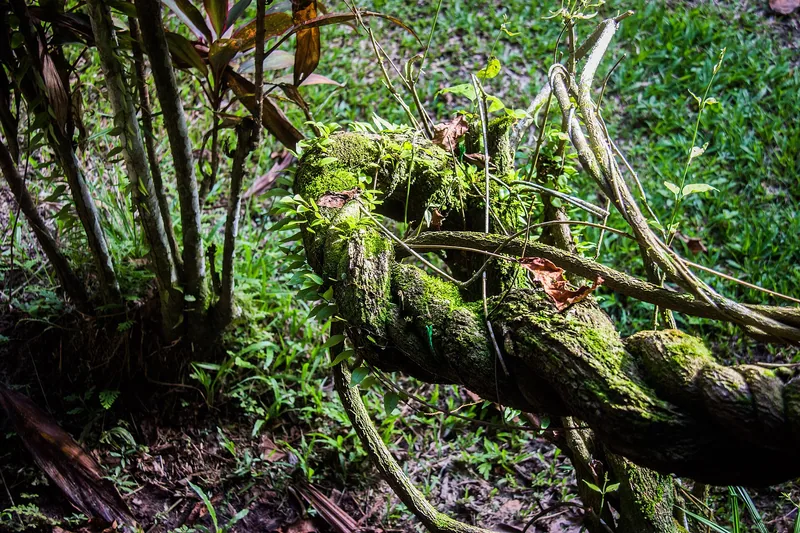
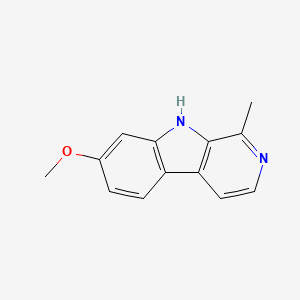
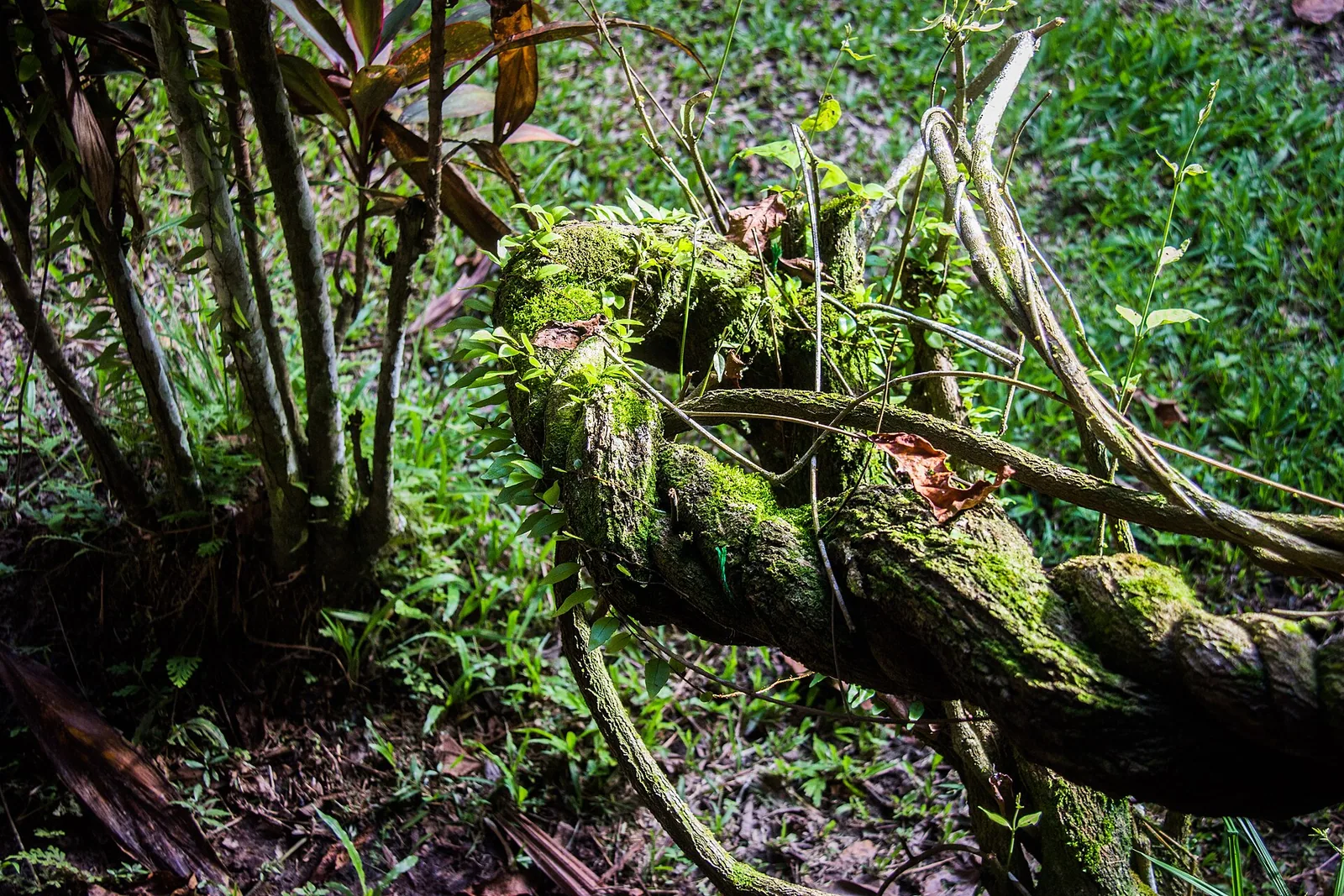
A large Amazonian liana of the Malpighiaceae. In Santo Daime it is commonly called jagube; in União do Vegetal, mariri. Its woody stem supplies harmine, tetrahydroharmine and smaller or variable amounts of harmaline. Church exegeses associate the vine with strength, doctrine and the collective labour of cultivation and feitio or preparo (Goulart, 2008; Labate and MacRae, 2010; dos Santos and Hallak, 2025).
Family / order
Malpighiaceae · Malpighiales
Growth form
Woody tropical liana; cultivated in forest gardens and church compounds
Principal alkaloids
Harmine · tetrahydroharmine · harmaline
Canonical role
Vine component of daime and hoasca; material focus of collective production
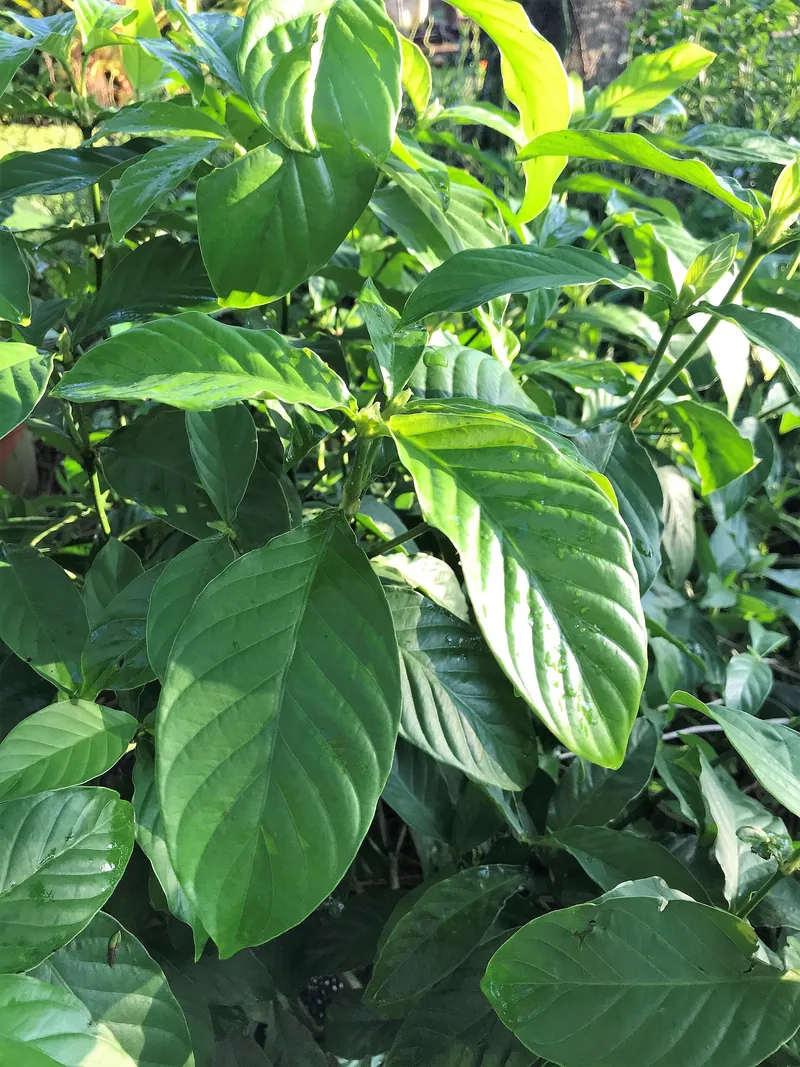
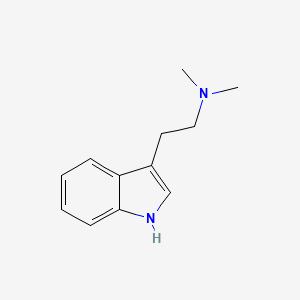
A Rubiaceae shrub cultivated for its leaves. Santo Daime commonly calls it rainha (“queen”), while UDV uses chacrona. The leaves supply N,N-dimethyltryptamine (DMT). Religious interpretation can gender and personify the plant, and mappings vary across branches. Selection, prayer, preparation, hierarchy and communal use distinguish daime or hoasca from a laboratory mixture (Hartogsohn, 2021; dos Santos and Hallak, 2025).
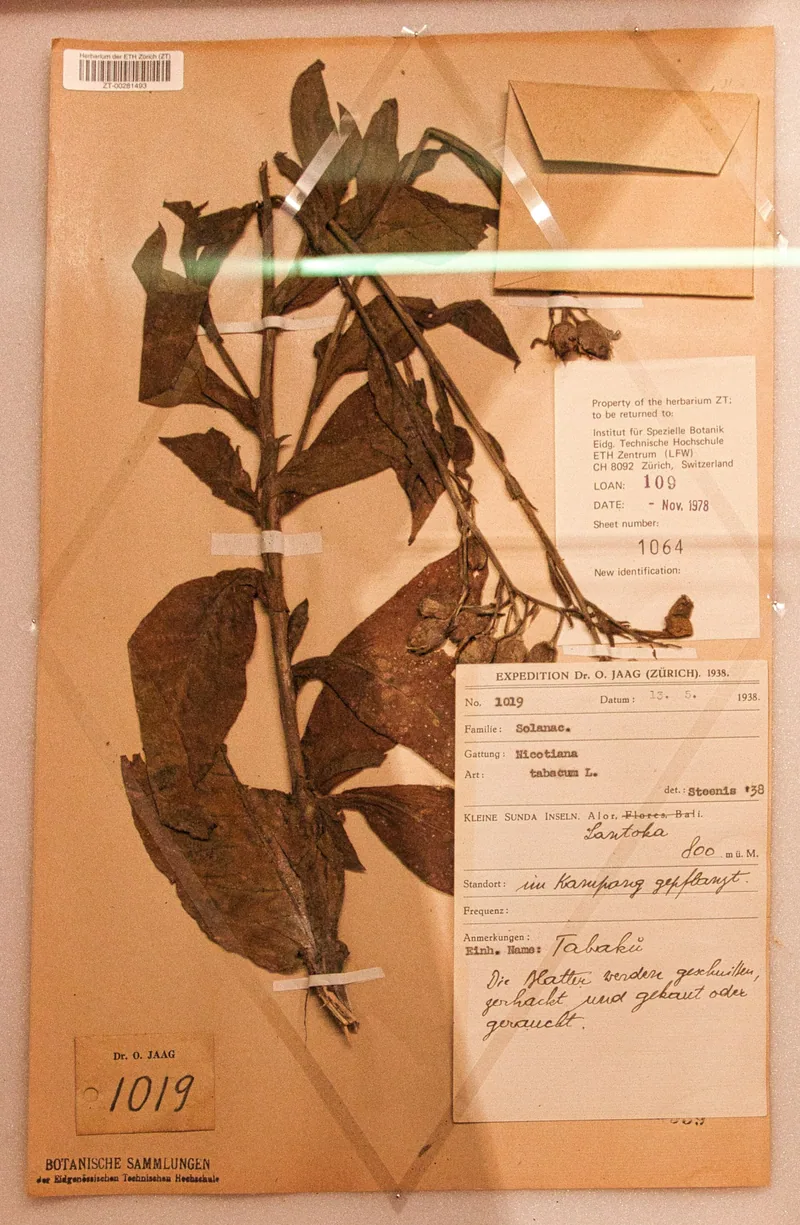
Tobacco may mark, cleanse, bless or mediate spirit relations. It is an independent ritual technology, used alongside ayahuasca more than in it.
Folhas / ewé
Sacred leaves · baths · smoke · medicines
Candomblé, Umbanda and related terreiros organise extensive plant knowledge through axé, orixá relations, cleansing, healing and initiation (Pagnocca et al., 2020).
Water, candles, flowers and vessels
Mesa · altar · salão · terreiro
Tables and altars organise directions, ranks and spirit presences. Cups, candles, flowers, images, crosses and water are active parts of ritual space.
Hymns, chamadas and pontos
Hinário · salmo · bailado · maracá · drum
Collective song, measured movement and percussion structure attention, memory, authority and incorporation.
Scope and safety: this page describes social forms of preparation without recipes, quantities or extraction instructions. Ayahuasca has clinically relevant interactions, particularly with serotonergic medicines and other monoamine oxidase inhibitors. Religious status does not remove medical risk (Durante et al., 2021; dos Santos and Hallak, 2025).
Plate 01 · Banisteriopsis caapi (Spruce ex Griseb.) C.V.Morton · deep view
Banisteriopsis caapi, Iquitos, Peru · Apollo, 2015 · CC BY 2.0 ↗
P. viridis; also reported in M. tenuiflora root bark and other plants.
Serotonergic psychedelic, especially at 5-HT2A; rapidly metabolised by monoamine oxidase when taken alone by mouth.
Why one vision is interpreted as miração, another as burracheira, and another as meeting a Mestre in an enchanted city is a question for ritual and doctrine; DMT is one part of the answer.
Harmine and harmaline
B. caapi; harmala alkaloids also occur in P. harmala.
Reversible monoamine oxidase-A inhibition contributes to oral DMT activity; harmine has additional pharmacology under investigation.
The “inhibitor + DMT” formula describes a chemical interaction; the institutional distinctions among daime, hoasca and contemporary juremahuasca lie elsewhere.
Tetrahydroharmine
Commonly present in B. caapi.
Weak serotonin reuptake inhibition and other actions may contribute to whole-brew effects; concentration varies.
Named sacraments are served in ritual measures, unstandardised as pharmaceutical doses.
Nicotine and plant volatiles
Tobacco smoke, incense, aromatic leaves and cleansing plants.
Can alter arousal, nausea, attention and sensory atmosphere.
“Set and setting” includes pharmacologically active ritual media as well as the scenery around the brew (Hartogsohn, 2021).
Principal alkaloid; agonist at neuronal nicotinic acetylcholine receptors.
Preparation as religious labour
SANTO DAIME · FEITIO
Vine and leaf are cultivated, harvested and transformed through an extended collective work with prayers, hymns, task-specific labour in many branches, repeated heating and the authority of experienced makers. The process produces community and doctrine as much as liquid; exact arrangements vary among Alto Santo, ICEFLU and independent churches (Dawson, 2013; Hartogsohn, 2021).
UDV · PREPARO
UDV preparation is supervised within a hierarchical institutional structure. The plants are commonly named mariri and chacrona, and the brew Vegetal or hoasca. Technical knowledge, conservation, doctrinal speech and rank are joined in the work (Goulart, 2008; Brissac, 2008).
JUREMA · MESA
Jurema may involve beverage, smoke, pipes, cachaça or wine, honey, herbs, candles, vessels and Catholic prayers in highly local combinations. The mesa is both furniture and a ritual arrangement from which Mestres, Mestras and caboclos are called, embodied and consulted. The formulation “Every Jurema is a Jurema” identifies internal diversity as a defining feature of the complex (Grünewald and Savoldi, 2020).
PHARMACOLOGICAL CAUTION
Traditional Jurema is often described in psychedelic literature as an oral DMT preparation, a claim the evidence supports only for some rites. Some effects arise through possession, trance, smoke, music, expectation and social authority; some modern preparations deliberately add a β-carboline source (Grünewald, Savoldi and Collins, 2022).
JUREMA · CHEMISTRY
The alkaloid of jurema preta is carried in the inner bark of the root, from which the “vinho da jurema” (also ajucá, anjucá or cotcha-lá) is made (Grünewald and Savoldi, 2020, pp. 222, 225). The chemistry has a long record. Gonçalves de Lima’s “nigerina” of 1942 came from Pankararu jurema (Grünewald and Savoldi, 2020, p. 224). Pachter and colleagues reported indole alkaloids from Mimosa hostilis in 1959 (Pachter, Zacharias and Ribeiro, 1959), and in 2005 a new phytoindole, yuremamine, was isolated from the stem bark (Vepsäläinen et al., 2005). The yuremamine paper characterises the compound’s structure. It does not show that the compound is active, so on present evidence yuremamine cannot explain how an oral jurema wine works.
02Culture
Peoples and territories
Acre and the upper Amazon borderlands
Black and northeastern migrants · rubber workers · Indigenous and mestizo knowledge networks
Rio Branco and surrounding forest settlements were shaped by rubber extraction, migration, frontier violence and exchange with Indigenous and mestizo ayahuasca specialists. Santo Daime and Barquinha emerged here as urbanising Amazonian religions whose founders were Black men from Maranhão (Labate, 2012; Labate and MacRae, 2010).
Rondônia and the Brazil–Bolivia frontier
Rubber camps · Porto Velho · UDV nuclei
José Gabriel da Costa founded the União do Vegetal in 1961 after learning about ayahuasca in frontier rubber-camp worlds. The organisation later developed a centralised national structure, formal ranks and urban centres (Goulart, 2008; Brissac, 2008).
Northeastern Brazil
Paraíba · Pernambuco · Rio Grande do Norte · Indigenous peoples · Afro-Indigenous terreiros
Colonial records locate a spreading Jurema movement among peoples identified as Corema, Panati, Pega, Xukuru and others in eighteenth-century Paraíba. Contemporary Jurema is especially visible in Indigenous communities and in Catimbó-Jurema, Umbanda and Candomblé houses (Wadsworth, 2006; Grünewald, Savoldi and Collins, 2022).
From the late twentieth century, Santo Daime and UDV expanded nationally and abroad; Jurema practitioners and neo-ayahuasca networks also connected northeast, southeast, Europe and North America. Law, translation and local religious markets now help determine what a “traditional” work can look like (Labate, 2012; Talin, 2025; Talin, 2026).
First trunk · institutional Brazilian ayahuasca religions
Founder lineages join popular Catholicism, esoteric Christianity, Spiritism, Amazonian plant knowledge and the social world of Black and northeastern migrants.
Rituals or trabalhos include concentration, healing, hymn festivals and danced hinários. Hymns are “received” as teachings and organised into leader-specific collections.
The bailado arranges dancers in gendered files around a central table, using march, waltz and mazurka steps, maracás, uniforms and long-duration collective attention (Flecha, 2023; Hartogsohn, 2021).
Barquinha
Daniel Pereira de Mattos · Frei Daniel · “little boat”
Founded in Rio Branco by a Maranhão-born sailor, musician and former participant in Mestre Irineu’s circle. Distinct branches developed after Frei Daniel’s death.
Its cosmology is maritime and missionary: boat, sea and spiritual voyage coexist with Saint Francis, Catholic devotion, Kardecist charity, caboclos and pretos velhos.
Mediumistic incorporation, healing and charitable service are prominent. Daime occupies a specific place within a wider system of Christian devotion, mediumship, cosmology and charitable work (Araújo, 2008; Santana de Rose, 2018a).
União do Vegetal
José Gabriel da Costa · Mestre Gabriel · CEBUDV
A Christian-reincarnationist institution with centralised administration, ranked quadro de mestres, oral doctrine and disciplined session format.
Sessions are generally seated and directed by a mestre through chamadas, stories, questions, music and silence; collective dance has little place.
The visionary state, burracheira, is cultivated as a relation of light, force, memory and understanding within institutional authority (Goulart, 2008; Brissac, 2008).
Second trunk and crossings · Jurema, Afro-Brazilian matrices and neo-churches
Jurema is a decentralised religious field. Houses and Indigenous communities maintain different plants, prayers, spirit lineages, vessels and obligations.
The enchanted realm is often mapped as cities or kingdoms inhabited by Masters, caboclos, princesses and other entities who descend to work in the mesa or terreiro.
Healing includes consultation, blessing, smoke, herbal prescription, spirit incorporation and the ethical formation of mediums (Wadsworth, 2006; Grünewald and Savoldi, 2020).
Candomblé is ordinarily distinct from the ayahuasca religions. Its autonomous nations and houses centre orixás, voduns or inquices, initiation, possession, drumming, offerings, divination and sacred leaves.
Umbanda developed its own plural field of Catholic, Kardecist, Afro-Brazilian and caboclo spirits. It became an important route by which incorporation practices entered some Santo Daime branches.
“Umbandaime” names later combinations of Daimista sacrament and hymnody with Umbanda spirit work. These are embraced in some communities and resisted in others (Dawson, 2012; Engler, 2023).
Independent centres may combine church hymns, Indigenous borrowings, New Age cosmology, yoga, psychotherapy, electronic or ambient music, ecology and arts practice.
Some seek legal protection by adopting church-like structures; others resist fixed doctrine. Founder charisma, professional facilitation and digital networks become new forms of authority.
These modern ritual cultures form a distinct field of anthropological study. Their institutions, borrowings, commercial relations and claims to lineage vary considerably (Talin, 2026).
History and evidence
The Indigenous Panoan peoples of Acre among whom, on Lagrou’s account, the rubber tappers met the brew — the Huni Kuin among them — are treated in Indigenous Amazonian Shamanisms.
The Brazilian ayahuasca religions were made on the rubber frontier in the twentieth century. Their founders were migrants from the north-east recruited into the rubber economy of Acre and Rondônia. They met the brew through regional networks of practice on the Bolivian border, and organised its use into churches with calendars, uniforms, hymnals and, later, statutes. Irineu Serra came from Maranhão in 1912 and first drank ayahuasca in the Brasiléia–Cobija borderland through the Costa brothers. He opened public works in Rio Branco in 1930, and the Alto Santo community grew from a state land grant in the 1940s (MacRae, 1992). José Gabriel da Costa, a Bahian rubber worker who came north in 1943, first drank hoasca in 1959 and created the União do Vegetal two years later (Melo, 2011).
A second generation turned regional churches into national ones. Padrinho Sebastião led the line that became CEFLURIS, now ICEFLU, from Colônia 5000 to Rio do Ouro and Céu do Mapiá. Céu do Mar, its first church outside the Amazon, opened in Rio de Janeiro in 1982 (MacRae, 1992). Federal regulation followed. The vine was briefly prohibited in 1985, and the prohibition was lifted the following year. Two decades of working groups and resolutions then produced a settlement that protects religious use while keeping DMT controlled (Labate and Feeney, 2012).
Jurema keeps a different chronology. The cult is known from colonial sources mainly through Inquisition persecution near the coast. Its first well-structured ritual record is the Pankararu Ajucá of 1938, and laboratory interest began in 1942 with Gonçalves de Lima’s “nigerina” (Grünewald and Savoldi, 2020, pp. 224, 226). Its newest layer dates from the late 1990s. Psychonauts abroad paired jurema with Peganum harmala, a combination Ott called “anahuasca” and Labate “juremahuasca”, and the first Brazilian groups began using it in 1997 (Grünewald and Savoldi, 2020, pp. 222, 231, 233).
The table sets the three genealogies on one timeline. Founding dates should be read as each source gives them. The Barquinha’s founding is given as 1945 by Frenopoulo, but MacRae’s account implies a date after 1947.
Date
Event
Source
1892
Raimundo Irineu Serra born in São Vicente Ferrer, Maranhão.
MacRae, 1992
1912
Irineu reaches the western Amazon with recruited rubber workers; he later works in Xapuri, Brasiléia and Sena Madureira, including for the Border Commission.
MacRae, 1992
1920s
The Costa brothers, through whom Irineu first drank ayahuasca in the Brasiléia–Cobija borderland, found the Círculo de Regeneração e Fé in Brasiléia.
MacRae, 1992
1922
José Gabriel da Costa born near Feira de Santana, Bahia.
Melo, 2011
1930
Irineu begins public works at Vila Ivonete, Rio Branco, under the name Daime.
MacRae, 1992
1936
The white farda is introduced.
Hartogsohn, 2021
1938
The Ajucá festival of the Pankararu: the first well-structured record of a Jurema ritual.
Grünewald and Savoldi, 2020, p. 224
1942
Oswaldo Gonçalves de Lima reports an alkaloid he calls “nigerina” in jurema preta used by the Pankararu of Tacaratu.
Grünewald and Savoldi, 2020, p. 224
1940s
A land grant from Governor Guiomard dos Santos becomes the Alto Santo community.
MacRae, 1992
1945
Daniel Pereira de Mattos founds the Barquinha on the outskirts of Rio Branco. MacRae places a six-month stay by Daniel at Alto Santo in 1947, before the founding, so the two accounts disagree on the date.
Frenopoulo, 2004; MacRae, 1992
1958
Death of Daniel Pereira de Mattos.
MacRae, 1992
1959
1 April: Gabriel first drinks hoasca, from Chico Lourenço, at the Guarapari rubber estate. The same year, Pachter and colleagues report the indole alkaloids of Mimosa hostilis (now M. tenuiflora).
Melo, 2011; Pachter, Zacharias and Ribeiro, 1959
1961
22 July: the União do Vegetal is created at the Sunta estate on the Bolivian border; it is soon established on the periphery of Porto Velho.
Melo, 2011
1965
Sebastião Mota de Melo (Padrinho Sebastião) joins the Daime.
MacRae, 1992
1971
6 July: death of Irineu Serra.
MacRae, 1992
1972
The blue farda, for seated works, is introduced.
Hartogsohn, 2021
1974
Sebastião separates from Alto Santo at Colônia 5000.
MacRae, 1992
1980
Settlement at Rio do Ouro begins; the community later moves to Céu do Mapiá.
MacRae, 1992
1982
November: Céu do Mar in Rio de Janeiro becomes the first Daime church outside the Amazon.
MacRae, 1992
1985
8 March: DIMED Portaria 02 lists B. caapi as prohibited. 30 July: CONFEN Resolução 04 sets up a working group.
Labate and Feeney, 2012
1986
4 February: CONFEN Resolução 06 provisionally lifts the prohibition.
Labate and Feeney, 2012
1987
28 August: the working group’s final report, approved by CONFEN, recommends that ritual and religious use be permitted; DMT itself stays controlled.
Labate and Feeney, 2012
1989
May: new CEFLURIS statutes approved.
MacRae, 1992
1990
20 January: death of Padrinho Sebastião.
MacRae, 1992
1997
The first Brazilian groups using “juremahuasca”, jurema combined with Peganum harmala, begin.
Grünewald and Savoldi, 2020, p. 233
2002
31 December: CONAD Resolução 26 bars use by minors and export.
Labate and Feeney, 2012
2004
4 November: CONAD Resolução 05 creates the Multidisciplinary Working Group (GMT).
Labate and Feeney, 2012
2006
23 November: the GMT delivers its final report.
Labate and Feeney, 2012
2010
25 January: CONAD Resolução 01 publishes the GMT’s principles for religious use.
Labate and Feeney, 2012
Ritual practice compared
Formation
Spatial order
Sonic order
Authority and spirit relation
Santo Daime
Central mesa; gendered files; seated concentration or synchronised bailado; uniforms distinguish occasions.
Received hymns, maracás, guitars and fixed hymnals; march, waltz and mazurka organise bodily time.
Padrinhos, madrinhas, commanders and fiscal roles; miração and incorporation are evaluated through doctrine and lineage.
Barquinha
Devotional altar and mission space; branches differ in table, dance, processional and mediumistic work.
Salmos, hymns, prayers and instrumental music; maritime and Franciscan imagery is prominent.
Charitable mission and mediumship; caboclos, pretos velhos, sailors and other beings may be incorporated to heal.
UDV
Seated salão with directed attention; comparatively restrained movement.
Chamadas, doctrinal narrative, questions, recorded or live music and deliberate silence.
Ranked mestre directs the session; burracheira is interpreted through oral teaching, memory and disciplined speech.
Jurema Sagrada
Mesa or terreiro with vessels, candles, pipes, images, plants and planted spirit cities; forms vary.
Pontos, prayers, maracás, drums, whistles and spoken consultation.
Padrinhos, madrinhas, juremeiros and mediums work with Mestres, Mestras, caboclos and enchanted lineages.
Umbandaime / neo-church
Church geometry may alternate with open circle, healing stations, mediumistic lines or art-performance space.
Daimista hymns coexist with pontos, popular songs, soundscapes or curated playlists.
Authority can combine lineage, mediumship, therapeutic credentials, charisma and peer facilitation.
Mythology and cosmology
Santo Daime: the forest is a revelatory domain of the Divine Queen, Virgin Mary, Christ, Saint John, sun, moon, stars and Juramidam. Founder hymnals form a lived scripture in which biography, cosmology and ethical instruction remain singable and renewable (Santana de Rose, 2018b; Hartogsohn, 2021).
Barquinha: human existence is figured as navigation and mission. The little boat carries practitioners through seas and spiritual realms; sailors, Franciscan devotion, the Cross and incorporated entities make a cosmology whose mobility is structural (Araújo, 2008).
UDV: Christian and reincarnationist teachings, Mestre Gabriel’s biography and orally transmitted stories organise the Vegetal as a path toward light, knowledge and moral evolution. Amerindian, popular Catholic, Kardecist and esoteric matrices combine into a doctrine that is more than their sum (Goulart, 2008).
Jurema: the tree opens an encante of cities, kingdoms and lineages inhabited by Mestres, Mestras, caboclos and other beings. Jurema can be plant, woman, city, science and sovereign force (Grünewald and Savoldi, 2020).
Candomblé and Umbanda: Candomblé nations maintain specific relations with orixás, voduns or inquices, ancestors, ritual kinship and axé. Umbanda’s spirit lines enter some ayahuasca settings through historically situated contact, while Brazilian religions keep distinct cosmologies (Capone, 2010; Dawson, 2012).
“Shamanism” fits unevenly. Mestre Irineu learned within an Amazonian ayahuasca milieu, yet Santo Daime formed a church-like congregation; UDV privileges its own mestre hierarchy; Barquinha and Jurema foreground mediumship and incorporation; Candomblé organises initiation and possession through terreiro lineages. The comparative term follows the local offices.
Healing can mean relief of illness, moral correction, reconciliation, spirit consultation, charitable care or the reordering of life around a religious community. Biomedical trials address selected symptoms and mechanisms; the reality of spirits and the clinical standing of a religion are outside their scope (Mercante, 2012; dos Santos and Hallak, 2025).
Art and material culture
Santo Daime · the farda
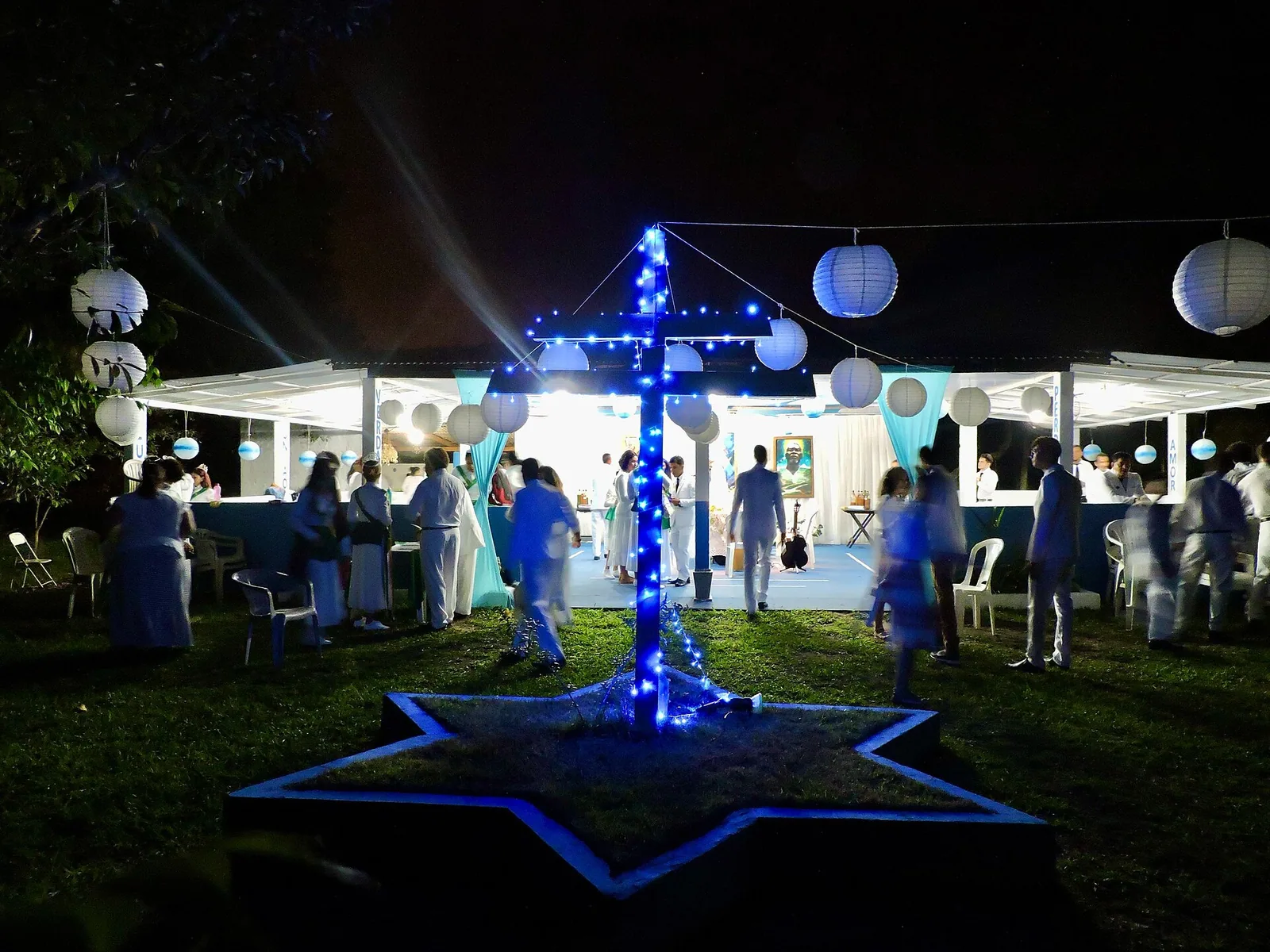
Uniform marks membership and the kind of work in hand. The white farda dates from 1936 and the blue, worn for seated works, from 1972. Green, blue and white are the sanctified colours, red and black are excluded, and the six-pointed star is worn as the church’s insignia (Hartogsohn, 2021).
Santo Daime · the star-table
At the centre of the hall stands a table in the form of the star. It carries the two-barred cruzeiro hung with a rosary, figures of Mary and Jesus, photographs of Irineu and Sebastião, flowers, water, incense and four candles. The altar thus gathers Catholic devotion and the church’s own founders into one composition (Hartogsohn, 2021).
Santo Daime · battalions, hinário and maracá
The hall is hexagonal. Men and women stand in separate “battalions” of three sections each around the table. The hymnal is sung to the maracá and guitar, and in the danced bailados, which last eight to twelve hours, the congregation keeps the hymns’ march, waltz or mazurka in step together (Hartogsohn, 2021).
Barquinha · church, congá and terreiro
A Barquinha centre has several distinct spaces. The main hall carries the Stations of the Cross. In the congá room, a top shelf of Catholic images stands above iron pieces for the orixás and statues of Pretos Velhos, with the Pedra de Xangô at its centre. Outside is an open terreiro. The architecture keeps the traditions side by side rather than fusing them (Frenopoulo, 2004).
Barquinha · farda and ring dance
Members wear a sailor-type uniform. Daime is served by candlelight, and there is no maracá. Spirit work moves through a counter-clockwise ring dance, and the instrução alternates sung psalms with speeches by the spirits (Frenopoulo, 2004).
Jurema · the mesa
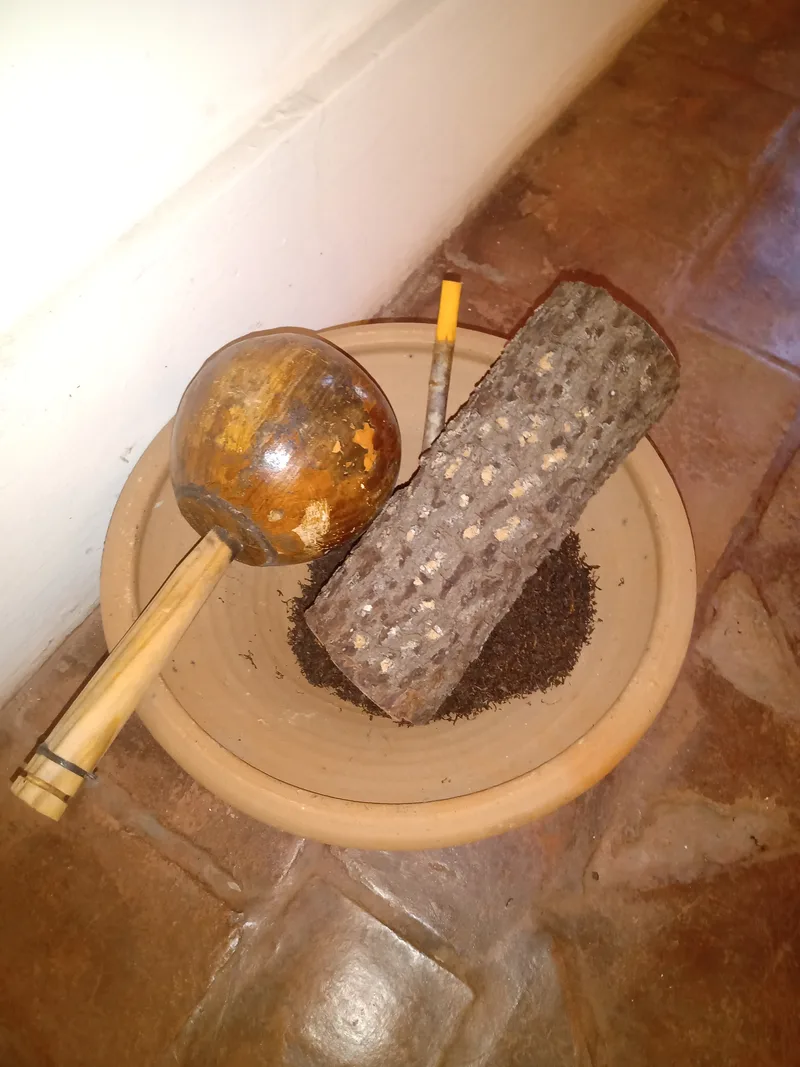
The Jurema table is set with crosses, aribés (vessels) of jurema, gourds, cachaça, candles, and cups called “princes and princesses”, through which the Mestres and Mestras are received (Grünewald and Savoldi, 2020, p. 227).
Jurema · pipe, maracá and the jurema de chão
The pipe (cachimbo) and the maracá are the working instruments of the Mestre. In the jurema de chão, a floor-level form, low stools and chalked pontos riscados take the place of the table. The spirits’ cities are figured in shrines (pejis) with tronqueiras. Houses take the name of their leader, who is free to innovate, so the material repertoire varies from house to house (Grünewald and Savoldi, 2020, pp. 227–229).
The Santo Daime star: an eagle over a crescent within a six-pointed star, the insignia worn by fardados.Tonelada · CC BY-SA 3.0 · Wikimedia CommonsObjects of the Jurema Sagrada: a gourd rattle, a length of jurema trunk and tobacco in a clay dish.Luiz79 · CC0 · Wikimedia Commons
03Visionary phenomenology
One pharmacological family, several cultivated modes
Ayahuasca commonly begins within roughly 20–60 minutes, reaches a strong phase during the next several hours and may remain experientially active for about four to six hours. Church works can last much longer—sometimes through the night—because of repeated servings, long hymnals and ritual calendars. Nausea, vomiting, diarrhoea, tremor, fear and autonomic stimulation may coexist with imagery, autobiographical memory, emotional release and perceived spiritual encounter. Jurema sessions may also last many hours, with no single pharmacological duration, because preparations and routes differ and some rites work without orally active DMT (Hartogsohn, 2021; Grünewald, Savoldi and Collins, 2022; dos Santos and Hallak, 2025).
Santo Daime · miração
Vision is worked. Geometric imagery, radiance, forest and Christian beings, moral review and biographical scenes may be organised by hymns and the demand to keep one’s place. Força names intensity or power; peia may describe a difficult, correcting passage. A hymn felt to “arrive” can be revelation and communal text (Hartogsohn, 2021).
UDV · burracheira
Clarity is directed. Participants speak of light, force, memory and understanding while the mestre’s chamadas, questions and narratives steer attention. Vivid imagery can occur, but disciplined comprehension and morally useful knowledge are privileged over spectacle (Brissac, 2008; Goulart, 2008).
Barquinha · mediumistic vision
Image becomes encounter. Healing imagery, spiritual voyage and contact with sailors, caboclos, pretos velhos or missionaries may move toward incorporation. The visionary and bodily meet: a being can be seen, heard, felt and enacted through the medium (Araújo, 2008; Mercante, 2012).
Jurema · encante
The forest becomes a city. Accounts emphasise enchanted kingdoms, Masters, caboclos and journeys through spiritual geography. Smoke, song, dance and possession can be more central than closed-eye imagery. The encounter belongs to a lineage and mesa, even when contemporary users also describe DMT-like geometry (Grünewald and Savoldi, 2020).
Umbandaime · incorporation under force
Vision becomes plurality of persons. Ayahuasca intensification may be interpreted as opening mediumship to caboclos, pretos velhos, exus or other lines. Critics within Santo Daime can view uncontrolled incorporation as disorder; supporters develop specific works and controls (Dawson, 2012).
Neo-church · psychospiritual synthesis
Self, ecology and art converge. Participants may translate imagery into trauma, nervous-system, ancestral, ecological or cosmic language. Curated music and facilitation produce flexible ritual “microclimates”; the phenomenology is modern and socially patterned (Talin, 2026).
Phases, intensities and interpretive thresholds
01 · Calendar and preparation
Works are fixed in a ritual calendar rather than taken at will. In Santo Daime, concentration works fall on the 15th and 30th of each month (Hartogsohn, 2021). In the Barquinha, healing works are held on Saturdays, and on the 27th of each month at the Prestação de Contas (Echazú Böschemeier, 2013). Entering a work means entering an appointed collective time.
02 · Current and force
Daimistas describe the shared state of a work as a corrente (current) carrying a força (force). Intensity is understood as a property of the assembled body as well as of the individual, which is why posture, line and song are kept (Hartogsohn, 2021).
03 · Firmeza and the trial
Difficult passages are named rather than avoided. Works are also called provas (trials) and framed as spiritual battles. Firmeza is the cultivated capacity to bear suffering while keeping one’s attention on beauty and love. It turns distress into a recognised stage of the work (Hartogsohn, 2021).
04 · Miração as contemplative thought
In Mercante’s Barquinha ethnography, miração is “pensar contemplativo”, contemplative thinking. It is an imaginative mode through which healing proceeds, and the person heals by surrendering (entrega), with the Daime regarded as the true therapist (Mercante, 2012, p. 224, cited in Echazú Böschemeier, 2013).
05 · Burracheira and grade
UDV teaching names the force of the tea burracheira and understands it as a meeting with the Mestre directed at self-knowledge, not as possession. Access to the “encantos” is graded by rank in the institution (Melo, 2011).
06 · Public dance and consecrated drink
In Jurema, the threshold is social as well as experiential. The Toré, the public ceremonial dance, is often performed without jurema at all (Grünewald and Savoldi, 2020, pp. 224–225). At the Kipupa of Malunguinho, two drinks are distinguished, one “de salão” and one “de consagração” (Grünewald and Savoldi, 2020, pp. 229–230).
Daime isn’t everything. God is everything.Barquinha leader Mestre Antônio Geraldo da Silva Filho, distinguishing sacrament from the total religious system (Híbridos, n.d.).
The remark identifies the relative position of Daime within Barquinha: the sacrament is situated inside a wider system of devotion, mediumship, charitable work and relation to God.
04Contemporary transformations
Expansion, translation and emergent institutions
International expansion turns local religious terms into portable brands, legal categories and therapeutic claims. Santo Daime congregations translate Portuguese hymnals and reproduce Amazonian calendars abroad; UDV maintains stronger central coordination; Barquinha remains comparatively regional; Jurema circulates through Indigenous revival, terreiros, arts and experimental juremahuasca networks. Neo-churches range from durable congregations to event-based circles. “Authenticity” is therefore negotiated through lineage, plant custody, repetition, legal recognition and the ethical quality of relations, as well as age (Labate and MacRae, 2010; Dawson, 2012; Grünewald and Savoldi, 2020; Talin, 2026).
Religious, cultural and biological economies
Church economy
Membership · donation · collective labour · travel
Congregations support land, temples, plantings, transport, feasts, musicians, publishing and social projects through labour, contributions and donations. These are economies even when profit is rejected; they distribute authority and access.
Retreat and facilitation economy
Ceremony fees · wellness tourism · training · media
Independent centres may charge for programmes, integration, accommodation or professional facilitation. Brazilian rules distinguish religious use from commercial promotion, but the practical boundary between donation, fee and tourism remains contested (Labate and Feeney, 2012; Krause, 2025).
Plant economy
Church gardens · nurseries · wild harvest · transnational supply
B. caapi and P. viridis are widely cultivated, yet rising demand, deforestation and transport restrictions create local pressure and incentives for extraction. Mature vine takes time; root-bark harvest can kill jurema even though the species resprouts vigorously.
Cultural economy
Hymnbooks · recordings · art · heritage · intellectual property
Songs, founder images, ritual names and Indigenous or Afro-Brazilian aesthetics circulate with uneven attribution. Copyright and trademark can protect institutions while converting shared religious forms into private assets.
Threat, conservation and safeguarding
PLANTS
B. caapi, P. viridis and M. tenuiflora are currently outside the globally threatened categories. Local risk remains: habitat conversion, destructive root harvest, removal of old vines and demand concentrated around particular cultivars can degrade populations. Community cultivation and plant exchange are conservation practices as well as ritual obligations.
TERRITORY
Biological sustainability is bound up with land. Caatinga degradation, Amazonian deforestation and displacement of Indigenous and Afro-Brazilian communities threaten knowledge transmission even when a plant remains common.
RELIGIOUS RACISM
Candomblé, Umbanda and Jurema houses continue to face demonisation, vandalism and pressure that Brazilian scholarship increasingly names religious racism. Material loss includes drums, altars, planted spirit settlements, sacred leaves, archives and safe spaces for initiation (Capone, 2010; Pagnocca et al., 2020).
HERITAGE
Recognition of ayahuasca religions as cultural heritage can support safeguarding, yet raises the question of whose heritage is represented. Institutional churches, Indigenous nations and independent groups enter state processes with unequal power (Labate, 2012).
Law and religious freedom
Jurisdiction / instrument
Status
What it does—and does not do
Brazil · CONAD Resolution 1/2010
RELIGIOUS USE RECOGNISED
Consolidates principles for religious ayahuasca use, cultivation, preparation and transport; rejects commercialisation, tourism promotion and unproven therapeutic advertising. It is an administrative framework for religious use, short of a general legalisation of DMT or of every psychoactive plant practice (CONAD, 2010; Labate and Feeney, 2012).
United States · UDV
GROUP-SPECIFIC PROTECTION
In Gonzales v O Centro (2006), the Supreme Court held that the government had not shown the compelling interest required under RFRA to bar UDV’s sacramental hoasca use. The judgment concerned that church alone (Supreme Court of the United States, 2006).
United States · Santo Daime
SPECIFIC INJUNCTION
A 2009 federal decision protected the Church of the Holy Light of the Queen in Oregon under RFRA, with conditions. Protection attaches to litigants and regulated practice (US District Court, District of Oregon, 2009).
Italy · 2022 prohibition
RESTRICTED
Prohibition reshaped diaspora practice: ethnography documents services with water in place of daime and new forms of religious travel. Ritual can persist while its central material is legally removed (Talin, 2025).
International field
VARIABLE
DMT is internationally controlled, while the treatment of plants, preparations and religious exemptions differs by state. Recognition of one church in one jurisdiction is poor evidence for another group elsewhere.
Patents, ownership and knowledge
The best-known controversy concerns US Plant Patent PP5,751 for a claimed cultivar of Banisteriopsis caapi named ‘Da Vine’, granted to Loren Miller in 1986. Indigenous organisations and advocates challenged it; the claim was cancelled in re-examination and later confirmed in amended form before the patent expired. The patent covered one claimed cultivar; ayahuasca, the species B. caapi, DMT and Indigenous ritual knowledge lay outside it. It was a narrow plant-patent claim whose political significance exceeded its technical scope (Press, 2022; Bosse, 2024; US Patent and Trademark Office, 1986). The episode nonetheless exposed structural problems: Indigenous peoples bore the cost of contesting a foreign property system, while plant variety, ceremony and collective knowledge were forced into categories designed for individual invention.
Research frontier · what is actually being studied
Study type
Recent finding
What may be inferred
What may not
Randomised depression trial
A 29-participant placebo-controlled trial reported rapid antidepressant effects after one ayahuasca session in treatment-resistant depression (Palhano-Fontes et al., 2019).
Supports further controlled investigation of a screened intervention.
A general treatment, long-term efficacy and equivalence between a clinical dose and church sacrament remain unestablished.
Long-term ritual users
A cross-sectional study associated long-term Santo Daime use with preserved global cognition and some memory differences (Fonseca et al., 2025).
Challenges simple claims of inevitable cognitive decline in the sampled community.
Selection effects and cross-sectional design prevent causal claims of enhancement.
fMRI and resilience
A small case-control study found distinct emotional-reactivity patterns and higher measured resilience in long-term users (Ramos et al., 2025).
Generates hypotheses about repeated ritual use and emotional processing.
Pharmacology stays entangled with community, lifestyle, expectancy and pre-existing differences.
Social-visual connectivity
A 2026 crossover fMRI study of 12 participants found changes involving the posterior superior temporal sulcus and sensorimotor networks (Soares et al., 2026).
Adds a mechanistic hypothesis about social perception under ayahuasca.
Religious visions remain undecoded, and no brain network is shown to cause a cosmology.
Ethnography of setting
Research on Santo Daime shows how music, symbols, posture, roles and expectation systematically shape experience (Hartogsohn, 2021).
Demonstrates that context is an active causal field.
Ritual controls leave adverse reactions and power differences in place.
05Linked species
Ayahuasca Complex
Indigenous, mestizo and institutional preparation lineages centred on B. caapi, with regional leaf plants, admixtures and cosmologies.
Jurema Religions Complex
Expanded treatment of Catimbó-Jurema, Indigenous northeast revivals, enchanted cities, mesa traditions and modern juremahuasca.
Modern combinations of MAOI and DMT-bearing plants, cognitive liberty, underground publishing and emergent neo-churches.
DMT and β-carbolines
Receptor pharmacology, metabolism, interactions, clinical research and patents without substituting compound for sacrament.
Cross-index
Ayahuasca complex
The preparation page tracks the brew across Indigenous, mestizo and church contexts; this page tracks the durable religious institutions built around it. PREPARATION ↔ INSTITUTION
Jurema religions
A distinct northeastern genealogy that intersects with Umbanda, Candomblé houses and modern ayahuasca-like preparations without becoming a branch of Santo Daime. PARALLEL TRUNK
Bwiti–Iboga
Comparable integration of psychoactive plant, healing, initiation, ancestor relations and modern therapeutic appropriation; organisational histories differ. PLANT + RELIGION
Neo-psychedelics
Modern clinics and churches institutionalise altered states through different combinations of science, lineage, law, charisma and care. EMERGENT INSTITUTION
06Bibliography
46 sources in 5 threads · 45 with a working locator · Harvard (Cite Them Right) · status and kind are recorded per source, not assumed
How to read the labels on each source
Source type
What kind of work it is: journal article, book, legislation, patent application, database record and so on. A word after the dot (ethnography, protologue, primary source) keeps the genre the entry was first filed under. “Unclassified” means the citation does not say enough to tell.
Peer review
Recorded for each work separately, and only where it has been confirmed for that work. It is never inferred from a DOI, a publisher or a journal, since journals also publish editorials, letters and commentaries. Where it has not been confirmed, the entry records it as not established. It does not apply to legislation, court decisions, treaties, patents, datasets, database and collection records, historical texts, films, talks, press releases or web pages.
Check
What was checked when the entry was added. DOI checked: the DOI’s registry record (Crossref) matched the citation’s title, first author and year. Verified: the record itself was opened and matched the citation: a library catalogue record for a book, or the page itself for a database entry, law, patent or archive document. “Verified (abstract)” and “(summary)” mean only the abstract or a summary was read. Located: a record was found but not fully matched. Bibliographic record and Stable record (in essays): a catalogue or stable web record exists; what was checked against it is not recorded. Unverified: no check is recorded. No locator found: a search found no record. Secondary: read through another source.
What the labels do not say
None of them means the source supports a particular sentence. Where a sentence is graded, its evidence note names its sources and whether each supports it, disputes it or gives context. Dates and reviewers of checks are not recorded for each entry; the version note at the foot of a graded page dates its last review.
Brazilian ayahuasca religions and history
MacRae, E. (1992) Guiado pela lua: xamanismo e uso ritual da ayahuasca no culto do Santo Daime. São Paulo: Brasiliense. English translation, ch. 3, available at: https://www.neip.info/downloads/edward/chapter3.htm (Accessed: 14 October 2026).
VerifiedBookPeer review not establishedOpen record ↗cited 16× in this record
VerifiedJournal articlePeer review not establishedOpen record ↗cited 5× in this record
Labate, B.C. and MacRae, E. (eds) (2010) Ayahuasca, Ritual and Religion in Brazil. London: Equinox.
VerifiedBookPeer review not establishedOpen record ↗cited 3× in this record
Goulart, S.L. (2008) ‘Religious matrices of the União do Vegetal’, Fieldwork in Religion, 2(3), pp. 286–318. Available at: https://doi.org/10.1558/firn.v2i3.286.
DOI checkedJournal articlePeer review not establishedOpen record ↗cited 6× in this record
Brissac, S. (2008) ‘In the light of Hoasca: an approach to the religious experience of participants of the União do Vegetal’, Fieldwork in Religion, 2(3), pp. 319–349. Available at: https://doi.org/10.1558/firn.v2i3.319.
DOI checkedJournal articlePeer review not establishedOpen record ↗cited 4× in this record
Araújo, W.S. (2008) ‘The Barquinha: symbolic space of a cosmology in the making’, Fieldwork in Religion, 2(3), pp. 350–362. Available at: https://doi.org/10.1558/firn.v2i3.350.
DOI checkedJournal articlePeer review not establishedOpen record ↗cited 3× in this record
Labate, B.C. (2012) ‘Ayahuasca religions in Acre: cultural heritage in the Brazilian borderlands’, Anthropology of Consciousness, 23(1), pp. 87–102. Available at: https://doi.org/10.1111/j.1556-3537.2012.01058.x.
DOI checkedJournal articlePeer review not establishedOpen record ↗cited 5× in this record
DOI checkedBookPeer review not establishedOpen record ↗cited 1× in this record
Jurema and Afro-Brazilian matrices
Wadsworth, J.E. (2006) ‘Jurema and Batuque: Indians, Africans, and the Inquisition in colonial northeastern Brazil’, History of Religions, 46(2), pp. 140–162. Available at: https://doi.org/10.1086/511448.
DOI checkedJournal articlePeer review not establishedOpen record ↗cited 2× in this record
Capone, S. (2010) Searching for Africa in Brazil: Power and Tradition in Candomblé. Translated by L.L. Grant. Durham, NC: Duke University Press. Available at: https://doi.org/10.1215/9780822392040.
DOI checkedBookPeer review not establishedOpen record ↗cited 2× in this record
Sansi, R. and Parés, L.N. (2012) ‘The multiple agencies of Afro-Brazilian religions’, Religion and Society, 3(1), pp. 76–94. Available at: https://doi.org/10.3167/arrs.2012.030105.
DOI checkedJournal articlePeer review not establishedOpen record ↗
Grünewald, R. de A. and Savoldi, R. (2020) ‘Cada jurema é uma jurema: continuidade, rupturas e inovações em religiosidades no Brasil’, Revista del CESLA, 26, pp. 221–244. Available at: https://doi.org/10.36551/2081-1160.2020.26.221-244.
DOI checkedJournal articlePeer review not establishedOpen record ↗cited 16× in this record
Grünewald, R. de A., Savoldi, R. and Collins, M.I. (2022) ‘Jurema in contemporary Brazil: ritual re-actualizations, mysticism, consciousness, and healing’, Anthropology of Consciousness, 33(2), pp. 307–332. Available at: https://doi.org/10.1111/anoc.12150.
DOI checkedJournal articlePeer review not establishedOpen record ↗cited 4× in this record
Pagnocca, T.S., Zank, S. and Hanazaki, N. (2020) ‘“The plants have axé”: investigating the use of plants in Afro-Brazilian religions of Santa Catarina Island’, Journal of Ethnobiology and Ethnomedicine, 16, 20. Available at: https://doi.org/10.1186/s13002-020-00372-6.
DOI checkedJournal articlePeer review not establishedOpen record ↗cited 2× in this record
Engler, S. (2023) ‘Umbanda: hybridity, tradition and semantic plurality’, Interdisciplinary Journal for Religion and Transformation in Contemporary Society, 9(2), pp. 311–334. Available at: https://doi.org/10.30965/23642807-bja10033.
DOI checkedJournal articlePeer review not establishedOpen record ↗cited 1× in this record
Ritual, material culture and phenomenology
Echazú Böschemeier, A.G. (2013) ‘Review of Mercante, M.S. (2012) Imagens de cura’, Anuário Antropológico, 38(1), pp. 268–273. Available at: https://www.redalyc.org/pdf/5998/599866435011.pdf (Accessed: 14 October 2026).
VerifiedJournal article · book reviewPeer review not establishedOpen record ↗cited 2× in this record
Dawson, A. (2012) ‘Spirit possession in a new religious context: the Umbandization of Santo Daime’, Nova Religio, 15(4), pp. 60–84. Available at: https://doi.org/10.1525/nr.2012.15.4.60.
DOI checkedJournal articlePeer review not establishedOpen record ↗cited 4× in this record
Mercante, M.S. (2012) Imagens de cura: ayahuasca, imaginação, saúde e doença na Barquinha. Rio de Janeiro: Editora Fiocruz.
UnverifiedBook · ethnographyPeer review not establishedcited 3× in this record
DOI checkedJournal articlePeer review not establishedOpen record ↗cited 16× in this record
Hartogsohn, I. (2022) ‘Virtual Daime: when psychedelic ritual migrates online’, Frontiers in Psychology, 13, 819994. Available at: https://doi.org/10.3389/fpsyg.2022.819994.
DOI checkedJournal articlePeer review not establishedOpen record ↗
Flecha, A. (2023) ‘Currents of knowledge: the Santo Daime bailado as decolonial dance’, Revista Brasileira de Estudos da Presença, 13(2), e128060. Available at: https://doi.org/10.1590/2237-2660128060vs02.
DOI checkedJournal articlePeer review not establishedOpen record ↗cited 1× in this record
Talin, P. (2025) ‘The Santo Daime without Daime: tactics, agency, and ritual change in ayahuasca religions under prohibition in Italy’, Quotidiana, 1(1), pp. 79–100. Available at: https://doi.org/10.30687/QU/0122-2244/2025/01/004.
DOI checkedJournal articlePeer review not establishedOpen record ↗cited 2× in this record
Talin, P. (2026) ‘Otherwise ayahuasca expressions: ritual reinvention and social change in ayahuasca rituals’, Studia Religiologica, 58(2). Available at: https://doi.org/10.4467/20844077SR.25.006.22458.
DOI checkedJournal articlePeer review not establishedOpen record ↗cited 4× in this record
Frenopoulo, C. (2004) ‘The mechanics of religious synthesis in the Barquinha religion’, REVER: Revista de Estudos da Religião, 4(1). Available at: https://www4.pucsp.br/rever/rv1_2004/t_frenopoulo.htm (Accessed: 14 October 2026).
VerifiedJournal articlePeer review not establishedOpen record ↗cited 3× in this record
Híbridos (n.d.) ‘A Barquinha’ [documentary ethnography and interview with Mestre Antônio Geraldo da Silva Filho]. Available at: Híbridos (Accessed: 29 July 2026).
VerifiedFilm, broadcast or podcastPeer review not applicableOpen record ↗cited 1× in this record
Botany, chemistry, clinical research and neuroscience
Pachter, I.J., Zacharias, D.E. and Ribeiro, O. (1959) ‘Indole alkaloids of Acer saccharinum (the silver maple), Dictyoloma incanescens, Piptadenia colubrina, and Mimosa hostilis’, Journal of Organic Chemistry, 24(9), pp. 1285–1287. Available at: https://doi.org/10.1021/jo01091a032.
DOI checkedJournal articlePeer review not establishedOpen record ↗cited 2× in this record
Vepsäläinen, J.J., Auriola, S., Tukiainen, M., Ropponen, N. and Callaway, J.C. (2005) ‘Isolation and characterization of yuremamine, a new phytoindole’, Planta Medica, 71(11), pp. 1053–1057. Available at: https://doi.org/10.1055/s-2005-873131.
DOI checkedJournal articlePeer review not establishedOpen record ↗cited 1× in this record
Plants of the World Online (POWO) (2026) ‘Banisteriopsis caapi, Psychotria viridis and Mimosa tenuiflora’. Royal Botanic Gardens, Kew. Available at: powo.science.kew.org (Accessed: 29 July 2026).
UnverifiedDatabase recordPeer review not applicableOpen record ↗
Rodríguez, L. et al. (2022) ‘New insights into the chemical composition of ayahuasca’, ACS Omega, 7(14), pp. 12307–12317. Available at: https://doi.org/10.1021/acsomega.2c00795.
DOI checkedJournal articlePeer review not establishedOpen record ↗
Palhano-Fontes, F., Barreto, D., Onias, H. et al. (2019) ‘Rapid antidepressant effects of the psychedelic ayahuasca in treatment-resistant depression: a randomized placebo-controlled trial’, Psychological Medicine, 49(4), pp. 655–663. Available at: https://doi.org/10.1017/S0033291718001356.
DOI checkedJournal articlePeer review not establishedOpen record ↗cited 1× in this record
Durante, Í., dos Santos, R.G., Bouso, J.C. et al. (2021) ‘Risk assessment of ayahuasca use in a religious context: self-reported risk factors and adverse effects’, Brazilian Journal of Psychiatry, 43(4), pp. 362–369. Available at: https://doi.org/10.1590/1516-4446-2020-0913.
DOI checkedJournal articlePeer review not establishedOpen record ↗cited 1× in this record
Fonseca, A.M., dos Santos, R.G., de Medeiros, L.S. et al. (2025) ‘Long-term ayahuasca use is associated with preserved global cognitive function and improved memory: a cross-sectional study with ritual users’, European Archives of Psychiatry and Clinical Neuroscience, 275(2), pp. 519–531. Available at: https://doi.org/10.1007/s00406-024-01817-9.
DOI checkedJournal articlePeer review not establishedOpen record ↗cited 1× in this record
Ramos, L.R., Fernandes, O. Jr, Sanchez, T.A. et al. (2025) ‘Resilience and brain changes in long-term ayahuasca users: insights from psychometric and fMRI pattern recognition’, Journal of Magnetic Resonance Imaging. Available at: https://doi.org/10.1002/jmri.70063.
DOI checkedJournal articlePeer review not establishedOpen record ↗cited 1× in this record
dos Santos, R.G. and Hallak, J.E.C. (2025) ‘Ayahuasca: pharmacology, safety, and therapeutic effects’, CNS Spectrums, 30(1), e2. Available at: https://doi.org/10.1017/S109285292400213X.
DOI checkedJournal articlePeer review not establishedOpen record ↗cited 5× in this record
Soares, C., Lima, G., Teixeira, M. et al. (2026) ‘Ayahuasca enhances functional connectivity in the third visual pathway and mirror neuron networks: a crossover, multiple-dose functional MRI study’, Social Cognitive and Affective Neuroscience, 21(1), nsag004. Available at: https://doi.org/10.1093/scan/nsag004.
DOI checkedJournal articlePeer review not establishedOpen record ↗cited 1× in this record
Regulation, religious freedom, heritage and patents
Conselho Nacional de Políticas sobre Drogas (CONAD) (2010) Resolução n.º 1, de 25 de janeiro de 2010. Brasília: Ministério da Justiça e Segurança Pública. Available at: gov.br (Accessed: 29 July 2026).
VerifiedLegislation or regulationPeer review not applicableOpen record ↗cited 1× in this record
Labate, B.C. and Feeney, K. (2012) ‘Ayahuasca and the process of regulation in Brazil and internationally: implications and challenges’, International Journal of Drug Policy, 23(2), pp. 154–161. Available at: https://doi.org/10.1016/j.drugpo.2011.06.006.
DOI checkedJournal articlePeer review not establishedOpen record ↗cited 8× in this record
Labate, B.C. (2012) ‘Paradoxes of ayahuasca expansion: the UDV–DEA agreement and the limits of freedom of religion’, Drugs: Education, Prevention and Policy, 19(1), pp. 19–26. Available at: https://doi.org/10.3109/09687637.2011.606397.
DOI checkedJournal articlePeer review not establishedOpen record ↗
Supreme Court of the United States (2006) Gonzales v O Centro Espírita Beneficente União do Vegetal, 546 U.S. 418. Available at: Legal Information Institute, Cornell Law School (Accessed: 29 July 2026).
VerifiedCourt decisionPeer review not applicableOpen record ↗cited 1× in this record
US District Court, District of Oregon (2009) Church of the Holy Light of the Queen v Mukasey, 615 F. Supp. 2d 1210. Available at: GovInfo (Accessed: 29 July 2026).
VerifiedCourt decisionPeer review not applicableOpen record ↗cited 1× in this record
DOI checkedJournal articlePeer review not establishedOpen record ↗cited 1× in this record
Press, S.V. (2022) ‘Ayahuasca on trial: biocolonialism, biopiracy, and the commodification of a sacred plant’, History of Pharmacy and Pharmaceuticals, 63(2), pp. 328–353. Available at: https://doi.org/10.3368/hopp.63.2.328.
DOI checkedJournal articlePeer review not establishedOpen record ↗cited 1× in this record
Bosse, J. (2024) ‘Re-examining the “wild” story of the ayahuasca plant patent’, Intellectual Property Quarterly, 2, pp. 136–162. Available at: Queen’s University Belfast Research Portal.
VerifiedJournal article · primary sourcePeer review not establishedOpen record ↗cited 1× in this record
US Patent and Trademark Office (1986) ‘Banisteriopsis caapi (cv.) “Da Vine”’, US Plant Patent PP5,751, granted 17 June. Available at: Google Patents (Accessed: 29 July 2026).
VerifiedGranted patentPeer review not applicableOpen record ↗cited 1× in this record