Mirante, D. (ed.) (2026) Andean Huachuma–Mesa Complex. Entheocene, version 1.0. Available at: https://entheocene.com/complex-andean-huachuma-mesa.html (Accessed: 17 October 2026).
DOI: not yet minted.
Introduction
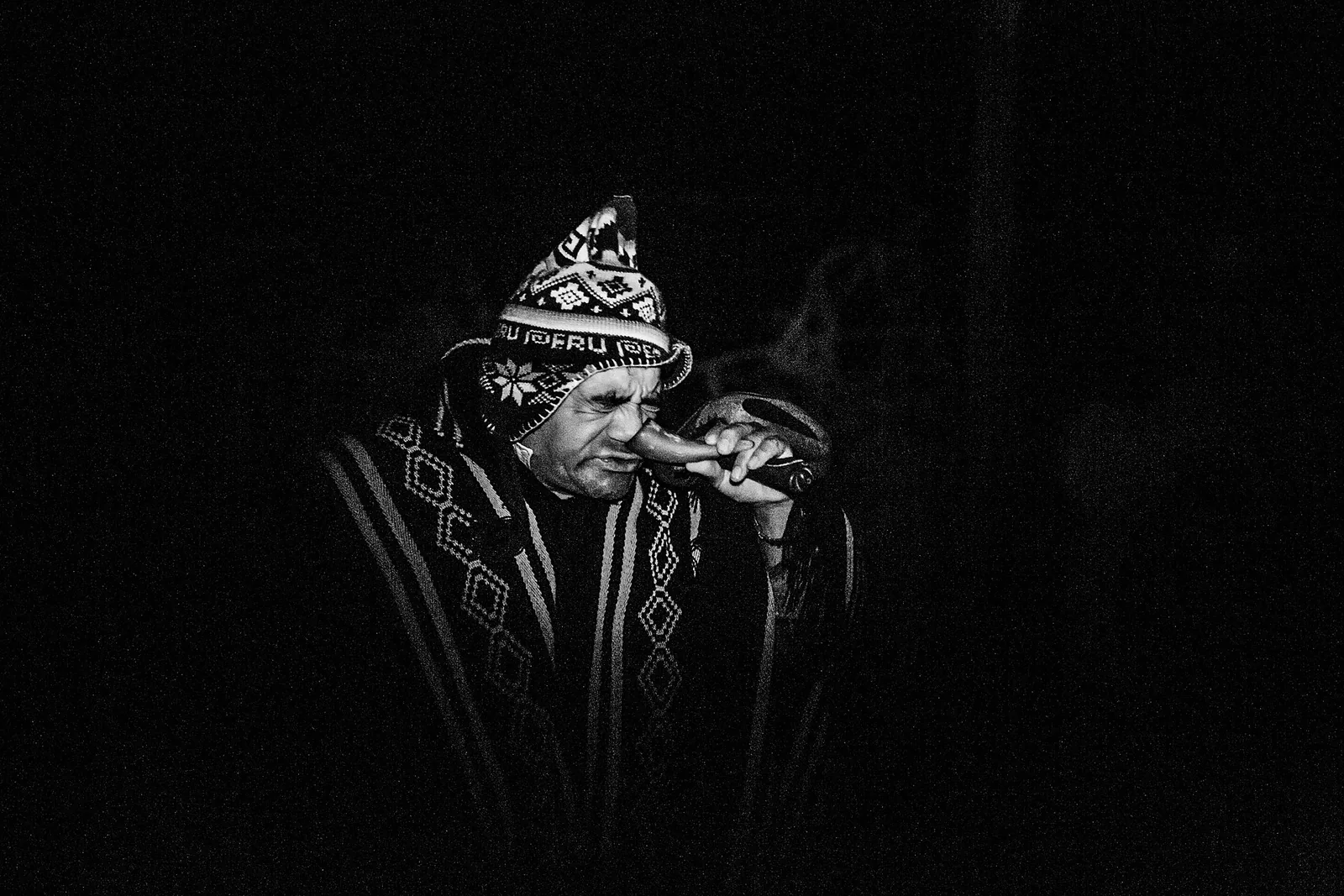
Across northern Peru, huachuma works inside a nocturnal theatre of staffs, stones, swords, shells, perfumes, tobacco, coca, song and water, arranged upon a mesa whose objects face one another like a material argument about illness, power and repair. The cactus opens vista—the trained capacity to see what ordinarily remains entangled or remote—and the mesa gives that perception direction. Dangerous mishas may intensify or derail it; tobacco clears and protects; coca reads and reciprocates; lagoons, ruins, saints, winds and ancestors enter as active parties. This dossier follows that whole apparatus: from Formative-period cactus imagery and Chavín’s newly confirmed multi-plant psychoactive world to the living curanderismo of Piura, Lambayeque and La Libertad, and onward into global retreat culture, mescaline research and questions of conservation, law and biocultural ownership. Where it claims continuity, it shows the evidence (Sharon, 1972; Glass-Coffin, 2010; Sharon, 2021; Rick et al., 2025).
The materials come first, and they are many. Huachuma is the visionary centre; mishas are specialist and sometimes rejected intensifiers; tobacco, coca, perfumes, waters and the mesa’s plant-filled seguros prepare, protect and interpret the work. Most are used side by side; few go into the drink.
Defining logic
A specialist-directed healing and divinatory system in which cactus-induced perception is governed by the spatial, sonic and moral technology of the mesa. Its plants may be swallowed, inhaled, smoked, chewed, applied, displayed or invoked; only some are admixtures.
Geographic centre
Northern Peru—especially Piura, Lambayeque, La Libertad, Cajamarca, Tumbes, Amazonas and Áncash—with related practices in Loja and other parts of Ecuador. “Andean huachuma” is used more broadly; the mesa norteña is the specifically northern tradition (Ministerio de Cultura del Perú, 2022; Sharon, 2021).
Ceremonial unit
The mesada: a night-long or extended sequence of invocation, tobacco, cactus, song/whistle, diagnosis, contest with pathogenic forces, cleansing and florecimiento. Sequence, plant selection and altar design vary by lineage and practitioner (Carod-Artal and Vázquez-Cabrera, 2006).
Interpretive caution
“Shamanism” serves for comparison; locally the authoritative figures are maestros/as, curanderos/as, yerbateros/as and allied specialists. “San Pedro cactus” may likewise cover several cultivated or wild Echinopsis/Trichocereus taxa, few of them botanically vouchered.
Role 01 · visionary centre / vista
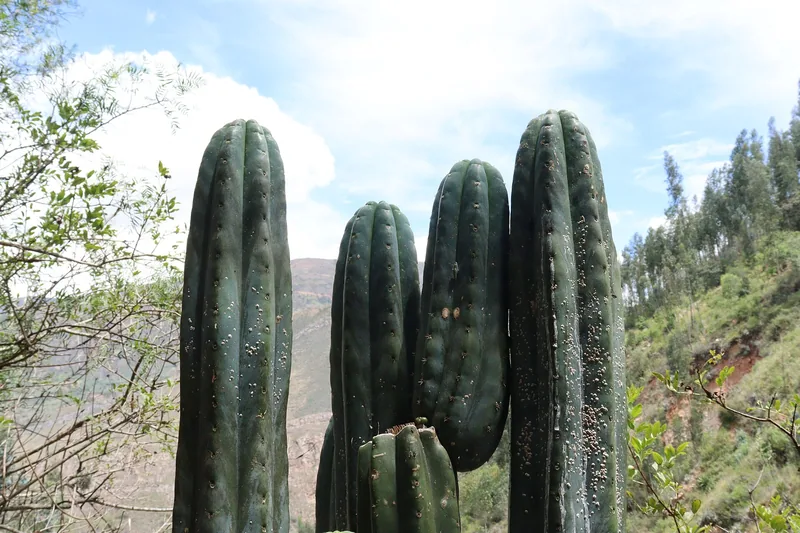
Huachuma / San Pedro
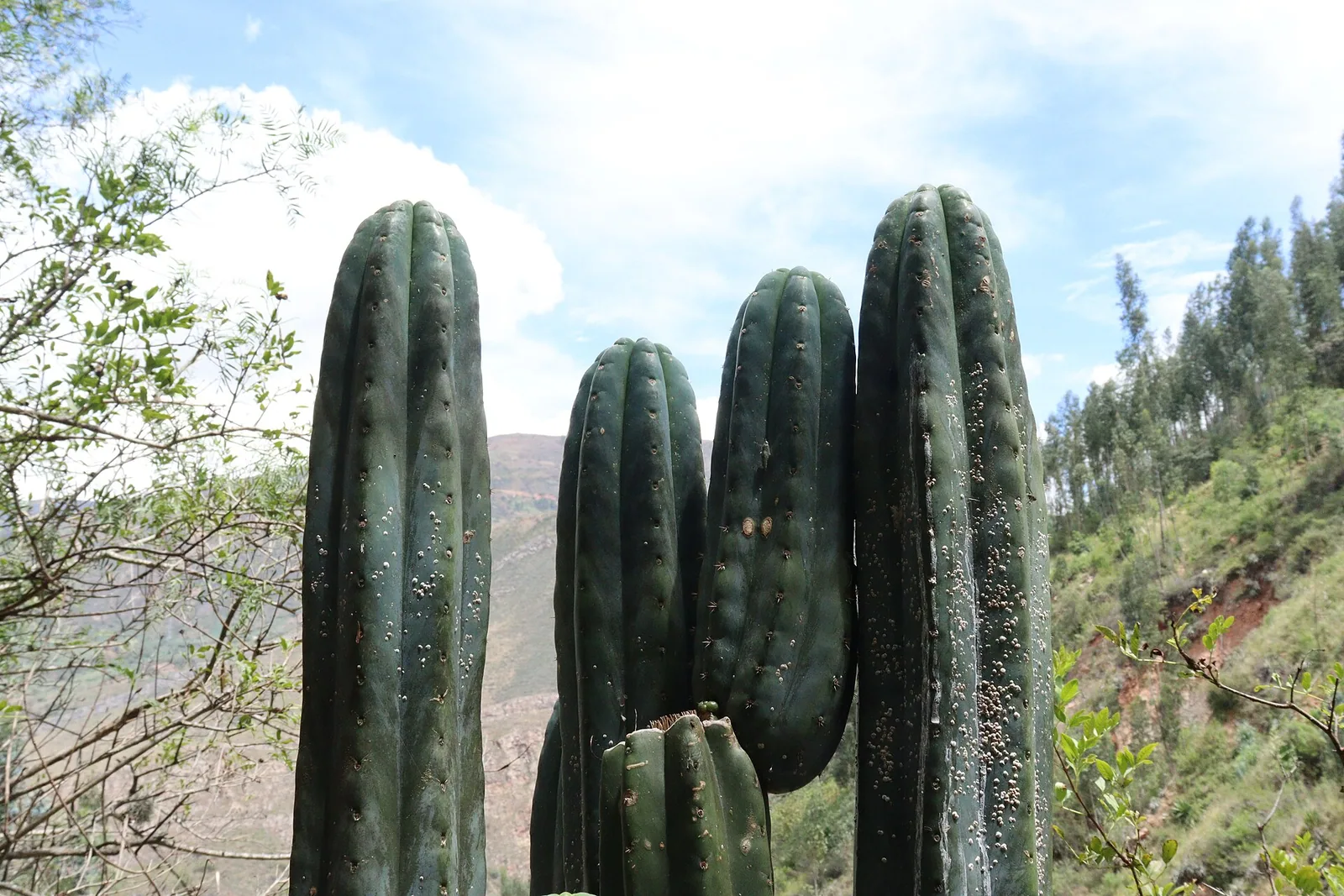
Echinopsis pachanoi and related columnar cacti
The accepted name used here is Echinopsis pachanoi (Britton & Rose) H.Friedrich & G.D.Rowley; Trichocereus pachanoi and T. macrogonus var. pachanoi remain common synonyms or alternative treatments (POWO, 2026a).
Mescaline is the principal entheogenic alkaloid. Its concentration varies widely among taxa, cultivars and individual tissues, whatever the vernacular name (Ogunbodede et al., 2010; Lin et al., 2023).
Ritually, huachuma is catalyst and guide: it imparts vista, allows causes of illness to be perceived and activates relations among healer, patient, plants, places, saints and artes (Sharon, 1972; Glass-Coffin, 2010).
Role 02 · specialist / perilous intensifier
Misha / Brugmansia
Brugmansia spp. · floripondio · toe · chamico
Misha is a variable ritual category. It may include cultivated Brugmansia forms and, in some records, Datura or other powerful plants (De Feo, 2004).
Scopolamine, hyoscyamine and atropine are antimuscarinic tropane alkaloids. Their delirium, amnesia and medical toxicity differ categorically from the lucid serotonergic psychedelic profile of mescaline (Petricevich et al., 2020).
Some practitioners use mishas as difficult-case adjuncts, divinatory medicines, initiatory plants or external remedies; others refuse to ingest them because of their adverse effects. They belong to particular specialists and particular cases (Sharon, 1972; De Feo, 2004).
Role 03 · diagnosis / protection / governance
Tobacco, coca & the mesa
sayri · mapacho · coca · artes · seguros · tarjos
Tobacco may be inhaled in a liquid singada, smoked, blown or placed on the altar; coca may be chewed, offered or read divinationally. Each has offices of its own in the rite (Sharon, 1972; Bussmann and Sharon, 2006).
The mesa is both altar and working cosmogram: staffs, swords, stones, shells, archaeological fragments, saint images, crosses, perfumes, waters and plant-filled seguros become differentiated artes with specific agencies (Joralemon, 1985; Sharon, 2021).
Song, whistle, rattle, breath, spraying and gesture direct the session. The material apparatus stabilises the healer’s attention and maps a morally charged field of protective and dangerous powers.
Botanical anchors
Ritual role
Accepted name / scope
Family / order
Range and morphology
Huachuma
Echinopsis pachanoi; related Echinopsis/Trichocereus taxa in local commerce
Cactaceae / Caryophyllales
Succulent shrub or small tree native from southern Ecuador to Peru. It forms branching, green to glaucous columns with usually 4–8 rounded ribs, small areoles and large white nocturnal flowers; cultivation extends well beyond its native range (POWO, 2026a).
Misha
Brugmansia arborea, B. aurea, hybrids and other locally named forms
Solanaceae / Solanales
Woody shrubs or small trees of tropical South America, often long cultivated and difficult to assign from vernacular reports. Pendulous trumpet flowers and large leaves make the genus distinctive; B. arborea ranges from Ecuador to northern Chile (POWO, 2026b).
Tobacco
Nicotiana rustica, N. tabacum and local cultivars
Solanaceae / Solanales
Annual or short-lived cultivated herbs. Kew treats N. rustica as native to Peru and N. tabacum as native to Bolivia; centuries of cultivation make ritual material biogeographically mobile (POWO, 2026c).
Coca
Erythroxylum coca var. coca; locally also E. novogranatense forms
Erythroxylaceae / Malpighiales
Evergreen shrubs with small alternate leaves and red drupes. E. coca var. coca is native to western South America, including Bolivia, Colombia, Ecuador and Peru (POWO, 2026d).
Associated compounds
The complex coordinates a classic serotonergic psychedelic, potentially lethal anticholinergic deliriants, nicotinic stimulation and coca alkaloids inside a cultural technology of sequence and restraint. Laboratory pharmacology explains the receptor actions. Specialists classify the same plants by other measures: as teachers, protectors, purges, perfumes or dangerous powers.
Source
Principal compounds
Pharmacology
Ethnobotanical significance
Huachuma cacti
Mescaline (3,4,5-trimethoxyphenethylamine); minor phenethylamines and tetrahydroisoquinolines variably reported.
Classic psychedelic whose subjective effects are mediated predominantly by 5-HT2A receptor agonism, with a broader receptor profile than that shorthand implies (Cassels and Sáez-Briones, 2018; Klaiber et al., 2024).
Mescaline concentration in analysed Echinopsis material ranged across roughly two orders of magnitude. Species names, rib counts, age and market labels are poor guides to chemistry (Ogunbodede et al., 2010).
Mishas / Brugmansia
Scopolamine, hyoscyamine, atropine and related tropane alkaloids.
Competitive antagonism at muscarinic acetylcholine receptors can produce confusion, true hallucination, amnesia, hyperthermia, tachycardia, urinary retention, seizures, coma and death (Petricevich et al., 2020).
The phenomenology is deliriant. Toxicity and chemical variation explain the ethnographic emphasis on specialist control, and why some healers refuse to combine it with huachuma (Sharon, 1972; De Feo, 2004).
Tobacco
Nicotine; nornicotine and other minor pyridine alkaloids.
Nicotinic acetylcholine-receptor agonism produces alerting and autonomic effects; high exposure can cause severe poisoning.
Liquid nasal tobacco is described as clearing and accelerating sight or thought. Its place in a mesa is simultaneously pharmacological, apotropaic and relational (Sharon, 1972).
Coca leaf
Cocaine plus cinnamoylcocaines, benzoylecgonine-related alkaloids and other constituents.
In ordinary traditional leaf use, mild stimulation and reduced fatigue predominate. Isolated cocaine and concentrated products differ from the leaf both pharmacologically and culturally.
Coca links divination, reciprocity, hospitality, labour and offering across the Andes. In huachuma settings it may orient diagnosis or relation with place without being a visionary driver.
The chemical identity problem
VARIATION
Uniform analysis of 14 Echinopsis taxa/cultivars found mescaline from 0.053% to 4.7% of dry tissue: “San Pedro” names a range of chemistries (Ogunbodede et al., 2010).
MAPPING
MALDI mass-spectrometry imaging has visualised the spatial distribution of mescaline in cactus tissue, while a 2025 UHPLC–MS/MS method improved rapid quantification across cacti. These tools are valuable for taxonomy, forensics and biosynthetic research, but can also intensify extractive selection for high-alkaloid plants (Lin et al., 2023; Gaur et al., 2025).
CATEGORY
Terms such as huachuma, San Pedro, cimora and misha may name a species, a cultivar, a preparation or a ritual class. Retrospective botanical certainty is strongest where voucher specimens and chemical analyses accompany ethnography.
Traditional preparation
There is no single timeless recipe. In the best-described north-coastal case, Eduardo Calderón Palomino’s household sliced cactus transversely and simmered it in water for much of the afternoon before a night ceremony. The resulting liquid was ordinarily taken without a visionary admixture. Additional plants were selected for particular diagnoses, while Calderón explicitly rejected the Brugmansia combinations used by some Chiclayo-area specialists because he considered them unnecessarily dangerous (Sharon, 1972).
Material operation
Traditional rationale
Interpretive caution
Selection and cutting
Rib number, provenance, age and highland origin may carry vernacular significance. Cut cactus is reduced to sections or slices before prolonged aqueous cooking.
Rib lore is culturally meaningful but a poor predictor of mescaline concentration. “San Pedro” may encompass several taxa and cultivars.
Decoction
Water and heat render the cactus into a shareable ceremonial drink. Preparation begins before participants gather and is part of the ritual day.
Published ethnographies document different quantities, durations and reductions. This dossier records them as history; it gives no recipe.
Case-specific adjuncts
Hornamos, purgative herbs or specialist mishas may be prepared separately or added for illnesses attributed to sorcery, obstruction or difficult spiritual agency.
Vernacular names are insecure botanical identifications. Tropane-bearing Brugmansia/Datura can cause fatal poisoning and appear only in some mesas (De Feo, 2004).
Liquid tobacco
A separately assembled nasal tabaco or singada may combine tobacco with small amounts of huachuma, citrus, perfumes, sweet ingredients and cane alcohol. It clears, accelerates and protects sight within the ceremony (Sharon, 1972).
This is a potent route of nicotine exposure and varies by practitioner. It belongs to the ritual’s governance as much as to its pharmacology.
Diet and aftermath
Restrictions around salt, fat, chilli and entangling foods are reported as ways of keeping the person and medicine ritually clear after treatment.
Dietary rules differ among lineages and should be analysed as embodied ritual discipline as well as possible physiological management.
02Culture
The Huachuma–Mesa Complex is a historically layered northern Andean institution, formed through Indigenous coastal and highland knowledge, colonial Catholicism, mestizo urban life, market herbalism, pilgrimage and individual healer lineages. No single people owns it, and it is more than a survival from Chavín. Its coherence lies in repeated relations among cactus, mesa, specialist, patient, sacred place and night-long therapeutic performance.
Peoples and territories
Trujillo · Moche · Chicama
Mestizo north-coast curanderismo
La Libertad’s coastal valleys generated some of the most detailed ethnographies. Eduardo Calderón Palomino combined fishing, artistic work at Chan Chan, Catholic devotion, family inheritance and apprenticeship among healers in Chiclayo, Motupe and Ferreñafe. Leoncio Carrión’s Chicama Valley practice shows the tradition still innovating locally, each maestro building his own mesa (Sharon, 1972; Sharon, 2021).
Chiclayo · Salas · Túcume
Lambayeque healer networks
Salas became famous in twentieth-century literature as a centre of north-coastal healers. Male and female practitioners worked with urban and rural clients, herbal markets, Catholic saints and archaeological landscapes. Research with Julia Calderón de Ávila and five curanderas studied by Glass-Coffin counters the recurrent reduction of the tradition to male “sorcerer-shamans” (Glass-Coffin, 1998; Sharon, 2021).
Huancabamba · Ayabaca · Las Huaringas
Highland pilgrims, collectors and maestros
The lagoon complex above Huancabamba is a source of cleansing water, difficult medicinal plants and ritual authority. Coastal healers may travel there, commission plant collection or maintain relation through waters, stones and plant-filled seguros. Pilgrimage, bathing and gathering join highland sacred geography to coastal curing economies (Sharon, 1972; De Feo, 2003).
Loja · Saraguro region
Related southern-Ecuadorian traditions
Cactus medicines, mountain relations and altar-based curing extend across the modern border into southern Ecuador. Local yachakkuna and other specialists work through their own Indigenous, Catholic and regional histories. They belong to the wider field, with forms distinct from the Peruvian mesa norteña (Sharon, 2021).
History and evidence
Evidence horizon
What it establishes
What remains unresolved
Early cactus remains
Possible columnar-cactus materials from early coastal and highland contexts demonstrate ancient handling and perhaps cultivation.
Species identification, mescaline content and ritual ingestion are unevenly demonstrated. A cactus fragment shows the plant was present; ceremony needs further evidence (Samorini, 2019).
Cupisnique and Chavín imagery
Four-lobed cacti occur with felines, serpents and stepped forms in Cupisnique ceramics; the Chavín cactus-bearer holds a ribbed column within an architecturally controlled procession of hybrid beings. The cactus was visually incorporated into a charged religious vocabulary (Torres, 2008; Sharon, 2019).
Images are silent on dose, preparation and who every participant was, and an unchanged line of transmission to a modern mesada lies beyond what they can show.
Moche and later north-coast art
Moche “achumera” vessels show female-presenting figures holding or handling cactus segments, complicating an exclusively male history of entheogenic authority (Scher, 2021).
The precise offices, preparations and narrative contexts represented remain debated; iconographic resemblance is indirect evidence.
Chavín residue evidence, 2025
Bone inhalers from restricted galleries directly yielded tobacco evidence and, in another case, DMT with Anadenanthera colubrina starch. Chavín ritual employed controlled psychoactive technologies in a multi-plant environment (Rick et al., 2025).
No mescaline was reported. Huachuma use at Chavín rests principally on visual and contextual evidence; direct chemical residue is lacking.
Colonial and modern transformation
Extirpation campaigns, Catholic reinterpretation, market medicine and changing class relations altered plant healing’s vocabularies, saints, objects, secrecy and public legitimacy, and it survived them (Glass-Coffin, 2010).
“Continuity” therefore means recurring relations and adaptive institutions—an untouched survival of a single pre-Hispanic religion is something else.
Twentieth–twenty-first-century ethnography
Work with multiple healers in Trujillo, Chiclayo, Lambayeque, Salas, Túcume, Chicama and the northern sierra documents shared ritual grammars alongside pronounced individual variation (Joralemon and Sharon, 1993; Sharon, 2021).
No single celebrated practitioner stands for the whole tradition, and published ethnography inevitably privileges the lineages to which researchers gained access.
Healers, apprenticeship and authority
Eduardo Calderón Palomino. Sharon’s “Galvaez” was later named as Calderón: a Spanish-speaking Catholic mestizo, fisherman, sculptor, ceramicist and Chan Chan restorer whose grandfathers had been highland curanderos. A mysterious illness, cure by a healer, four years of apprenticeship and further study across northern centres preceded his independent mesa. His vocation formed through family memory, illness, skilled labour, dreams, artistic practice and regional circulation (Sharon, 1972).
Maestras and gender. Glass-Coffin’s work with women healers shows different emphases in calling, bodily knowledge, family responsibility, patient participation and the negotiation of public authority. Women’s practice changes what counts as expertise and how the history of the complex is told (Glass-Coffin, 1998).
Lineage and invention. Apprentices learn plant identities, prayers, rhythms, tarjos, protections and the grammar of the mesa, but mature practitioners also compose new songs, acquire objects through dreams and travel, and reorganise their ritual fields. Tradition supplies a disciplined repertoire within which personal revelation becomes accountable practice (Sharon, 1972; Joralemon and Sharon, 1993).
Ritual practice — anatomy of a mesada
The sequence below synthesises one influential north-coastal pattern, especially Calderón’s sessions. It is a comparative scaffold: nights, ingredients, altar geometry, participant roles and the order of cleansing vary by maestro, locality and therapeutic problem (Sharon, 1972; Joralemon, 1984).
Preparation and arrival
The cactus is cooked during the day while the case is discussed and materials are selected. Patients may arrive with relatives or supporters, so the ceremony is a social gathering around illness from the start.
Opening the mesa
Cloth, staffs, swords, stones, shells, saint images, perfumes, waters and seguros are positioned. The maestro establishes protected space and places potentially dangerous and beneficent powers into an intelligible relation.
Invocation and purification
Prayers, rattling, whistles and tarjos address Christ, saints, hills, lagoons, winds, ancestors and plant powers. Perfumes and liquids cleanse the altar, medicine and participants. In Calderón’s pattern this ceremonial phase occupied the late evening.
Tobacco and ingestion
Liquid tobacco may be raised through the nostrils at intervals to clear and accelerate perception. Huachuma is then circulated in a hierarchically ordered sequence, beginning with the maestro and ending with assistants, followed by cleansing.
Activation and vista
As bodily and visual effects develop, songs, rattle, perfume, darkness and concentrated attention activate relations among the healer, the medicine and the artes. The mesa becomes operative, an organised field through which perception is tested.
Individual diagnosis
Participants approach the mesa in turn. A staff or object may be selected; the maestro sings its tarjo, traces biography and conflict, and identifies daño, enredo, bad fortune or another source of disorder. Others may confirm, contest or share elements of the perception.
Combat, extraction and cleansing
Danger is dramatised and acted upon through sword movements, breath, spraying, rubbing, sweeping and exorcistic gesture. The patient performs as well as receives: vomiting, trembling, dancing, speech and posture can disclose the disorder and participate in its release (Joralemon, 1986).
Closure and flourishing
After each patient has been treated, final purification closes the dangerous work. Dawn-oriented objects, sweetness, flowers, perfume and blessing shift the operation from removing harm toward florecimiento: restored luck, vitality, social openness and the capacity to proceed.
Mythology and cosmology
Animate geography. Hills, lagoons, springs, ruins, winds and distant shrines are agents, sources and destinations of visionary travel. At Las Huaringas the waters cleanse and authorise, the slopes supply plants, and the place itself can be condensed into stones, bottles and seguros carried back to the coast (Sharon, 1972; Glass-Coffin, 2010).
The cactus as axis. Saint Peter’s keys provide a Catholic-Andean language of access, while the cactus tip and central crucifix can form an axis around which roads, directions and planes are organised. Calderón invoked four roads and four winds around a quartered mesa; Sharon compares this geometry with quadripartite forms in Cupisnique, Chavín and Moche art, and notes that mesas differ in plan (Sharon, 2021).
Fields of time and power. In a widespread northern interpretation, the left contains “hot,” wild, ancestral or dangerous forces associated with the past and the undoing of harm; the right contains “cold,” cultivated, Christian, fragrant or fortunate powers oriented toward dawn and the future; the centre balances them in the present of divination. The opposition is operational: healing requires knowing how to mediate what can also injure (Joralemon, 1985; Sharon, 2021).
Plant personhood and reciprocal activation. Magical plants are spoken of as living powers capable of advising, warning and indicating remedies. Their agency works through the specialist: plant, earth, water, inherited forms and the trained “intellectual power” of the curandero activate one another. The ontology is relational (Sharon, 1972).
Shamanism and healing
“Shamanism” names genuine features—visionary travel, spirit assistance, transformation, combat and mediation—but local titles such as maestro/a, curandero/a, yerbatero/a and rastreador/a are more precise. Huachuma gives vista, but competence lies in transforming perception into diagnosis, protection and a publicly intelligible therapeutic act.
Illness may be bodily, emotional, interpersonal, economic and spiritual at once. Daño names intentionally inflicted harm or sorcery; enredo can involve binding or love magic; susto, envy, bad air and loss of suerte articulate fractures between person, family, work, place and fortune. These categories organise suffering in a moral and relational world shared by healer, patient and community, with a reach biomedical disease names do not have (Dobkin de Rios, 1969; Joralemon and Sharon, 1993).
Joralemon’s analyses show that therapeutic force is distributed across pharmacology, sensory orchestration, social attention and patient performance. Music, odour, darkness, harsh nasal tobacco, tactile cleansing, public biography and the expectation of action make the participant’s body a site where diagnosis becomes perceptible. The patient takes a substance and is placed inside a culturally legible drama of danger and restitution (Joralemon, 1984; 1986).
Art and material culture
Formative visionary image. On Cupisnique ceramics, four-part cactus forms enter compositions with felines, serpents, volutes and transformed beings. At Chavín, a cactus-bearing hybrid figure belongs to a procession in the sunken circular plaza, where architecture, restricted movement, stone image, sound and psychoactive technologies formed an environment of controlled revelation. The relevant art object there is the temple as a sensory machine, with the carved cactus inside it (Torres, 2008; Rick et al., 2025).
Moche achumeras. Female-presenting figures holding cactus segments recur in Moche ceramics. Scher argues that their ambiguous status and gender coding opens questions about who handled huachuma and how ritual plants marked social position. They resist the easy projection of a timeless male shaman onto every ancient image (Scher, 2021).
The mesa as composition. A living mesa is an assemblage artwork whose elements have provenance, biography and differentiated force. Archaeological fragments may carry ancestral danger; swords retain the violent technology of conquest while becoming instruments of defence; shells bring sea and water; crystals make vision material; saint images and crosses establish celestial alliances; perfumes, flowers and manufactured goods orient the work toward cultivation and future flourishing. Arrangement is simultaneously aesthetic, mnemonic, cosmological and tactical (Joralemon, 1985; Sharon, 2021).
Ephemeral and sonic arts. The complex also produces arts that exist only in performance: individually elaborated tarjos, whistled melodic lines, rattle rhythms, breath, liquid sprays, processional movement and the choreography of patients before the altar. These forms take part in ordering the visionary field as it happens (Joralemon, 1984).
03Visionary phenomenology
The phenomenological unit is cactus, body, darkness, song, tobacco, perfume, altar, specialist attention and a culturally available language of illness and power. Laboratory mescaline helps establish duration and receptor action; the trained vista and collective interpretation of a mesada lie outside it. Equally, ethnographic meaning sits alongside vomiting, cardiovascular activation and the radically different delirium produced by tropane alkaloids.
Accounts
Maestro · trained vista
Eduardo Calderón described the medicine as an initial barely noticed dizziness followed by bodily quieting, perceptual clarification and the activation of all the senses. Mature vision meant projecting attention across distance, entering hills and shrines, distinguishing hostile forces and returning with knowledge applicable to a patient (Sharon, 1972).
Anthropologist-apprentice · partial perception
Douglas Sharon recorded warmth, relaxation, a red-and-yellow remolino, peripheral flashes, pale outlines around patients, a vibrating staff and delicate multicoloured designs after the ceremony. He remained lucid and repeatedly stressed that he did not acquire the maestro’s diagnostic sight during three sessions (Sharon, 1972).
Patients · collective interpretation
During one episode, several patients appeared to share a frightening interpretation of a person being pulled backward by an attacking being, while Sharon saw bodily movement without the same entity. The case shows pharmacological alteration becoming synchronised through attention, expectation, ritual authority and a shared ontology of attack (Sharon, 1972).
And then a great vision, a clarifying of all the faculties.Eduardo Calderón Palomino, translated and recorded by Douglas Sharon (1972, p. 131).
I felt myself enter the hill which opened all its passages, all its labyrinths.Eduardo Calderón Palomino on visionary travel during song and whistling (Sharon, 1972, p. 132).
Visionary descriptions
01 · Somatic opening
Slow onset; warmth, nausea, heaviness or energy; perspiration, tremor and sometimes vomiting. Purging can be interpreted simultaneously as bodily effect and the visible discharge of harmful influence.
02 · Luminous field
Colours intensify; edges acquire halos; surfaces breathe or move; flashes arrive from the periphery; red-yellow vortices and soft geometric patterning may overlay ordinary sight. Through the darkness, participants stay aware of the ritual field around them.
03 · Animate objects
Staffs may seem to vibrate, stones become presences, shadows acquire intention and the arrangement of the mesa appears dynamically charged. The object selected for a patient becomes a focus around which biography, sensation and inference converge.
04 · Relational vision
Attention extends toward absent persons, earlier events, distant places or imagined futures. Hills open, lagoons and shrines become accessible, and plants or saints communicate. Within the tradition these are possible sources of diagnosis and instruction.
05 · Attack and contest
Fear, muscular tension and ambiguous movement may be organised as sorcerous attack, predatory beings, abduction or foreign objects in the body. The maestro answers perception with action—song, sword, prayer, cleansing—preventing intensity from remaining an uninterpreted private crisis.
06 · Clarification and restitution
After danger is named and treated, reports emphasise tranquillity, perceptual clarity, emotional release, renewed relation and restored fortune. The endpoint is less “ego dissolution” than an altered capacity to proceed within family, work and place.
Temporal profile and pharmacological contrast
Element
Duration and intensity
Relation to ceremonial phenomenology
Huachuma / mescaline
Slow onset and a long plateau. Controlled studies report mean effects around 11 hours in direct comparison, with dose-dependent averages spanning approximately 6.4–14 hours (Ley et al., 2023; Klaiber et al., 2024).
Experimental subjects report classic psychedelic alterations, but ceremonial research additionally found strong spiritual experience, moderate ego dissolution and relatively low disembodiment or impaired control. The night-long duration permits repeated social interpretation and action (Bohn et al., 2023).
Misha / tropane delirium
Potentially prolonged confusion, true hallucination and amnesia with dry mouth, blurred vision, overheating, tachycardia, urinary retention, agitation, seizures, coma or death.
Delirium is a different state from huachuma vision. Failure to distinguish event from hallucination can destroy the lucid, relational conditions on which diagnostic vista depends (Petricevich et al., 2020).
Tobacco, coca and sensory form
Tobacco effects are rapid and may recur; coca is subtler and longer; song, breath, touch, perfume and rattle organise the whole session.
These elements sharpen, interrupt, protect and publicly anchor perception. Joralemon argues that sensory stimulation and symbolic message operate together, so the ritual is more than the sum of each plant’s pharmacology (Joralemon, 1984).
04Contemporary transformations
Contemporary expressions and transformations
The complex now exists in several overlapping presents. Northern Peruvian maestros and maestras continue to receive local clients for illness, sorcery, family conflict, blocked livelihood and protection; sacred-lagoon pilgrimage and medicinal markets remain active; urban practitioners adapt mesas to changing houses, occupations and media; and international retreat culture increasingly extracts huachuma from the dense diagnostic institution that made it intelligible. These fields coexist, unequally, exchanging plants, aesthetics, authority and money (Bussmann and Sharon, 2013).
Outside Peru, ceremonies may borrow the cactus and the language of the four directions while omitting liquid tobacco, sorcery diagnosis, Catholic invocation, individual altar objects and the maestro’s public divinatory work. Such events can become genuine new ritual formations, and are best named as contemporary huachuma practices. The anthropological question is how authority is being made now: through apprenticeship, Indigenous relation, therapy credentials, charisma, online reputation or ownership of a retreat venue.
Cultural and biological threat / conservation
Echinopsis pachanoi is listed as Least Concern in the IUCN’s 2017 amended assessment and is widely cultivated, propagated and traded ornamentally (Ostolaza, Cáceres and Roque, 2017). The category is global; local populations, cultivars and knowledge systems can still be at risk. Wild collection, habitat conversion, taxonomic confusion and selective demand for “potent” clones can create local pressure that a species-level assessment misses. Cultivation is generally more defensible than wild harvest, and sustainability also requires transparent provenance, legal trade and the consent and benefit of traditional knowledge holders.
The comparison with peyote is ethically important but imperfect. Survey respondents reported San Pedro as their most common mescaline-cactus source and often used cultivated material; this can reduce pressure on slow-growing peyote, yet it may also transfer commodification to Andean cacti and traditions (Engel et al., 2023).
Keeping cactus clones alive is only part of cultural conservation. Threats include the ageing or economic marginalisation of practitioners, loss of access to sacred waters and collecting grounds, sensational media, unsafe commercial imitation, disappearance of vernacular plant distinctions and the conversion of lineage knowledge into decontextualised “facilitation techniques.” Peru’s heritage recognition creates a safeguarding instrument; meaningful protection requires practitioner communities to determine what may be documented, taught, commercialised or withheld.
Local and global economies
Economy
Actors and goods
Benefit
Risk
Northern medicinal markets
Plant vendors, collectors, healers, patients; cacti, mishas, seguros, perfumes, waters and “magical” herbs.
Livelihoods, affordable care, conservation of vernacular taxonomy and continued transmission of practice.
Unvouchered species, contaminated material, overcollection, secrecy under legal uncertainty and detachment of plants from competent practitioners (Bussmann and Sharon, 2006; 2013).
Pilgrimage and ritual services
Maestros/as, assistants, transport, lodging and regional sacred sites such as Las Huaringas.
Income and cultural recognition for communities of practice.
Commercial pressure, performance for tourists, gatekeeping, unequal payment and ecological strain at sacred sites.
Global ornamental trade
Nurseries, collectors, online clone markets and botanical gardens.
Ex-situ propagation and reduced need for wild extraction.
Mislabelling, illegal cross-border plant movement, potency-driven breeding and laundering of wild plants as nursery stock.
Retreat / wellness economy
International facilitators, centres, tourists, therapists and media.
New livelihoods, intercultural visibility and demand for harm-reduction standards.
False lineage claims, unsafe admixtures, sexual or financial exploitation, medical screening failures and concentration of value outside source communities.
Cultural heritage
In November 2022, Peru’s Ministry of Culture declared “the knowledge, know-how and traditional uses of the San Pedro cactus in the practices of curanderismo in northern Peru” National Cultural Heritage. The resolution recognises a systemic healing universe with pre-Hispanic antecedents and Christian elements, and calls for periodic safeguarding reports with practitioner communities. It protects an intangible tradition; drug, plant-health, export, medical and criminal law still apply (Ministerio de Cultura del Perú, 2022).
Legality — selected jurisdictions, checked July 2026
Jurisdiction
Mescaline
Cactus / traditional context
International
Mescaline is in Schedule I of the 1971 Convention on Psychotropic Substances.
The Convention schedules the chemical, not Echinopsis pachanoi as a botanical species. National implementations differ; plant material or preparations may still be controlled (UNODC, 1971).
Peru
Purified mescaline remains subject to controlled-substance law.
Traditional northern knowledge and uses of San Pedro have national heritage status. Export, commercial retreats, endangered-species rules and non-traditional possession fall under other law (Ministerio de Cultura del Perú, 2022).
United States
Mescaline is federally Schedule I under 21 CFR §1308.11.
San Pedro is widely sold as an ornamental, but extraction or possession as a mescaline preparation can trigger federal law. The federal peyote religious exemption is specific to peyote (eCFR, 2026).
United Kingdom
Mescaline is a Class A drug and Schedule 1 controlled drug.
A living ornamental cactus is not named in the Misuse of Drugs Act, but producing or possessing a mescaline-containing preparation is legally high risk; supply may engage additional legislation (UK Government, 2025).
This is a research summary, not legal advice. Laws can turn on intent, preparation, concentration, import status and local interpretation.
Patents and scientific research
A patent document that names a wild cactus or centuries-old traditional knowledge confers no ownership of either. Contemporary applications target purified mescaline, salts, analogues, dosing regimes and psychotherapy methods. A US application filed by Universitätsspital Basel for mescaline-assisted psychotherapy was published as US20230000799A1 and is listed as abandoned; it illustrates how clinical data and ritual prior art can be rhetorically separated in commercial claims (Liechti, 2023). Patent status is territorial and claim-specific, and a published application is a step before any grant.
The ethical problem extends beyond formal validity. Oral, secret or Indigenous-language knowledge may be invisible to patent examiners even when it is genuine prior art. Good governance therefore requires Indigenous and local participation, accurate provenance, access-and-benefit sharing, and a refusal to recast longstanding diagnosis, preparation or ceremonial support as newly invented because it has entered a clinical vocabulary.
Current research fronts
2023
A direct randomised comparison found broadly similar acute altered-state profiles for mescaline, LSD and psilocybin at psychoactive-equivalent intensities, but mescaline lasted longest (mean 11.1 hours) and produced slightly more subacute adverse effects (Ley et al., 2023).
2024
A placebo-controlled dose-response study found dose-dependent subjective and autonomic effects; ketanserin attenuated most acute effects, supporting predominant 5-HT2A mediation. The study was in screened healthy volunteers using pharmaceutical mescaline, not cactus ceremony (Klaiber et al., 2024).
2025
Human pharmacokinetic work quantified dose-proportional exposure, effect relationships and urinary recovery. Archaeology at Chavín independently delivered the first direct chemical/microbotanical evidence for tobacco and Anadenanthera-related psychoactives in restricted ritual chambers (Mueller et al., 2025; Rick et al., 2025).
2026
A mega-analysis of 11 human resting-state fMRI datasets, including mescaline, reported a shared classic-psychedelic signature of increased communication across normally segregated cortical hierarchies and effects in subcortical circuits (Girn et al., 2026). A first awake-rat mescaline fMRI study separately reported cerebellar BOLD suppression alongside increased global connectivity; translation to human huachuma experience remains speculative (Cavallaro et al., 2026).
Research gap. There is still no robust clinical trial of traditional huachuma for a diagnosed disorder, no controlled comparison of cactus and synthetic mescaline, and little community-led research on how global retreat economies affect northern Peruvian practitioners and cactus populations. Laboratory mescaline research is evidence about mescaline; whether a culturally embedded mesa treatment is clinically effective is a separate question.
Safety and ethical cautions
HIGH RISK
Brugmansia and Datura can cause fatal anticholinergic poisoning. “Traditional,” “plant medicine” and “misha” are not assurances of identity or safety. Confusion, overheating, urinary retention, seizures, coma or inability to recognise reality require urgent medical care.
MEDICAL
Mescaline can increase blood pressure, heart rate and temperature and commonly causes nausea. Long duration increases exposure to dehydration, accidents and delayed psychiatric distress. Risk is higher with cardiovascular disease, pregnancy, seizure vulnerability, bipolar/psychotic disorders and interacting drugs; contemporary screening evidence remains limited (Klaiber et al., 2024).
CONTEXT
Ritual authority does not remove the need for consent, safeguarding, emergency plans and accountability. Seek specific information about plant identity, Brugmansia/Datura, tobacco administration, facilitator training, touch and sexual-boundary policies, medical referral and who materially benefits.
CULTURAL
Do not claim Chavín descent, Indigenous title or lineage without accountable transmission. Pay practitioners fairly, name sources, avoid wild-harvest demand, and distinguish personal spiritual experience from archaeological or clinical fact.
05Linked species
Complex pages call species records into a cultural assemblage, leaving the full botanical dossiers to the plant pages. A linked plant may be drunk, inhaled, chewed, displayed, preserved in a seguro or invoked; the link records its function.
Misha / floripondio. Tropane-bearing plants whose ritual category, route and species vary; sometimes combined, sometimes applied externally and sometimes explicitly refused.
Chavín’s 2025 residue evidence establishes an Anadenanthera–tobacco snuff technology inside the broader ceremonial environment in which cactus imagery also appears. The two meet in one place; a single mixed recipe is unproven. ARCHAEOLOGICAL CONVERGENCE
Ayahuasca
Both are specialist-led South American healing fields with song, diagnosis and relational plant ontologies. Their principal preparations, temporal profiles and historical geographies differ; calling huachuma “Andean ayahuasca” obscures both. RITUAL ANALOGY / CHEMICAL CONTRAST
Peyote traditions
Mescaline provides a chemical bridge, but peyote belongs to distinct North American pilgrimage, church and sovereignty complexes. Substitution may reduce peyote pressure while transferring commodification to Andean plants and names. SHARED ALKALOID / DISTINCT TRADITIONS
Coca–llipta
Coca’s divinatory, reciprocal and labour-sustaining roles reach well beyond its occasional place in huachuma ceremony. Within the mesa it acts as offering, diagnostic medium and social substance; the visionary catalyst is the cactus. RITUAL INFRASTRUCTURE
06Bibliography
42 sources in 6 threads · 39 with a working locator · Harvard (Cite Them Right) · status and kind are recorded per source, not assumed
How to read the labels on each source
Source type
What kind of work it is: journal article, book, legislation, patent application, database record and so on. A word after the dot (ethnography, protologue, primary source) keeps the genre the entry was first filed under. “Unclassified” means the citation does not say enough to tell.
Peer review
Recorded for each work separately, and only where it has been confirmed for that work. It is never inferred from a DOI, a publisher or a journal, since journals also publish editorials, letters and commentaries. Where it has not been confirmed, the entry records it as not established. It does not apply to legislation, court decisions, treaties, patents, datasets, database and collection records, historical texts, films, talks, press releases or web pages.
Check
What was checked when the entry was added. DOI checked: the DOI’s registry record (Crossref) matched the citation’s title, first author and year. Verified: the record itself was opened and matched the citation: a library catalogue record for a book, or the page itself for a database entry, law, patent or archive document. “Verified (abstract)” and “(summary)” mean only the abstract or a summary was read. Located: a record was found but not fully matched. Bibliographic record and Stable record (in essays): a catalogue or stable web record exists; what was checked against it is not recorded. Unverified: no check is recorded. No locator found: a search found no record. Secondary: read through another source.
What the labels do not say
None of them means the source supports a particular sentence. Where a sentence is graded, its evidence note names its sources and whether each supports it, disputes it or gives context. Dates and reviewers of checks are not recorded for each entry; the version note at the foot of a graded page dates its last review.
Botany & conservation
Plants of the World Online (POWO) (2026a) ‘Echinopsis pachanoi (Britton & Rose) H.Friedrich & G.D.Rowley’. Royal Botanic Gardens, Kew. Available at: powo.science.kew.org (Accessed: 29 July 2026).
UnverifiedDatabase recordPeer review not applicableOpen record ↗
Plants of the World Online (POWO) (2026b) ‘Brugmansia arborea (L.) Sweet’. Royal Botanic Gardens, Kew. Available at: powo.science.kew.org (Accessed: 29 July 2026).
UnverifiedDatabase recordPeer review not applicableOpen record ↗
Plants of the World Online (POWO) (2026c) ‘Nicotiana rustica L.’ Royal Botanic Gardens, Kew. Available at: powo.science.kew.org (Accessed: 29 July 2026).
UnverifiedDatabase recordPeer review not applicableOpen record ↗
Plants of the World Online (POWO) (2026d) ‘Erythroxylum coca var. coca’. Royal Botanic Gardens, Kew. Available at: powo.science.kew.org (Accessed: 29 July 2026).
UnverifiedDatabase recordPeer review not applicableOpen record ↗
DOI checkedDatabase recordPeer review not applicableOpen record ↗cited 1× in this record
Engel, L., Barratt, M., Ferris, J., Puljevic, C. and Winstock, A. (2023) ‘Mescaline, Peyote and San Pedro: Is sustainability important for cacti consumers?’, Journal of Psychedelic Studies, 7(2), pp. 135–142. Available at: https://doi.org/10.1556/2054.2023.00252.
DOI checkedJournal articlePeer review not establishedOpen record ↗cited 1× in this record
Ethnography & mesa
Sharon, D. (1972) ‘The San Pedro cactus in Peruvian folk healing’, in Furst, P.T. (ed.) Flesh of the Gods: The Ritual Use of Hallucinogens. New York: Praeger, pp. 114–135. Available at: samorini.it.
UnverifiedBook chapterPeer review not establishedOpen record ↗cited 17× in this record
Dobkin de Rios, M. (1969) ‘Folk curing with a psychedelic cactus in the north coast of Peru’, International Journal of Social Psychiatry, 15(1), pp. 23–32. Available at: https://doi.org/10.1177/002076406901500102.
DOI checkedJournal articlePeer review not establishedOpen record ↗
Joralemon, D. (1984) ‘The role of hallucinogenic drugs and sensory stimuli in Peruvian ritual healing’, Culture, Medicine and Psychiatry, 8(4), pp. 399–430. Available at: https://doi.org/10.1007/BF00114665.
DOI checkedJournal articlePeer review not establishedOpen record ↗cited 4× in this record
Joralemon, D. (1985) ‘Altar symbolism in Peruvian ritual healing’, Journal of Latin American Lore, 11(1), pp. 3–29. Available at: Library of Congress record.
UnverifiedJournal articlePeer review not establishedOpen record ↗cited 3× in this record
DOI checkedJournal articlePeer review not establishedOpen record ↗cited 1× in this record
Joralemon, D. and Sharon, D. (1993) Sorcery and Shamanism: Curanderos and Clients in Northern Peru. Salt Lake City: University of Utah Press.
UnverifiedBookPeer review not establishedcited 3× in this record
De Feo, V. (2003) ‘Ethnomedical field study in northern Peruvian Andes with particular reference to divination practices’, Journal of Ethnopharmacology, 85(2–3), pp. 243–256. Available at: https://doi.org/10.1016/S0378-8741(03)00017-5.
DOI checkedJournal articlePeer review not establishedOpen record ↗
DOI checkedJournal articlePeer review not establishedOpen record ↗
Bussmann, R.W. and Sharon, D. (2006) ‘Traditional medicinal plant use in Northern Peru: tracking two thousand years of healing culture’, Journal of Ethnobiology and Ethnomedicine, 2, 47. Available at: https://doi.org/10.1186/1746-4269-2-47.
DOI checkedJournal articlePeer review not establishedOpen record ↗cited 2× in this record
Glass-Coffin, B. (1998) The Gift of Life: Female Spirituality and Healing in Northern Peru. Albuquerque: University of New Mexico Press.
UnverifiedBookPeer review not establishedcited 2× in this record
Glass-Coffin, B. (2010) ‘Shamanism and San Pedro through time: some notes on the archaeology, history, and continued use of an entheogen in northern Peru’, Anthropology of Consciousness, 21(1), pp. 58–82. Available at: https://doi.org/10.1111/j.1556-3537.2010.01021.x.
DOI checkedJournal articlePeer review not establishedOpen record ↗cited 3× in this record
Sharon, D. (2021) ‘Andean mesas and cosmologies’, Ethnobotany Research and Applications, 21, pp. 1–41. Available at: https://doi.org/10.32859/era.21.10.1-41.
DOI checkedJournal articlePeer review not establishedOpen record ↗cited 9× in this record
Bussmann, R.W. and Sharon, D. (2013) ‘The globalization of traditional medicine in Northern Peru: from shamanism to molecules’, Evidence-Based Complementary and Alternative Medicine, 2013, 291903. Available at: https://doi.org/10.1155/2013/291903.
DOI checkedJournal articlePeer review not establishedOpen record ↗cited 1× in this record
Archaeology & history
Carod-Artal, F.J. and Vázquez-Cabrera, C.B. (2006) ‘Mescalina y ritual del cactus de San Pedro: evidencias arqueológicas y etnográficas en el norte de Perú’, Revista de Neurología, 42(8), pp. 489–498. Available at: https://doi.org/10.33588/rn.4208.2006040.
DOI checkedJournal articlePeer review not establishedOpen record ↗cited 1× in this record
Torres, C.M. (2008) ‘Chavín’s psychoactive pharmacopeia: the iconographic evidence’, in Conklin, W.J. and Quilter, J. (eds.) Chavín: Art, Architecture, and Culture. Los Angeles: Cotsen Institute of Archaeology, pp. 237–260.
UnverifiedBook chapterPeer review not establishedcited 2× in this record
DOI checkedJournal articlePeer review not establishedOpen record ↗cited 1× in this record
Scher, S. (2021) ‘The Achumera: gender, status, and the San Pedro cactus in Moche ceramic motifs and iconography’, in Staller, J.E. (ed.) Andean Foodways: Pre-Columbian, Colonial, and Contemporary Food and Culture. Cham: Springer, pp. 237–256. Available at: https://doi.org/10.1007/978-3-030-51629-1_9.
DOI checkedBook chapterPeer review not establishedOpen record ↗cited 2× in this record
Samorini, G. (2019) ‘The oldest archaeological data evidencing the relationship of Homo sapiens with psychoactive plants: a worldwide overview’, Journal of Psychedelic Studies, 3(2), pp. 63–80. Available at: https://doi.org/10.1556/2054.2019.008.
DOI checkedJournal articlePeer review not establishedOpen record ↗cited 1× in this record
Rick, J.W. et al. (2025) ‘Pre-Hispanic ritual use of psychoactive plants at Chavín de Huántar, Peru’, Proceedings of the National Academy of Sciences, 122(19), e2425125122. Available at: https://doi.org/10.1073/pnas.2425125122.
DOI checkedJournal articlePeer review not establishedOpen record ↗cited 3× in this record
Nesbitt, J. et al. (2025) ‘Psychoactive plants and secret rituals in ancient Peru’, Proceedings of the National Academy of Sciences, 122(24), e2509867122. Available at: https://doi.org/10.1073/pnas.2509867122.
DOI checkedJournal articlePeer review not establishedOpen record ↗
Chemistry & toxicology
Ogunbodede, O., McCombs, D., Trout, K., Daley, P. and Terry, M. (2010) ‘New mescaline concentrations from 14 taxa/cultivars of Echinopsis spp. (Cactaceae) (“San Pedro”) and their relevance to shamanic practice’, Journal of Ethnopharmacology, 131(2), pp. 356–362. Available at: https://doi.org/10.1016/j.jep.2010.07.021.
DOI checkedJournal articlePeer review not establishedOpen record ↗cited 3× in this record
Cassels, B.K. and Sáez-Briones, P. (2018) ‘Dark classics in chemical neuroscience: mescaline’, ACS Chemical Neuroscience, 9(10), pp. 2448–2458. Available at: https://doi.org/10.1021/acschemneuro.8b00215.
DOI checkedJournal articlePeer review not establishedOpen record ↗cited 1× in this record
Petricevich, V.L., Salinas-Sánchez, D.O., Avilés-Montes, D., Sotelo-Leyva, C. and Abarca-Vargas, R. (2020) ‘Chemical compounds, pharmacological and toxicological activity of Brugmansia suaveolens: a review’, Plants, 9(9), 1161. Available at: https://doi.org/10.3390/plants9091161.
DOI checkedJournal articlePeer review not establishedOpen record ↗cited 3× in this record
Lin, J., Yang, S., Ji, J., Xiang, P. and Wu, L. (2023) ‘Natural or artificial: an example of topographic spatial distribution analysis of mescaline in cactus plants by MALDI-MSI’, Frontiers in Plant Science, 14, 1066595. Available at: https://doi.org/10.3389/fpls.2023.1066595.
DOI checkedJournal articlePeer review not establishedOpen record ↗cited 2× in this record
Gaur, P. et al. (2025) ‘A UHPLC-(ESI)MS/MS method for the determination of the psychedelic secondary metabolite mescaline in San Pedro (Trichocereus spp.) and its applicability for screening mescaline in other cacti varieties’, Forensic Chemistry, 44, 100659. Available at: https://doi.org/10.1016/j.forc.2025.100659.
DOI checkedJournal articlePeer review not establishedOpen record ↗cited 1× in this record
Phenomenology & neuroscience
Bohn, A., Kiggen, M.H.H., Uthaug, M.V., van Oorsouw, K.I.M., Ramaekers, J.G. and van Schie, H.T. (2023) ‘Altered states of consciousness during ceremonial San Pedro use’, The International Journal for the Psychology of Religion, 33(4), pp. 309–331. Available at: https://doi.org/10.1080/10508619.2022.2139502.
DOI checkedJournal articlePeer review not establishedOpen record ↗cited 1× in this record
Ley, L. et al. (2023) ‘Comparative acute effects of mescaline, lysergic acid diethylamide, and psilocybin in a randomized, double-blind, placebo-controlled cross-over study in healthy participants’, Neuropsychopharmacology, 48(11), pp. 1659–1667. Available at: https://doi.org/10.1038/s41386-023-01607-2.
DOI checkedJournal articlePeer review not establishedOpen record ↗cited 2× in this record
Klaiber, A. et al. (2024) ‘Acute dose-dependent effects of mescaline in a double-blind placebo-controlled study in healthy subjects’, Translational Psychiatry, 14, 395. Available at: https://doi.org/10.1038/s41398-024-03116-2.
DOI checkedJournal articlePeer review not establishedOpen record ↗cited 4× in this record
Mueller, L. et al. (2025) ‘Pharmacokinetics, pharmacodynamics, and urinary recovery of oral mescaline hydrochloride in healthy participants’, Clinical Pharmacokinetics, 64(10), pp. 1495–1506. Available at: https://doi.org/10.1007/s40262-025-01544-x.
DOI checkedJournal articlePeer review not establishedOpen record ↗cited 1× in this record
Girn, M. et al. (2026) ‘An international mega-analysis of psychedelic drug effects on brain circuit function’, Nature Medicine, 32(4), pp. 1543–1554. Available at: https://doi.org/10.1038/s41591-026-04287-9.
DOI checkedJournal articlePeer review not establishedOpen record ↗cited 1× in this record
Cavallaro, N. et al. (2026) ‘Mescaline alters cerebellar function, global connectivity, and frequency-selective acoustic gating: a BOLD fMRI study in awake rats’, Neuroscience Bulletin. Advance online publication. Available at: https://doi.org/10.1007/s12264-026-01632-3.
DOI checkedJournal articlePeer review not establishedOpen record ↗cited 1× in this record
Law, heritage & patents
United Nations Office on Drugs and Crime (UNODC) (1971) Convention on Psychotropic Substances, 1971. Vienna: United Nations. Available at: unodc.org (Accessed: 29 July 2026).
UnverifiedLegislation or regulationPeer review not applicableOpen record ↗
Ministerio de Cultura del Perú (2022) Resolución Viceministerial N.º 000252-2022-VMPCIC/MC: Conocimientos, saberes y usos tradicionales del cactus San Pedro. Available at: Diario Oficial El Peruano (Accessed: 29 July 2026).
UnverifiedLegislation or regulationPeer review not applicableOpen record ↗
Electronic Code of Federal Regulations (eCFR) (2026) ‘21 CFR §1308.11—Schedule I’. Available at: ecfr.gov (Accessed: 29 July 2026).
UnverifiedLegislation or regulationPeer review not applicableOpen record ↗cited 1× in this record
UK Government (2025) ‘List of most commonly encountered drugs currently controlled under the misuse of drugs legislation’. Updated 1 April. Available at: gov.uk (Accessed: 29 July 2026).
UnverifiedLegislation or regulationPeer review not applicableOpen record ↗
Liechti, M.E. (2023) ‘Effects of mescaline and of mescaline analogs (scalines) to assist psychotherapy’, US Patent Application US20230000799A1, published 5 January; status listed as abandoned. Available at: Google Patents (Accessed: 29 July 2026).
UnverifiedPatent applicationPeer review not applicableOpen record ↗cited 1× in this record