Introduction
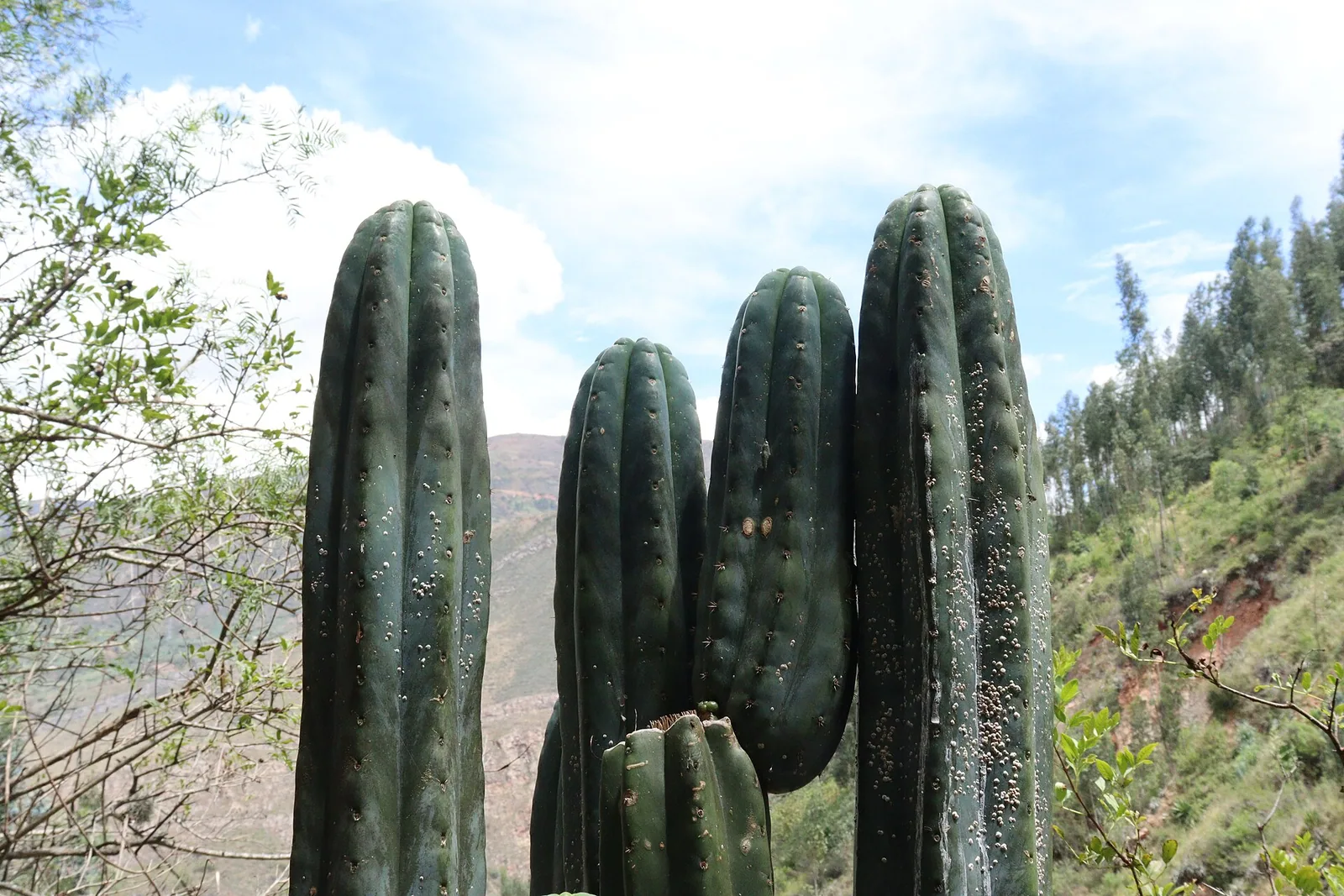
San Pedro or huachuma, Echinopsis pachanoi, is a columnar cactus of the dry inter-Andean valleys of southern Ecuador and Peru, now cultivated worldwide. Its principal active is mescaline, whose concentration varies by about two orders of magnitude between cacti. Columnar cacti appear in Cupisnique ceramics and on a Chavín relief of about 800–700 BCE, and mescaline has been detected in ancient hair from southern Peru. In northern Peru the cactus remains the healer’s way to the vista, the sight that divines the cause of illness, and those uses were declared national cultural heritage in 2022.
All sections
| Botanical name | Echinopsis pachanoi |
|---|---|
| Taxa | Cactaceae · Caryophyllales · Angiosperms |
| Traditional names | Huachuma · wachuma · achuma · San Pedro · aguacolla · gigantón · cimora |
| Regions | Southern Ecuador to Peru, principally in seasonally dry tropical Andean environments. |
| Ethnographic entheogenic use | Columnar cacti and mescaline have a long Andean history — cactus imagery at Chavín and among the Moche, mescaline in ancient hair from southern Peru — and in northern Peru San Pedro remains the healer's way to the vista, the sight that divines the cause of illness (Sharon, 2019; Socha, Sykutera and Orefici, 2022; Glass-Coffin, 2010). |
01Ethnobotany of Echinopsis pachanoi
Botanical Info
| Accepted name | Echinopsis pachanoi (Britton & Rose) H.Friedrich & G.D.Rowley. Kew currently accepts the species; it was described as Trichocereus pachanoi Britton & Rose in 1920 and transferred to Echinopsis in 1974 (Britton and Rose, 1920; POWO, 2026). |
|---|---|
| Taxonomic problem | Trichocereus pachanoi remains common in horticulture and ethnobotany. Some treatments place it under Trichocereus macrogonus var. pachanoi. Molecular work found traditional Echinopsis polyphyletic, and boundaries among cultivated columnar taxa remain unsettled; identification needs a voucher, beyond any nursery name or vernacular label (Schlumpberger and Renner, 2012; Albesiano, 2012). |
| Family | Cactaceae · subfamily Cactoideae · tribe Cereeae/Trichocereeae according to the classification used. |
| Order | Caryophyllales. |
| Native range | Southern Ecuador to Peru, principally in seasonally dry tropical Andean environments. Kew records introduced occurrences in Bolivia, Colombia, central Chile, Spain and the Canary Islands; cultivation is now global (POWO, 2026). |
| Habitats | Inter-Andean valleys, rocky slopes, scrub and disturbed or settled landscapes, often around 2,000–3,000 m. Long cultivation in gardens, hedges, shrines and healing economies complicates any simple boundary between wild, naturalised and domesticated distribution. |
| Local names | Huachuma/wachuma/achuma, San Pedro, aguacolla/huacolla, gigantón, cardo, cimora, lapituq and regional variants. Names can denote a plant, cultivar, preparation or ritual class; “San Pedro” also covers related mescaline-bearing Echinopsis/Trichocereus taxa (Sharon, 1972; Bussmann and Sharon, 2006). |
Territories
- 1Ayabaca highlands · the “cimoras”, Brugmansia and Trichocereus, in a 1988 field study (De Feo, 2003); 207 of 510 medicinal plants in northern Peru treat “magical/ritual” ailments (Bussmann and Sharon, 2006)
- 2Moche coast · columnar-cactus imagery among the Moche (Sharon, 2019)
- 3Chavín de Huántar · cactus imagery at Chavín (Sharon, 2019), where vilca and tobacco are confirmed and cactus remains iconographic (Rick et al., 2025)
Deep Time
- 8th millennium BCE?Cactus fragments and pollen at Guitarrero Cave, Áncash, cited for an early huachuma association; undated and unidentified.
- 2nd millennium BCECupisnique ceramics show ribbed columnar cacti beside felines, serpents and transforming figures.
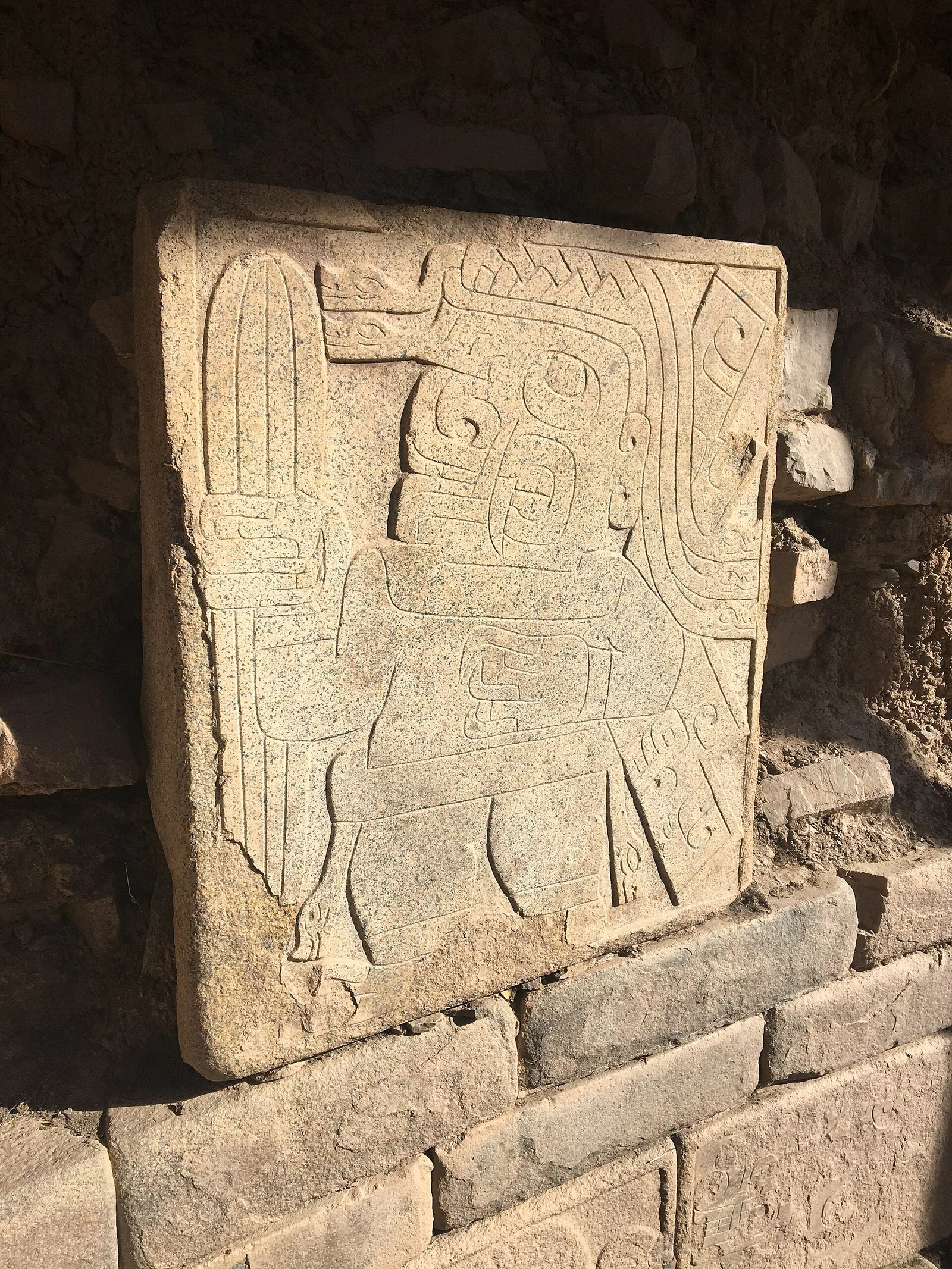
- c. 800–700 BCEA fanged figure holds a four-ribbed column on a relief in the Circular Plaza at Chavín de Huántar.
- 1988Field study in the Ayabaca highlands: the “cimoras”, Brugmansia and Trichocereus.
- 2017IUCN assessment: Least Concern.
Morphology and life history
A branching succulent shrub or tree, usually about 3–6 m tall but capable of greater height, with erect green to blue-green columns commonly 6–15 cm in diameter. Stems usually bear four to eight broad, rounded ribs separated by shallow furrows. Small whitish areoles are spaced along the rib crests; each may carry no spine or several yellow-brown spines, frequently short in cultivated forms. Rib number varies within plants and has cultural as well as horticultural significance, though it is a poor chemical or taxonomic diagnostic.
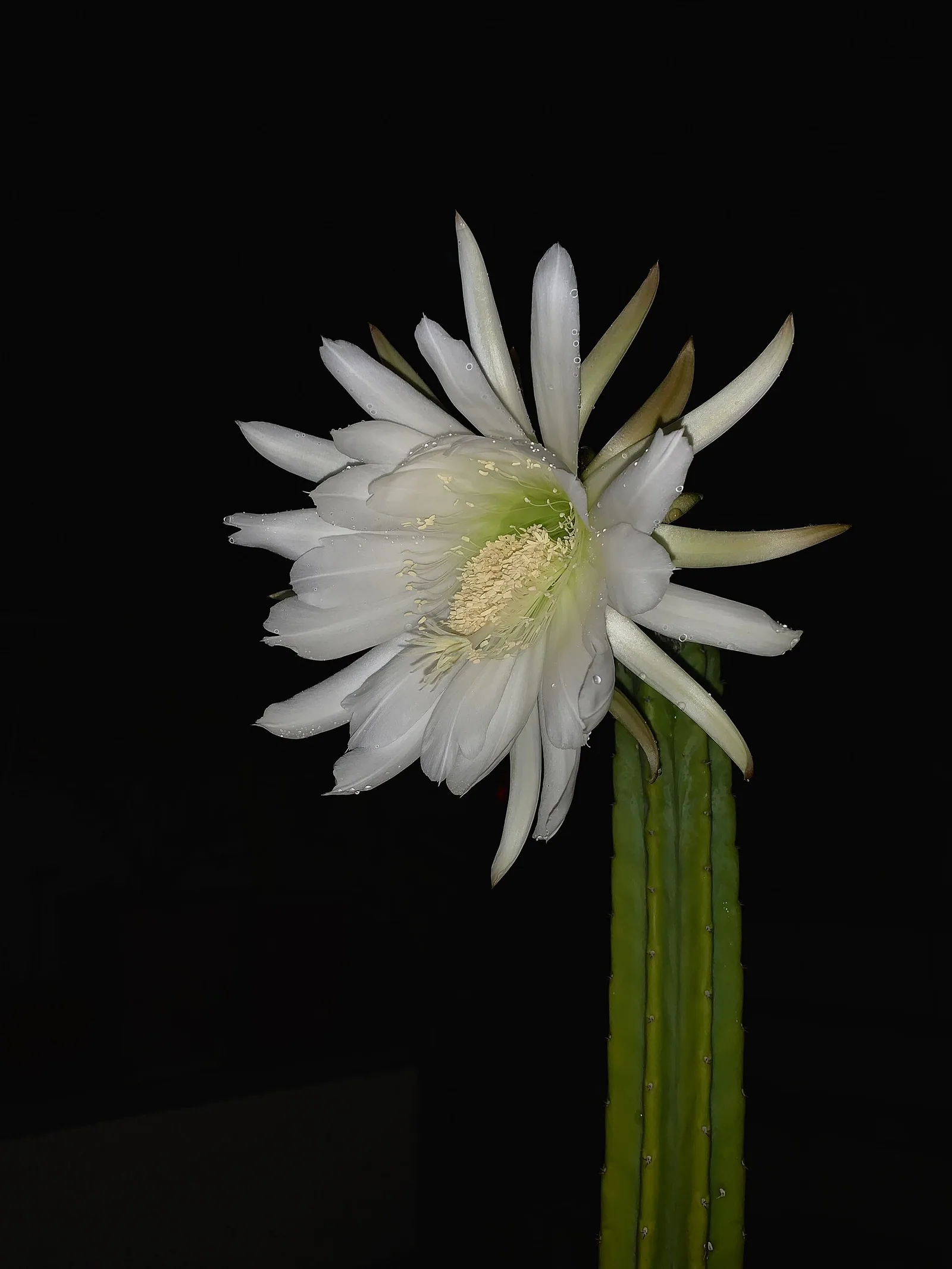
Large, fragrant white flowers arise near stem apices, open at night and may persist into the following day. The long, hairy floral tube and nocturnal anthesis are characteristic of the columnar complex. Fertilised flowers form oblong green fruits that split to expose white pulp and numerous small black seeds. Broken or cut stems root readily, and basal or wound-induced branches allow rapid clonal propagation. This vegetative resilience partly explains the cactus’s presence as a living fence and widely exchanged heirloom.
Field characters and confusions
- Field useful
Rounded ribs, sparse short spines, broad green columns and large hairy-tubed white flowers support identification, but each character overlaps with related cultivated taxa.
- Hybrid field
E. peruviana, E. lageniformis, E. scopulicola and named hybrids circulate as “San Pedro.” Horticultural clone labels—including “PC” in North American trade—record commerce and resemblance; ancestry, species identity and alkaloid content need separate evidence.
- Four ribs
Four-ribbed plants are ritually prized in some lineages as “four winds.” The symbolism is ethnographically consequential; the claim that four ribs predict exceptional mescaline content is unsupported by comparative chemistry.
02Chemistry
Mescaline is the principal established entheogenic compound. Reported minor phenethylamines and tetrahydroisoquinolines vary with specimen, tissue, analytical method and taxonomic identification. A compound list is therefore a record of detections; plants differ in their ensembles, and the part minor alkaloids play in human experience is unknown.
Mescaline
3-Methoxytyramine
Hordenine
ALKALOID
FIELD
Other reported alkaloids
Concentration and distribution
In a comparative analysis of fourteen Echinopsis taxa and cultivars, dry-tissue mescaline values ranged across roughly two orders of magnitude, including material reported from about 0.053% to 4.7%. The study’s central lesson is variability (Ogunbodede et al., 2010). MALDI mass-spectrometry imaging later mapped mescaline’s non-uniform topography within cactus sections, and a 2025 UHPLC–MS/MS method found preliminary evidence for higher concentrations in chlorenchyma than inner parenchyma (Lin et al., 2023; Gaur et al., 2025).
- Known
Mescaline is biosynthesised from tyrosine-derived precursors and is the dominant explanation for the species’ classic psychedelic effects.
- Mechanism
Human effects are mediated predominantly by agonism at serotonin 5-HT₂A receptors. Ketanserin substantially attenuates mescaline’s acute effects, although receptor binding is broader than a single-target shorthand (Klaiber et al., 2024).
- Whole plant
No controlled study has compared a chemically characterised cactus preparation with matched synthetic mescaline. Claims that minor alkaloids make huachuma intrinsically gentler, warmer or more “earthy” remain phenomenological hypotheses.
- Potency lore
Colour, rib number, clone name, stress and age are often used as folk or collector predictors. Without vouchered quantitative analysis, none can substitute for chemical measurement.
03Tradition, ritual & cultural use
Oldest evidenced or proposed human use
| Guitarrero Cave | Proposed Cactus fragments and pollen from early deposits in Áncash have been cited as evidence extending huachuma association into the eighth millennium BCE. The cave’s stratigraphy and old excavations are complex; direct dating of the cactus, secure species identification and proof of psychoactive use are lacking. The claim belongs in the history of the hypothesis (Lynch, 1980; Lynch et al., 1985; Samorini, 2019). |
|---|---|
| El Paraíso | Reported A preserved cactus segment recovered at the Late Preceramic site near Lima in 2016 was publicly described as about four thousand years old and possibly San Pedro. Published contextual and taxonomic analysis remains limited; it is a potentially important find awaiting secure ritual identification. |
| Cupisnique | Iconographic Ceramics of the second millennium BCE show ribbed columnar cacti beside felines, serpents, birds and transforming anthropomorphic figures. Botanical inference is strong at the generic-form level; mescaline and preparation lie beyond what images can show (Sharon, 2019). |
| Chavín de Huántar | Iconographic A fanged anthropomorphic figure holds a four-ribbed column in a stone relief from the Circular Plaza, commonly dated c. 800–700 BCE. It is the clearest ancient Andean cactus image in an architecturally restricted ceremonial setting. In 2025 residue work on bone inhalers directly detected tobacco and, separately, DMT with Anadenanthera colubrina starch; no mescaline was found. This confirms a multi-plant psychoactive institution while leaving cactus ingestion at Chavín iconographically inferred (Rick et al., 2025; Nesbitt et al., 2025). |
| Moche and Nasca | Visual / biomolecular Moche ceramic “achumera” figures connect columnar cactus with gendered ritual personae and status; Nasca images include cactus-bearing and plant-associated beings. A 2022 hair study from southern Peru detected mescaline in ancient individuals, giving direct evidence of exposure, though the botanical source could be any mescaline cactus (Scher, 2021; Socha, Sykutera and Orefici, 2022). |
These records demonstrate recurrent Andean relations with columnar cacti and mescaline over long periods. Whether recipe, priestly office or mesa configuration stayed the same from the Formative period to the present is beyond what they can show. Ethnoarchaeology is strongest when formal parallels are treated as questions about transmission and transformation (Glass-Coffin, 2010; Sharon, 2019).
Peoples and territories
Northern Peru
Archaeological, historical and ethnographic evidence points to uninterrupted use of San Pedro in northern Peru for travelling between worlds and for the vista, the magical sight by which healers divine the cause of illness. The cactus is associated with ancestor worship, water and fertility cults and wind spirits, over a time depth of more than two thousand years (Glass-Coffin, 2010).
The Andean "health axis"
Northern Peru — Piura, Lambayeque, La Libertad, Cajamarca and San Martín — lies at the centre of a healing region stretching from Ecuador to Bolivia, its roots reaching at least to the Moche period (AD 100–800). Of 510 medicinal plants recorded there, the largest group, 207 species, treat "magical/ritual" ailments (Bussmann and Sharon, 2006).
Ayabaca highlands
A 1988 field study between Ayabaca (about 2,900 m) and the high lagoons of Piura found the use and knowledge of psychoactive plants especially important, above all the "cimoras", Brugmansia and Trichocereus species (De Feo, 2003).
Ritual practice and healing
The most detailed twentieth-century account follows Eduardo Calderón Palomino of coastal northern Peru, known as “Don Eduardo” and earlier pseudonymously as Gálvaez. In Douglas Sharon’s collaborative ethnography, cactus is prepared during the day for a night ceremony in which the healer’s mesa, songs, whistles, rattles, perfumes, tobacco and individual work with patients organise the unfolding effects (Sharon, 1972; Sharon, 1978). Bonnie Glass-Coffin’s work with female healers, including Julia Calderón de Ávila, broadens a literature once disproportionately centred on male maestros and shows healing knowledge as embodied, familial and negotiated through gendered life histories (Glass-Coffin, 1998).
| Preparation | Cut cactus is cooked in water into a bitter liquid, often over much of the day. Ethnographies describe considerable variation. The preparation is part of the ritual day and household economy; this account omits operational quantities. |
|---|---|
| The mesa | An altar and operative cosmogram arranged with staffs, swords, stones, shells, archaeological objects, crosses, saints, waters, perfumes, herbs and bottle-like seguros. Left, right and centre can differentiate aggressive, protective and mediating forces, though individual mesas vary (Joralemon, 1985; Sharon, 2021). |
| Sequence | Invocation and opening; separately administered tobacco; circulation of cactus; tarjos, whistle and rattle; diagnostic encounters at the mesa; contest, extraction or cleansing; and dawn work of blessing or florecimiento. No single sequence represents every lineage (Joralemon, 1984). |
| Illness | Patients may present biomedical symptoms together with susto, daño, envy, sorcery, bad air, relational conflict or lost suerte. Ritual diagnosis makes affliction visible within family, work, landscape and moral relation, then acts on that configuration (Dobkin de Rios, 1969; Joralemon, 1986). |
| Shamanism | Comparative “shamanism” describes vision, spirit mediation, transformation and combat, but local offices—maestro/a, curandero/a, yerbatero/a, rastreador/a, yachak—are more precise. Authority rests in apprenticeship, relations with places and objects, diagnostic performance and reputation. |
| Associated plants | Tobacco and coca may clear, protect, divine or reciprocate. Perfumes and medicinal plants enter cleansings and seguros. Brugmansia “mishas” are specialist, dangerous and non-universal; some healers explicitly refuse them (Sharon, 1972; De Feo, 2004). |
04Cosmology & key terms
Huachuma ritual joins several historical registers: animated Andean landscapes; relations with archaeological places and ancestral powers; Catholic saints, crosses and prayers; and the healer’s personal alliances with plants, waters and objects. The mesa holds these together and materialises a working theory of the world in which powers have direction, temperament and biography, and in which illness can be the effect of disturbed relations among persons, places and agencies (Joralemon, 1985; Sharon, 2021).
- Huachuma / San Pedro
- Cactus as medicine, guide and source of vista. The Saint Peter name associates access with the keys of heaven; local accounts also address the plant as an agent whose power is learned relationally.
- Vista
- Literally “sight”: an acquired diagnostic faculty. A novice may see colour and movement; a maestro learns to identify a patient’s affliction and decide what action follows.
- Mesa
- Both surface and assemblage: an altar, map, archive and instrument. Its arrangement encodes oppositions and alliances while its artes become participants in treatment.
- Artes
- Stones, staffs, swords, shells, images, archaeological fragments and other empowered things with specialised tasks. Their efficacy emerges through provenance, consecration, placement and use.
- Tarjo
- A melodic invocation, often sung or whistled, that calls, directs and identifies powers. Sound structures attention, sequence and public interpretation.
- Las Huaringas
- A sacred lagoon complex in Piura whose waters and surrounding páramo anchor pilgrimage, cleansing and healer legitimacy. Landscape here acts, remembers and authorises.
- Four winds
- A directional idiom linking four-ribbed cactus, mesa quadrants, winds and the healer’s command of a spatial field. Its forms vary, and ancient four-ribbed images may have meant other things.
Art and the problem of recognition
Ancient artists transformed the plant as they depicted it. Cupisnique ceramics fold ribbed plants into feline, serpent and avian transformation; the Chavín cactus-bearer combines human posture, fangs, hair-serpents and vegetal form; Moche artists depict women and ritual figures with stylised cacti; Nasca imagery links plants to complex beings and trophy-head worlds. Identification depends on repeated morphology, context and comparison, and a serrated or radiating form needs more than its shape to count as drug iconography (Scher, 2021; Tierney, 2022).
Modern material culture is equally active. A mesa may contain pre-Columbian fragments beside factory-made perfume, Catholic cards and steel blades. An object becomes an arte through place of origin, ownership, encounter and ritual work, whatever its age. The assemblage is thus a living archive of conquest, trade, archaeology, family inheritance and individual practice (Glass-Coffin, 2010; Sharon, 2021).
05Visionary phenomenology
| Phase | Typical profile | Evidentiary source |
|---|---|---|
| Onset | Gradual, often around 1–3 hours; nausea, bodily warmth, tremor, heaviness or energy may precede marked visual change. | Ethnography and controlled mescaline pharmacokinetics (Sharon, 1972; Mueller et al., 2025). |
| Plateau | Long, lucid and environmentally engaged for many users: intensified colour and salience, patterned surfaces, halos, movement, altered time, affective opening and visionary imagery. | Naturalistic ceremonial study and human laboratory work (Bohn et al., 2023; Ley et al., 2023). |
| Total duration | Frequently 8–14 hours, with dose-dependent modelled effects extending from shorter low-intensity states to approximately 15 hours at the highest controlled dose. | Purified mescaline studies; variable cactus chemistry prevents direct conversion to a plant dose (Klaiber et al., 2024; Mueller et al., 2025). |
| After-effects | Fatigue from a night-long session, wakefulness, emotional clarity or tenderness; adverse after-effects can include headache, insomnia and delayed distress. | Ethnographic accounts and modern studies. |
Time course
Oral mescaline in a controlled study of 100, 200, 400 and 800 mg: the mean duration of subjective effects rose from 6.4 to 14 hours with dose; concentrations peaked after about 2 hours, and the elimination half-life was about 3.5 hours (Klaiber et al., 2024). Cactus strength varies, so a ceremony’s course cannot be read off a dose.
Phenomenological profile
The profile lists effects the sources report, for each preparation separately, grouped by domain. Each row gives the grade, how often the sources say the effect occurs (only where they say so; most do not) and the kinds of source behind it. A chip naming a compound, such as “Trial · psilocybin”, means the evidence comes from studies of that compound rather than of the preparation itself; “partial” means the route, purity or dose differs from the traditional preparation, so the row cannot be graded above supported. The line under each preparation says which domains have evidence entered here. A domain with nothing entered has not yet been assessed in this profile; that is not a finding that the literature is silent, and the article may discuss it. Open a row for the note and the sources.
Cactus drunkAndean healing, and ceremonies abroad
Evidence entered for 6 of 8 domains. Not yet entered: relation to other beings, states of consciousness.
Mescaline is the principal active (Cassels and Sáez-Briones, 2018), and its content varies widely between cacti (Ogunbodede et al., 2010). Controlled trials of oral mescaline correspond in full. The ceremonial study took place at Dutch retreats, with brews and powders of unrecorded strength (Bohn et al., 2023), outside the northern Peruvian tradition.
Visual
Geometric patterningLattices, spirals, tunnels and other repeating forms seen with eyes closed or overlaid on the visual field.SupportedSurvey
In a field study of 42 people at ceremonial San Pedro retreats, elementary imagery scored a mean of 43.8 out of 100 (Bohn et al., 2023, Table 1).
Immersive realmsCoherent places or events that surround the experiencer, who seems to be located in them rather than looking at images.SupportedSurvey
In a field study of 42 people at ceremonial San Pedro retreats, complex imagery scored a mean of 45.2 out of 100 (Bohn et al., 2023, Table 1). Disembodiment, which the archive reads as part of immersive realms, scored lower, a mean of 22.6 (Bohn et al., 2023, Table 1). Read about the phenomenology of immersive realms →
Other senses
Sound–vision couplingMusic or voice changing the form, movement, colour or emotional tone of imagery.SupportedSurvey
In a field study of 42 people at ceremonial San Pedro retreats, audio-visual synaesthesia scored a mean of 36.7 out of 100 (Bohn et al., 2023, Table 1).
Body
Nausea and purgingNausea, vomiting or diarrhoea during the acute state.SupportedTrial · mescaline
Nausea rose at 400–800 mg of mescaline against placebo, and nausea and vomiting were frequent at 800 mg (Klaiber et al., 2024). An earlier review links nausea and vomiting more to peyote than to other forms of mescaline, and attributes them to the cactus’s bitterness and other constituents, since volunteers given synthetic mescaline in one study reported none (Uthaug et al., 2022); the dose–response trial does not bear that out at higher doses, and the disagreement is left open.
Raised blood pressureA measured rise in arterial blood pressure during the acute state.SupportedTrial · mescaline
Mescaline raised systolic and diastolic blood pressure at doses above 100 mg, with no difference between 200 and 800 mg; heart rate rose with dose (Klaiber et al., 2024). A measured sign rather than an experience.
Self and unity
Ego dissolutionLoosening or loss of the sense of being a bounded self.SupportedSurvey
In a field study of 42 people at ceremonial San Pedro retreats, ego dissolution was of medium level, a mean of 47.9 out of 100 on the Ego Dissolution Inventory (Bohn et al., 2023, Table 1). Respondents to a survey of mescaline use, most of whom named peyote or San Pedro for their most memorable experience, rated it “slight” (Uthaug et al., 2022).
Unitive experienceThe sense that self and world, or all things, are one or interconnected.SupportedTrial · mescalineSurvey · mescaline
In a field study of 42 people at ceremonial San Pedro retreats, the experience of unity scored a mean of 53.6 out of 100, and 26 participants (62%) met the criterion for a “complete mystical experience” (Bohn et al., 2023, Table 1). Mystical-type experience rose with dose of mescaline in a controlled trial (Klaiber et al., 2024), and survey respondents rated it “moderate” (Uthaug et al., 2022).
Affect
Fear and dreadFear, panic, chaos or a sense of threat during the experience.SupportedOccasionalTrial · mescalineSurvey · mescaline
Anxiety rose significantly only at the highest dose, 800 mg (Klaiber et al., 2024). In the ceremonial study it was the lowest-scoring dimension, a mean of 10.9 out of 100, although one participant of 42 had a strong to extremely challenging experience (Bohn et al., 2023); survey respondents rated challenging effects “very slight” (Uthaug et al., 2022).
Bliss and euphoriaIntense joy, beauty, love or wellbeing.SupportedSurvey
In a field study of 42 people at ceremonial San Pedro retreats, the blissful state scored a mean of 51.0 out of 100 (Bohn et al., 2023, Table 1).
Cognition
NoesisThe felt disclosure of knowledge: understanding that seems to arrive with what is perceived.SupportedEthnographySurvey
In northern Peru San Pedro is the healer’s way to the vista, the sight that divines the cause of illness (Glass-Coffin, 2010). In a field study of 42 people at ceremonial San Pedro retreats, insightfulness scored a mean of 51.7 out of 100 (Bohn et al., 2023, Table 1); survey respondents rated psychological insight “slight” (Uthaug et al., 2022).
IneffabilityThe experience resists description in words.SupportedSurvey
In the ceremonial study, ineffability scored a mean of 3.4 out of 5 on the Mystical Experience Questionnaire (Bohn et al., 2023, Table 2).
Time distortionTime felt to slow, stretch, stop or lose its ordinary order, or durations misjudged.SupportedSurvey
In the ceremonial study, transcendence of space and time scored a mean of 2.6 out of 5, the lowest of the mystical-experience subscales (Bohn et al., 2023, Table 2).
Loss of ordinary awarenessOrdinary sense, orientation or self-control is lost or overwhelmed.SupportedSurvey
In a field study of 42 people at ceremonial San Pedro retreats, impaired control and cognition scored low, a mean of 21.8 out of 100, though above the sober state (Bohn et al., 2023, Table 1).
Visionary descriptions
Comparable to LSD and psilocybin
In a double-blind trial with 32 healthy volunteers, the acute subjective effects of mescaline at its higher dose were comparable to those of LSD and psilocybin on several psychometric scales; mescaline's effects lasted longest, about 11 hours on average (Ley et al., 2023).
Through the 5-HT2A receptor
Blocking the serotonin 5-HT2A receptor with ketanserin attenuated and shortened the effects of mescaline, and the duration of subjective effects grew with dose (Klaiber et al., 2024).
What users report
Of 452 people surveyed, most had taken mescaline once a year or less, for spiritual exploration or to connect with nature; they rated mystical-type effects as moderate, ego dissolution and insight as slight and challenging effects as very slight, and most named peyote or San Pedro for their most memorable experience (Uthaug et al., 2022).
a whirlpool of red and yellow light spinning inward before my eyes Douglas Sharon’s field note after a ceremony with Eduardo Calderón, quoted in Sharon (1972, p. 132).
Sharon also recorded peripheral flashes, pale outlines around patients, a staff appearing to vibrate and softly unfolding multicoloured designs. He remained aware of the ceremony yet did not share the participants’ interpretation of an “attack.” The episode is analytically valuable because it separates recurrent sensory form from learned perception: similar visual perturbations can be organised through different cultural expectations, while the healer’s vista is trained to convert them into publicly meaningful diagnosis (Sharon, 1972).
Contemporary measurement
In a preregistered observational study of 42 participants at ceremonial retreats in the Netherlands, San Pedro use produced significant changes on all eleven dimensions of the 11D-ASC. Spiritual experience was prominent; insight, bliss, unity, ego dissolution, changed perceptual meaning, imagery and audio-visual integration were moderate, while disembodiment, anxiety and impaired control/cognition were comparatively low. Two-thirds met the study’s questionnaire threshold for a “complete mystical experience” (Bohn et al., 2023). Selection, expectation, variable plant chemistry and absence of placebo or randomisation prevent causal claims about the cactus alone.
The psychometric vocabulary and the curandero’s vocabulary answer different questions. “Ego dissolution” scores an alteration in self-boundaries; vista names a socially trained capacity to see illness and power. Each keeps its own meaning. A full phenomenology requires the molecule, body, night, song, material arrangement, healer authority and patient’s problem to be analysed together.
06Contemporary status
Conservation and cultural safeguarding
| IUCN status | Least Concern in the 2017 amended global assessment. This reflects wide occurrence and cultivation; wild populations, locally valued landraces and access to sacred collecting grounds each need their own measure (Ostolaza, Cáceres and Roque, 2017). |
|---|---|
| CITES | Cactaceae are generally listed in Appendix II subject to annotations and exemptions. International movement may therefore involve wildlife-trade, plant-health and customs requirements even where ornamental possession is lawful (CITES, 2026). |
| Biological pressures | Habitat conversion, opportunistic wild cutting, loss of local lineages, disease and potency-driven selection. Ready propagation from cuttings and substantial ornamental cultivation can reduce pressure, provided provenance is lawful and laundering of wild plants is avoided. |
| Cultural heritage | Peru’s Resolution No. 252-2022-VMPCIC/MC declared the knowledge, know-how and traditional uses of San Pedro in northern curanderismo National Cultural Heritage. It recognises a systemic healing universe with pre-Hispanic antecedents and Christian elements and calls for safeguarding with practitioner communities (Ministerio de Cultura del Perú, 2022). |
Biological and cultural conservation intersect. A greenhouse can preserve a clone while the pilgrimage route, local name, healer apprenticeship or right to determine how knowledge circulates disappears. Equally, secrecy or restricted knowledge can be part of conservation.
Local and global economies
Huachuma moves through northern Peruvian medicinal markets, household gardens, healer networks and pilgrimages to Las Huaringas; through global ornamental nurseries and collector exchanges; and through an expanding retreat and wellness economy. These markets trade different things—living genetics, dried or cut material, ritual service, therapeutic promise, lineage and aesthetic identity—and reliable species-specific volume data are scarce (Bussmann and Sharon, 2013).
Online trade has generated a parallel folk taxonomy of clones, hybrids and potency reputations. It has also made cultivated mescaline cacti accessible beyond the Andes. A 2023 survey found that consumers often considered sustainability and commonly reported San Pedro in preference to peyote as a mescaline source; self-selected online respondents say little about population-level demand or ecological outcome (Engel et al., 2023).
Legality — selected frameworks, checked August 2026
| Jurisdiction | Mescaline | Plant and cultural context |
|---|---|---|
| International | Mescaline is Schedule I under the 1971 Convention on Psychotropic Substances. | The Convention schedules the chemical; E. pachanoi is unnamed. National laws may nevertheless control preparations, intent, import or extraction; CITES and phytosanitary rules are separate (UN, 1971; INCB, 2010). |
| Peru | Purified mescaline remains controlled. | Traditional northern knowledge and uses have national heritage status. The declaration is cultural safeguarding; export, commercial retreats and other preparations fall under other law (Ministerio de Cultura del Perú, 2022). |
| United States | Mescaline is federally Schedule I. | Live cacti are commonly sold ornamentally, but manufacture or possession of a mescaline preparation can trigger federal law. The peyote religious exemption is specifically framed around peyote (eCFR, 2026). |
| United Kingdom | Mescaline is Class A and Schedule 1. | The living species is absent from the Misuse of Drugs Act, but producing, supplying or possessing a mescaline-containing preparation can be criminal. Intent and form matter (UK Government, 2026). |
This table is comparative research; local rules and enforcement change.
Patents, trials and research fronts
- Mescaline-assisted psychotherapy. — Patent publications have claimed salts, formulations, administration regimes and therapeutic methods involving synthetic mescaline. A publication precedes any grant; claims are territorial, and E. pachanoi and traditional curanderismo lie outside them.
- Prior art and benefit. — Orally transmitted preparation, diagnosis and ceremonial support can be invisible to a patent examiner, however visible they are archaeologically. Accurate provenance, community participation and benefit-sharing remain distinct from formal novelty analysis.
- 2023
A randomized, double-blind comparison found mescaline, LSD and psilocybin produced broadly comparable acute psychedelic profiles at roughly equivalent intensities; mescaline lasted longest, with a mean of 11.1 hours (Ley et al., 2023).
- 2024
A controlled dose-response study found increasing subjective and autonomic effects across mescaline doses; 5-HT₂A antagonist ketanserin attenuated most effects. The material was pharmaceutical mescaline in screened volunteers (Klaiber et al., 2024).
- 2025
Human pharmacokinetic modelling found peak plasma concentration at about two hours, a 3.5-hour half-life and dose-dependent effect duration; about 53% was recovered unchanged in urine. Analytical work separately improved mescaline screening across cultivated cacti (Mueller et al., 2025; Gaur et al., 2025).
- 2026
A systematic review mapped renewed mescaline research, while awake-rat fMRI reported altered whole-brain connectivity and cerebellar BOLD suppression. A clinical indication for huachuma and an account of culturally trained vista are beyond both (Shaw et al., 2026; Cavallaro et al., 2026).
Research gap. There is no robust controlled trial of a botanically and chemically characterised E. pachanoi preparation for a diagnosed disorder, no direct cactus-versus-mescaline comparison, and little community-led longitudinal research on retreat tourism, practitioner economies or cultivar conservation. Evidence for isolated mescaline applies to mescaline; the whole plant and the mesa tradition need their own.
Safety
Mescaline commonly produces nausea and may increase blood pressure, heart rate and body temperature. The long duration extends exposure to dehydration, accidents, insomnia and difficult psychological states. Risk assessment is especially important with cardiovascular disease, pregnancy, seizure vulnerability, bipolar or psychotic disorders and interacting medication. Admixture with tropane-bearing Brugmansia/Datura adds a categorically different risk of delirium, amnesia, hyperthermia, seizures, coma and death (Klaiber et al., 2024; Petricevich et al., 2020).
Open questions on this entry
Safety and law
07Cross-correlations
| Andean Huachuma–Mesa | Ceremonial complex page: mesa lineages, ritual roles, tobacco, coca, mishas, sacred lagoons and contemporary transformation. PRIMARY CULTURAL COMPLEX |
|---|---|
| Related cacti | Echinopsis peruviana, E. lageniformis, E. scopulicola and hybrids circulate within “San Pedro” horticulture. TAXONOMIC / CHEMICAL FIELD |
| Nicotiana rustica | Tobacco is independently active as cleansing, protection, activation and offering, used alongside the cactus drink and ordinarily kept out of it. RITUAL INFRASTRUCTURE |
| Erythroxylum coca | Coca enters reciprocity, divination and endurance within a far wider Andean cultural complex. ASSOCIATED MEDICINE |
| Brugmansia spp. | Mishas are contingent specialist medicines whose antimuscarinic delirium and toxicity differ categorically from mescaline. HIGH-RISK ADJUNCT |
| Lophophora williamsii | Peyote shares mescaline but belongs to distinct North American pilgrimage, church and sovereignty traditions. CHEMICAL CONVERGENCE / CULTURAL DISTINCTION |
08Bibliography
How to read the labels on each source
- Source type
- What kind of work it is: journal article, book, legislation, patent application, database record and so on. A word after the dot (ethnography, protologue, primary source) keeps the genre the entry was first filed under. “Unclassified” means the citation does not say enough to tell.
- Peer review
- Recorded for each work separately, and only where it has been confirmed for that work. It is never inferred from a DOI, a publisher or a journal, since journals also publish editorials, letters and commentaries. Where it has not been confirmed, the entry records it as not established. It does not apply to legislation, court decisions, treaties, patents, datasets, database and collection records, historical texts, films, talks, press releases or web pages.
- Check
- What was checked when the entry was added. DOI checked: the DOI’s registry record (Crossref) matched the citation’s title, first author and year. Verified: the record itself was opened and matched the citation: a library catalogue record for a book, or the page itself for a database entry, law, patent or archive document. “Verified (abstract)” and “(summary)” mean only the abstract or a summary was read. Located: a record was found but not fully matched. Bibliographic record and Stable record (in essays): a catalogue or stable web record exists; what was checked against it is not recorded. Unverified: no check is recorded. No locator found: a search found no record. Secondary: read through another source.
- What the labels do not say
- None of them means the source supports a particular sentence. Where a sentence is graded, its evidence note names its sources and whether each supports it, disputes it or gives context. Dates and reviewers of checks are not recorded for each entry; the version note at the foot of a graded page dates its last review.