Mirante, D. (ed.) (2026) Pangaean Entheobotanical Renewal : Ayahuasca Analogues. Entheocene, version 1.1. Available at: https://entheocene.com/complex-ayahuasca-analog.html (Accessed: 17 October 2026).
DOI: not yet minted.
Introduction
During the 1980s and 1990s, an underground movement emerged at the crossroads of ethnobotany, psychedelic counterculture, amateur chemistry and experimental spirituality. Inspired by Amazonian ayahuasca traditions, its participants began exploring whether visionary preparations could be recreated using plants from entirely different parts of the world. For Terence McKenna, such experiments belonged to an archaic revival, a rediscovery of humanity’s ancient relationship with psychoactive plants; Jonathan Ott envisioned a Pangaean entheobotanical revival, in which the visionary potential of the world’s flora could be explored beyond its traditional geographical boundaries. Against the backdrop of psychedelic prohibition and what Ott called the pharmacratic inquisition, this emerging culture also represented an assertion of individual autonomy over consciousness itself. Its enthusiasts exchanged botanical knowledge, experimental reports and increasingly elaborate cosmologies through underground publications, seed catalogues, correspondence networks and the early internet. Figures such as McKenna, Ott and Jim DeKorne helped give shape to a decentralised community of psychonauts, amateur ethnopharmacologists and seekers pursuing what might be called a democratisation of vision. The resulting culture of ayahuasca analogues occupied a fascinating territory between scientific inquiry, countercultural resistance, spiritual experimentation and speculative metaphysics, while raising enduring questions about safety, cultural transmission, ecological responsibility and the boundaries of legitimate knowledge. This article traces that movement, its personalities, literature, experiments and extraordinary ideas, as a distinctive chapter in the modern history of psychedelic exploration (Ott, 1994; DeKorne, 1994; Monteith, 2016; Walsh, 2016; Söderberg, 2022).
Contents
01Culture
Peoples and territories: a distributed social formation
This complex has no single people or homeland. Its territories are circuits: the small-press underground of the United States, European natural-products laboratories, Brazilian jurema and ayahuasca networks, Australian Acacia communities, global internet forums and, increasingly, university hospitals. These sites share methods and symbols without sharing one ancestry.
Jim DeKorne’s Entheogen Review, founded in 1992, turned private bioassay into a distributed field notebook. Letters, reprinted chemistry, cultivation notes and cautions moved through a low-cost mail network before the web consolidated the scene (DeKorne, 1996).
Pangaean psychonautics
Jonathan Ott · natural-products experimenters · independent scholars
Ott’s Ayahuasca Analogues (1994) reframed the planet as a pharmacological commons: local plants could fill globally intelligible roles. His later pharmahuasca work formalised first-person experiment as human pharmacology (Ott, 1999).
Cyberdelic circuits
Terence McKenna · rave/cyberculture · early online psychonauts
McKenna joined DMT, plant intelligence, archaic revival, novelty and intelligent machines in a lecture culture that circulated by cassette, book, sampling and early network media. Psychedelic revelation became compatible with cybernetic futurity as well as pastoral return (Rushkoff, 1994; Turner, 2006; Davis, 2019).
Brazilian and transatlantic juremahuasca
Yatra · Rio psychonaut networks · Daimista and jurema interlocutors
Wanda Maria da Silveira Barbosa (“Yatra”) developed a jurema–rue practice in the Netherlands and carried it to Rio and northeastern Brazil in 1997. It became a site of dialogue, friction and bricolage among psychonautic, ayahuasqueiro and Indigenous jurema worlds: a formation of the 1990s (Grünewald, Savoldi and Collins, 2022; Leite, 2026).
Native wattles support a distinctive local analogue imaginary; Aboriginal authority is another matter. Contemporary Acacia use must be separated from abductive claims about undocumented precolonial entheogenic use and considered alongside Indigenous sovereignty and species-specific conservation (Gearin, 2015; Gearin and Calavia Sáez, 2021).
Zurich DMT–harmine studies and a Melbourne Acacia-derived pilot translate the analogue into capsules, buccal tablets, nasal delivery, psychometric scales and therapist dyads. The clinic has a culture of its own: a ritual architecture of permission, measurement and professional authority (Mueller et al., 2025; Bonomo et al., 2025).
History and evidence
1967–72
The Amazonian precedent analysed Before there were analogues there was an explanation of ayahuasca. Ott credits Bo Holmstedt and Jan-Erik Lindgren with the hypothesis that the brew’s β-carbolines protect its DMT from digestion. Analysing Amazonian samples in 1972, Laurent Rivier and Lindgren found substantial DMT in Psychotria viridis leaves and reported that “only DMT, Harmine, Harmaline and Tetrahydroharmine were detected in the decoction”. Their paper does not itself discuss monoamine oxidase; McKenna, Towers and Abbott later demonstrated the inhibition in vitro. The principle the underground would generalise was, in this sense, first a laboratory reading of an Indigenous preparation (Ott, 1999; Rivier and Lindgren, 1972; McKenna, Towers and Abbott, 1984).
1971–75
La Chorrera and the Timewave In 1971 Terence and Dennis McKenna travelled to La Chorrera in the Colombian Amazon and staged what Erik Davis describes as an experiment shaped by Jungian alchemy, Marshall McLuhan’s media theory and science fiction. The Invisible Landscape (1975) set out the theory the brothers built from it, including the “Timewave” later read as pointing to 21 December 2012. The episode supplied the scene with its founding myth of the plant-mediated revelation (Davis, 2016; McKenna and McKenna, 1993; Hanegraaff, 2010).
1978–85
Underground bioassay Jeremy Bigwood made a single self-experiment in 1978 that Ott later counted as the starting point for his own. In 1985 the pseudonymous chemists Gracie and Zarkov, writing in their self-published Notes from the Underground, called Syrian rue “a convenient, concentrated and easily obtainable source of beta-carbolines” that might stand in for caapi, and floated the idea of a “synthetic Ayahuasca”. They had only planned the oral experiment; their tests were of smoked rue, by two people. The analogue first appears, then, as a proposal in a xeroxed newsletter (Ott, 2001; Gracie and Zarkov, 1985).
1979
Entheogen as terminological intervention Carl Ruck, Jeremy Bigwood, Danny Staples, Jonathan Ott and R. Gordon Wasson proposed entheogen for psychoactive substances used to occasion experiences understood as sacred or divine. The term displaced clinical and pejorative vocabularies while making an interpretive claim of its own (Ruck et al., 1979).
1980s–1991
The archaic revival Terence McKenna connected psychoactive plants, ecological crisis, anti-authoritarian politics and a recovery of premodern modes of relation. His books, lectures and recordings turned psychonautic experience into a countercultural religious and political discourse (McKenna, 1991; Monteith, 2016).
1990
Pharmahuasca Ott began the series of self-experiments with pure DMT and harmine that he would later publish as “pharmahuasca”, building explicitly on Bigwood’s trial and on Gracie and Zarkov’s “secrets”. The work made the analogue’s defining operation measurable on a single human subject (Ott, 2001; Ott, 1999).
1992
A correspondence network Jim DeKorne founded Entheogen Review. Reader reports, botanical identifications, chemical literature, seed exchange and warnings made the periodical a distributed research infrastructure outside universities and pharmaceutical firms (DeKorne, 1996; Söderberg, 2022).
1992–93
From query to bioassay The anthology later drawn from the Review credits a question DeKorne put to his readers in mid-1992 with starting modern analogue research. Within months, Peganum harmala seed had been collected from a Texas highway median (August 1992) and strains of Phalaris grass had been bioassayed with rue (late 1992, published in summer 1993). Contributors wrote under pseudonyms such as David Aardvark, K. Trout, Johnny Appleseed and Doctor Know: the scene’s authorship was collective, playful and legally cautious. The founding idea was stated plainly — that temperate-zone plants carrying the same alkaloids as caapi and P. viridis could make an ayahuasca-like brew — and so was its ethic: “The cultivation and use of these plants is a shamanic discipline” (DeKorne, Aardvark and Trout, 2000; Lux, 2008).
1993
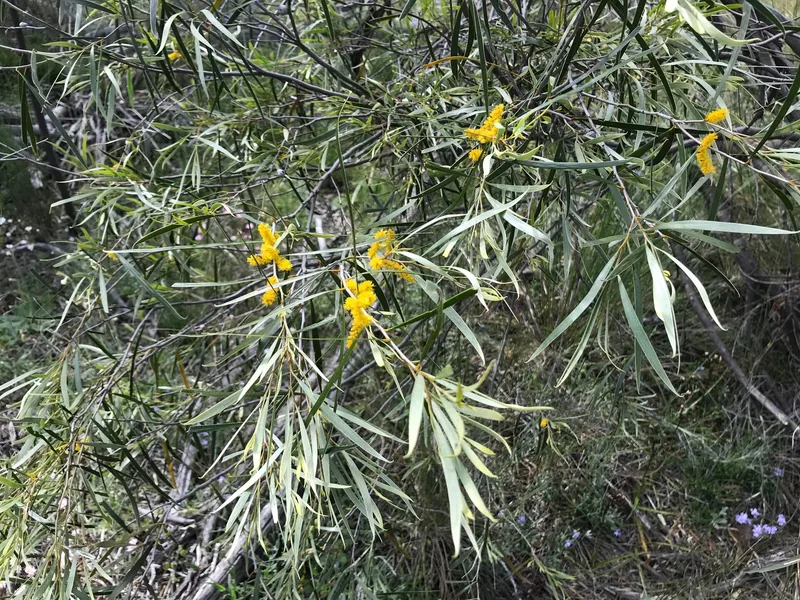
Australian Acacia A 1992 article in the Sydney student paper Honi Soit, written by an anonymous chemistry student from a 1990 CSIRO publication, led the Australian experimenter known as Nen in January 1993 to what he called “the edge of something massive and unprecedented”. The tree turned out to be Acacia obtusifolia, whose alkaloids were roughly two-thirds NMT and one-third DMT. At least 150 DMT-bearing Acacia species have since been reported. Commercial harvesting in the mid-1990s brought disenchantment within the scene itself (St John, 2017).
1993–96
Pharmacotheon Ott’s encyclopaedic Pharmacotheon (first published 1993; second edition 1996) called entheogens “sacramental plant teachers of countless generations of the family of humankind” and argued that prohibition is “first and foremost” a limitation on the practice of religion in a broad sense. It became the scene’s reference work and its theology (Ott, 1996).
1994
Pangaean print formation Ott’s Ayahuasca Analogues: Pangaean Entheogens and DeKorne’s Psychedelic Shamanism consolidated the analogue as both a reproducible pharmacological operation and a programme of self-initiation. Different plants could occupy comparable biochemical roles without becoming culturally identical (Ott, 1994; DeKorne, 1994).
1995
The Age of Entheogens Ott’s The Age of Entheogens & The Angels’ Dictionary recast Western history around a “Pharmacratic Inquisition” that suppressed ecstatic religion, and foresaw an “Entheogenic Reformation” in which genuine entheogens would replace the “placebo sacraments” of symbolic religion. The accompanying lexicon gave the movement a vocabulary (see The speculative canon) (Ott, 1995; Case, 2007).
1997
Wattles, tryptamines and Byron Bay Alexander and Ann Shulgin’s TiHKAL discussed the golden wattle among the natural sources of tryptamines. At the Beyond the Brain gathering in Byron Bay, Terence McKenna told an Australian audience that “the Acacia ecology of Australia is jammed with DMT”. Local terms such as “aussiehuasca” and “aussiewaska” followed (Shulgin and Shulgin, 1997; St John, 2017).
1998–2000
A second editorial generation After six years DeKorne handed the Review to David Aardvark, with Keeper Trout as technical editor; the periodical doubled in size. A second, enlarged edition of the analogues anthology, covering 1992–1999, appeared in 2000 as the first of the Review’s monograph series (Lux, 2008; DeKorne, Aardvark and Trout, 2000).
1999–2003
Cognitive liberty Richard Glen Boire and Wrye Sententia’s Center for Cognitive Liberty and Ethics formulated a two-sided right: protection from non-consensual mental intervention and freedom to direct one’s own consciousness. The concept supplied a rights vocabulary for practices that sat outside recognised medicine or religion (Boire, 2000; Walsh, 2016).
1990s–2000s
Network distribution Mailing lists, Usenet, Erowid-style archives, forums and vendor networks accelerated the circulation of botanical and experiential knowledge. Searchable peer archives widened access while weakening editorial control and enabling unsafe claims to travel with well-supported ones.
2003–06
Changa “Changa was created by Australian Julian Palmer as an alternative to smoking or vaporizing DMT crystal”: a smoking blend of DMT and herbs. The first mixes date from mid-2003 and the name from mid-2004. By 2006 changa had reached the Boom Festival in Portugal, and from there it travelled to Brazil (St John, 2017).
2008
Print gives way to the forum Jon Hanna introduced changa to Erowid readers, and the Entheogen Review published its final issue at the end of the year. The periodical that had begun as a clearinghouse for “hard-to-find empirical data” was succeeded by online forums such as the DMT-Nexus, where St John locates a DMT culture organised around “plant allies” (Lux, 2008; St John, 2017).
2009
An Australian encyclopaedia Snu Voogelbreinder’s self-published Garden of Eden surveyed psychoactive flora and fauna from over 1,700 genera, more than 440 in detail: the grower-scholar tradition in its most comprehensive form (Voogelbreinder, 2009).
2010
Analogue or ayahuasca? Changa’s popularity provoked a debate about names and borrowing. A 2010 Reality Sandwich article by Chen Cho Dorge drew criticism, and Daniel Mirante — the editor of this archive — objected to conflating analogues with ayahuasca and warned of cultural appropriation. The disclosure matters: the archive’s editor is himself one of the scene’s recorded voices (St John, 2017).
2010s
Decriminalisation and medicalisation Reform campaigns challenged criminal penalties while university research and venture-backed firms translated psychedelics into trials, therapist training, intellectual property and investable products. Liberation and institutionalisation ran concurrently (Noorani, 2020; Söderberg, 2022).
2015–17
The scene historicised Graham St John’s Mystery School in Hyperspace (2015) gave DMT a book-length cultural history, and The World Ayahuasca Diaspora (2017) placed the Australian analogues beside the wider globalisation of ayahuasca. The underground had become an object of anthropology (St John, 2015; Labate, Cavnar and Gearin, 2017; St John, 2017).
2021–26
Proprietary analogue DMT–harmine combinations, salts, routes and delivery devices entered patent portfolios and clinical studies. The same modularity that enabled countercultural substitution made the analogue legible to pharmaceutical development (Dornbierer, Kosanic and Scheidegger, 2021; Marks and Cohen, 2022; Mueller et al., 2025).
2025
Death of Jonathan Ott Ott died on 5 July 2025, aged 76. Obituaries remembered the natural-products chemist and translator who had coined “anahuasca” and hosted the Palenque Conversations, and his conviction that the spiritual use of entheogens was “one of the brightest human hopes” in the ecological crisis (Leite, 2025; McKenna, 2025).
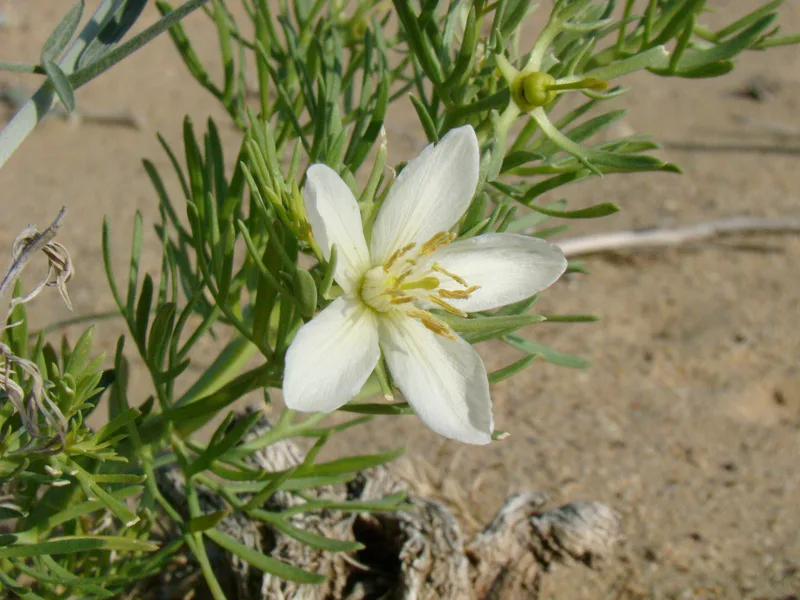
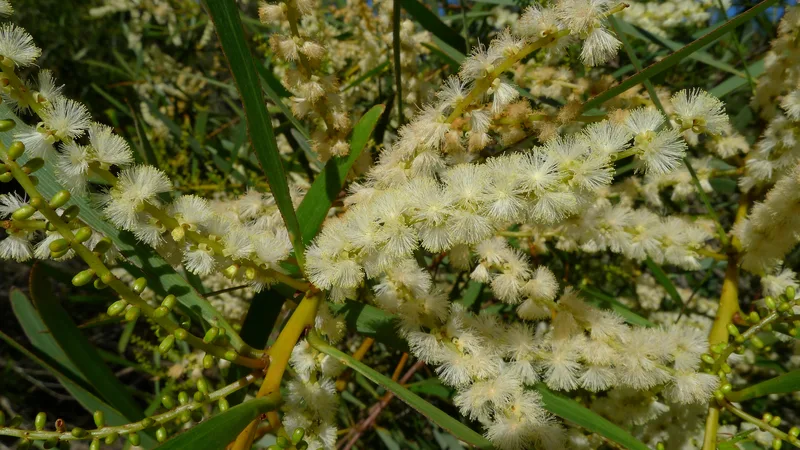
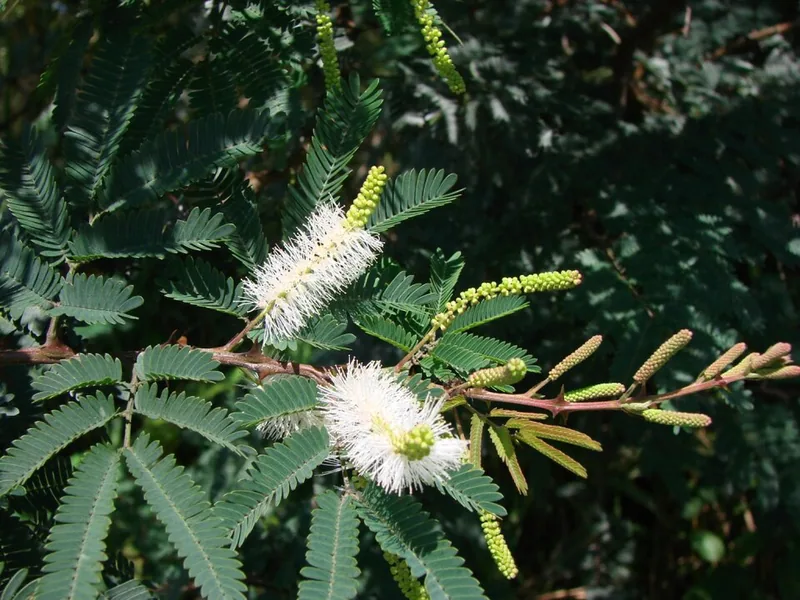
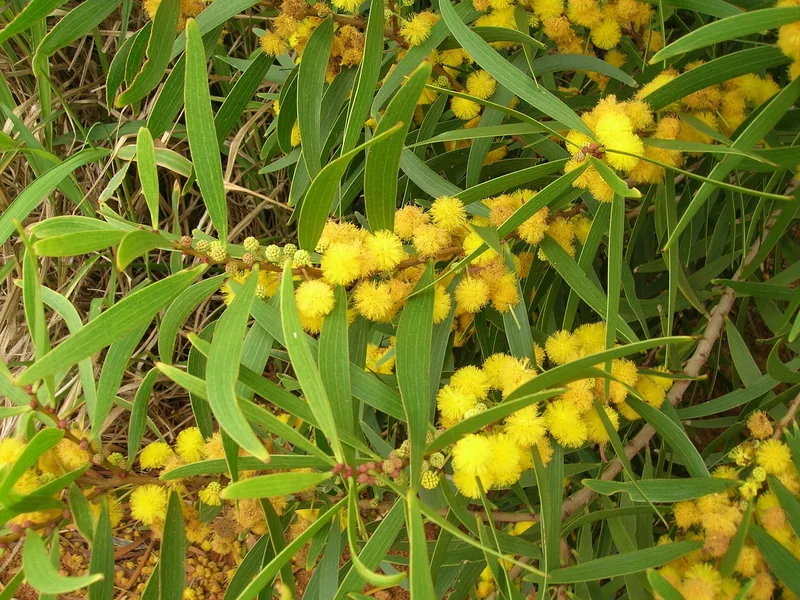
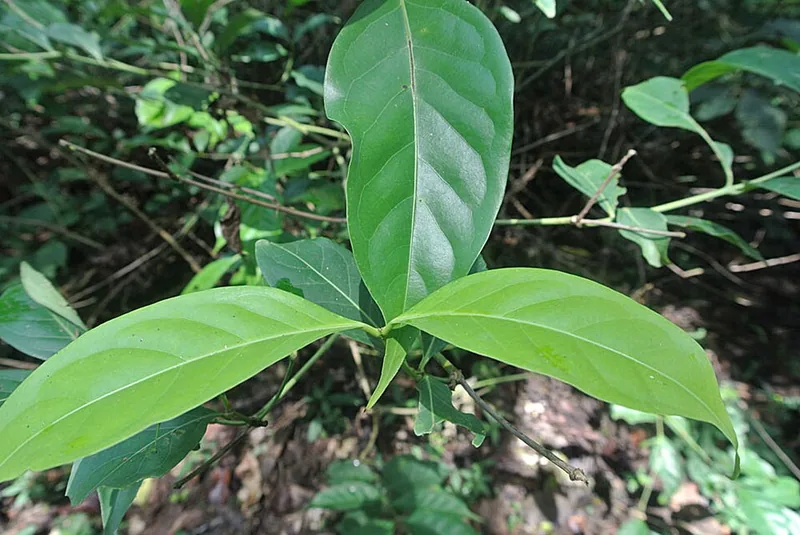
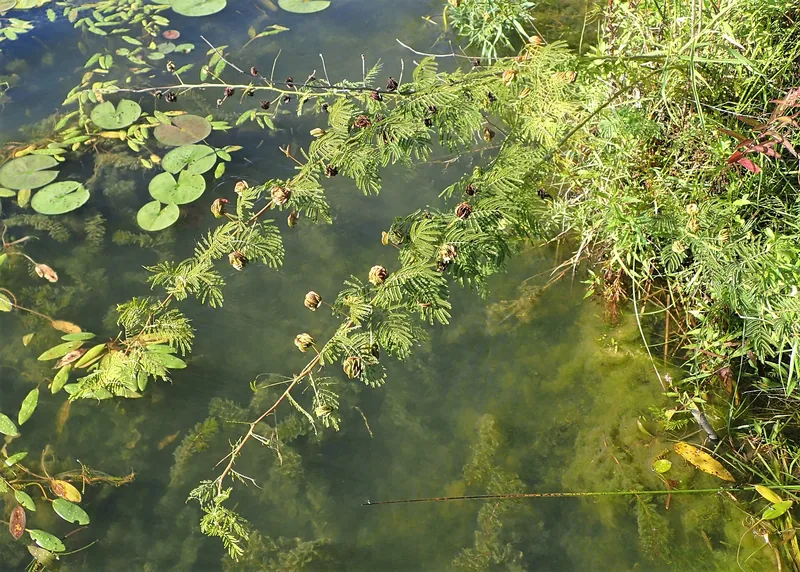
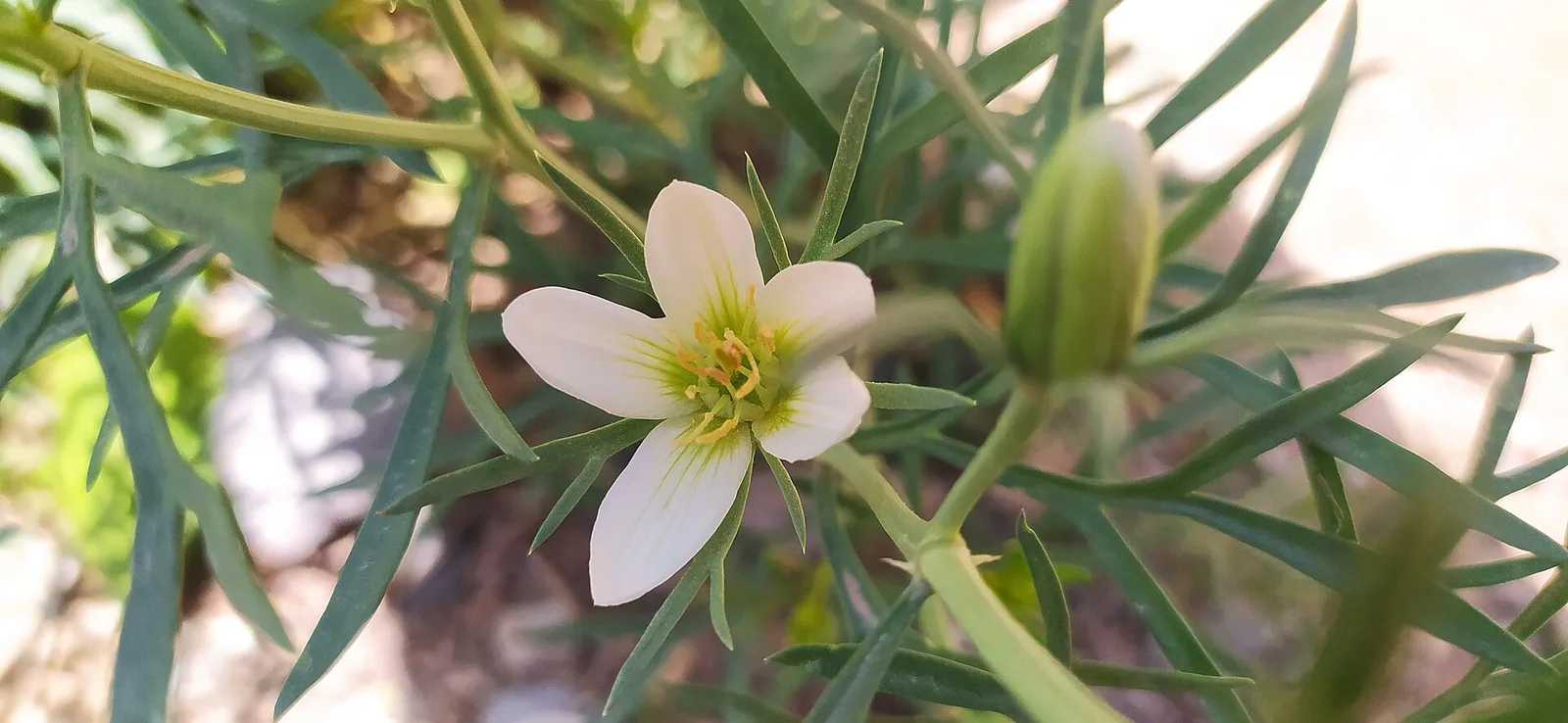
Peganum harmala in flower, wild near Baikonur, Kazakhstan: the Old World rue whose seed the analogue correspondents bioassayed as a substitute for the vine.Yuriy75 · CC BY-SA 3.0 · Wikimedia CommonsAcacia obtusifolia in flower, Woronora Reserve, New South Wales: the wattle of Nen’s 1993 encounter, which opened the Australian chapter.John Tann · CC BY 2.0 · Wikimedia Commons
What the chronology records is a modern formation, intellectual and material at once. The knowledge it rests on is Indigenous and Amazonian: oral tryptamine activity produced through β-carboline-bearing vine preparations. What the formation added was abstraction. Plants were reduced to functional roles, and those roles were relocated into non-Amazonian flora, isolated compounds and distributed experiments — first by post, then online.
From the start the formation was ideologically mixed. McKenna offered a prophetic, anti-materialist archaic revival. Ott combined philology, natural-products scholarship and self-experiment with an openly anti-prohibitionist “Entheogenic Reformation”. DeKorne joined practical plant information to occult and Jungian accounts of self-initiation. Later, cognitive-liberty writers translated the sovereignty of consciousness into secular rights language. What these positions shared was opposition to exclusive state, clerical or medical jurisdiction over visionary experience (Ott, 1994; 1996; Monteith, 2016; Walsh, 2016).
Figureheads
A subculture without institutions still has its authorities. In the analogue scene they were authors, editors and self-experimenters whose standing came from publication, chemical competence and a willingness to report on their own nervous systems. Several wrote under pseudonyms, and the scene’s habit of collective, half-anonymous authorship is part of its history. The cards below describe roles as the sources record them; they are not endorsements of the claims each figure made.
A student of Richard Evans Schultes, and through him of Albert Hofmann and R. Gordon Wasson, Ott translated Hofmann’s LSD: My Problem Child, co-proposed entheogen in 1979, and from 1990 ran the self-experiments behind “pharmahuasca” and “anahuasca”, the latter his name for jurema with rue. Pharmacotheon, Ayahuasca Analogues and The Age of Entheogens gave the movement its reference work, its programme and its polemic. Living on a ranch in Mexico, he hosted the Palenque Conversations, which Beatriz Labate has called a precursor of today’s psychedelic conferences (Leite, 2025; McKenna, 2025; Ott, 2001).
Terence and Dennis McKenna
Bard and pharmacologist · La Chorrera · the archaic revival
The brothers’ 1971 experiment and The Invisible Landscape made them the scene’s mythographers. Terence became its public voice, carrying hyperspace, plant intelligence and the archaic revival from lecture halls to rave culture. Dennis took the laboratory route: his 1984 paper with Towers and Abbott measured monoamine-oxidase inhibition in Amazonian plants, and his phrase “ayahuasca borealis” named the northern-hemisphere analogue (McKenna, 1991; McKenna, Towers and Abbott, 1984; St John, 2017; Davis, 2016).
Jim DeKorne
Former English teacher · editor · Jungian psychonaut
DeKorne founded the Entheogen Review in 1992 while researching Psychedelic Shamanism, as a clearinghouse for empirical reports on growing, extraction and subjective effects. The periodical was “deliberately edited not to appeal to popular drug-culture expectations”, and his own writing kept a darker register: in 1993 he wrote that DMT’s nature is “to sear away our illusions” (Lux, 2008; DeKorne, Aardvark and Trout, 2000; St John, 2017).
David Aardvark and K. Trout
Pseudonymous editors · botanical compilers
Aardvark took over the Review in 1998 and edited it until its final issue in 2008, with Keeper Trout as technical editor. (Lux, 2008; DeKorne, Aardvark and Trout, 2000).
Bigwood, Gracie and Zarkov
Precursors · underground chemists
Jeremy Bigwood, a co-author of the 1979 entheogen proposal (Ruck et al., 1979), made the single 1978 trial on which Ott later built. Gracie and Zarkov’s newsletters of the mid-1980s turned the idea of a rue-based “synthetic Ayahuasca” into a published proposal (Ott, 2001; Gracie and Zarkov, 1985).
Alexander and Ann Shulgin
Chemist and lay therapist · TiHKAL
The Shulgins’ 1997 book joined a memoir of tryptamine exploration to a catalogue of compounds, with notes on natural sources and the β-carbolines. It gave the analogue scene a chemical reference written from inside the practice of self-experiment (Shulgin and Shulgin, 1997).
Nen, Julian Palmer and Snu Voogelbreinder
The Australian wattle scene
Nen’s 1993 encounter with Acacia obtusifolia opened the Australian chapter, and Nen later insisted that acacia has “a very different profile to the ayahuascan”. Palmer’s changa carried that chapter to the world, and Voogelbreinder’s Garden of Eden catalogued its botany. Entheogenesis Australis gave the scene a gathering of its own (St John, 2017; Voogelbreinder, 2009).
The inhaled-DMT culture that grew alongside these figures, from Strassman’s clinical studies to the “hyperspace” literature, has its own entry: the psychonautic DMT complex.
The analogue library
The scene’s literature moved from the newsletter to the encyclopaedia to the academic monograph. The table records what each work contributed to the formation; its practical contents are not reproduced here.
Work
Form and circulation
What it contributed
Gracie and Zarkov, Notes from the Underground (1985)
Self-published newsletter
The first published proposal of rue as a stand-in for caapi (Gracie and Zarkov, 1985)
The Entheogen Review (1992–2008)
Quarterly; mail-order, then online
A distributed field notebook of reader reports, bioassays and cautions (Lux, 2008)
Ott, Pharmacotheon (1993; 2nd edn 1996)
Encyclopaedic monograph, small press
The reference work and its theology of “sacramental plant teachers” (Ott, 1996)
DeKorne, Psychedelic Shamanism (1994)
Trade paperback, Loompanics
Cultivation joined to a Jungian programme of self-initiation (DeKorne, 1994)
Ott, Ayahuasca Analogues: Pangaean Entheogens (1994)
127-page monograph
Tables of more than 60 plants in each of two roles, “at least four thousand” possible combinations, more than three dozen recorded experiments (Ott, 1994)
Ott, The Age of Entheogens & The Angels’ Dictionary (1995)
Essay and lexicon
The Pharmacratic Inquisition thesis and a vocabulary for entheogenic experience (Ott, 1995)
The 1992–99 correspondence gathered as a book (DeKorne, 1996; DeKorne, Aardvark and Trout, 2000)
Shulgin and Shulgin, TiHKAL (1997)
Memoir and chemical catalogue
Tryptamines and their natural sources in a single reference (Shulgin and Shulgin, 1997)
Ott, ‘Pharmahuasca’ (1999; Spanish 2001)
Journal articles
First-person experiment presented as human pharmacology (Ott, 1999; Ott, 2001)
Voogelbreinder, Garden of Eden (2009)
Self-published encyclopaedia, 509 pp.
Over 1,700 genera surveyed (Voogelbreinder, 2009)
St John, Mystery School in Hyperspace (2015)
Cultural history
The DMT underground as an object of history (St John, 2015)
Labate, Cavnar and Gearin (eds), The World Ayahuasca Diaspora (2017)
Edited academic volume
Analogues placed within the globalisation of ayahuasca (Labate, Cavnar and Gearin, 2017; St John, 2017)
Archaic revival and radical anti-prohibitionism
In this archive, the archaic revival names McKenna’s proposed recovery of forms of knowledge and social relation displaced by industrial modernity: ecstatic ritual, plant-mediated consciousness, animacy, local subsistence and direct experience. “Archaic” functioned as a critical counter-image to bureaucratic, consumer and prohibitionist society, joined in McKenna’s thought to electronic media, cybernetics and speculative futures. Monteith’s account of McKenna’s reception shows how healing discourse, political critique and religious formation converged in the psychonaut networks that carried these ideas (McKenna, 1991; Monteith, 2016).
The analogue gave this critique a material practice. Anti-prohibitionism was enacted through substitution, cultivation, chemical education, anonymous testimony and the circulation of seeds and texts. A controlled molecule might recur in unscheduled plants; a restricted Amazonian preparation might be functionally reassembled from organisms growing on another continent; practical knowledge could be copied at negligible cost. The state’s attempt to confine access met a biological and informational system with many points of entry. Ott’s “Pangaean” vocabulary names this conjunction of planetary phytochemistry and reproducible knowledge (Ott, 1994; Tupper and Labate, 2012).
The political force of the claim has exact limits. The relevant alkaloids occur across numerous taxa and continents, in some plants and not in others, and their abundance says nothing about identity, useful concentration or safety. Governments can regulate DMT, extraction, preparations, importation, possession and intended use even where the source plant itself is unscheduled. Analogue botany complicates prohibition and makes regional plant bans porous; borders and legal power remain.
Entheogen and the politics of authorised reality
Ott participated with Ruck, Bigwood, Staples and Wasson in the 1979 proposal of entheogen. The word was intended for substances used to occasion an experience interpreted as divine or sacred, distinguishing such use from the pathology implied by hallucinogen and the psychiatric history carried by psychedelic (Ruck et al., 1979). Its later countercultural use extended beyond a narrow scholarly classification. Naming a plant an entheogen could assert that visionary states had religious, ethical or epistemic value before medical validation.
McKenna and Ott often presented prohibition as more than control of toxic substances: it also delimited legitimate consciousness and protected a materialist account of reality from experiences interpreted as animate, sacred or transpersonal. That diagnosis belongs to their political cosmology; drug-control regimes have multiple historical causes, including racism, geopolitics, administrative expansion, public-health claims and moral regulation. Its importance here lies in how analogue communities understood suppression. The conflict concerned who could alter consciousness and which descriptions of the resulting experience—neurochemical event, symptom, sacrament, encounter or knowledge—public institutions would recognise.
Ritual practice: from protocol to ceremony
There is no inherited liturgy proper to the whole complex. Instead, analogue practice assembles ritual from four recurring operations. The form can be austere self-experiment, occult psychonautics, borrowed ayahuasca ceremony, Brazilian hybrid religion, therapeutic retreat or clinical session.
Research and sourcing
Books, zines, plant networks, forums, taxonomy and chemical assays establish authority. The bibliography, vendor list and chromatogram function where a lineage genealogy might function elsewhere.
Transformation and testing
Plants become extracts, powders or standardised compounds. Chemical literacy becomes ritual competence; bioassay and peer testimony produce a provisional canon.
Set, setting and mediation
Domestic altars, darkness, music, eyeshades, facilitator roles or clinical rooms frame what counts as encounter, treatment, revelation or adverse event.
Report and integration
The trip report, forum thread, therapy session or research scale returns private vision to a collective archive. Testimony is both meaning-making and data.
Where analogue ceremony borrows from a living tradition, the borrowing has a history of its own. In north-eastern Brazil the name jurema covers plants, drinks and religious forms at once. Grünewald follows its uses among Indigenous peoples, in catimbó and umbanda, and in a post-modern “neo-juremeiro” psychonautics, and treats these ritual traditions as dynamic and entangled with one another (Grünewald, 2018). The Indigenous end of that field is political as well as religious: the toré ritual was central to the twentieth-century re-emergence of Northeastern peoples once declared officially extinct, mobilising bodies, land, culture and memory as a practice of citizenship (Poets, 2021). At the other end are contemporary esoteric ceremonies in which jurema is mixed with Syrian rue as juremahuasca (Grünewald, Savoldi and Collins, 2022). An exploratory study of 26 participants in “holistic” ayahuasca and jurema rituals found the ayahuasca session higher in temporal quality, ineffability and religious quality on a mysticism scale; ethnographic observation and interviews pointed to the setting as playing a key role in the differences (Savoldi, Roazzi and Sales, 2023).
Plate 03 · toré, Xakriabá · deep view
Toré of the Xakriabá, Terra Indígena Xakriabá, Minas Gerais, 2023 — young people, children and elders in traditional rituals, held for cultural strengthening (the photographer’s description) · Xakriaba · CC BY-SA 4.0 ↗
McKenna’s Gaian futurism. The archaic revival joined rhetoric of cultural recovery to plant intelligence, the Logos, hyperspace, autonomous entities, cybernetics, novelty and machine intelligence. DMT became a communications technology between human language and an animate cosmos (McKenna, 1991; Monteith, 2016; St John, 2018a; Davis, 2019).
DeKorne’s imaginal peril. DeKorne’s world drew on Jung, occultism and shamanic literature. The visionary field could heal and instruct, but it also contained deceptive agencies and psychic danger. Self-initiation demanded discrimination as well as openness (DeKorne, 1994).
Ott’s Pangaean entheogenic reformation. If equivalent compounds occurred across world flora, sacramental access could be open everywhere. “Pangaean” named a global pharmacological commons and an anticipated reformation of consciousness (Ott, 1994; 1996).
Cognitive liberty. In secular form, sovereignty of consciousness becomes the complex’s moral cosmology: persons claim protection against imposed mental intervention and a freedom to alter their own minds. The claim contests prohibition and challenges medical systems that make legitimate access conditional on diagnosis and professional custody (Boire, 2000; Walsh, 2016; González Romero, 2023).
The Pangaean commons. Planetary distribution is imagined as a political property of life: pharmacological possibility exceeds the territorial monopoly of any state or market. The claim concerns recurring biochemical roles; the plants stay distinct, and culturally situated traditions stay their owners’.
Authorised reality. McKenna and Ott read prohibition as an epistemic institution that privileges materialist explanation and disciplines experiences interpreted as sacred, animate or transpersonal. This is a countercultural theory of state power, and one strand in the causal history of drug control (Ott, 1996; Monteith, 2016).
The speculative canon
Alongside its botany the scene produced a body of speculation: theories of history, evolution, time and the mind that were argued in books, retold in lectures and repeated on forums until they became common property. They are recorded here as an anthropologist would record a cosmology — for what they meant to those who held them and what work they did — and not as findings. Each is graded conjectural: a reasoned hypothesis without direct evidence. Where scholars have assessed one, the assessment is given beside it. Read together, the theories supply what religions usually supply: a sacred history, an account of human origins, an eschatology, a cosmology, a theory of the soul and a liturgical language. Monteith reads McKenna’s reception as the formation of a “psychonaut religion”; Davis, writing of the brothers McKenna, calls the result a “weird naturalism” (Monteith, 2016; Davis, 2016).
A sacred history: the Pharmacratic Inquisition. Ott’s The Age of Entheogens offers “a radical reexamination of the history of western civilization”. In it, a “Pharmacratic Inquisition” brutally suppressed ecstatic, experiential religions, leaving the West with the “placebo sacraments” of “purely symbolic religions”. The remedy is an “Entheogenic Reformation” that restores genuine entheogens to worship. The vocabulary is borrowed from the Protestant Reformation and turns it against its source: here the reformers return to the sacrament rather than away from it. Rendi Case, reviewing it for Erowid, summed up the book’s appeal as winning back “that real ‘old time religion’: the original, organic practice of direct experience of the spirit through entheogens”. Pharmacotheon had already framed prohibition as “first and foremost” a limitation on religion (Ott, 1995; Case, 2007; Ott, 1996).
A liturgical language: the Angels’ Dictionary. Bound with the same book is a lexicon of 318 words about “sacred inebriants, ecstatic states and kindred topics”: 290 definitions, 445 quotations in six languages, 37 neologisms and 70 entries drawn from 29 non-European languages. Ott presented it as an answer to Wasson’s call for a vocabulary to describe “all the modalities of a Divine Inebriant”. Inventing words is a way of making a world speakable; the dictionary is the scene’s most literal act of religion-making (Ott, 1995).
A myth of origins: the stoned ape. In Food of the Gods McKenna proposed that psilocybin-containing mushrooms in the hominin diet, by sharpening vision, raising sexual activity and occasioning ecstatic experience, drove the rapid reorganisation of the brain’s information-processing capacities. Rodríguez Arce and Winkelman, reviewing the evolutionary literature, conclude that psychedelics were not the “missing link” and that a simplistic version of McKenna’s account “is most certainly false”, though they argue that more careful hypotheses about psychedelics and human sociality deserve examination (McKenna, 1992; Rodríguez Arce and Winkelman, 2021).
A theory of history: partnership and domination. The same book set the archaic revival inside a larger story in which early egalitarian societies organised around plant-induced ecstasy were displaced by a “dominator culture” whose patriarchal and monotheistic institutions suppressed the plants. The story explains the present as a fall and makes the analogue a means of return — the structure of a redemption myth (McKenna, 1992; Monteith, 2016).
An eschatology: Timewave Zero. From the revelation at La Chorrera the brothers derived, in The Invisible Landscape, a mathematical model of “novelty” in time. Hanegraaff traces the millenarian expectation attached to 21 December 2012 to this “Eschaton Timewave”, which charted history as a wave of increasing novelty converging on a single end-point. He reads it as an attempt to make sense of a single overwhelming experience — a pattern familiar from the history of religions (McKenna and McKenna, 1993; Hanegraaff, 2010).
A ritual science: the experiment at La Chorrera. Davis shows how the 1971 experiment drew on Jungian alchemy, McLuhan and science fiction, and on Terence’s unpublished 1969 Crypto-Rap. On his reading, the brothers “esotericized” media theory into an occult apparatus of resonance, sympathy and apocalyptic ontology. The episode is the scene’s model of the experiment that is also a rite (Davis, 2016; Davis, 2019).
A cosmology: hyperspace and its inhabitants. For McKenna, DMT opened onto a “hyperspace” populated by autonomous, self-transforming “machine elves”, and the mushroom was itself a sentient visitor from space. Such encounters were taken as contact with intelligences independent of the person who meets them. St John reads the “breakthrough” as a liminal aesthetic with its own conventions; the fuller phenomenology belongs to the psychonautic DMT complex (McKenna, 1991; St John, 2018a; Monteith, 2016).
A theory of the soul: the spirit gland. Rick Strassman’s hypothesis that the pineal gland produces DMT left the clinic and entered popular culture, where the gland became a “lightning rod of the soul”. St John traces its uptake in Theosophical re-evolutionism and Lovecraftian gothic, and notes that the claim that the pineal gland releases psychedelic quantities of DMT still lacks the evidence it needs (St John, 2016).
An Old World antiquity: haoma as harmel. The Deep Time record above finds no ancient analogue lineage. One hypothesis would supply one. David Flattery and Martin Schwartz argued that the Indo-Iranian sacred drink haoma (Vedic soma) was prepared from Peganum harmala, with ephedra as a lesser ingredient. If it held, the analogue’s β-carboline would have a sacramental history in the Old World. The Encyclopaedia Iranica judges the proposal “open to strong objections” (Flattery and Schwartz, 1989; Taillieu, 2003).
A sacred landscape: the wattle continent. McKenna’s remark that “the Acacia ecology of Australia is jammed with DMT” turned a botanical observation into a promise of abundance. The scene’s own chronicler records the cost of that promise in commercial harvest, and Nen’s caution that acacia has “a very different profile to the ayahuascan”. Claims of precolonial Aboriginal entheogenic use belong to the same imaginative territory and are treated with caution elsewhere on this page (St John, 2017).
The canon’s durability owes more to what it does than to what it proves. It gives a dispersed, legally exposed community a shared past (an inquisition), a destiny (a reformation, an end of history), a home (hyperspace, the archaic) and a language (the Angels’ Dictionary). These are the ordinary materials of new religious movements, and they have been studied as such (Monteith, 2016; Hanegraaff, 2010; Davis, 2016).
Shamanism, healing and the problem of authority
“Neoshamanism” here names an unstable field of apprenticeship, borrowing, invention and market exchange. Some contemporary ceremonies are sincere, some are not, and sincerity confers no Indigenous lineage. Analogue specialists often earn authority through experience, chemical competence, charisma, therapeutic training or a network reputation, where Indigenous specialists earn it through kinship and territorial transmission. When Amazonian songs, titles, aesthetics or claims are imported, their displacement must be made visible (Fotiou, 2016; Gearin and Calavia Sáez, 2021).
Clinical translation substitutes another authority-system: screening, ethics approval, standardised compounds, therapist dyads and validated scales. Spirits become imagery, purge becomes tolerability, revelation becomes insight, and lineage becomes protocol. This is a biopolitical change in who may produce extraordinary consciousness, under what conditions, and whose account counts as truth.
Ethnography has also unsettled the assumption that neo-shamanic ritual is simply individualist. Studying ayahuasca neoshamanism in Australia, Gearin found collectivist logics of social action in the ritual practices of ecstatic purging and visions, and read them through the anthropological notion of “dividualism”, in which the person is multiple, partible and exchangeable along social relations of obligation — a challenge to what the article’s title calls the New Age individualism orthodoxy (Gearin, 2017).
Cut-and-paste pages placed receptor diagrams beside visionary testimony; cultivation notes beside warnings; hand-drawn apparatus beside ethnography. The rough page made specialist knowledge portable and intimate.
Cyberdelic image-worlds
Fractals · rave flyers · sampled speech · early web graphics
McKenna’s voice circulated as audio sample and digital oracle. Recursive geometry, biomechanical ornament and virtual reality gave a visual language to “hyperspace” and to the conjunction of archaic plants with technical futures (Rushkoff, 1994; Davis, 2019).
Domestic ritual hardware
Glassware · scales · jars · playlists · altars
The kitchen and home laboratory collapse medicine, sacrament and experiment into one room. Their objects materialise the complex’s characteristic ambiguity: care and risk, devotion and engineering.
The trial room retains soft light, plants, music and reclining bodies while surrounding them with monitoring and documentation. “Set and setting” becomes a reproducible intervention component (Perkins et al., 2021; Bonomo et al., 2025).
02Visionary phenomenology
Analogue reports are often grouped under “ayahuasca-like,” but DMT is only one of the factors. Plant chemistry, RIMA profile, route, expectancy, nausea, social frame and the absence or presence of a ritual specialist all shape the experience. Caapi, rue, grass, Acacia and isolated compounds can be compared while each keeps its own profile.
Three voices in the archive
Jonathan Ott · systematic psychonautics
Ott’s approximately seventy pharmahuasca bioassays treated subjective experience as disciplined human pharmacology. Their enduring contribution was the demonstration that oral DMT–harmine effects could be repeatably produced and studied outside the canonical brew (Ott, 1999).
Jim DeKorne · experimental warning
A particularly violent Phalaris-derived inhalation led DeKorne to describe “a psychic hydrogen bomb go off in my brain.” It was not an oral analogue session, but the report became a cautionary legend about variable grass chemistry and psychonautic overconfidence (DeKorne, 1996).
Terence McKenna · networked gnosis
McKenna called DMT the “quintessential hallucinogen” and part of a human “birthright.” His influence lay in converting an intense private event—entities, impossible surfaces, visible language—into a public cosmology legible to cyberculture (St John, 2018a).
a psychic hydrogen bomb go off in my brain.DeKorne (1996), recalling an inhaled Phalaris-derived experiment. Salient because it resists the analogue culture’s utopian tendency; it is not a dosage model or a description of oral ayahuasca.
Temporal and intensity profiles
Form
Typical temporal envelope
Reported character and evidential limit
Oral plant analogues
Onset often within 20–60 minutes; main effects commonly 3–6 hours.
From gradual bodily threshold to overwhelming vision; highly variable plant chemistry and reporting conditions make these broad orientation ranges only (Ott, 1999).
Oral pharmahuasca
Several hours, with a slower rise and longer narrative arc than inhaled DMT.
More reproducible than unassayed plants but still strongly shaped by harmala exposure, absorption, expectation and setting (Ott, 1999).
Intranasal DMT + buccal harmine
Approximately 2–3 hours, with a deliberately extended plateau.
In 31 healthy men, the formulation was reported tolerable and controllable; the all-male healthy sample and laboratory frame sharply limit cultural and clinical generalisation (Mueller et al., 2025).
Acacia-derived oral formulation
Multi-hour supported clinical session.
Nine experienced healthy volunteers generally judged three formulations similar to ayahuasca. Open-label design, expectancy and the specialised sample prevent claims of equivalence (Bonomo et al., 2025).
Inhaled plant extracts
Seconds to minutes; abrupt peak; shorter total course.
Pharmacologically and ritually distinct from an oral analogue. Accounts can be exceptionally intense and chemically uncertain.
Recurring experiential sequence
01 · Somatic threshold
Heat, tremor, pressure, yawning, nausea, autonomic activation and a sense that the body is becoming permeable. Whether emesis is read as adverse effect, cleansing or absent feature depends on the frame.
02 · Visual structuring
Geometric filigree, saturated lattices, organic-machine morphologies and internally illuminated surfaces may organise the visual field before fully scenic imagery appears.
03 · Autobiographical intelligence
Memory replay, moral inventory, grief, shame, attachment and interpersonal scenes acquire unusual vividness and conviction. Therapeutic language calls this insight or emotional processing; other frames call it teaching.
04 · World or entity encounter
Autonomous scenes, presences, ancestors, animals, architectures, “aliens” or an impersonal intelligence may appear. The noetic force—the feeling that the vision reveals—is often more salient than visual complexity.
05 · Language and impossible media
Meaning may seem seen, sung or embodied. McKenna’s “visible language” and cyberdelic descriptions of information-rich hyperspace became templates that can also shape later reports (St John, 2018a).
06 · Return and archive
Afterglow, exhaustion, vulnerability and interpretive urgency follow. Integration with a therapist, peer group, journal or forum decides whether the event becomes symptom, revelation, artwork, research datum or life-project.
DISTINCTION
Removing bitterness, nausea or purge changes more than “delivery.” It changes bodily attention, symbolism, vulnerability and the relation between ordeal and meaning. Likewise, a clinical capsule can reproduce selected compounds while leaving behind ayahuasca as a whole social and more-than-human event.
03Contemporary transformations
Radical anti-prohibitionism
Analogue culture grew up as a practical opposition to prohibition. Its decisive discovery was that the controlled experiential principle could be reconstituted along many botanical routes: cultivated rue, regional wattles, Mimosa, selected grasses, retained caapi, the canonical leaves and isolated compounds together formed a repertoire of substitutions. Print and digital circulation added a second redundancy. Once the pharmacological roles were public knowledge, the seizure of a shipment, the closure of a supplier or the restriction of one species could simply redirect experimentation (Ott, 1994; DeKorne, 1996; Söderberg, 2022).
This was radical anti-prohibitionism in two senses. It rejected criminal punishment as the organising response to self-directed alteration of consciousness, and it challenged the premise that access required prior authorisation from the state, medicine or a recognised church. Ott’s polemical language of an “Entheogenic Reformation” cast the analogue as a means of breaking clerical and pharmacological monopolies. McKenna’s archaic revival situated prohibition within a wider critique of managed consciousness, consumer culture and ecological alienation. DeKorne’s small-press practice supplied the reproducible, provisional and corrective archive through which those ideas could become material experiments (Ott, 1994; 1996; McKenna, 1991; Monteith, 2016).
Biological distribution frustrates a plant-by-plant model of control, while government borders keep their force in law and practice. States can control a molecule, preparation, extract, act of manufacture or intended use; policing can burden some communities more heavily than others; and unscheduled status can change. The analogue’s political achievement is better described as regulatory redundancy: prohibition faces multiple species, techniques and knowledge pathways (Tupper and Labate, 2012; Walsh, 2016).
Cognitive liberty and democratisation
Cognitive liberty joins freedom from non-consensual intervention with freedom to investigate, alter and direct one’s own consciousness. Boire’s formulation emerged amid late-1990s concern with psychopharmacology, surveillance and neurotechnology; psychedelic drug policy became one instance of a wider contest over mental self-determination (Boire, 2000; Walsh, 2016; González Romero, 2023). Analogue practice gives the positive liberty claim a material infrastructure: distributed plants, an intelligible combination principle, replicable first-person inquiry and a peer archive.
Democratisation here has several layers. Geographic democratisation reduces dependence on Amazonian travel and imported flora. Technical democratisation translates an apparently singular preparation into functional roles that can be investigated by non-specialists. Epistemic democratisation admits first-person report and community knowledge alongside institutional evidence. Political democratisation treats extraordinary consciousness as a capacity whose legitimate exercise extends beyond patients, research participants and members of exempted religions.
Each layer has exclusions. Plant knowledge, secure space, time, health screening, disability access, legal counsel and the ability to absorb criminal risk are unequally distributed. Online openness can conceal expertise behind confident prose, while race and class shape who is read as an experimenter, a patient or an offender. Local sourcing may reduce a long-distance commodity chain or transfer pressure to a rare species and erase the Indigenous history from which the combination principle became known. An open pharmacological commons requires conservation, attribution, reciprocal benefit and accessible safety knowledge if “democratisation” is to describe more than dispersal.
Corporate psychedelic renaissance and medicalised access
The contemporary “psychedelic renaissance” converts selected compounds and experiences into medicines, therapy protocols, professional competencies and investment assets. This translation can produce controlled safety data, screening standards, adverse-event response, legal routes of access and public legitimacy. It also narrows the authorised purposes of altered consciousness toward diagnosable illness, measurable outcome and supervised treatment. A person becomes eligible as a patient, where the analogue writers spoke of a citizen claiming cognitive liberty; the experience enters public life through efficacy (Noorani, 2020; Walsh, 2016).
Analogue history complicates corporate accounts of innovation. Decades of illicit or legally ambiguous user practice generated botanical leads, experiential reports, interaction warnings and practical knowledge before venture-backed development. Pharmaceutical firms can formalise parts of this dispersed knowledge as compounds, salts, delivery systems, protocols and patents. Söderberg describes this movement as the conversion of “outlaw user innovation” into protected commercial assets; Marks and Cohen identify risks to competition, access and Indigenous knowledge when weak prior-art records meet expansive psychedelic patenting (Söderberg, 2022; Marks and Cohen, 2022).
Medicalisation is itself a cultural framework. Diagnosis, informed consent, therapist neutrality, psychometric scales, quiet rooms, playlists and integration appointments organise expectation and interpretation. This framework has developed expertise in screening and acute support, yet it can translate sacrament into active ingredient, teacher into drug effect, community obligation into treatment compliance and long-term practice into a limited course of sessions. Costly therapist time, restrictive trial criteria, insurance exclusions and proprietary formulations can make legal access narrower than the rhetoric of a renaissance suggests (Noorani, 2020; Langlitz, 2013).
The analogue critique is directed at exclusivity; it accepts much clinical knowledge. On this view, research and professional care can thrive without a monopoly over legitimate use. A plural governance model could recognise medical treatment, religious exercise, community practice and non-commercial adult self-direction while imposing proportionate standards for consent, advertising, ecological sourcing and facilitator accountability.
Direct access and missing institutions
Removing professional and geographic gatekeepers leaves the social capacities that make difficult experiences navigable still to be built. Analogue culture often circulates chemical concepts more readily than durable preparation, supervision and aftercare. A forum can identify an interaction or normalise a crisis; a charismatic facilitator can offer continuity or exploit dependence; a borrowed ceremonial form can stabilise attention or misrepresent its authority. The political value of access and the practical need for competent care occupy different axes.
Four infrastructures recur where decentralised practice becomes sustainable: preparation, including medication review, psychiatric and physical-health screening and explicit consent; experienced accompaniment, including boundaries, emergency planning and referral; interpretive plurality, allowing spiritual, psychological and uncertain accounts without compelled belief; and integration, including follow-up, peer support and recognition of adverse or destabilising outcomes. Their absence is a public-health and community-governance problem. Criminal prohibition can worsen it by driving practice underground, discouraging disclosure and making transparent training or quality control legally hazardous (Tupper, 2008; Perkins et al., 2021; Bouso et al., 2022).
Materialism, ontology and the freedom to interpret
McKenna’s and Ott’s anti-materialist arguments treated entheogenic prohibition as regulation of admissible reality. Experiences of plant intelligence, autonomous entities, sacred presence or transpersonal knowledge challenged institutions that recognised only intoxication, hallucination or symptom. In this analysis, criminalisation protected public order and also an epistemic hierarchy: biochemical explanation could be official, while metaphysical interpretation was privatised, medicalised or denied (Ott, 1996; Monteith, 2016).
That argument is most precise when framed as a conflict over interpretive jurisdiction; it does not require modern authorities to share one materialist motive. A neurobiological description and a sacred interpretation can coexist, compete or remain unresolved. Cognitive liberty includes room to interpret an experience without state-mandated metaphysics, clinical coercion or pressure from a ceremonial leader. It also includes freedom from imposed psychoactive states and from compulsory spiritual explanation. The political claim is that no institution should secure exclusive custody of consciousness by defining in advance every legitimate meaning it may bear.
Where the scene stands now
Three decades after the Entheogen Review’s first issue, the formation it helped to found has dispersed in several directions at once. The print correspondence has become the online forum, where DMT culture is organised around “plant allies” and pseudonymity survives as a habit. Changa, an Australian invention, circulates on the festival circuit from Portugal to Brazil. The analogue has become an object of scholarship: cultural histories, an edited volume on the ayahuasca diaspora and studies of ayahuasca’s globalisation beyond the Amazon now read the scene from outside (St John, 2017; St John, 2015; Labate, Cavnar and Gearin, 2017; Tupper, 2009).
The most striking change is institutional. Ott’s pharmahuasca, once a self-experiment, now has clinical descendants in DMT–harmine formulations tested in Zurich and Melbourne and protected by patents, as the research table below records. The critique of borrowing has also moved from the forum to the journal: arguments made within the scene in 2010 against conflating analogues with ayahuasca now sit beside academic accounts of how globalised practice can erase Indigenous shamanism (St John, 2017; Fotiou, 2016).
The founding generation is passing. Ott’s death in July 2025 closed a line of descent that ran from Schultes, Hofmann and Wasson through the 1979 entheogen proposal to the analogue. His obituarists recorded his belief that the spiritual use of entheogens was “one of the brightest human hopes” in the ecological crisis. Whether the formation keeps that hope, settles into the clinic, or remains a plural field of the two is the open question this entry leaves (Leite, 2025; McKenna, 2025).
Contemporary research
Study
What it adds
What it cannot establish
Mueller et al. (2025)
Thirty-one healthy men received intranasal DMT with buccal harmine; the combination extended effects into a 2–3-hour, controllable window and was tolerated in this setting.
Silent on efficacy, on women and on diverse clinical populations; plants, ceremony and ayahuasca equivalence were outside its design.
Bonomo et al. (2025)
First published clinical pilot of purified oral formulations derived from two unnamed Australian Acacia species and P. harmala; nine experienced healthy volunteers, supported by a therapist dyad.
The species were reported only as Acacia A/B. The small open-label sample and expectancy prevent generalisation; one high-dose participant had transient suicidal ideation that resolved with therapist intervention.
Suay et al. (2025)
Controlled DMT–harmine work investigated changes in creative dynamics, widening the research focus beyond acute intensity alone.
Laboratory creativity measures leave claims of plant intelligence or therapeutic transformation untested.
Aicher et al. (2026)
In 28 healthy men, DMT–harmine reduced post-performance embarrassment and shame in a karaoke paradigm, suggesting a testable social-emotional after-effect.
A small healthy-male experiment: short of an antidepressant trial, and silent on durable social healing.
Stojanović et al. (2026)
A scoping review mapped 26 registered interventional trials of ayahuasca, DMT and DMT–harmine, showing rapid institutional expansion and heterogeneous routes and targets.
A registered trial is a plan, and evidence comes with its results; compound studies leave whole-rite ethnopharmacology untested.
Conservation and biological threat
Species, not genera
Acacia conservation
Some wattles are common or invasive; others have tiny ranges. Acacia courtii is nationally Vulnerable in Australia and was listed Endangered in New South Wales in 2026. It was not identified as a source in the 2025 clinical paper, which withheld its two species names (Australian Government, 2026; NSW Threatened Species Scientific Committee, 2026; Bonomo et al., 2025).
Destructive plant parts
Mimosa and bark markets
Mimosa tenuiflora is globally assessed as Least Concern, but root-bark removal kills or damages individual plants. Local extraction pressure, provenance and the ethics of commodity chains lie outside that assessment (BGCI and IUCN, 2019).
Reed canary grass and rue are invasive in parts of their introduced ranges, but variable toxic alkaloids, contaminated sites and misidentification remain concerns. Abundance as a weed is no measure of fitness as a medicine (Read et al., 2020).
Amazonian displacement
Caapi supply
Substitution may reduce demand for transported vine, yet it can also preserve “ayahuasca” branding while removing Indigenous cultivators from the value chain. Global endangerment and sustainability both need local evidence.
Law and governance
Jurisdiction
Current position and analogue-specific problem
International
DMT is in Schedule I of the 1971 Psychotropic Convention. The INCB has stated that the plants themselves are not internationally controlled in the same way, and national control of preparations, extraction and possession varies (United Nations, 1971; INCB, 2011).
United States
DMT remains Schedule I under federal law. Religious protections for ayahuasca churches are case-specific; analogues, home manufacture and secular cognitive-liberty claims fall outside them (US Government, 2026).
United Kingdom
DMT is a Class A, Schedule 1 controlled drug; preparations intended to contain it carry severe legal risk, whatever the plant’s own status (UK Government, 2026).
Brazil
CONAD Resolution No. 1/2010 regulates religious ayahuasca use. Juremahuasca, pharmahuasca and substitutions outside recognised ayahuasca practice lie outside its framework (CONAD, 2010).
Australia
The 2025 Acacia pilot reports that DMT and harmala alkaloids were Schedule 9 substances available in that study only through research permits, native plant or not (Bonomo et al., 2025).
Legal information changes and is not legal advice. The analogue complex is particularly exposed to uncertainty because plant, preparation, isolated compound, intention, extraction and religious context may be treated differently.
Patents: from prior art to proprietary route
The DMT–harmala principle is old knowledge and implausible as a new invention. Contemporary patents instead target salts, solubility, delivery routes, kits, devices and therapeutic use. WO2021259962A1, assigned to the University of Zurich, concerns DMT–harmine combinations and non-oral administration; WO2024023274A2, assigned to Reconnect Labs AG, concerns soluble harmine formulations; US11235110B1 claims a vaporisation delivery system for “ayahuasca-like” substances (Dornbierer, Kosanic and Scheidegger, 2021; Dornbierer et al., 2024; Ellis, 2022).
ASYMMETRY
Indigenous combination knowledge can be treated as unownable prior art while a salt, device, route or clinical claim becomes private property. The analogue sits at a sharp frontier between cognitive commons and pharmaceutical enclosure.
04Linked species
These are constituent pages. Each species carries its own ecology, chemistry and cultural history beyond the analogue complex.
AMAZONIAN PRECEDENT ANALYSEDVine and leaf chemistry, 1967–72
UNDERGROUND BIOASSAYBigwood 1978; Gracie and Zarkov 1985
TERMINOLOGICAL TURNEntheogen, 1979
CORRESPONDENCE NETWORKEntheogen Review, 1992–2008
AUSTRALIAN ACACIASydney, 1993
PRINT FORMATIONOtt and DeKorne, 1994
RIGHTS TURNCognitive liberty, 1999–2003
SMOKING BLENDChanga, 2003–04
CORPORATE–CLINICAL TURNDMT–harmine patents and trials, 2021–26
END OF THE FOUNDING GENERATIONOtt dies, 2025
The common analogue flora
Unlike canonical ayahuasca, the analogue complex has no universal botanical pair. The large cards identify its most recurrent RIMA and tryptamine-source plants; the smaller field shows canonical crossover plants, regional wattles, grasses and prairie alternatives.
The most widely circulated non-Amazonian source of reversible MAO-A inhibition in analogue practice. Rue brings to the complex its own Central and West Asian medicinal, fumigatory and apotropaic histories.
Functional role
RIMA source · often substitutes for caapi
Compounds
Harmine · harmaline · related β-carbolines
Modern position
Anahuasca · juremahuasca · acaciahuasca · experimental and clinical formulations
Many analogues substitute only the tryptamine-bearing partner and retain caapi. Such hybrids preserve the vine’s harmine–tetrahydroharmine profile and sometimes its ritual prestige while moving into new botanical, legal and cultural assemblages.
A major DMT-bearing plant in modern analogue circulation and the source behind the name juremahuasca. Its recruitment into an analogue pair must remain distinct from the far older and culturally specific Jurema religious complex of northeastern Brazil.
Functional role
Tryptamine source · paired with rue or caapi
Principal compound
N,N-dimethyltryptamine (DMT)
Cultural boundary
Analogue use is one modern branch of a much older Jurema religion
One of the most visible wattles in transnational analogue discourse and commerce. Its prominence belongs to contemporary circulation, with no evidenced ancient sacramental lineage; alkaloid claims remain dependent on verified taxon, plant part and provenance.
Functional role
Tryptamine-source wattle · commonly paired with rue or caapi
Compounds
DMT and related alkaloid claims are tissue- and provenance-specific
Modern position
Acaciahuasca · online ethnobotany · global plant trade
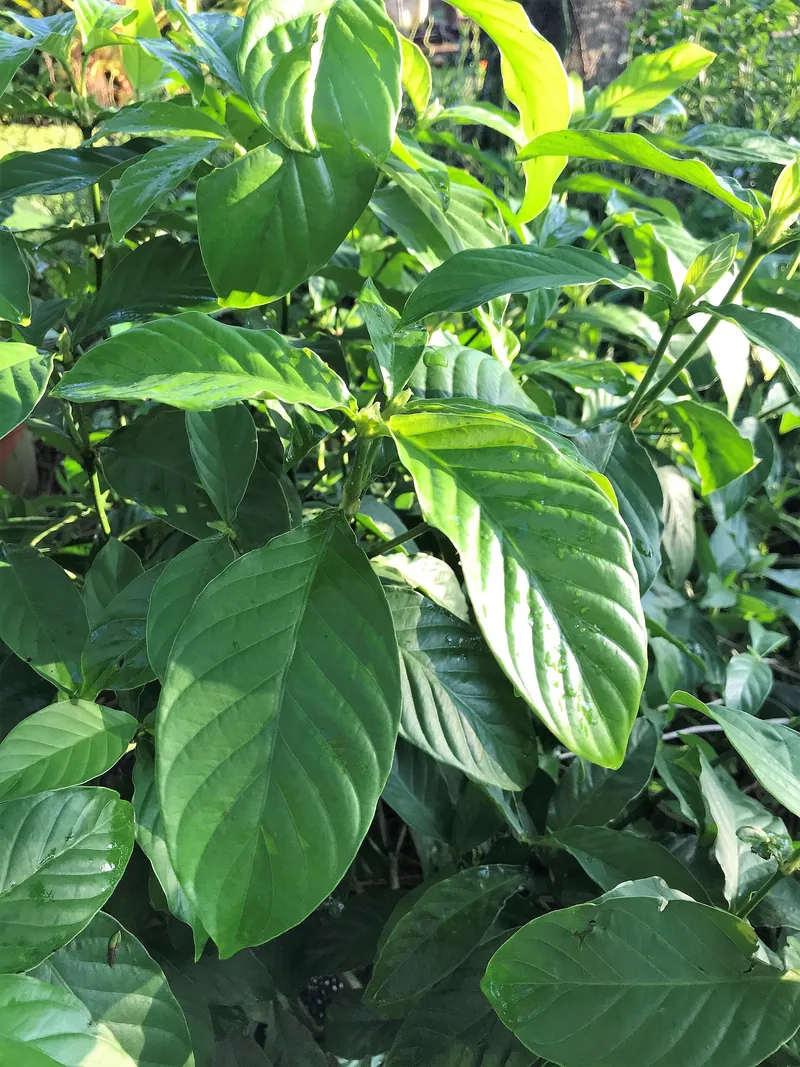
The principal ayahuasca leaf may be paired with rue. The ceremony, authority and cosmology of an Amazonian rite stay behind unless they are carried over too.
Dick Culbert from Gibsons, B.C., Canada · CC BY 2.0 · Wikimedia Commons
A north-western Amazonian co-principal sometimes recruited into noncanonical RIMA pairings; its culturally dense yagé relations travel only partly with its chemistry.
A North American native recruited into the analogue field; the cultural name is more stable than evidence for consistently useful alkaloid expression.
Card scale indicates prominence in analogue literature, exchange networks and practice; safety, chemical reliability and cultural legitimacy are separate questions. Every plant remains a variable biological population.
A tryptamine-bearing plant and a reversible monoamine oxidase-A inhibitor (RIMA) are brought into one pharmacological sequence, substituting one or both functional roles of the canonical Banisteriopsis caapi–Psychotria viridis/Diplopterys cabrerana assemblage (McKenna et al., 1984; Ott, 1999).
Boundary of the complex
Plant-based analogues; hybrid preparations retaining caapi or an Amazonian leaf; and pharmahuasca, in which isolated or synthesised compounds replace the plants. The boundary is functional.
Associated compounds
Principally N,N-dimethyltryptamine (DMT), harmine, harmaline and tetrahydroharmine (THH). Depending on species, tissue, season and processing, N-methyltryptamine, 5-MeO-DMT, gramine, hordenine and other alkaloids may complicate the picture (Mack, Mulvena and Slaytor, 1988; Callaway, Brito and Neves, 2005; Santos et al., 2020).
Names in circulation
Anahuasca is Ott’s broad term; juremahuasca, acaciahuasca and prairiehuasca name locally available tryptamine sources; pharmahuasca names the isolated-compound logic. These are unstable vernacular categories, and composition varies within each.
Preparation principle
Identification and sourcing are followed by some form of assay, transformation or standardisation; the two pharmacological roles are sequenced inside a chosen setting; experience is then narrated and integrated. This page intentionally gives no extraction method, ratio or dose: chemical variability, botanical misidentification and RIMA drug interactions make the recipe-form an irresponsible reduction of the complex.
Combines a Central and West Asian medicine with American or Australasian tryptamine plants.
Rue is richer in harmaline and lacks caapi’s characteristic THH profile.
Calling rue “the cheap MAOI” erases its own medicinal, fumigatory and apotropaic histories (Moloudizargari et al., 2013).
Compounds replace plants
DMT + harmine / harmaline · capsules, buccal or intranasal systems
Maximises reproducibility and separates route, duration and tolerability from the whole brew.
Makes the Indigenous pharmacological principle legible to trials, regulators and patents.
Also reveals what standardisation removes: taste, purge, plant relation and ceremonial authority.
The analogue matrix
Functional role
Principal plants / compounds
Ethnobotanical and chemical distinction
Amazonian RIMA vine
Banisteriopsis caapi
Harmine and THH usually predominate; a culturally dense teacher-plant whose ritual identity reaches well past MAO-A inhibition (Callaway, Brito and Neves, 2005; Santos et al., 2020).
Pangaean RIMA substitute
Peganum harmala
Harmine and harmaline-rich seeds; long-standing fumigant, medicinal and apotropaic uses precede the analogue complex by centuries (Moloudizargari et al., 2013).
Canonical Amazonian leaves
Psychotria viridis; Diplopterys cabrerana
DMT-bearing ayahuasca/yagé companions. The social relations of an Amazonian rite stay behind unless they are carried over too.
Jurema source
Mimosa tenuiflora
DMT-bearing root bark; independently central to northeastern Brazilian jurema traditions. Its analogue use is a modern branch of a much older religion (Gaujac et al., 2012; Grünewald, Savoldi and Collins, 2022).
Acacia sources
Acacia confusa, A. acuminata and other species
Global and Australian networks use several wattles, but alkaloid profiles vary by taxon, tissue and provenance, so “Acacia” names many chemistries.
Cosmopolitan, cultivable and radically variable. Some chemotypes contain DMT or 5-MeO-DMT; gramine/hordenine and livestock toxicity make abundance a poor proxy for safety (Mack, Mulvena and Slaytor, 1988; Read et al., 2020).
Prairie source
Desmanthus illinoensis
Associated with “prairiehuasca” in North American networks; evidence for reliable alkaloid yield is less consistent than the name suggests.
Isolated pair
DMT + harmine/harmaline
Pharmahuasca removes taxonomic ambiguity and enables controlled pharmacokinetics, while transforming a plant relation into a formulation (Ott, 1999; Mueller et al., 2025).
Combination pharmacology
Oral DMT is normally metabolised rapidly by monoamine oxidase-A in the gut and liver. Harmine and harmaline reversibly inhibit MAO-A, allowing DMT to reach systemic circulation; DMT’s psychedelic effects are then mediated chiefly through serotonergic receptors including 5-HT2A (McKenna et al., 1984; Riba et al., 2003). Yet the popular metaphor of a simple “key” and “lock” is incomplete. Harmala alkaloids have central effects of their own, THH contributes a different profile, routes of administration reshape the time-course, and whole plants add variable minor alkaloids (Callaway, Brito and Neves, 2005; Rodríguez et al., 2022).
The analogue literature tested this pharmacology by self-experiment. Ott summarised some seventy psychonautic bioassays by eight self-experimenters of “pharmahuasca” — capsules of crystalline DMT with harmine — and of other pairings of tryptamines with β-carbolines, and read them as confirming the 1967 Holmstedt–Lindgren hypothesis that DMT becomes active by mouth when β-carbolines taken with it inhibit monoamine oxidase (Ott, 1999). The first measurements in human plasma came from a ceremony. When hoasca was prepared and given in a ceremonial context to fifteen volunteers, peak psychoactivity coincided with high alkaloid concentrations; DMT reached its peak on average at 107.5 ± 32.5 minutes and its parameters correlated with harmine’s, while tetrahydroharmine, a weak inhibitor of serotonin uptake, followed a course relatively independent of harmine (Callaway et al., 1999). Harmine has actions of its own. A review of its pharmacology lists, beside MAO inhibition, actions at 5-HT2A and imidazoline receptors and inhibition of the kinase DYRK1A and of the dopamine transporter, and records the botanical (“anahuasca”) and synthetic (“pharmahuasca”) substitutes as a recent development in ayahuasca use (Brierley and Davidson, 2012).
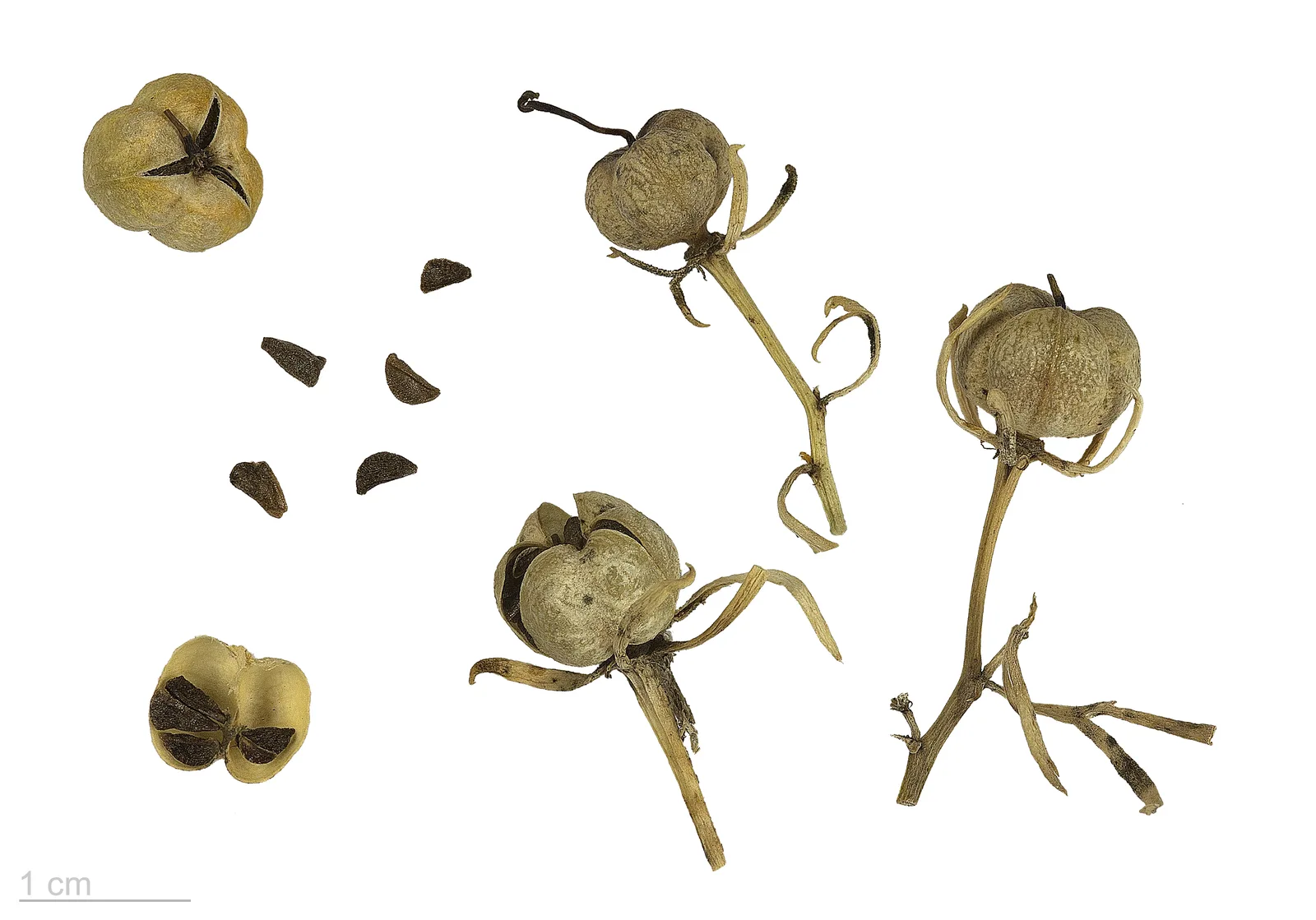
Plate 02 · Peganum harmala, fruit and seeds · deep view
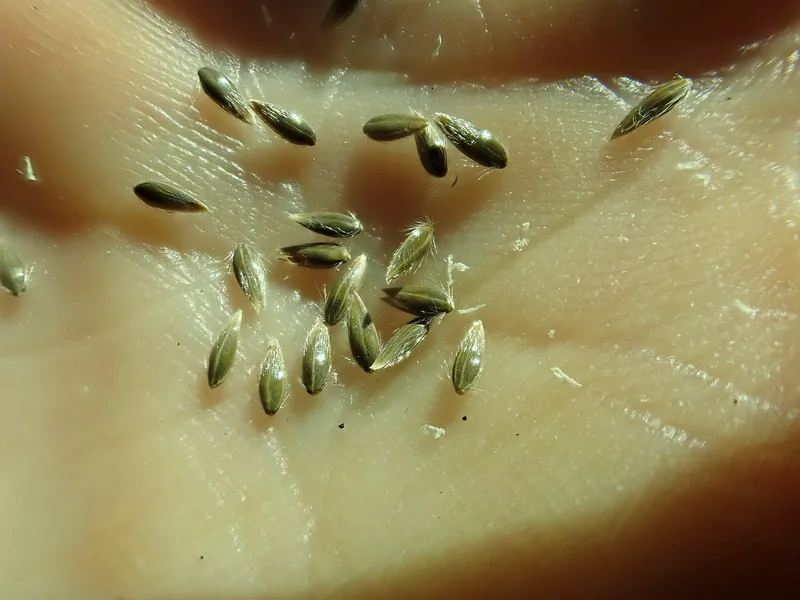
Peganum harmala (esfand), fruit and seeds · Muséum de Toulouse, MHNT.BOT.2015.34.29 · Roger Culos, 2015 · CC BY-SA 3.0 ↗
RIMAs can interact dangerously with serotonergic and sympathomimetic medicines and drugs. 5-MeO-DMT has a distinct risk profile, and combining it with MAO inhibition is especially hazardous. Rue toxicity, pregnancy risk, psychiatric vulnerability and uncertain grass or Acacia chemistry require expert screening; botanical abundance and online testimony are not safety evidence (Berdai et al., 2014; Bouso et al., 2022).
05Bibliography
88 sources in 8 threads · 85 with a working locator · Harvard (Cite Them Right) · status and kind are recorded per source, not assumed
How to read the labels on each source
Source type
What kind of work it is: journal article, book, legislation, patent application, database record and so on. A word after the dot (ethnography, protologue, primary source) keeps the genre the entry was first filed under. “Unclassified” means the citation does not say enough to tell.
Peer review
Recorded for each work separately, and only where it has been confirmed for that work. It is never inferred from a DOI, a publisher or a journal, since journals also publish editorials, letters and commentaries. Where it has not been confirmed, the entry records it as not established. It does not apply to legislation, court decisions, treaties, patents, datasets, database and collection records, historical texts, films, talks, press releases or web pages.
Check
What was checked when the entry was added. DOI checked: the DOI’s registry record (Crossref) matched the citation’s title, first author and year. Verified: the record itself was opened and matched the citation: a library catalogue record for a book, or the page itself for a database entry, law, patent or archive document. “Verified (abstract)” and “(summary)” mean only the abstract or a summary was read. Located: a record was found but not fully matched. Bibliographic record and Stable record (in essays): a catalogue or stable web record exists; what was checked against it is not recorded. Unverified: no check is recorded. No locator found: a search found no record. Secondary: read through another source.
What the labels do not say
None of them means the source supports a particular sentence. Where a sentence is graded, its evidence note names its sources and whether each supports it, disputes it or gives context. Dates and reviewers of checks are not recorded for each entry; the version note at the foot of a graded page dates its last review.
01 Foundational psychonautics and print networks
DeKorne, J. (1994) Psychedelic shamanism: the cultivation, preparation, and shamanic use of psychotropic plants. Port Townsend, WA: Loompanics Unlimited.
VerifiedBookPeer review not establishedOpen record ↗cited 4× in this record
DeKorne, J. (ed.) (1996) Ayahuasca analogues and plant-based tryptamines: the best of The Entheogen Review 1992–1996. El Rito, NM: The Entheogen Review.
UnverifiedBookPeer review not establishedcited 5× in this record
McKenna, T. (1991) The archaic revival. San Francisco, CA: HarperSanFrancisco.
VerifiedBookPeer review not establishedOpen record ↗cited 6× in this record
McKenna, T. (1992) Food of the gods: the search for the original tree of knowledge. New York: Bantam.
VerifiedBookPeer review not establishedOpen record ↗cited 2× in this record
McKenna, T. and McKenna, D. (1993 [1975]) The invisible landscape: mind, hallucinogens, and the I Ching. San Francisco: HarperSanFrancisco.
VerifiedBookPeer review not establishedOpen record ↗cited 2× in this record
Monteith, A. (2016) ‘“The words of McKenna”: healing, political critique, and the evolution of psychonaut religion since the 1960s counterculture’, Journal of the American Academy of Religion, 84(4), pp. 1081–1109. Available at: https://doi.org/10.1093/jaarel/lfw010.
DOI checkedJournal articlePeer review not establishedOpen record ↗cited 12× in this record
Ott, J. (1994) Ayahuasca analogues: Pangaean entheogens. Kennewick, WA: Natural Products Co.
VerifiedBookPeer review not establishedOpen record ↗cited 8× in this record
Ott, J. (1996) Pharmacotheon: entheogenic drugs, their plant sources and history. 2nd edn. Kennewick, WA: Natural Products Co.
VerifiedBookPeer review not establishedOpen record ↗cited 8× in this record
Ruck, C.A.P., Bigwood, J., Staples, D., Ott, J. and Wasson, R.G. (1979) ‘Entheogens’, Journal of Psychedelic Drugs, 11(1–2), pp. 145–146. Available at: https://doi.org/10.1080/02791072.1979.10472098.
DOI checkedJournal articlePeer review not establishedOpen record ↗cited 3× in this record
Rushkoff, D. (1994) Cyberia: life in the trenches of hyperspace. London: Flamingo.
VerifiedBookPeer review not establishedOpen record ↗cited 2× in this record
Turner, F. (2006) From counterculture to cyberculture: Stewart Brand, the Whole Earth Network, and the rise of digital utopianism. Chicago: University of Chicago Press.
VerifiedBookPeer review not establishedOpen record ↗cited 1× in this record
Davis, E. (2019) High weirdness: drugs, esoterica, and visionary experience in the seventies. Cambridge, MA: MIT Press.
VerifiedBookPeer review not establishedOpen record ↗cited 4× in this record
St John, G. (2018a) ‘The breakthrough experience: DMT hyperspace and its liminal aesthetics’, Anthropology of Consciousness, 29(1), pp. 57–76. Available at: https://doi.org/10.1111/anoc.12089.
DOI checkedJournal articlePeer review not establishedOpen record ↗cited 4× in this record
St John, G. (2018b) ‘Gnosis potency: DMT breakthroughs and paragnosis’, in Labate, B.C. and Cavnar, C. (eds.) Plant medicines, healing and psychedelic science. Cham: Springer, pp. 205–222.
DOI checkedBook chapterPeer review not establishedOpen record ↗
Gracie and Zarkov (1985) ‘Three beta-carboline containing plants as potentiators of synthetic DMT and other indole psychedelics’, Notes from the Underground, 7. Gracie and Zarkov Productions. Available at: Erowid (Accessed: 17 October 2026).
VerifiedInstitutional report or publication · newsletterPeer review not establishedOpen record ↗cited 3× in this record
Ott, J. (1995) The age of entheogens & the angels’ dictionary. Kennewick, WA: Natural Products Co.
VerifiedBookPeer review not establishedOpen record ↗cited 4× in this record
Shulgin, A. and Shulgin, A. (1997) TiHKAL: the continuation. Berkeley, CA: Transform Press.
VerifiedBookPeer review not establishedOpen record ↗cited 3× in this record
DeKorne, J., Aardvark, D. and Trout, K. (eds) (2000) Ayahuasca analogues and plant-based tryptamines: the best of The Entheogen Review 1992–1999. 2nd edn. Sacramento, CA: The Entheogen Review (ER Monograph Series, 1). Available at: Erowid (Accessed: 17 October 2026).
VerifiedBookPeer review not establishedOpen record ↗cited 5× in this record
Case, R. (2007) ‘Review of The age of entheogens & the angels’ dictionary by Jonathan Ott’, Erowid, 18 May. Available at: https://www.erowid.org/library/review/review.php?p=229 (Accessed: 17 October 2026).
VerifiedWeb page · book reviewPeer review not applicableOpen record ↗cited 2× in this record
Lux (2008) ‘The Entheogen Review’, Erowid Extracts, 15. Available at: https://www.erowid.org/library/periodicals/journals/journals_ter_article1.shtml (Accessed: 17 October 2026).
VerifiedInstitutional report or publication · newsletterPeer review not establishedOpen record ↗cited 6× in this record
Voogelbreinder, S. (2009) Garden of Eden: the shamanic use of psychoactive flora and fauna, and the study of consciousness. Self-published.
VerifiedBookPeer review not establishedOpen record ↗cited 3× in this record
Leite, M. (2025) ‘Jonathan Ott, apostle for jurema and entheogens, dies at 76’, Chacruna, 8 July. Available at: https://chacruna.net/jonathan-ott-apostle-for-jurema-and-entheogens-dies-at-76/ (Accessed: 17 October 2026).
VerifiedWeb page · obituaryPeer review not applicableOpen record ↗cited 3× in this record
McKenna, D. (2025) ‘View from the far side: reflections and remembrance of Jonathan Ott’, McKenna Academy of Natural Philosophy, 8 July. Available at: https://mckenna.academy/reflections-and-remembrance-of-jonathan-ott/ (Accessed: 17 October 2026).
VerifiedWeb page · obituaryPeer review not applicableOpen record ↗cited 3× in this record
02 Anthropology, neoshamanism and globalisation
Fotiou, E. (2016) ‘The globalization of ayahuasca shamanism and the erasure of Indigenous shamanism’, Anthropology of Consciousness, 27(2), pp. 151–179. Available at: https://doi.org/10.1111/anoc.12056.
DOI checkedJournal articlePeer review not establishedOpen record ↗cited 2× in this record
Fotiou, E. (2020) ‘Shamanic tourism in the Peruvian lowlands: critical and ethical considerations’, Journal of Latin American and Caribbean Anthropology, 25(3), pp. 374–396. Available at: https://doi.org/10.1111/jlca.12508.
DOI checkedJournal articlePeer review not establishedOpen record ↗
Gearin, A.K. (2015) ‘“Whatever you want to believe”: kaleidoscopic individualism and ayahuasca healing in Australia’, The Australian Journal of Anthropology, 26(3), pp. 442–455.
DOI checkedJournal articlePeer review not establishedOpen record ↗cited 1× in this record
Gearin, A.K. (2017) ‘Dividual vision of the individual: ayahuasca neo-shamanism in Australia and the New Age individualism orthodoxy’, International Journal for the Study of New Religions, 7(2), pp. 199–220. Available at: https://doi.org/10.1558/ijsnr.v7i2.31955.
DOI checkedJournal articlePeer review not establishedOpen record ↗cited 1× in this record
Gearin, A.K. and Calavia Sáez, O. (2021) ‘Altered vision: ayahuasca shamanism and sensory individuality’, Current Anthropology, 62(2), pp. 138–163. Available at: https://doi.org/10.1086/713737.
DOI checkedJournal articlePeer review not establishedOpen record ↗cited 2× in this record
DOI checkedJournal articlePeer review not establishedOpen record ↗cited 1× in this record
Grünewald, R. de A., Savoldi, R. and Collins, M.I. (2022) ‘Jurema in contemporary Brazil: ritual re-actualizations, mysticism, consciousness, and healing’, Anthropology of Consciousness, 33(2), pp. 307–332.
DOI checkedJournal articlePeer review not establishedOpen record ↗cited 3× in this record
Labate, B.C., Cavnar, C. and Gearin, A.K. (eds.) (2017) The world ayahuasca diaspora: reinventions and controversies. Abingdon: Routledge.
DOI checkedBookPeer review not establishedOpen record ↗cited 3× in this record
Leite, M. (2026) ‘Juremahuasca, a sacrament to challenge all doctrines’, in Leite, M. The psychedelic science of the Jurema tree. Cham: Springer, pp. 105–120.
DOI checkedBook chapterPeer review not establishedOpen record ↗cited 1× in this record
Poets, D. (2021) ‘Citizenship and settler colonialism in Brazil: the toré ritual as a decolonial indigenous practice in the Northeast Region’, Citizenship Studies, 28(3), pp. 282–300. Available at: https://doi.org/10.1080/13621025.2021.1984504.
DOI checkedJournal articlePeer review not establishedOpen record ↗cited 1× in this record
Tupper, K.W. (2008) ‘The globalization of ayahuasca: harm reduction or benefit maximization?’, International Journal of Drug Policy, 19(4), pp. 297–303. Available at: https://doi.org/10.1016/j.drugpo.2006.11.001.
DOI checkedJournal articlePeer review not establishedOpen record ↗cited 1× in this record
Tupper, K.W. (2009) ‘Ayahuasca healing beyond the Amazon: the globalization of a traditional Indigenous entheogenic practice’, Global Networks, 9(1), pp. 117–136. Available at: https://doi.org/10.1111/j.1471-0374.2009.00245.x.
DOI checkedJournal articlePeer review not establishedOpen record ↗cited 1× in this record
St John, G. (2015) Mystery school in hyperspace: a cultural history of DMT. Berkeley, CA: Evolver Editions/North Atlantic Books.
VerifiedBookPeer review not establishedOpen record ↗cited 3× in this record
St John, G. (2017) ‘Aussiewaska: a cultural history of changa and ayahuasca analogues in Australia’, in Labate, B.C., Cavnar, C. and Gearin, A.K. (eds) The world ayahuasca diaspora: reinventions and controversies. Abingdon: Routledge, pp. 143–162.
VerifiedBook chapterPeer review not establishedOpen record ↗cited 13× in this record
03 Chemistry, botany and variability
Brierley, D.I. and Davidson, C. (2012) ‘Developments in harmine pharmacology — implications for ayahuasca use and drug-dependence treatment’, Progress in Neuro-Psychopharmacology and Biological Psychiatry, 39(2), pp. 263–272. Available at: https://doi.org/10.1016/j.pnpbp.2012.06.001.
DOI checkedJournal articlePeer review not establishedOpen record ↗cited 1× in this record
Callaway, J.C. et al. (1999) ‘Pharmacokinetics of hoasca alkaloids in healthy humans’, Journal of Ethnopharmacology, 65(3), pp. 243–256. Available at: https://doi.org/10.1016/S0378-8741(98)00168-8.
DOI checkedJournal articlePeer review not establishedOpen record ↗cited 1× in this record
Callaway, J.C., Brito, G.S. and Neves, E.S. (2005) ‘Phytochemical analyses of Banisteriopsis caapi and Psychotria viridis’, Journal of Psychoactive Drugs, 37(2), pp. 145–150.
DOI checkedJournal articlePeer review not establishedOpen record ↗cited 4× in this record
Gaujac, A., Dempster, N., Navickiene, S., Brandt, S.D. and de Andrade, J.B. (2012) ‘Determination of N,N-dimethyltryptamine in Mimosa tenuiflora inner barks by matrix solid-phase dispersion procedure and GC–MS’, Journal of Chromatography B, 881–882, pp. 107–110. Available at: https://doi.org/10.1016/j.jchromb.2011.11.014.
DOI checkedJournal articlePeer review not establishedOpen record ↗cited 1× in this record
Read, E., Reddy, P., Rendell, D. and Rochfort, S. (2020) ‘Changes in field concentrations of five phalaris alkaloids and their association with toxicity in pastures of Victoria, Australia’, Crop and Pasture Science, 71(4), pp. 389–400.
DOI checkedJournal articlePeer review not establishedOpen record ↗cited 2× in this record
Mack, J.P., Mulvena, D.P. and Slaytor, M. (1988) ‘N,N-Dimethyltryptamine production in Phalaris aquatica seedlings: a mathematical model for its regulation’, Plant Physiology, 88(2), pp. 315–320. Available at: https://doi.org/10.1104/pp.88.2.315.
DOI checkedJournal articlePeer review not establishedOpen record ↗cited 2× in this record
McKenna, D.J., Towers, G.H.N. and Abbott, F. (1984) ‘Monoamine oxidase inhibitors in South American hallucinogenic plants: tryptamine and β-carboline constituents of ayahuasca’, Journal of Ethnopharmacology, 10(2), pp. 195–223. Available at: https://doi.org/10.1016/0378-8741(84)90003-5.
DOI checkedJournal articlePeer review not establishedOpen record ↗cited 4× in this record
Moloudizargari, M., Mikaili, P., Aghajanshakeri, S., Asghari, M.H. and Shayegh, J. (2013) ‘Pharmacological and therapeutic effects of Peganum harmala and its main alkaloids’, Pharmacognosy Reviews, 7(14), pp. 199–212. Available at: https://doi.org/10.4103/0973-7847.120524.
DOI checkedJournal articlePeer review not establishedOpen record ↗cited 2× in this record
Ott, J. (1999) ‘Pharmahuasca: human pharmacology of oral DMT plus harmine’, Journal of Psychoactive Drugs, 31(2), pp. 171–177. Available at: https://doi.org/10.1080/02791072.1999.10471741.
DOI checkedJournal articlePeer review not establishedOpen record ↗cited 10× in this record
Riba, J., Valle, M., Urbano, G., Yritia, M., Morte, A. and Barbanoj, M.J. (2003) ‘Human pharmacology of ayahuasca: subjective and cardiovascular effects, monoamine metabolite excretion, and pharmacokinetics’, Journal of Pharmacology and Experimental Therapeutics, 306(1), pp. 73–83. Available at: https://doi.org/10.1124/jpet.103.049882.
DOI checkedJournal articlePeer review not establishedOpen record ↗cited 1× in this record
Rodríguez, L. et al. (2022) ‘New insights into the chemical composition of ayahuasca’, ACS Omega, 7(14), pp. 12307–12317.
DOI checkedJournal articlePeer review not establishedOpen record ↗cited 1× in this record
Santos, B.W.L., Oliveira, R.C., Sonsin-Oliveira, J., Fagg, C.W., Barbosa, J.B.F. and Caldas, E.D. (2020) ‘Biodiversity of β-carboline profile of Banisteriopsis caapi and ayahuasca, a plant and a brew with neuropharmacological potential’, Plants, 9(7), 870. Available at: https://doi.org/10.3390/plants9070870.
DOI checkedJournal articlePeer review not establishedOpen record ↗cited 2× in this record
Rivier, L. and Lindgren, J.-E. (1972) ‘“Ayahuasca,” the South American hallucinogenic drink: an ethnobotanical and chemical investigation’, Economic Botany, 26(2), pp. 101–129. Available at: https://doi.org/10.1007/BF02860772.
DOI checkedJournal articlePeer review not establishedOpen record ↗cited 1× in this record
Ott, J. (2001) ‘Pharmahuasca, anahuasca y vino de jurema: farmacología humana del DMT oral más harmina’, trans. M. Nárvaez Marín, Cultura y Droga, 6(6–7), pp. 243–262. Available at: https://revistasojs.ucaldas.edu.co/index.php/culturaydroga/article/view/7010 (Accessed: 17 October 2026).
VerifiedJournal articlePeer review not establishedOpen record ↗cited 5× in this record
VerifiedJournal articlePeer review not establishedOpen record ↗cited 3× in this record
González Romero, M. (2023) ‘Cognitive liberty and the psychedelic humanities’, Frontiers in Psychology, 14, 1128996.
DOI checkedJournal articlePeer review not establishedOpen record ↗cited 2× in this record
Langlitz, N. (2013) Neuropsychedelia: the revival of hallucinogen research since the decade of the brain. Berkeley: University of California Press.
VerifiedBookPeer review not establishedOpen record ↗cited 1× in this record
Noorani, T. (2020) ‘Making psychedelics into medicines: the politics and paradoxes of medicalization’, Journal of Psychedelic Studies, 4(1), pp. 34–39. Available at: https://doi.org/10.1556/2054.2019.018.
DOI checkedJournal articlePeer review not establishedOpen record ↗cited 3× in this record
Söderberg, J. (2022) ‘The psychedelic renaissance: a case of outlaw user innovation in the pharmaceutical industry’, Prometheus, 38(4), pp. 385–398. Available at: https://doi.org/10.13169/prometheus.38.4.0385.
DOI checkedJournal articlePeer review not establishedOpen record ↗cited 5× in this record
Tupper, K.W. and Labate, B.C. (2012) ‘Plants, psychoactive substances and the International Narcotics Control Board: the control of nature and the nature of control’, Human Rights and Drugs, 2(1), pp. 17–28.
VerifiedJournal articlePeer review not establishedOpen record ↗cited 2× in this record
Walsh, C. (2016) ‘Psychedelics and cognitive liberty: reimagining drug policy through the prism of human rights’, International Journal of Drug Policy, 29, pp. 80–87. Available at: https://doi.org/10.1016/j.drugpo.2015.12.025.
DOI checkedJournal articlePeer review not establishedOpen record ↗cited 7× in this record
05 Phenomenology, psychology and clinical translation
Aicher, H.D. et al. (2024) ‘Potential therapeutic effects of an ayahuasca-inspired N,N-DMT and harmine formulation: a controlled trial in healthy subjects’, Frontiers in Psychiatry, 14, 1302559.
DOI checkedJournal articlePeer review not establishedOpen record ↗
Aicher, H.D. et al. (2026) ‘Combined DMT–harmine formulation reduces negative self-referential emotions during social self-evaluation: a randomized placebo-controlled trial in healthy volunteers’, Psychopharmacology.
DOI checkedJournal articlePeer review not establishedOpen record ↗
Bonomo, Y.A., Norman, A.F., Collins, L., Ross, M., Dwyer, J., Perkins, D. and Sarris, J. (2025) ‘DMT and harmala alkaloids: an exploratory study of oral Acacia based formulations in healthy volunteers’, Frontiers in Psychiatry, 16, 1545915. Available at: https://doi.org/10.3389/fpsyt.2025.1545915.
DOI checkedJournal articlePeer review not establishedOpen record ↗cited 5× in this record
Mueller, M.J. et al. (2025) ‘Pharmacokinetics and pharmacodynamics of an innovative psychedelic N,N-dimethyltryptamine/harmine formulation in healthy participants: a randomized controlled trial’, International Journal of Neuropsychopharmacology, 28(1), pyaf001.
DOI checkedJournal articlePeer review not establishedOpen record ↗cited 4× in this record
Perkins, D. et al. (2021) ‘Influence of context and setting on the mental health and wellbeing outcomes of ayahuasca drinkers’, Frontiers in Pharmacology, 12, 623979. Available at: https://doi.org/10.3389/fphar.2021.623979.
DOI checkedJournal articlePeer review not establishedOpen record ↗cited 2× in this record
Savoldi, R., Roazzi, A. and Sales, R.C.O. (2023) ‘Mystical and ego-dissolution experiences in ayahuasca and jurema holistic rituals: an exploratory study’, The International Journal for the Psychology of Religion, 33(4), pp. 332–360. Available at: https://doi.org/10.1080/10508619.2023.2185369.
DOI checkedJournal articlePeer review not establishedOpen record ↗cited 1× in this record
Stojanović, T. et al. (2026) ‘Registered clinical trials of ayahuasca and DMT: a scoping review’, Clinical Pharmacology & Therapeutics, 120(1), pp. 94–108.
DOI checkedJournal articlePeer review not establishedOpen record ↗
Strassman, R.J., Qualls, C.R., Uhlenhuth, E.H. and Kellner, R. (1994) ‘Dose-response study of N,N-dimethyltryptamine in humans’, Archives of General Psychiatry, 51(2), pp. 98–108. Available at: https://doi.org/10.1001/archpsyc.1994.03950020022002.
DOI checkedJournal articlePeer review not establishedOpen record ↗
Suay, D. et al. (2025) ‘Ayahuasca-inspired DMT/harmine formulation alters creative thinking dynamics during artistic creation’, Journal of Psychopharmacology, 40(8), pp. 1292–1304.
DOI checkedJournal articlePeer review not establishedOpen record ↗
Timmermann, C. et al. (2019) ‘Neural correlates of the DMT experience assessed with multivariate EEG’, Scientific Reports, 9, 16324. Available at: https://doi.org/10.1038/s41598-019-51974-4.
DOI checkedJournal articlePeer review not establishedOpen record ↗
06 Safety and conservation
Berdai, M.A., Labib, S. and Harandou, M. (2014) ‘Peganum harmala L. intoxication in a pregnant woman’, Case Reports in Emergency Medicine, 2014, 783236.
DOI checkedJournal articlePeer review not establishedOpen record ↗cited 1× in this record
Bouso, J.C. et al. (2022) ‘Adverse effects of ayahuasca: results from the Global Ayahuasca Survey’, PLOS Global Public Health, 2(11), e0000438. Available at: https://doi.org/10.1371/journal.pgph.0000438.
DOI checkedJournal articlePeer review not establishedOpen record ↗cited 2× in this record
Australian Government (2026) Species profile and threats database: Acacia courtii. Canberra: Department of Climate Change, Energy, the Environment and Water. Available at: Species profile (Accessed: 29 July 2026).
UnverifiedLegislation or regulationPeer review not applicableOpen record ↗cited 1× in this record
BGCI and IUCN SSC Global Tree Specialist Group (2019) ‘Mimosa tenuiflora’, The IUCN Red List of Threatened Species 2019, e.T144287589A148998299.
DOI checkedDatasetPeer review not applicableOpen record ↗cited 1× in this record
NSW Threatened Species Scientific Committee (2026) Acacia courtii — final determination. Sydney: NSW Government.
UnverifiedLegislation or regulationPeer review not applicablecited 1× in this record
07 Law, governance and patents
CONAD (2010) Resolução No. 1, de 25 de janeiro de 2010. Brasília: Conselho Nacional de Políticas sobre Drogas.
UnverifiedLegislation or regulationPeer review not applicablecited 1× in this record
International Narcotics Control Board (2011) Report of the International Narcotics Control Board for 2010. New York: United Nations, paras 284–287.
VerifiedBook · primary sourcePeer review not establishedOpen record ↗cited 1× in this record
Marks, M. and Cohen, I.G. (2022) ‘Patents on psychedelics: the next legal battlefront of drug development’, Harvard Law Review Forum, 135, pp. 212–235. Available at: Harvard Law Review.
UnverifiedJournal articlePeer review not establishedOpen record ↗cited 2× in this record
Ellis, G. (2022) Delivery system for ayahuasca-like substances. US Patent US11235110B1.
VerifiedGranted patentPeer review not applicableOpen record ↗cited 1× in this record
Dornbierer, D. et al. (2024) Highly soluble formulations of harmine. International Patent WO2024023274A2 (applicant Reconnect Labs AG).
VerifiedPatent applicationPeer review not applicableOpen record ↗cited 1× in this record
UK Government (2026) Controlled drugs list. London: Home Office. Available at: GOV.UK (Accessed: 29 July 2026).
VerifiedLegislation or regulationPeer review not applicableOpen record ↗cited 1× in this record
United Nations (1971) Convention on Psychotropic Substances 1971. Vienna: United Nations.
VerifiedTreaty or conventionPeer review not applicableOpen record ↗cited 1× in this record
Dornbierer, D., Kosanic, D. and Scheidegger, M. (2021) Compositions and kits of parts comprising N,N-dimethyltryptamine and harmine and their use in therapy. International Patent WO2021259962A1 (applicant Universität Zürich).
VerifiedPatent applicationPeer review not applicableOpen record ↗cited 2× in this record
US Government (2026) ‘§1308.11 Schedule I’, Code of Federal Regulations, Title 21. Available at: eCFR (Accessed: 29 July 2026).
VerifiedLegislation or regulationPeer review not applicableOpen record ↗cited 1× in this record
08 Speculative theories and their critics
Flattery, D.S. and Schwartz, M. (1989) Haoma and harmaline: the botanical identity of the Indo-Iranian sacred hallucinogen “soma” and its legacy in religion, language, and Middle Eastern folklore. Berkeley, CA: University of California Press (Near Eastern Studies, 21).
VerifiedBookPeer review not establishedOpen record ↗cited 1× in this record
Taillieu, D. (2003) ‘Haoma i. Botany’, in Yarshater, E. (ed.) Encyclopaedia Iranica, XI(6), pp. 659–662. Available at: https://www.iranicaonline.org/articles/haoma-i (Accessed: 17 October 2026).
VerifiedReference workPeer review not establishedOpen record ↗cited 1× in this record
Hanegraaff, W.J. (2010) ‘“And end history. And go to the stars”: Terence McKenna and 2012’, in Cusack, C.M. and Hartney, C. (eds) Religion and retributive logic: essays in honour of Professor Garry W. Trompf. Leiden: Brill (Numen Book Series, 126), pp. 291–312.
VerifiedBook chapterPeer review not establishedOpen record ↗cited 3× in this record
Davis, E. (2016) ‘The weird naturalism of the brothers McKenna: esoteric media and the experiment at La Chorrera’, International Journal for the Study of New Religions, 7(2), pp. 175–198. Available at: https://doi.org/10.1558/ijsnr.v7i2.31944.
VerifiedJournal articlePeer review not establishedOpen record ↗cited 5× in this record
St John, G. (2016) ‘The DMT gland: the pineal, the spirit molecule, and popular culture’, International Journal for the Study of New Religions, 7(2), pp. 153–174. Available at: https://doi.org/10.1558/ijsnr.v7i2.31949.
VerifiedJournal articlePeer review not establishedOpen record ↗cited 1× in this record
Rodríguez Arce, J.M. and Winkelman, M.J. (2021) ‘Psychedelics, sociality, and human evolution’, Frontiers in Psychology, 12, 729425. Available at: https://doi.org/10.3389/fpsyg.2021.729425.
DOI checkedJournal articlePeer review not establishedOpen record ↗cited 1× in this record