Introduction
Anadenanthera colubrina, vilca or cebil, is a deciduous tree of the seasonally dry forests of South America whose seeds have been smoked, snuffed, drunk and offered for some four thousand years. Bufotenine is the seed’s principal alkaloid, with DMT and 5-MeO-DMT in variable amounts. Pipes and seeds from north-west Argentina date its use to about 2000 BCE, and tubes from a sealed gallery at Chavín de Huántar carry its starch with tobacco, the oldest evidence of the two taken together as snuff. Colonial writers recorded vilca as purge, drink, medicine and sacred substance, and it remains in Andean markets, mesas and Chaco practice.
All sections
| Botanical name | Anadenanthera colubrina |
|---|---|
| Taxa | Fabaceae · Fabales · Angiosperms |
| Traditional names | Vilca · willka · cebil · curupay · angico |
| Regions | Seasonally dry tropical South America. |
| Ethnographic entheogenic use | Seeds and pipes from north-west Argentina place Anadenanthera, usually A. colubrina var. cebil, in human use about four thousand years ago, and a sealed gallery at Chavín de Huántar has yielded direct evidence of vilca and wild tobacco taken together as snuff. Colonial writers recorded vilca as purge, drink, medicine and sacred substance, and peoples of the southern Andes and Chaco, among them the Comechingón, snuffed cebil (Lema, 2024; Rick et al., 2025; Ott, 2001b). |
01Ethnobotany of Anadenanthera colubrina
Botanical Info
| Accepted name | Anadenanthera colubrina (Vell.) Brenan. Vellozo published the basionym Mimosa colubrina; J.P.M. Brenan made the accepted combination in Kew Bulletin 10:182 in 1955 (Brenan, 1955; POWO, 2026). |
|---|---|
| Family | Fabaceae (Leguminosae) · subfamily Caesalpinioideae, mimosoid clade. |
| Order | Fabales. |
| Native range | Seasonally dry tropical South America. Kew’s current accepted-name backbone summarises the native range as Bolivia to Brazil; floristic and population literature extends the colubrina/cebil complex through Peru, Bolivia, Paraguay, north-west Argentina and multiple Brazilian dry-forest nuclei. Archaeological occurrence in arid coastal and highland Peru and northern Chile often records trade from warmer eastern valleys (POWO, 2026; Lema, 2024; Mangaravite et al., 2024). |
| Habitats | Caatinga, Cerrado and Atlantic dry-forest remnants in Brazil; Chiquitano and inter-Andean dry forest; piedmont forest, Chaco margins and Yungas transition in Bolivia, Paraguay and Argentina. It is drought-deciduous, light-demanding and characteristic of the disjunct Neotropical seasonally dry forest biome. |
| Local names | Willka/wilka, vilca, huilca, huilco (central and southern Andes); cebil (Argentina); curupay, curupau, kurupa’y (Paraguay, eastern Bolivia and north-east Argentina); angico, angico-branco, angico-vermelho (Brazil). Market ethnography also records bayan, yarisana, chipi/ch’ij’pi, liman and urilimpi. Vernacular names may identify seeds, remedies or ritual commodities as well as trees, and few are voucher-confirmed (Lema, 2024). |
| Historical synonyms | Mimosa colubrina Vell., Piptadenia colubrina (Vell.) Benth., Piptadenia macrocarpa Benth. and Anadenanthera macrocarpa (Benth.) Brenan occur in the literature. “A. colubrina var. cebil” remains essential for finding archaeological and ethnobotanical work even where current authors favour species rank for A. macrocarpa (POWO, 2026; Mangaravite et al., 2024). |
Territories
- 1Chavín de Huántar · bone tubes from a sealed gallery, c. 1200–400 BCE, with microbotanical and chemical evidence of vilca and wild tobacco (Rick et al., 2025)
- 2Garagay · a relief read as the discharge that follows snuffing (Ott, 2001b)
- 3San Pedro de Atacama · pipes and snuff tablets side by side, the earliest tablet AD 190 ± 100 (Llagostera, 2015); tryptamines detected in preparations (Torres et al., 1991)
- 4Inca Cueva, Jujuy · seeds and pipes of about 2000 BCE, the oldest direct evidence of vilca or cebil use (Rick et al., 2025)
- 5Tartagal, Salta · a Wichí shaman’s hatáj, roasted, ground and smoked with tobacco (Ott, 2001b)
- 6Tucumán · the Comechingón, in 1583, taking powdered sebil through the nostrils (Ott, 2001b)
Deep Time
- c. 2000 BCESeeds and smoking pipes at Inca Cueva and Huachichocana, north-west Argentina: the deepest horizon of use, by smoke or fumigation.
- c. 1350–1200 BCEPossible snuffing trays and tubes on the Peruvian coast, at Asia and Huaca Prieta.
- c. 800–350 BCEBone tubes and spoons in Gallery 3 at Chavín de Huántar carry cebil and tobacco starches: the oldest evidence of the two taken together as snuff.
- AD 190 ± 100The earliest dated snuff tablet at San Pedro de Atacama.
- c. 500–1450 CESnuff apparatus across Tiwanaku, Wari and Atacameño networks; microscopy identifies var. cebil in an archaeological powder.
- c. 905–1170 CEBufotenine in the Cueva del Chileno bundle, Bolivia, with DMT, harmine and cocaine: Anadenanthera is a strong inference.
- 1583Sotelo Narváez reports that the Comechingón of Tucumán took powdered sebil through the nostrils.
- 16th–17th centuriesAlbornoz, Guaman Poma, Cobo, Polo de Ondegardo and Bertonio record vilca as purge, enema, drink and sacred substance.
Morphology and taxonomy
Morphology and life history
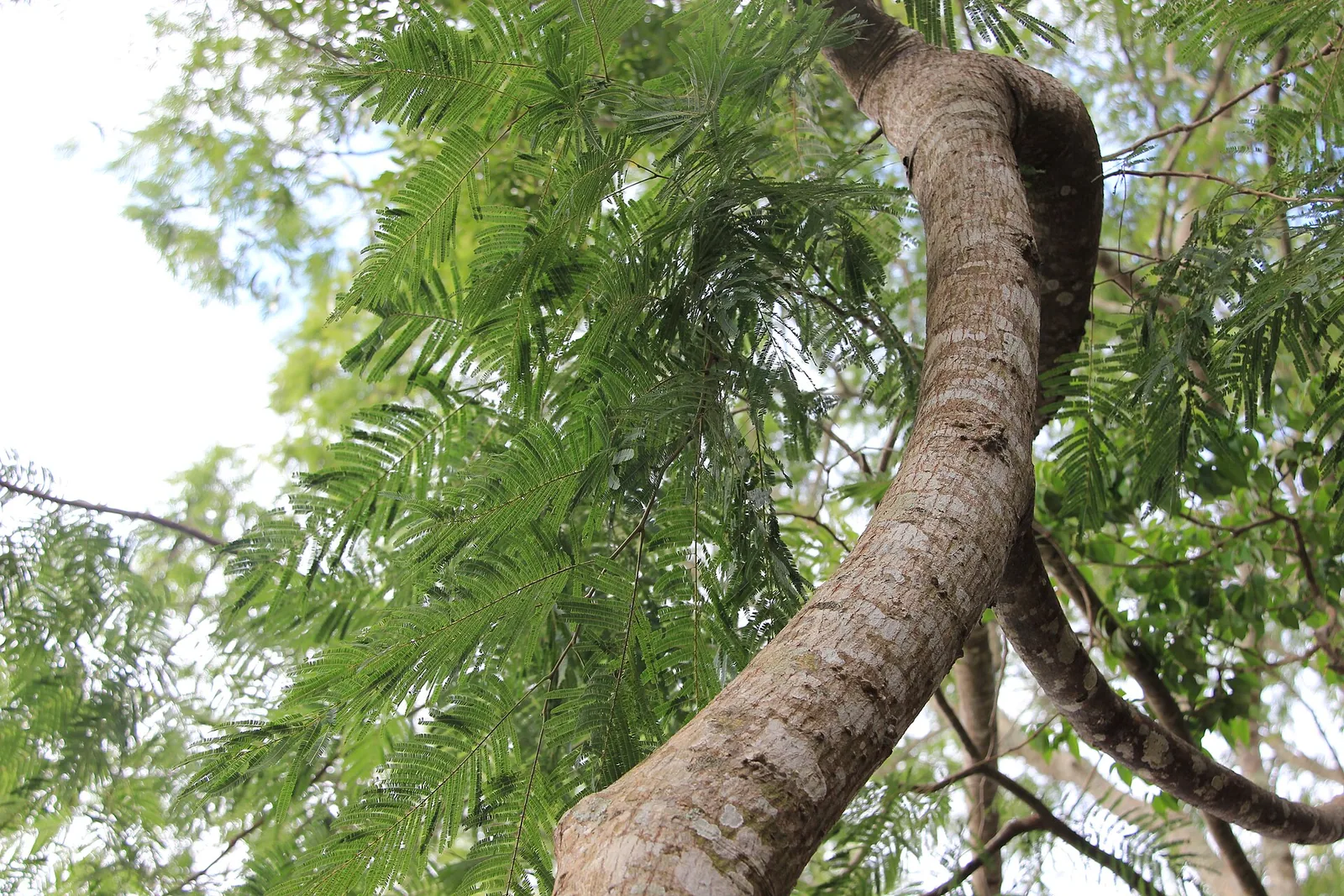
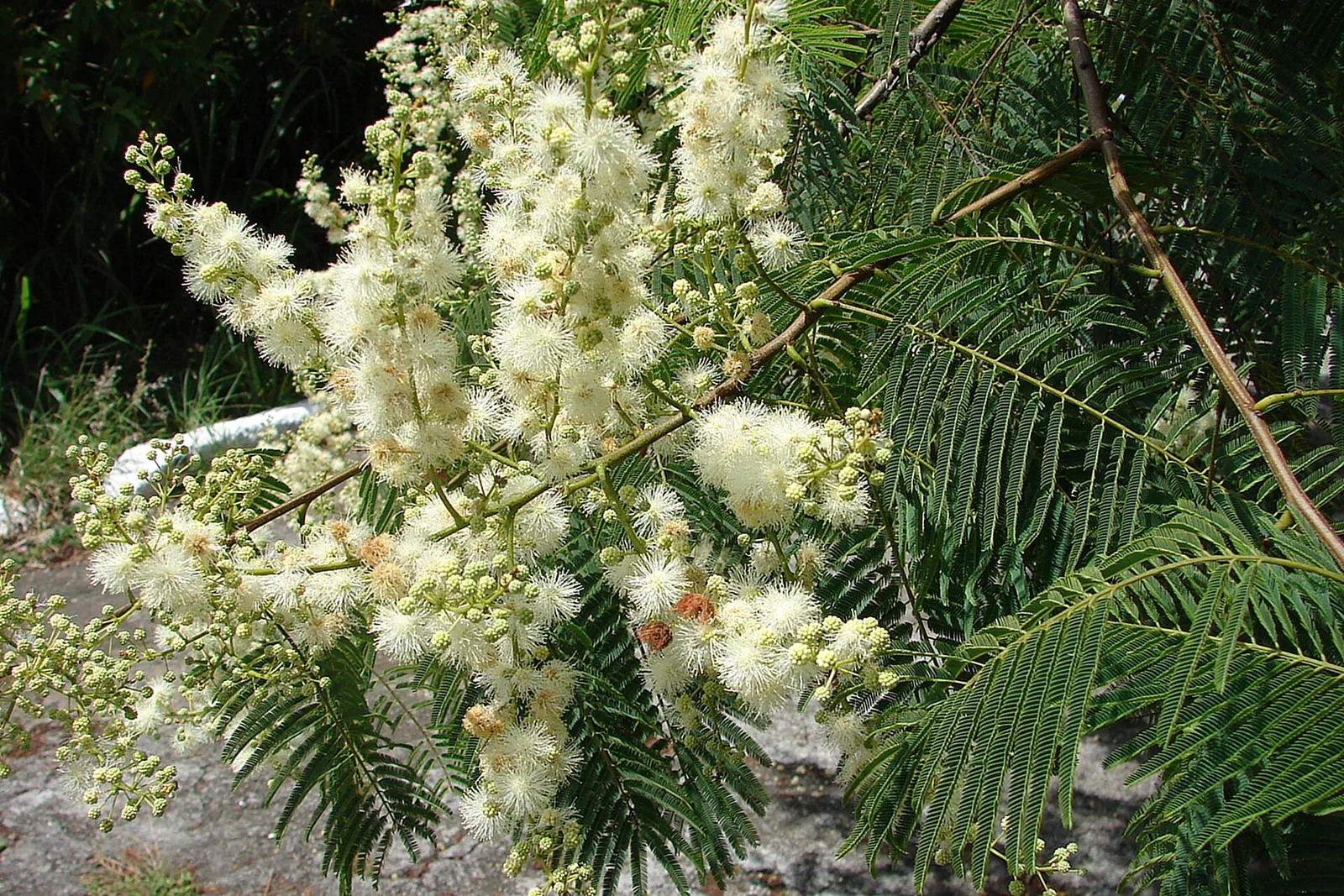
A deciduous tree usually 5–20 m tall, occasionally larger, with a spreading crown and grey-brown trunk. Bark may be relatively smooth or carry conspicuous conical or mammillose projections. Alternate bipinnate leaves create a fine, feathery canopy; numerous opposite leaflets are only about 8–9 mm long. Small flowers are massed in dense globose heads up to about 20 mm across, varying from greenish-white and cream to yellow-orange. The flattened brown pod may reach roughly 35 × 3 cm, opens along one suture, and contains commonly 8–16 thin, hard, glossy, orbicular brown-to-black seeds about 10–20 mm across (Lema, 2024; Delices et al., 2023).
The species is insect-pollinated; research documents bee visitation and probable nectariferous trichomes. Its relatively heavy seeds fall close to the parent, while people have carried them far beyond the tree’s ecological range. Bark is tannin-rich, wood is dense and durable, and the tree is retained or planted for medicine, shade, apiculture, fuel, timber and dry-forest restoration. These utilitarian lives coexist with the seed’s ritual circulation (Borges, Machado and Lopes, 2017; Monteiro et al., 2006; Mota et al., 2017).
Taxonomic limits
- Page convention
This page follows Kew in accepting A. colubrina. It retains var. cebil exactly where cited by archaeological, ethnographic and population-genetic sources, keeping historical determinations as they were made.
- Species boundary
Altschul’s influential treatment organised the genus as two species with two varieties each. Recent genomic work instead supports Brenan’s four-species interpretation—A. colubrina, A. macrocarpa, A. peregrina and A. falcata—while also detecting incomplete lineage sorting and gene flow (Mangaravite et al., 2024).
- Archaeological ID
A glossy seed, carved tray or occurrence of the word vilca is suggestive; species identification needs more. Microscopy, starch morphology, chemical residue, associated macroremains, geography and historical terminology provide different levels of certainty (Pochettino, Cortella and Ruiz, 1999; Rick et al., 2025).
02Chemistry
Seeds contain indolealkylamines, most consistently bufotenine (5-hydroxy-DMT). In a voucherable modern extraction from commercial A. colubrina seed, bufotenine formed the major HPLC peak and was confirmed by mass spectrometry; earlier surveys and later reviews also report DMT, 5-MeO-DMT, N-oxides, N-methyltryptamines, serotonin derivatives and quaternary bufotenidine in variable combinations. Species, individual tree, tissue, maturity, heating and storage all affect the profile. “DMT-containing seed” is therefore too blunt a description of either a living specimen or an archaeological preparation (Vigerelli et al., 2014; Delices et al., 2023).
Bufotenine
N,N-Dimethyltryptamine
5-Methoxy-DMT
Other constituents
Across the genus the analyses divide the tree: bufotenine is the major alkaloid of the seed, while 5-MeO-DMT is that of bark, leaves and roots (Ott, 2001b, p. 31). For var. cebil the strongest seed on record is the hatáj of a Wichí shaman near Tartagal — 12.4% bufotenine, with 0.57% N-methylserotonin and 0.06% DMT — while two other collections from Salta held bufotenine alone, at 4.41% and 3.51%, and bark from the same region only traces of DMT and bufotenine (Torres and Repke, 1996, cited in Ott, 2001b, pp. 29–30).
Prepared forms and chemical transformation
The historical record contains roasted or charred seed, smoked mixtures, nasal powders joined to alkaline ash or calcined material, liquid suspensions, enemas, fermented drinks and composite ritual substances. Heat can alter companion indoles; alkalinity shifts alkaloid protonation and can change transfer across nasal mucosa. Tobacco occurs as a partner in several Chaco and archaeological contexts, but no single ash, pH or formula defines every cebil or vilca preparation. Chicha, aloja, the Ayacucho llampu drink and nasal powder are culturally and pharmacokinetically different forms (Torres et al., 1991; Lema, 2024).
Pharmacology and evidence boundaries
- 5-HT receptors
Bufotenine engages serotonergic receptors including 5-HT2A, 5-HT1A and 5-HT2C. 5-HT2A agonism is central to psychedelic visual effects, while receptor balance, route and peripheral activity help shape its marked bodily profile (McBride, 2000; Wallach et al., 2023).
- Seed isolate
Bufotenine purified from A. colubrina has been studied in cell and animal models, including antiviral and biodistribution research. These experiments establish chemical identity and biological activity; vilca and cebil ceremonial preparations are clinically untested (Vigerelli et al., 2014; 2018).
- New receptor work
Structural pharmacology published in 2025 examines bufotenine derivatives at 5-HT1A receptors and behavioural models. It concerns molecular leads and remains preclinical, separate from ethnobotanical claims (Li et al., 2025).
- Whole preparation
No controlled human study has characterised authenticated A. colubrina seed preparations across their traditional routes and ritual settings. Archaeological chemistry, receptor studies, purified-alkaloid reports and ethnographic accounts must remain distinct evidence classes.
03Tradition, ritual & cultural use
Oldest evidenced or proposed human use
| c. 2000 BCE | Macroremains / pipes Seeds and smoking pipes from early north-west Argentine contexts, including Inca Cueva and Huachichocana, place Anadenanthera—usually assigned to A. colubrina var. cebil—in human use approximately four millennia ago. The apparatus points to smoke or fumigation; nasal use is unproven (Lema, 2024; Torres and Repke, 2006). |
|---|---|
| 1st millennium BCE | Chavín direct evidence Bone tubes and associated artifacts from a sealed gallery at Chavín de Huántar, dated within c. 1200–400 BCE, yielded microbotanical and chemical evidence of vilca and Nicotiana. This 2025 study provides direct plant-use evidence where earlier claims rested principally on iconography (Rick et al., 2025). |
| c. 500–1450 CE | Southern Andes Snuff trays, tubes, spoons, pouches and powders appear across Tiwanaku, Wari, Atacameño/Lickanantay and neighbouring networks. Microscopy identified A. colubrina var. cebil in archaeological powder from north-west Argentina; chemical studies at San Pedro de Atacama detected tryptamines in contextual preparations (Pochettino, Cortella and Ruiz, 1999; Torres et al., 1991). |
| c. 905–1170 CE | Chemical attribution A ritual bundle from Cueva del Chileno, Bolivia, contained multiple psychoactive residues including bufotenine, DMT, harmine, cocaine and benzoylecgonine. Bufotenine makes Anadenanthera a strong contextual inference, though the species and any single combined beverage remain beyond what the chemistry can show (Miller et al., 2019). |
| 16th–17th centuries | Colonial texts Albornoz, Guaman Poma, Cobo, Polo de Ondegardo and Bertonio record vilca/willka as purge, enema, drink, chicha ingredient, medicine and sacred substance. Colonial genres translated Indigenous categories into Christian extirpation, medical and administrative vocabularies; plant identification and practice must therefore be evaluated record by record (Lema, 2024). |
Peoples, territories and traditions
Comechingón and Olongasta
In 1583 Pedro Sotelo Narváez reported that the Comechingón of Tucumán powdered sebil, “a fruit like vilca”, and took it through the nostrils; archaeological remains show their Olongasta neighbours snuffed cebil too (Sotelo Narváez, 1885, cited in Ott, 2001b, pp. 16, 21).
Lule and Wichí
Pedro Lozano wrote early in the eighteenth century that the Lule snuffed cebil seed. Métraux reported that “Lule and Mataco shamans snuff a powder made of the seeds of the cebil… to put themselves in a state of mild trance” (Métraux, 1946, cited in Ott, 2001b, pp. 21, 23).
Huarpe
At the southern edge of cebil use, beyond the tree’s own range, Allentiac and Millcayac people were described in 1703 as carrying an “herb” called cibil in the mouth, which “alone sustains them for several days” (de Ovalle, 1888, cited in Ott, 2001b, p. 21).
Abipón and Mbayá
The Abipón of the Corrientes–Asunción region burned the pods and seeds in closed huts and breathed the smoke; upriver the Mbayá snuffed the powdered seed individually and smoked it collectively (Ott, 2001b, p. 22).
Macurap and Tupari
On the Rio Guaporé, Tupi-speaking Macurap snuffed crushed angico seed with tobacco leaf and bark ash; the Tupari called their cebil snuff aimpa-kid and mixed it with the bark ash they also put in tobacco snuff (von Reis Altschul, 1972, cited in Ott, 2001b, p. 22).
Piro and Katawishi
The northernmost cebil users, in the Peruvian montaña, the Piro snuffed and ate the seeds and gave the snuff to their hunting dogs; the neighbouring Katawishi took it as snuff and as enema, and also gave the enema to their dogs (Farabee, 1922, cited in Ott, 2001b, p. 22).
Weenhayek and Wichí today
Weenhayek of the Bolivian Chaco still both smoke hatáj, mixed with tobacco, and snuff it. Near Tartagal, a Wichí shaman studied by Torres and Rätsch took his hatáj from a tree beside his house, seeds being generally harvested in August; the roasted seed is ground, and today mainly smoked with tobacco (Ott, 2001b, p. 23).
Tribute
Under the colonial encomienda, cebil and coro were tributary items in Santiago del Estero, and overseers gave cebil as gifts to keep the favour of the people they exploited (Pérez Gollán and Gordillo, 1994, cited in Ott, 2001b, p. 22).
Ritual action and associated substances
Shamanism, healing and ritual action
Vilca/cebil participates in multiple therapeutic logics. Early chronicles describe evacuation of harmful humours through purgation; contemporary sources describe cleansing deep-seated affliction, provoking the return of a lost animu in susto, reversing envy or sorcery, regulating reproductive processes, and strengthening protection. In Aymara black mesas, vilca may function with other kuti substances through counter-direction and return. In Ayacucho herranza, ground willka is part of llampu, a composite substance offered to powerful mountains (wamanis), consumed in ritual preparation and sprayed counter-clockwise over animals and space (Lema, 2024).
The inhalatory record shows a different scale of bodily action: seed powder, tube, breath and nasal passage compose a forceful transformation. Smoking, fumigation, enema and drink distribute that force differently. In the Chaco, specialist songs and spirit relations organise diagnosis and power; at Chavín and San Pedro de Atacama, architecture and mortuary assemblage disclose institutions, while their ritual scripts are lost. The analytical category “shaman” is therefore useful only when tied to a particular people, office, apparatus and historical source.
Associated plants and substances
| Nicotiana spp. | Tobacco appears with cebil in early pipes, the Chavín gallery and modern Wichí/‘Weenhayek accounts. It may be smoked, inhaled or otherwise ritually coordinated, in mixtures that vary. |
|---|---|
| Fermented drinks | Vilca occurs in records of maize chicha, chicha de molle (Schinus molle) and aloja made from Neltuma pods. Archaeological vessel residues and colonial descriptions support several beverage contexts, with no single “Andean ayahuasca” formula (Lema, 2024). |
| Coca and mesa materials | Coca, wayruru seeds, maize, carnations, llama fat, minerals, incense, wool, metals and Christian miniatures can accompany vilca in offerings, bundles and healing. These associations are semiotic, alimentary and reciprocal as well as pharmacological. |
| Alkaline minerals / ash | Archaeological and ethnographic powders may include mineral lime or plant ash. Their ritual provenance and material role require contextual analysis; shared alkalinity makes them chemically similar to the llipta of coca chewing, and leaves them culturally distinct. |
Pipes and snuff in the archaeological record
The first pipes, read again
The oldest direct evidence of vilca or cebil use comes from seeds and pipes in north-western Argentina, dated to about 2000 BCE; Inca Cueva 7 and Huachichocana III, rock shelters at the edge of the Jujuy puna, are among the sites that hold it (Rick et al., 2025). Alicia Fernández Distel excavated tubular pipes in these preceramic caves in the 1970s and placed them around 2000 BC. Her chemical analysis of the contents of the Inca Cueva pipes reported an alkaloid behaving like N,N-dimethyltryptamine; the Huachichocana pipes reacted strongly for alkaloids but not for that compound, and she concluded that cebil had not been smoked in them — "por ello debemos descartar que se haya fumado el Cebil" (Fernández Distel, 1980, p. 65, cited in Llagostera, 2015). Inca Cueva's seventh cave also holds a context of about 4000 BP that includes a basket coated with clay (García, 2020).
Ott’s survey describes them as puma-bone smoking pipes, some 4,000 years old, from the Quebrada de Humahuaca, filled with charred Anadenanthera seed, and of nearby rock art showing human figures smoking such pipes (Ott, 2001b, p. 20; Schobinger, 1997, cited in Ott, 2001b, p. 20). The sentence carries no reference of its own; the work it goes on to cite, Fernández Distel (1980), is cited there for the chemistry only, and the accounts of her excavation summarised above do not name the bone.
Forty years later the Huachichocana pipes were opened again. They are heavy tubes of stone — one of andesite, 238 mm long, one of red sandstone, 227 mm — from a burial dated 3600–3000 BP, and Fernández Distel's gas chromatography of them had been read as possible argemonine, fumaritine, glaucine, hunnemannine and O-methylcaseadine. Microscopy of the carbonised residue found starch of cebil in one of them, pipe 2038. Across eleven pipes from north-west Argentina dated 3600–1390 BP, the same study identified cebil together with Nicotiana longiflora, Trichocline reptans, Cestrum and cotton — smoking mixtures — and cautioned that DMT alone is a weak marker for cebil, since the compounds exclusive to it are bufotenine and 5-MeO-DMT (Lema et al., 2015). The record of the first pipes is therefore one of chemistry revised by microscopy.
From smoke to snuff
The pipes come first. The earliest possible snuffing trays and tubes are from the Peruvian coast, at Asia about 1350 BCE and at Huaca Prieta about 1200 BCE (Rick et al., 2025). San Pedro de Atacama preserves perhaps the only record in which both practices — smoke drawn through pipes, and powder taken from tablets through tubes — can be followed side by side; the earliest tablet dated there is of AD 190 ± 100 (Llagostera, 2015).
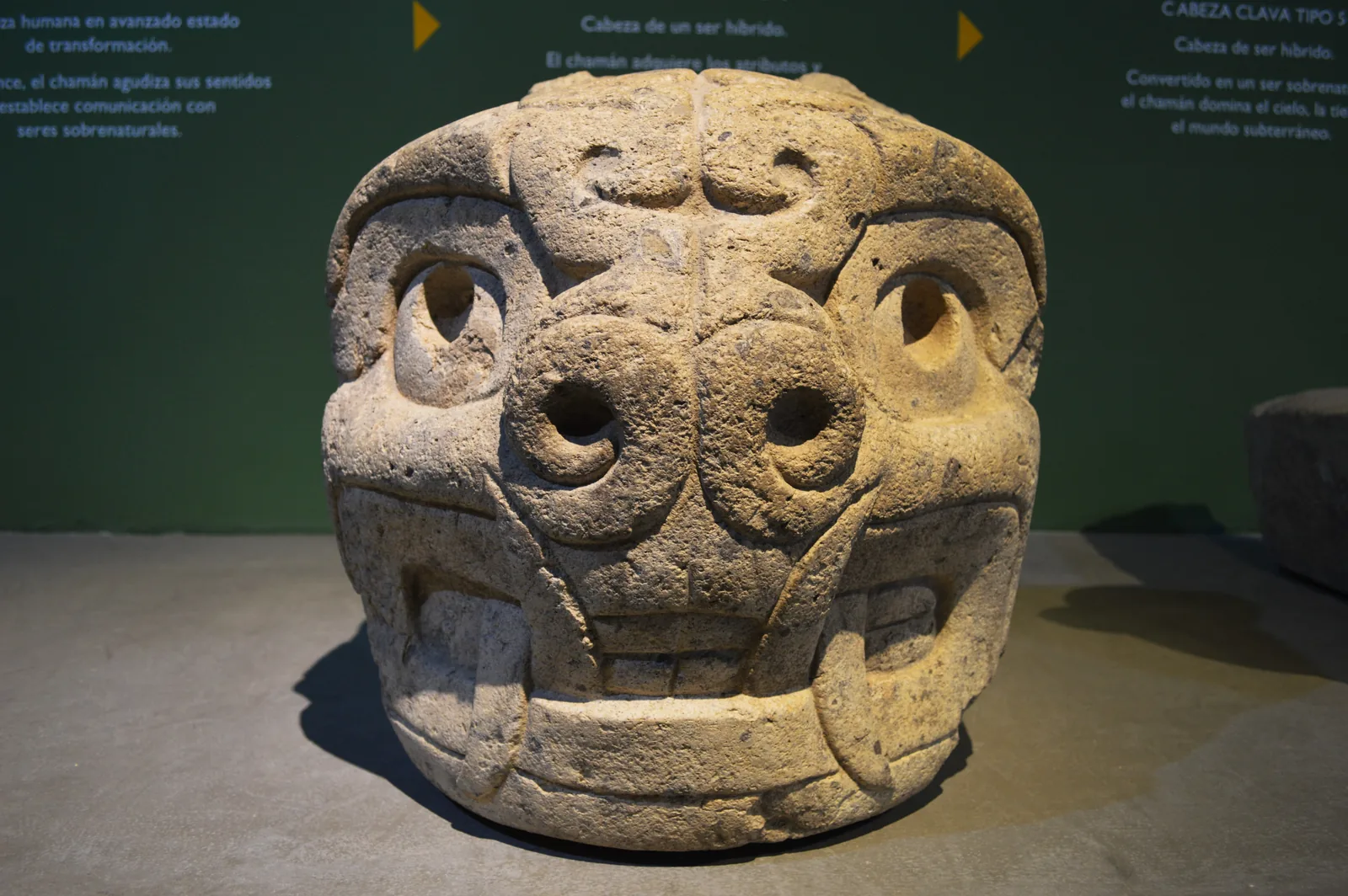
At Chavín de Huántar the sealed Gallery 3 held bone tubes and spoons deposited between about 800 and 350 BCE. Six carried DMT, bufotenine and nicotine, with starches of cebil seed and leaf and of wild tobacco root; no products of combustion were found, which supports inhaling a powder rather than smoking it, and makes these the oldest evidence in the Americas of vilca and tobacco taken together as snuff. On the temple's outer walls, carved tenon heads have been argued to depict a sequence of shamanic transformation induced by such substances, some with mucus flowing from the nostrils (Rick et al., 2025).
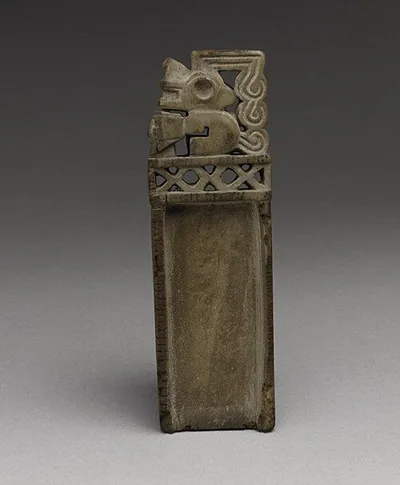
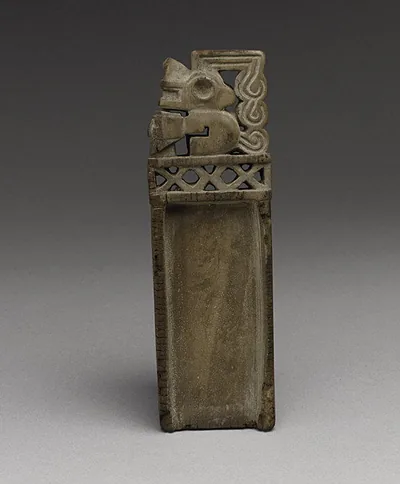
Later snuffing paraphernalia — tubes, wooden trays, small spoons and spatulas — is often made in Tiwanaku style (Rick et al., 2025). The wooden tablet below, attributed with a query to Tiwanaku and dated to the fourth to eighth centuries, is in the Metropolitan Museum of Art (The Metropolitan Museum of Art, 2026).
04Cosmology & key terms
- Willka / vilca
- An Aymara and Quechua historical semantic field that may designate sacred beings or places, shrines or huacas, an ancient name of the sun, and the tree or its seed. Context decides which meaning is active. The polysemy helps explain ritual prestige but prevents every textual “willka” from serving as botanical proof (Lema, 2024).
- Kuti / cuti
- Turning, reversal or change of direction. Vilca seeds may be classified with substances that return affliction and redirect fortune; counter-clockwise gestures and composite mesas enact the same movement. The seed’s curved fissure or horseshoe-like form can materially carry that relation.
- Susto and animu
- Susto is an illness involving fright and the loss or capture of a person’s vital principle, often called animu. Vilca occurs in family and specialist therapies that smoke, cleanse and call the displaced principle back.
- Wamani / mountain power
- In Ayacucho livestock rites, llampu containing willka is payment to, protection from and controlled relation with powerful mountains. Offering and ingestion address reciprocity and the danger of capture as well as drug effect.
- “Cebil wine”
- In a Wichí initiation narrative reported by Califano and analysed by Lema, the initiate reaches a spirit world where the cebil seed is wine and produces corresponding effects. The transformation is perspectival: substance and appearance depend on the embodied world from which they are encountered.
Image, transformation and authority
Chavín stonework represents human–feline, raptor and serpent transformations, fanged beings, nasal emissions and staffs. Burger argued that pod imagery and nasal motifs identify vilca snuff; the 2025 residue study materially strengthens the general proposition that psychoactive plants operated at Chavín, while individual iconographic identifications remain interpretations. The subterranean galleries also transform perception through darkness, constricted movement, acoustic effects and controlled revelation, making architecture part of the visionary technology (Burger, 2011; Rick et al., 2025; Nesbitt, 2025).
Tiwanaku-related snuff tablets and tubes carry front-facing staff-bearing figures, profile sacrificers, trophy heads, felines, raptors and camelids. At San Pedro de Atacama these images travelled on portable equipment that joined bodily technique to regional political and religious styles. Some objects index specialist knowledge or status; others may have been curated heirlooms or mortuary signs. Powder, dose and the identity of the user need evidence beyond iconography (Torres and Repke, 2006; Llagostera, 2006).
Art and material assemblage
Ott gathers a series of Peruvian works read as showing Anadenanthera. The identifications are iconographic, several of them his own, and none rests on residue from the object itself (Ott, 2001b, pp. 19–21).
Garagay, 1600–900 BCE
A relief carving at Garagay, now within Lima, has been read as the nasal discharge that follows snuffing; a similar motif recurs at Chavín de Huántar (Burger, 1992, cited in Ott, 2001b, p. 19).
Paracas Necropolis, 700–100 BCE
Three textiles seem to show the pods: “flying shamans” holding what may be mushrooms in one hand and pods in the other, and dancing shaman–feline transformation figures holding pods (Reid, 1986, cited in Ott, 2001b, pp. 19–20).
Ica Valley textile
A Chavín-style textile from the Ica Valley has been conjectured to show both the San Pedro cactus and Anadenanthera pods (Cordy-Collins, 1982, cited in Ott, 2001b, p. 19).
Moche, Chimú, Chancay
Moche pottery of about 500 CE shows pod-laden trees beside San Pedro and deer; a Chimú textile seems to Ott to show paired cebil pods flanking four coca leaves; a Chancay pot of c. 1000–1500 CE shows what appear to be cebil pods (Ott, 2001b, p. 20).
is used for cleansing, as it is considered the strongest plant capable of expelling deep-seated evils Karen Urcia, Mochica plant specialist, quoted in Lema (2024)
05Visionary phenomenology
The evidence divides cleanly by preparation. For the snuffs as traditionally made and taken, the record is ethnographic and historical, and it is consistent across peoples and centuries: the snuff gives access to beings and to knowledge. Pané’s account of Taíno cohoba, written within a few years of contact, describes the powder placed on the heads of cemí figures, and the caciques and behiques questioning the cemís under its influence (Pané, 1999; Kaye, 1999; Oliver, 2009). Among the Piaroa of southern Venezuela, divination and sorcery battles are conducted inside yopo visions (Rodd, 2006). Shamans adjust their dose of the Banisteriopsis caapi they take alongside the snuff to the strength of vision a given task requires (Rodd, 2002), and laypeople describe yopo as “required by shamans to create the future” (Rodd and Sumabila, 2011).
At Chavín de Huántar, snuffing tubes and spoons from the underground galleries, dated c. 800–350 BCE, carry residues of Anadenanthera colubrina var. cebil mixed with wild tobacco (Rick et al., 2025). The galleries were dark, enclosed and restricted, and the temple’s sculpture shows human heads in transformation, with nasal discharge, and the deity of the Lanzón (Burger, 2011; Nesbitt, 2025). The iconography is consistent with visionary encounter, but it is a representation shaped by the cult that made it, not a record of what any individual saw.
Isolated bufotenine, the seeds’ principal alkaloid, has a different and thinner record. Injection studies of the 1950s reported play of colours, lights and patterns alongside marked physical toxicity (Fabing and Hawkins, 1956; Isbell, 1956, cited in Turner and Merlis, 1959). Ott’s self-experiments found bufotenine visionary when snuffed or held under the tongue, without the facial flushing seen after injection, and with effects resembling yopo (Ott, 2001a). None of this literature reports encounters with beings. That absence says more about the conditions of study than about the plant. Laboratory and solitary self-experiments lack the admixtures, songs, expectations and trained specialists through which yopo visions acquire their inhabitants and their meaning.
Time course
Snuff and smoke. Bands are the ranges this entry gives for nasal and smoked forms; the 20–60 minutes of major effects comes from purified-bufotenine comparators. The mark is Ott’s field record with toasted seed, which peaked at about five minutes (Ott, 2001b). Not charted: drinks and enemas, which the entry describes as slower and more variable, without timings.
Phenomenological profile
The profile lists effects the sources report, for each preparation separately, grouped by domain. Each row gives the grade, how often the sources say the effect occurs (only where they say so; most do not) and the kinds of source behind it. A chip naming a compound, such as “Trial · psilocybin”, means the evidence comes from studies of that compound rather than of the preparation itself; “partial” means the route, purity or dose differs from the traditional preparation, so the row cannot be graded above supported. The line under each preparation says which domains have evidence entered here. A domain with nothing entered has not yet been assessed in this profile; that is not a finding that the literature is silent, and the article may discuss it. Open a row for the note and the sources.
Seed snuff or smoketoasted seed, inhaled
Evidence entered for 6 of 8 domains. Not yet entered: self and unity, states of consciousness.
No single ash, pH or formula defines every cebil or vilca preparation; tobacco is a partner in several Chaco and archaeological contexts (Torres et al., 1991; Lema, 2024). Bufotenine is the seed’s principal alkaloid (Vigerelli et al., 2014). Studies of purified bufotenine, injected, snuffed or vaporised, count at partial weight: route and purity differ from the toasted-seed snuff.
Visual
Immersive realmsCoherent places or events that surround the experiencer, who seems to be located in them rather than looking at images.SupportedEthnography
Cuiva accounts describe a “world of beauty and abundance” (Rodd and Sumabila, 2011, p. 41). Pané records spatial inversion: the house turned upside down (Kaye, 1999). Purified bufotenine has not been reported to produce this in controlled or self-experimental studies (Fabing and Hawkins, 1956; Ott, 2001a); those studies lack the admixtures, setting and specialists of traditional use, so the silence says little about the snuff. Read about the phenomenology of immersive realms →
Geometric patterningLattices, spirals, tunnels and other repeating forms seen with eyes closed or overlaid on the visual field.SupportedExperienceTrial · bufotenine, partial
With toasted cebil seed, Ott saw “sinuous, multihued, arabesque patterns”, first with eyes closed, then on a wall in a darkened hallway, and at last on lit surfaces (Ott, 2001b); purified bufotenine produced colours, lights and patterns after injection (Isbell, 1956, cited in Turner and Merlis, 1959; Fabing and Hawkins, 1956) and ring-like, swirling coloured patterns in self-experiment (Ott, 2001a); route and purity differ from the seed snuff, so this counts at partial weight.
Other senses
Intensified hearingHeightened acuity, salience or alteration of sound.AnecdotalSingle reportExperience
Ott’s toasted-seed field record notes a ringing in the ears (Ott, 2001b).
Body
Nausea and purgingNausea, vomiting or diarrhoea during the acute state.SupportedRecurrentEthnographyExperienceTrial · bufotenine, partial
Inhaled preparations are repeatedly described as forceful at the threshold, with nausea and retching; within Andean therapeutic language, expulsion can be the work itself (Lema, 2024). Purified bufotenine caused nausea and vomiting after injection (Fabing and Hawkins, 1956), and is “extremely nauseating” in first-person testimony (Morris, 2021).
Raised blood pressureA measured rise in arterial blood pressure during the acute state.SupportedTrial · bufotenine, partial
Medical experiments with injected bufotenine recorded marked peripheral cardiovascular effects; they model traditional routes poorly, so this counts at partial weight (McLeod and Sitaram, 1985).
Affect
Fear and dreadFear, panic, chaos or a sense of threat during the experience.SupportedTrial · bufotenine, partial
Extreme anxiety and a sense of imminent death at a high intravenous dose of bufotenine (McLeod and Sitaram, 1985). Injection differs from snuffing, so this counts at partial weight.
Cognition
NoesisThe felt disclosure of knowledge: understanding that seems to arrive with what is perceived.SupportedEthnography
Knowledge sought and acted on: divination, diagnosis, and for the Piaroa, creating the future (Rodd and Sumabila, 2011; Rodd, 2006; Rodd, 2002a).
Relation to other beings
Autonomous entitiesBeings experienced as acting, communicating or observing independently of the experiencer’s will.SupportedEthnographyIconography
Taíno caciques and behiques consulted cemís through cohoba (Pané, 1999; Kaye, 1999); Piaroa conduct divination and sorcery battles within visions (Rodd, 2006); Chavín iconography shows transformation and deities (Burger, 2011; Nesbitt, 2025). Graded as reports of practice; the iconography is interpretive. Purified bufotenine has not been reported to produce this in controlled or self-experimental studies (Fabing and Hawkins, 1956; Ott, 2001a); those studies lack the admixtures, setting and specialists of traditional use, so the silence says little about the snuff. Read about the phenomenology of autonomous entities →
Phenomenology Discussion
Route, duration and evidence
| Form / route | Temporal character | Evidence and limits |
|---|---|---|
| Nasal powder | Very rapid onset; concentrated short peak; major effects often under one hour. | Archaeological apparatus, residue work, ethnographic comparison and purified-bufotenine self-reports converge on rapidity, but authenticated traditional A. colubrina sessions are untimed in controlled studies. |
| Smoked / fumigated | Seconds to minutes; brief crest. | Strong archaeological and Chaco documentation of pipes or smoke; plant combinations and exact inhaled chemistry vary. |
| Drink / chicha | Slower and potentially longer; highly formulation-dependent. | Archaeological and colonial evidence is substantial, but modern pharmacokinetic data for whole vilca beverages are absent. |
| Enema | Rapid mucosal absorption is plausible; timing poorly documented. | Paraphernalia and chroniclers attest the route. Later descriptions record particular preparations, each in its own place. |
| Whole seed / mesa | No necessary visionary phase. | Amulet, offering, burial and cleansing uses work through form, presence and ritual relation; “psychoactive plant use” can include uses without ingestion. |
Bodily passage
Inhaled Anadenanthera preparations are repeatedly described as forceful at the threshold: nasal burning and pressure, lacrimation, salivation, constriction of face or chest, changes in pulse, dizziness, nausea, retching, heaviness, trembling and temporary loss of ordinary coordination. Historical medical experiments with injected bufotenine exaggerated peripheral cardiovascular effects and model traditional routes poorly; later intranasal and pulmonary self-experiments nevertheless confirm that bodily intensity and visual activity can coincide (McLeod and Sitaram, 1985; McBride, 2000; Ott, 2001a).
Within Andean therapeutic language, expulsion can be the work itself. Tears, mucus, vomit, evacuation and smoke may be read as movements that remove obstruction or contamination and make sacred efficacy possible. Interpretation and physiology describe the event together, each in part. The same somatic force may be framed as cleansing, ordeal, proof of potency, attack or failed administration according to office and context (Lema, 2024).
Visual and relational descriptions
Comparative reports of bufotenine-rich Anadenanthera states describe brightening and saturation of colour; scintillating points, latticework, zigzags, spirals and tessellated fields; rapid alternation between abstract geometry and scenic imagery; enlarged depth and movement; closed-eye animal, human or architectural forms; and episodes in which the visual field becomes engulfing. Auditory compression or amplification, altered body boundaries and an impression of acceleration often accompany the images (Ott, 2001a; Torres and Repke, 2006).
One field record comes from northern Chile, where Ott took toasted cebil seed, collected in north-western Argentina, with C. Manuel Torres and Agustín Llagostera. Effects began within a few minutes and peaked at about five, with a short plateau and a fifteen-minute descent: a brief bodily “rush”, a ringing in the ears, and “sinuous, multihued, arabesque patterns”, seen first with eyes closed, then on a wall in a darkened hallway, and at last on lit surfaces (Ott, 2001b, p. 107). Christian Rätsch, taking the same powder in Chiapas, drew the sinuous forms he saw and likened them to a carving at Chavín de Huántar (Rätsch, 1996, cited in Ott, 2001b, pp. 107–108).
Ethnographic phenomenology relocates these forms in worlds of agents and obligations. Chaco specialists encounter instruction, adversaries, helpers and spirit substances; Andean curing materialises the return of animu, reversal of harm and negotiation with place powers; Chavín and Tiwanaku imagery gives bodily transformation feline, avian, serpentine, sacrificial and political form. First-person transcripts are lost to archaeology, but apparatus, spatial control, iconography and residue together show that altered perception was organised as social knowledge.
Salient account and its limits
Jonathan Ott’s human pharmacology supplies the most systematic modern temporal comparator for bufotenine, describing brief, rapidly developing visual effects across intranasal, pulmonary and other routes (Ott, 2001a). It remains an individual self-experimental record of isolated alkaloid. Califano’s Wichí initiation account—preserved through Lema’s analysis—places the initiate in a domain where cebil appears as wine. One source clarifies route and temporal profile; the other clarifies relational ontology. Each answers its own question.
06Contemporary status
| Global conservation | Least Concern The IUCN assessment published in 2020 lists A. colubrina as Least Concern across its broad range (Canteiro and Lewis, 2020). |
|---|---|
| Habitat pressure | A global LC category leaves local populations exposed. Caatinga, Cerrado, Atlantic dry forest and inter-Andean seasonal forest are heavily fragmented by agriculture, pasture, fire change, roads and urbanisation. Gravity-dispersed seed and dependence on pollinator movement make stand connectivity important (Alzate-Marin et al., 2025). |
| Cultural continuity | Vilca persists in Andean markets, mesas, amulets, cleansing, reproductive medicine, susto treatment and offerings; cebil remains present in Chaco knowledge and regional herbal economies. Continuity is uneven, and contemporary uses may differ from pre-Hispanic snuff institutions (Lema, 2024). |
| Local economies | Angico supplies high-density timber, posts, flooring, fuelwood, charcoal, tannin-rich bark, gum, medicine, shade, bee forage and restoration stock. Southern Andean markets trade seeds as ritual and medicinal objects. No robust species-specific estimate exists for either its global ritual market or total commodity value (Monteiro et al., 2006; Mota et al., 2017). |
Law and regulation
| Jurisdiction | Plant and compounds | Status logic |
|---|---|---|
| UN conventions | The tree and seed are absent from the 1971 Convention schedules; DMT is listed in Schedule I. International control attaches to the scheduled substance, while treatment of plant material is left to national law (INCB, 2025). | Species and molecule are legally distinct categories. |
| United States | DMT and 5-MeO-DMT are Schedule I controlled substances; A. colubrina has no separate entry in the federal schedule (eCFR, 2026). | Extraction, possession and intended use can alter legal treatment. |
| United Kingdom | DMT and 5-MeO-DMT fall within Class A and Schedule 1 controls; the plant has no listing by binomial name (UK Government, 2026). | Prepared material may be treated through its controlled constituents. |
| South America | Forest harvest, Indigenous heritage, phytosanitary trade and controlled-drug rules differ among Brazil, Argentina, Bolivia, Peru, Paraguay and Chile. | There is no single “Andean legality” for vilca/cebil. |
Research, safety and open questions
Patents, commodification and research
- WO2009106934A1 — · angico-branco (Piptadenia colubrina) extracts for cosmetic or dermatological preparations. The claim concerns formulations and extract use; the species and its histories lie outside it (WIPO, 2009).
- Ethnopharmacology — · current work investigates tannin- and flavonoid-rich bark, gum polysaccharides, anti-inflammatory, antimicrobial, wound-healing and immunomodulatory activity. Most evidence remains extract-based, in vitro or animal research (Delices et al., 2023; Ramos et al., 2024).
- Neuropharmacology — · receptor-signalling studies of bufotenine and derivatives now resolve 5-HT2A and 5-HT1A mechanisms at molecular and preclinical levels; no clinical trial has tested A. colubrina as a psychiatric intervention (Wallach et al., 2023; Li et al., 2025).
- Archaeobotany — · the 2025 Chavín study combines microbotanical and chemical methods to move beyond iconographic inference. It is presently the most consequential new evidence for vilca in Formative-period central Andean ritual (Rick et al., 2025).
- Genomics and ecology — · molecular studies are revising species boundaries and measuring pollinator connectivity, phenology and spatial genetic structure in fragmented dry forests. These findings matter for seed sourcing and restoration even while the species remains globally LC (Mangaravite et al., 2024; Alzate-Marin et al., 2025).
Open questions on this entry
Safety and law
07Cross-correlations
| Circum-Amazonian Snuff Complex | Regional complex page: Anadenanthera, Virola and Nicotiana snuffs, ashes, apparatus and distinct ceremonial traditions. PRIMARY PREPARATION COMPLEX |
|---|---|
| Anadenanthera peregrina | Sister monograph: yopo/niopo/dopa and cohoba/cojoba histories of Orinoco–Guiana and Caribbean regions. Northern names and evidence belong to their own region, distinct from vilca/cebil. TAXONOMIC / CULTURAL SIBLING |
| Nicotiana rustica | Species monograph: tobacco appears with vilca/cebil in Chavín residue evidence, early smoking pipes and living Chaco practice. RITUAL ALLY / CO-PRESENCE |
| Erythroxylum coca | Species monograph: coca and vilca share Andean routes, market spaces, offerings and some ritual bundles, but their preparations and pharmacologies remain distinct. ANDEAN MATERIAL-CULTURE ALLY |
| Schinus molle | Molle fruit supplied fermented chicha in archaeological contexts where vilca has been proposed or identified as an ingredient. FERMENTED-BEVERAGE ASSOCIATE |
| Andean Huachuma–Mesa Complex | Cultural complex page: some contemporary mesas and market systems contain vilca, while huachuma’s lineage, ritual offices and phenomenology remain separate. INTERSECTING ANDEAN COMPLEX |
| Shared tryptamines | 5-MeO-DMT, DMT and bufotenine also occur in Diplopterys cabrerana; 5-MeO-DMT and DMT in the bark resin of Virola theiodora, the forest snuff tree SHARED CHEMISTRY |
| Mimosa tenuiflora | Species monograph: jurema-preta, a fellow mimosoid legume of the north-eastern Brazilian Caatinga whose root bark carries DMT; in Brazilian folk taxonomy jurema and angico are barely distinguished, and the two ranges overlap (Ott, 2001b, p. 70). MIMOSOID KIN / SHARED DMT |
| Pangaean Entheobotanical Renewal | Cultural complex page: cebil among the plants drawn into contemporary analogue practice CONTEMPORARY COMPLEX |
08Bibliography
How to read the labels on each source
- Source type
- What kind of work it is: journal article, book, legislation, patent application, database record and so on. A word after the dot (ethnography, protologue, primary source) keeps the genre the entry was first filed under. “Unclassified” means the citation does not say enough to tell.
- Peer review
- Recorded for each work separately, and only where it has been confirmed for that work. It is never inferred from a DOI, a publisher or a journal, since journals also publish editorials, letters and commentaries. Where it has not been confirmed, the entry records it as not established. It does not apply to legislation, court decisions, treaties, patents, datasets, database and collection records, historical texts, films, talks, press releases or web pages.
- Check
- What was checked when the entry was added. DOI checked: the DOI’s registry record (Crossref) matched the citation’s title, first author and year. Verified: the record itself was opened and matched the citation: a library catalogue record for a book, or the page itself for a database entry, law, patent or archive document. “Verified (abstract)” and “(summary)” mean only the abstract or a summary was read. Located: a record was found but not fully matched. Bibliographic record and Stable record (in essays): a catalogue or stable web record exists; what was checked against it is not recorded. Unverified: no check is recorded. No locator found: a search found no record. Secondary: read through another source.
- What the labels do not say
- None of them means the source supports a particular sentence. Where a sentence is graded, its evidence note names its sources and whether each supports it, disputes it or gives context. Dates and reviewers of checks are not recorded for each entry; the version note at the foot of a graded page dates its last review.