Introduction
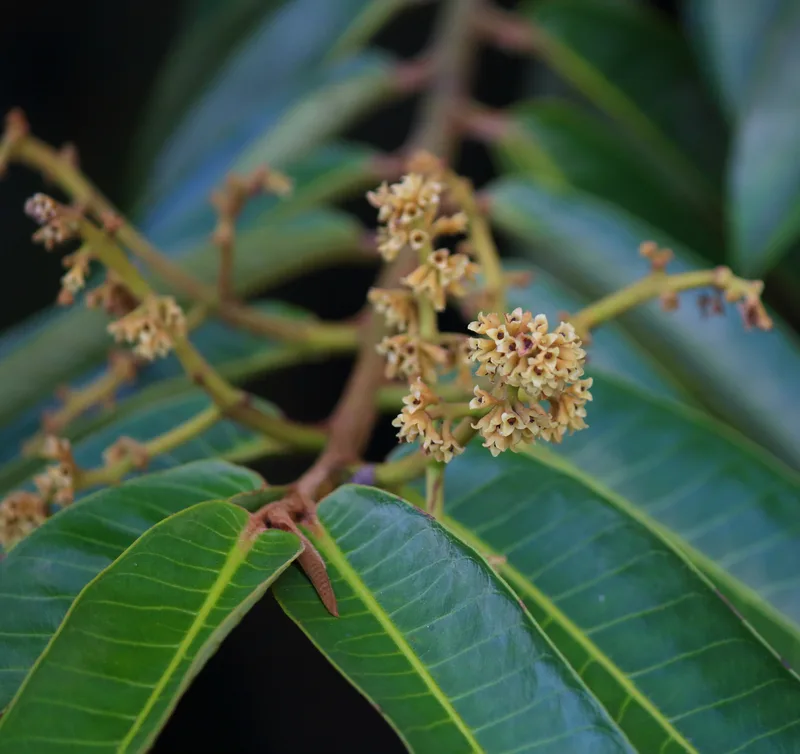
Virola theiodora is a tree of the nutmeg family in the western Amazon, especially the Rio Negro drainage, whose bark resin is dried and powdered as epéna, the snuff of the Waiká (Yanomami); Witoto and Bora peoples once ate it as pellets. Bentham described it in 1853 from Spruce’s collection, and Schultes and Holmstedt identified it as the Waiká snuff tree in 1967–68. The resin’s chief alkaloid is usually 5-MeO-DMT, with DMT, in amounts that vary between organs, trees and species. No dated find is specific to Virola, so the antiquity of its use is inferred.
All sections
| Botanical name | Virola theiodora |
|---|---|
| Taxa | Myristicaceae · Magnoliales |
| Traditional names | Epéna · Nyakwána · Paricá · Oo-koo-na |
| Regions | Western Amazonia of Brazil and Colombia, especially abundant in the Rio Negro drainage, in well-drained forest (Schultes and Holmstedt, 1968; Holmstedt et al., 1980). |
| Ethnographic entheogenic use | Epéna is the bark-resin snuff of the Waiká (Yanomami) north of the Rio Negro, whom Schultes and Holmstedt took to be the centre of today's most intensive use of these snuffs; Witoto and Bora peoples make an oral preparation from the resin (Schultes and Holmstedt, 1968; Schultes, 1969). |
01Ethnobotany of Virola theiodora
Botanical Info
| Accepted name | Virola theiodora (Spruce ex Benth.) Warb., 1897 — first published by Warburg in Nova Acta Academiae Caesareae Leopoldino-Carolinae 68: 187 (IPNI, 2026; WFO, 2026) |
|---|---|
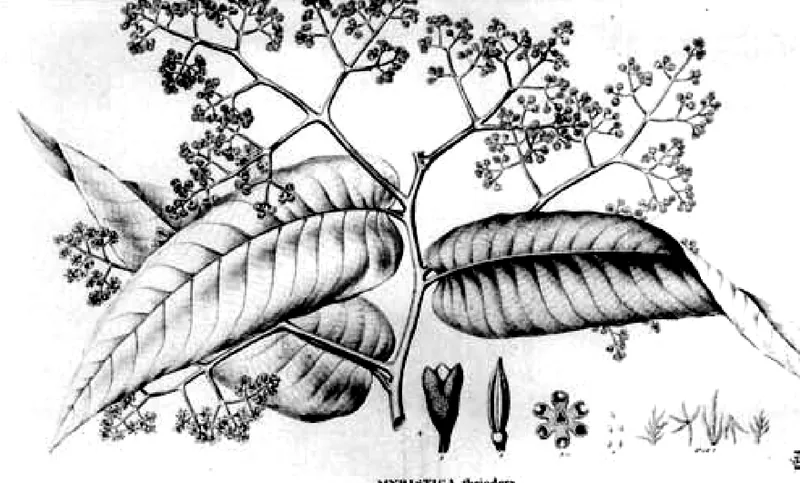
| Basionym | Myristica theiodora Spruce ex Benth., 1853, described from Spruce's specimen gathered in March in the forest about Barra do Rio Negro (Bentham, 1853); type Spruce 1444 (Schultes and Holmstedt, 1968) |
| Family | Myristicaceae, the nutmeg family; until Warburg's 1897 monograph the American species were held in Myristica (Holmstedt et al., 1980) |
| Order | Magnoliales |
| Geographic range | Western Amazonia of Brazil and Colombia, especially abundant in the Rio Negro drainage, in well-drained forest (Schultes and Holmstedt, 1968; Holmstedt et al., 1980). Occurrence records now also come from Peru and Ecuador: 1,167 in all — Brazil 409, Colombia 303, Peru 265, Ecuador 132, Venezuela 9 — not every identification vouchered (GBIF.org, 2026) |
| Local names |
|
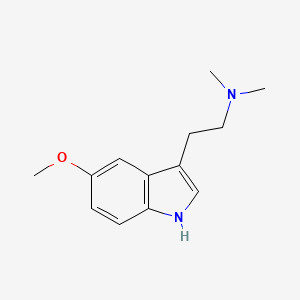
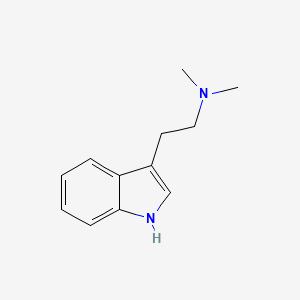
| Entheogenic compounds | 5-MeO-DMT · DMT · N-methyltryptamine · 5-MeO-N-methyltryptamine · trace β-carbolines — proportions vary by organ and specimen |
| Morphology | Bentham's protologue gives a tree of 20 feet, its leaves broadly ovate to oblong, subcordate at the base and glaucous beneath: "The leaves, when drying, are said to emit a strong odour of tea" (Bentham, 1853). Schultes recorded trees used for snuff from about 40 to 70 feet (Schultes and Holmstedt, 1968).
|
Territories
- 1Rio Ventuari · Koch-Grünberg’s Yekuana bark snuff, its source never collected; later fieldwork found no present use (Schultes, 1968)
- 2Colombian Vaupés · Virola snuff among Puinave, Kuripako, Tukano and neighbouring peoples (Schultes, 1954)
- 3Waiká (Yanomami) · identified as the snuff tree of the Waiká in 1968 (Schultes, 1968); Tototobí bark almost all 5-MeO-DMT (Holmstedt et al., 1980)
- 4Manaus · a DMT-led bark analysed by Agurell and colleagues (Holmstedt et al., 1980)
Deep Time
- UndatedUse held to be of great but undated age; no archaeological evidence is specific to Virola.
- 1853Described by Bentham from Spruce’s collection near Barra do Rio Negro (Manaus).
- 1923Koch-Grünberg reports a Yekwana bark snuff, plausibly Virola; its source was never collected.
- 1954Schultes first names Virola as a snuff source, in the Colombian Vaupés.
- 1967–68Schultes and Holmstedt identify V. theiodora as the snuff tree of the Waiká.
A disputed species
The name has not always held. A. C. Smith's 1937 monograph placed V. theiodora in synonymy under V. elongata; Schultes kept it apart, granting the close relationship but arguing that the two are easily told in the field — and that the Waiká, searching the forest for a tree to bleed, told them apart too (Smith, 1937, cited in Schultes and Holmstedt, 1968). Bentham had hesitated a century earlier, admitting that from fruit alone he would have taken the plant for a variety of M. sebifera, "had not Mr. Spruce assured me that it is perfectly distinct" (Bentham, 1853). Current name authorities accept the species (WFO, 2026; IPNI, 2026), but the older synonymy persists: Wikimedia Commons still files the 1860 plate above under V. elongata. Records of "Virola snuff" therefore have to be read for the taxonomic concept their authors held.
02Chemistry
5-MeO-DMT
DMT

N-methyltryptamines
trace
Tetrahydro-β-carbolines
alkaloid
The red of the resin
The figures above are single collections, and they disagree. The Manaus bark that Agurell and colleagues analysed was DMT-led; a bark from the Tototobí, the village where the resin is snuffed alone, was almost all 5-MeO-DMT (Agurell et al., 1969, cited in Holmstedt et al., 1980). Holmstedt's group stresses that composition differs between organs of one tree, between specimens of one species and between species, and that boiling, drying, coating and storage would alter it again (Holmstedt et al., 1980). A broader survey of Myristicaceae found the same: alkaloid profiles varied even between collections of one species, while prepared drugs ran far richer than bark or leaf (McKenna, Towers and Abbott, 1984). The nyakwána snuff analysed in 1969 was 11% base (Holmstedt et al., 1980). The resin's red comes from other compounds: a review of Amazonian Myristicaceae proposed oxidative dimers of flavans for the colour, and tentatively linked the family's wound-healing uses to neolignans and pterocarpans (Gottlieb, 1979).
The Tototobí resin shows how far preparation concentrates the tree. Bark from the tree used for the nyakwána held 0.065% alkaloid; the dried exudate made from it held 11.0%, about 170 times as much, with the same balance of 5-MeO-DMT to DMT (Agurell et al., 1969, cited in Ott, 2001, p. 44). Across the fourteen Virola species in which tryptamines have been found, 5-MeO-DMT is the chief alkaloid of bark and of every snuff confidently traced to the genus, and DMT the chief alkaloid of leaves (Ott, 2001, pp. 45–46).
Pharmacological open questions
- Unresolved
Bufotenine. Holmstedt's analysis of epéna from the Rio Marauiá found smaller amounts of bufotenine beside 5-MeO-DMT and DMT (Schultes and Holmstedt, 1968); twelve years later the same laboratory reported bufotenine absent from every Virola investigated and from the snuffs made from them (Holmstedt et al., 1980). The 1968 sample also contained bark ash and a herb. Ott suggests a mixed snuff — the Waiká sometimes combine powders and still call them epéna — or carry-over from a mortar used for Anadenanthera, and notes tentative reports of bufotenine in seeds of V. bicuhyba and in the related Osteophloeum (Ott, 2001, pp. 43, 47).
- Unresolved
Leaves. Ducke’s 1939 report of a leaf snuff has been set aside, but Ott argues it cannot be dismissed: leaves of some eight Virola species contain tryptamines, chiefly DMT, and in one strain of V. calophylla at more than seventeen times the level of its bark (Ott, 2001, pp. 46–47).
- Unresolved
Oral activity. The body inactivates 5-MeO-DMT chiefly through monoamine oxidase A (Shen et al., 2010), so a swallowed Virola pellet should do little. Schultes asked whether the leached ash it is rolled in supplies an inhibitor (Schultes, 1969). Tested Myristicaceous pastes inhibited the enzyme only as much as their own tryptamines would, and two of four produced some oral activity in self-experiment (McKenna, Towers and Abbott, 1984).
- Unresolved
The poison. The Tototobí Waiká tip their arrows with the same resin they snuff, and call it slow-acting; Schultes and Holmstedt could name no constituent that would make it lethal, and wondered whether the indoles act by incapacitating the animal (Schultes and Holmstedt, 1968). The snuff's high base content was later offered as a partial explanation (Holmstedt et al., 1980).
03Tradition, ritual & cultural use
| Oldest evidenced / proposed use | No dated archaeological or archaeobotanical evidence is specific to Virola. The written record begins with Koch-Grünberg's report of a bark snuff among the Yekwana, published in 1923, its source never collected — and later fieldwork on the Ventuari found no present-day use there (Koch-Grünberg, 1923; Wurdack, cited in Schultes and Holmstedt, 1968). In 1939 Ducke reported that the paricá of the upper Rio Negro came from Virola leaves; every later study found the bark resin, not the leaf, was used (Ducke, 1939, cited in Schultes, 1954). Probable antiquity — Documented from the twentieth century only. |
|---|---|
| Peoples & traditions | Waiká (Yanomami) villages on the Rios Cauaburí, Marauiá and Tototobí; a Tukano medicine man on the middle Rio Negro; Witoto of the Karaparaná, with Muinane and Bora reports of the oral drug (Schultes and Holmstedt, 1968; Seitz, 1967; Schultes, 1969) |
Koch-Grünberg’s report came from the Yekuana of the Rio Ventuari, where he worked between 1911 and 1913: "The healings in which the shaman snuffs «hakûdufha» are considered to be the most powerful magic." The powder was the sediment left when crushed bark "of a certain tree" was boiled dry; only the shaman took it, and then sang "in a fierce and strident way", thrusting his body backwards and forwards (Koch-Grünberg, 1923, cited in Ott, 2001, p. 33). He named no tree, and most later writers have taken it for Virola (Ott, 2001, p. 34).
The Waiká: epéna and nyakwána
The identification came late. When Schultes first named Virola as a snuff source in 1954, the trees were V. calophylla and V. calophylloidea, among Puinave, Kuripako, Tukano and neighbouring peoples of the Colombian Vaupés (Schultes, 1954). V. theiodora entered the record in 1967, when Schultes and Bo Holmstedt of the Karolinska Institutet worked among the Waiká north of the Rio Negro from the research vessel Alpha Helix. Their conclusion was that the Waiká use it "apparently to the exclusion of others" (Schultes, 1969), and that the Waiká "form the center of today’s most intensive use of the myristicaceous snuffs and may even represent the area of origin of the use of these preparations" (Schultes and Holmstedt, 1968).
The two villages they studied made the snuff in different ways. At Maturacá, on the upper Rio Cauaburí, epéna joined dried inner-bark scrapings of V. theiodora with the powdered leaves of a cultivated aromatic herb, mashi-hiri (Justicia pectoralis var. stenophylla), and the white ash of Elizabetha princeps bark. It was kept full in a bamboo tube hung from the house beams, taken by any adult man, alone or with others, at any hour as well as at festivals. At Wayhana-oo-thle on the Rio Tototobí the resin was used alone. Trees were felled and stripped, the bark warmed over a slow fire in the forest until the red resin bled, and the thickened resin carried home to be ground: nyakwána, the name of both snuff and tree. The batch Schultes saw was made for what he called the annual endocannibalistic festival, and the Tototobí people had never made snuff from Anadenanthera seed (Schultes and Holmstedt, 1968).
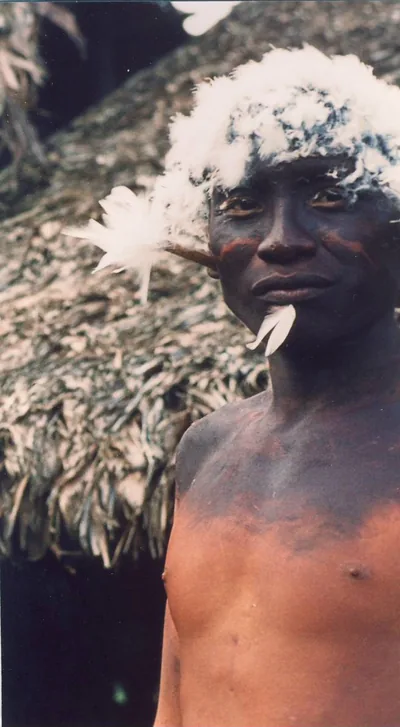
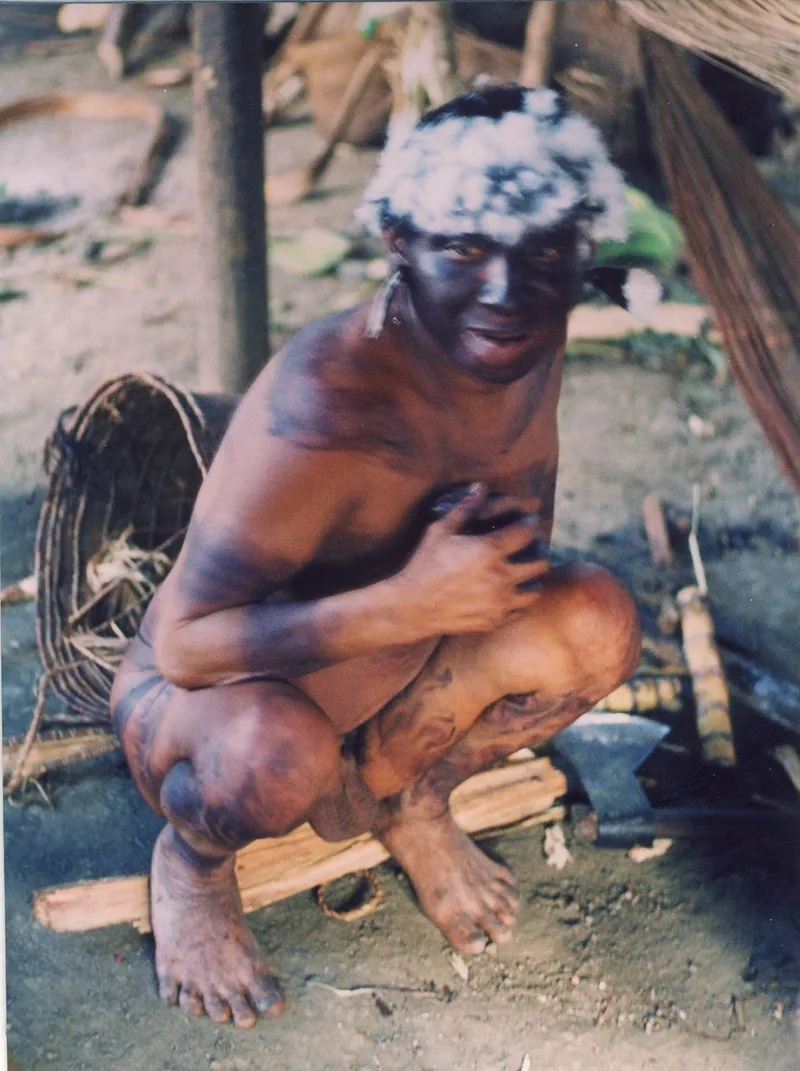
George Seitz, who filmed epéna-making on the Rio Marauiá in 1965, described the preparations around it: faces and upper bodies painted, feather ornaments tied to the arm, the snuffing itself in the early afternoon, by adult men only, one blowing the powder into the other's nostril through a tube 23 to 28 inches long (Seitz, 1967). He identified the Marauiá tree as V. calophylloidea; Schultes and Holmstedt, examining his photograph and specimens, judged it more like V. theiodora (Schultes and Holmstedt, 1968) — an instance of the taxonomic uncertainty that runs through this literature.
Paricá: the medicine man's snuff
At Tapurucuara on the Rio Negro, Seitz watched Agostino, a Tukano medicine man from the Rio Papurí, prepare paricá from the same inner bark, boiled down slowly to a crust and ground with no admixture. Agostino was the only one permitted to take it; he did so before diagnosing a patient, and in the intoxication spoke confused words that his brother interpreted, then treated the patient with rattle and quartz crystal (Seitz, 1967). Schultes and Holmstedt identified Seitz's Tapurucuara specimens as V. theiodora (Schultes and Holmstedt, 1968). The pattern matches what Schultes had found among the peoples of the Colombian Vaupés: there the Virola snuff belonged to medicine men alone, for divination and the diagnosis of illness, and its sleep was attended by an assistant who interpreted what the healer said (Schultes, 1954).
Oral pellets
In 1969 a Witoto assistant told Schultes that men of his father's generation ate pellets of the resin, rolled in a salt leached from the ashes of Gustavia poeppigiana bark, when they wanted "to see and converse with the little people". The pellets were taken in a group with the payé, irregularly and only when need arose: for divination, prophecy, finding lost property, and luck in the hunt. No voucher could be collected; Schultes believed the tree was V. theiodora, which he had collected among the Witoto in 1942 with the annotation "intoxicating" (Schultes, 1969). Muinane and Bora informants knew the same drug under other names; the Muinane mixed the boiled-down bark with ashes of Theobroma fruit rind or of palm leaves before rolling the pellets.
The arrow and the wound
On the Tototobí the resin is also the arrow poison, painted onto bamboo points from the very trees being bled for snuff, with no other preparation. When the festival's snuff ran out, the men scraped the dried resin from newly poisoned arrow points and snuffed that instead (Schultes and Holmstedt, 1968). The exudate of the genus has a third life in medicine: some fourteen peoples in four countries are reported to apply it to fungal infections of the skin (Plotkin and Schultes, 1990).
Among the Sanamá Waiká of Auaris, Prance found the bark heated over a fire and the exuding resin scraped straight onto the points. They would “occasionally fill a small gourd with the resin”, but “their main method of storage [of the snuff] appears to be on the arrowheads”; and, unlike other Waiká groups, “no casual uses of the snuff were observed” — it was kept for shamanic divination and funeral rites (Prance, 1970, cited in Ott, 2001, p. 36). Resin scraped from Yanoama darts was later found to be about 8% 5-MeO-DMT (Galeffi et al., 1983, cited in Ott, 2001, p. 45).
Other trees of the genus
V. theiodora is one of several species bled for the same purpose. Schultes's 1954 vouchers from the Rio Apaporis came from V. calophylla, V. calophylloidea and possibly V. elongata (Holmstedt et al., 1980, p. 216). By 1980 seven species were held to be used as hallucinogens in Brazil, Colombia, Peru and Venezuela: V. calophylla, V. calophylloidea, V. cuspidata, V. elongata, V. pavonis, V. surinamensis and V. theiodora (Schultes and Hofmann, 1979; 1980, cited in Holmstedt et al., 1980, p. 217).
V. elongata has the widest record after V. theiodora. In a Yanomamö village on the border of Brazil and Venezuela, Brewer-Carías and Steyermark found epena made from its bark scrapings, dried on potsherds over a fire and powdered, with the ash of áma-ásita (Elizabetha princeps). The cultivated mashihiri was snuffed on its own there, but was generally used "to strengthen the more powerful [Virola] epena". The Arawakan Paumarí of the Rio Purús made a snuff, kawabó, from the inner bark of the same species (Brewer-Carías and Steyermark, 1976, and Prance et al., 1977, cited in Ott, 2001, p. 37). Among the Yekuana of the Orinoco it was known as akurjua, and the shaman made himself drunk on its boiled bark (Boom and Moestl, 1990, cited in Ott, 2001, p. 38).
In Peru the resin was eaten rather than snuffed. Bora of the Rio Yaguasyacu told Schultes's group in 1977 that they had once made pellets of Virola resin, presumably mainly from V. elongata. Residents of Brillo Nuevo named V. surinamensis and V. loretensis as sources too, and V. pavonis was pointed out at Tierra Firme. At Puca Urquillo the source named was Iryanthera macrophylla, another genus of the family (Schultes et al., 1977, cited in Ott, 2001, p. 39). It was the first time a genus other than Virola had been linked to these drugs. The nomadic Makú of the Rio Piraparaná in Colombia were reported to drink the resin directly, with no preparation and no admixture. Herbarium labels from Venezuela record the inner bark of V. sebifera smoked by "witch doctors" at dances when curing fevers (Holmstedt et al., 1980, p. 216).
The laboratory does not always bear the testimony out. Holmstedt's group analysed fifty-three voucher collections of Virola and related genera, and eighteen held no alkaloids. All four collections of V. surinamensis were negative: bark, leaves, seed, aril and a paste between them. So was bark from two collections of V. loretensis. V. rufula, by contrast, was rich in alkaloids but is not known to be used at all (Holmstedt et al., 1980, pp. 221, 223, 225). Ott's survey of the analyses names seven species with appreciable tryptamines: V. calophylla, V. calophylloidea, V. elongata, V. peruviana, V. rufula, V. sebifera and V. theiodora. V. cuspidata is the one reported snuff species not yet shown to contain them, because its bark has not been studied (Ott, 2001, p. 46). The Brillo Nuevo naming of V. surinamensis and V. loretensis rests, so far, on testimony that analysis has not confirmed.
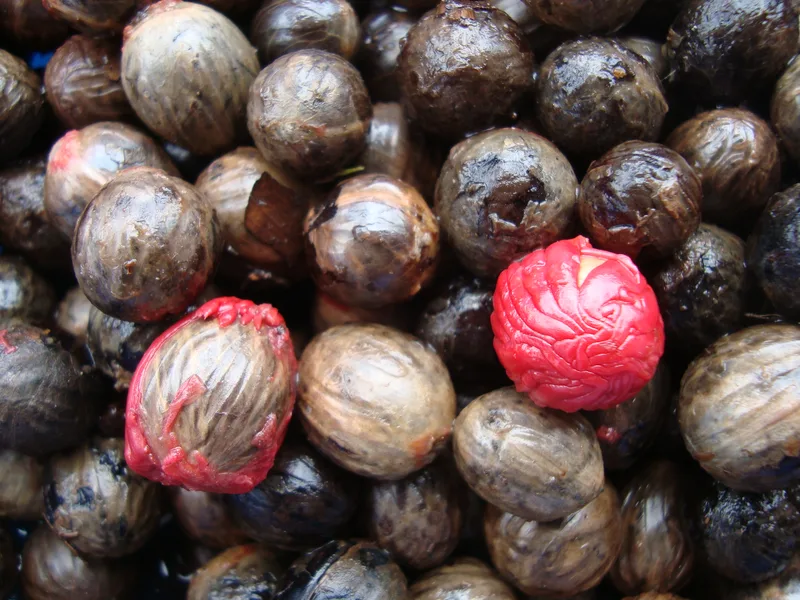
V. surinamensis, the ucuúba of Brazil, is better known for other things. It is an important export timber of the floodplain forests of the Amazon estuary (Macedo and Anderson, 1993). Its seeds are rich in fat, and the butter pressed from them has been studied for cosmetic use (Takano et al., 2019). The Warao of Venezuela, who do not take snuff, know the honey that stingless bees make from it as an inebriant (Wilbert, 1996, cited in Ott, 2001, p. 38).
Indigenous Amazonian shamanisms
Davi Kopenawa, interviewed by Bruce Albert in 1990, said: “Nós Yanomami temos pajés que inalam o pó de yakõana” — we Yanomami have shamans who inhale the yãkoana powder — and that through it they know of the epidemic smoke of gold. The interview’s editorial note identifies the powder as resin of Virola elongata, not V. theiodora (Kopenawa Yanomami, 1990). Yanomami shamanism is treated in the Indigenous Amazonian Shamanisms.
04Cosmology & key terms
The ethnographers who first described Waiká snuff placed it inside a relation with spirits. Otto Zerries, working on the upper Orinoco in the 1950s, wrote that snuffing "is an indispensable prerequisite for invoking the spirits, for only then can the hekula enter the medicine man’s chest and allow him to see the spirits in his yopo-intoxication"; a medicine man overcome by it loses consciousness, a state the Waiká "revealingly call by the word for 'dying'" (Zerries, cited in Schultes and Holmstedt, 1968). Zerries took the snuff for Anadenanthera; Schultes and Holmstedt argued from his own description of its strongest ingredient — the inner bark of a wild tree — that it was Virola. Names travel independently of plants here, and the glossary below records what each term named for its recorder.
Later fieldwork widened the term. Chagnon’s group found ebene a generic word for snuffs, which “may include bark, seeds, leaves, and resin from several different plants”; the Yanomamö mix powders of different composition and still call the result ebene. Of the cultivated Justicia they wrote that these plants “are not merely aromatic additives to ebene but are also used by themselves as ebene to produce intoxication” — against what the Tototobí Waiká told Schultes and Holmstedt (Chagnon et al., 1970, cited in Ott, 2001, p. 37).
- Epéna / ebéna
- The Waiká snuff, as recorded at Maturacá and on the Marauiá (epéna) and by Zerries on the upper Orinoco (ebéna). The name of a preparation.
- Nyakwána
- On the Tototobí, both the tree and the snuff of its resin; the resin as arrow poison is nyakwána-hoó-soo, hoó-soo meaning latex or resin. Schultes and Holmstedt noted, as a question for linguists, its likeness to the Yekwana people's name.
- Hekula / hekura
- The spirits the snuff allows the medicine man to see and receive. A young Karauetarí man described them to Seitz as "big men living there above in big huts".
- Paricá
- A Tupi-Guarani loan word in the Rio Negro trade language, used for snuffs of both Virola and Anadenanthera — the source of a century of misidentification that Schultes's 1954 paper set out to untangle.
- Mashi-hiri
- The cultivated aromatic herb, Justicia pectoralis var. stenophylla, mixed into epéna at Maturacá; the Waiká say it is added to improve the smell.
- Oo-koo-na
- The Witoto name for the tree whose resin was eaten in pellets; possibly generic across several Virola species.
- Hakûdufha
- The Yekuana shaman’s bark snuff recorded by Koch-Grünberg, the first report of a Virola-type snuff (Ott, 2001, p. 33).
- Yá-kee / yá-to
- Puinave and Kuripako snuffs of the Colombian Vaupés from V. calophylla and V. calophylloidea, identified with voucher specimens by Schultes in 1954 (Ott, 2001, p. 34).
- Hisioma
- The Waiká name for Anadenanthera peregrina seed and its snuff, which some prefer to Virola epéna (Ott, 2001, p. 17).
05Visionary phenomenology
Phenomenological profile
The profile lists effects the sources report, for each preparation separately, grouped by domain. Each row gives the grade, how often the sources say the effect occurs (only where they say so; most do not) and the kinds of source behind it. A chip naming a compound, such as “Trial · psilocybin”, means the evidence comes from studies of that compound rather than of the preparation itself; “partial” means the route, purity or dose differs from the traditional preparation, so the row cannot be graded above supported. The line under each preparation says which domains have evidence entered here. A domain with nothing entered has not yet been assessed in this profile; that is not a finding that the literature is silent, and the article may discuss it. Open a row for the note and the sources.
Epéna snuffresin of the bark, insufflated
Evidence entered for 7 of 8 domains. Not yet entered: affect.
Seitz insisted that epéna gave “a strong intoxication but by no means an entire state of trance” (Seitz, 1967). Composition varies tree by tree; 5-MeO-DMT is broken down mainly by monoamine oxidase A (Shen et al., 2010).
Visual
Cosmic and scalar visionThe world, the body or space seen at an altered scale: shrunk, enlarged, or opened to the immense.SupportedEthnography
“The EPÉNA makes me so big that I can see them and talk with them!”, a young Karauetarí man told Seitz, who read the effect as an enlargement of the self and the world (Seitz, 1967, p. 334).
Other senses
Intensified hearingHeightened acuity, salience or alteration of sound.SupportedPharmacology · 5-meo-dmt, partial
Distortions of auditory perception are among the reported effects of 5-MeO-DMT (Reckweg et al., 2022). Measured with 5-MeO-DMT, one constituent of a resin whose composition varies, mostly vaporised, so this counts at partial weight.
Body
Nausea and purgingNausea, vomiting or diarrhoea during the acute state.SupportedEthnographyExperience
Insufflation brings a violent headache, salivation and vomiting (Seitz, 1967); Schultes’s own trial of a V. calophylla snuff recorded nausea (Schultes, 1954).
Altered bodily sensationTingling, vibration, heat, cold, heaviness, pressure or internal movement felt in the body.SupportedExperience
Schultes recorded tingling and numbness of the extremities after a V. calophylla snuff (Schultes, 1954).
Tremor and motor slowingTrembling, impaired coordination or slowed movement.SupportedEthnography
A swaying walk that steadies, before the dance (Seitz, 1967).
Self and unity
Ego dissolutionLoosening or loss of the sense of being a bounded self.SupportedPharmacology · 5-meo-dmt, partial
Feelings of ego dissolution, usually short-lasting (Reckweg et al., 2022). Measured with 5-MeO-DMT, one constituent of a resin whose composition varies, mostly vaporised, so this counts at partial weight.
Cognition
Time distortionTime felt to slow, stretch, stop or lose its ordinary order, or durations misjudged.SupportedPharmacology · 5-meo-dmt, partial
Distortions of time perception (Reckweg et al., 2022). Measured with 5-MeO-DMT, one constituent of a resin whose composition varies, mostly vaporised, so this counts at partial weight.
Relation to other beings
Autonomous entitiesBeings experienced as acting, communicating or observing independently of the experiencer’s will.SupportedEthnography
The hekula are seen and spoken with as “big men living there above in big huts”; a man from the Tapurucuara mission said he had seen and spoken with “angels” (Seitz, 1967). Read about the phenomenology of autonomous entities →
States of consciousness
Dreamlike statesOneiric experience: dream formation, dreamlike sequences or a waking state resembling dreaming.SupportedEthnography
Medicine men’s sleep under the full snuff brought mumblings or shouts and very often visions or dreams, interpreted by an assistant (Schultes, 1954).
Accounts
The fullest outside description of epéna in use is Seitz's, from four Waiká villages visited between 1956 and 1965. He records a violent headache at the moment of insufflation, salivation and vomiting, then a swaying walk that steadies, a fixed stare and heavy sweating; the man begins a rhythmic stamping dance with recitative song broken every few minutes by a yell, arms lifted towards the mountains to the north, and after about an hour lies down. Seitz insisted it was "a strong intoxication but by no means an entire state of trance" — the dancer could still find his arrows in the house (Seitz, 1967).
"Then I will see the HAKULA, who are big men living there above in big huts. … The EPÉNA makes me so big that I can see them and talk with them!"A young Karauetarí man, not yet permitted the snuff, to George Seitz (Seitz, 1967, p. 334)
Another man, who had lived at the Tapurucuara mission, told Seitz he had seen and spoken with "angels". Seitz read the two accounts as one drug effect — an enlargement of the self and the world — overlaid by what each man had been taught to expect, and judged much of the snuffing he saw to be display (Seitz, 1967). His is an outsider's reading from 1967, and it sits uneasily beside Zerries's account of spirits entering the medicine man's chest; the two together show how much of what is reported depends on who is asking. For a Virola snuff of the Colombian Vaupés, prepared from V. calophylla, Schultes's own trial recorded headache, tingling and numbness of the extremities, nausea and a heavy, broken sleep; the medicine men's sleep under the full snuff, he was told, brought mumblings or shouts and very often visions or dreams, interpreted by an assistant (Schultes, 1954).
Duration
| Context | Duration | Caveat |
|---|---|---|
| Waiká epéna, insufflated | About an hour | Observed by Seitz in Marauiá and Maturacá-area villages; a hangover followed (Seitz, 1967) |
| Witoto resin pellets, swallowed | Onset within minutes; up to two hours | Informant's report; species attribution without voucher (Schultes, 1969) |
| 5-MeO-DMT, clinical studies | Usually short-lasting | Depends on route of administration; synthetic or toad-derived material, not Virola (Reckweg et al., 2022) |
Recurring visionary motifs
- Enlargement — of the body, and of everything around it
- Spirits seen and spoken with: hekula as "big men" in huts above
- The "little people" of the Witoto pellets
- Song, dance and shouting directed outward, to mountains or to a patient
- Speech in the intoxication read by an interpreter as diagnosis or divination
- Loss of consciousness named by the word for "dying"
What the pharmacology describes
The neuroscience addresses the molecule. 5-MeO-DMT acts chiefly as an agonist at serotonin 5-HT1A and 5-HT2A receptors, with its highest affinity at 5-HT1A; its reported effects include distortions of auditory and time perception, amplified emotional states and ego dissolution, usually short-lasting (Reckweg et al., 2022). It is broken down mainly by monoamine oxidase A and in part converted by the enzyme CYP2D6 to bufotenine (Shen et al., 2010). None of this research used Virola; it describes one constituent of a resin whose composition varies tree by tree, taken in settings — a festival, a healing, a dance — that laboratory studies do not reproduce.
06Contemporary status
| Conservation | Least Concern on the IUCN Red List (IUCN SSC Global Tree Specialist Group and BGCI, 2021). The tree is considered secure; what Schultes warned of was the loss of knowledge — the "rapid disintegration and disappearance of aboriginal cultures" that made the ethnobotany urgent (Schultes, 1969). |
|---|---|
| Research | Plotkin and Schultes called for laboratory study of the resin's antifungal use, which both had employed on themselves (Plotkin and Schultes, 1990). No controlled human study of Virola preparations was found in the sources read for this record. |
Legality
| Jurisdiction | Status |
|---|---|
| International | DMT is in Schedule I of the 1971 Convention on Psychotropic Substances; 5-MeO-DMT is not among the substances the Convention schedules. The Convention lists compounds, not plants (United Nations, 1971). |
| United States | DMT, 5-MeO-DMT and bufotenine are each listed in federal Schedule I, 21 CFR §1308.11; Virola is not named (Electronic Code of Federal Regulations, 2026). |
Other jurisdictions are not summarised here because their primary texts could not be opened for this record.
Open questions on this entry
Safety and law
07Cross-correlations
| Family | Myristicaceae — no other Myristicaceae entries yet |
|---|---|
| Compounds | 5-MeO-DMT ↳ shared with Anadenanthera peregrina, A. colubrina, Diplopterys cabrerana, Phalaris DMT ↳ shared with Psychotria viridis, Mimosa tenuiflora, Diplopterys cabrerana |
| Region | Rio Negro basin · north-west Amazon ↳ shared with Banisteriopsis caapi, the caapi of the Vaupés, and its admixture Justicia pectoralis, here mixed into epéna |
| Sacrament complex | Circum-Amazonian snuff — contrasts with yopo: a seed of open savanna against the bark resin of closed forest, long confused under the one name paricá |
| Indigenous Amazonian Shamanisms | Indigenous Amazonian Shamanisms: the Yanomami shaman’s yãkoana snuff, given in Kopenawa’s 1990 interview as V. elongata. INDIGENOUS COMPLEX |
08Bibliography
How to read the labels on each source
- Source type
- What kind of work it is: journal article, book, legislation, patent application, database record and so on. A word after the dot (ethnography, protologue, primary source) keeps the genre the entry was first filed under. “Unclassified” means the citation does not say enough to tell.
- Peer review
- Recorded for each work separately, and only where it has been confirmed for that work. It is never inferred from a DOI, a publisher or a journal, since journals also publish editorials, letters and commentaries. Where it has not been confirmed, the entry records it as not established. It does not apply to legislation, court decisions, treaties, patents, datasets, database and collection records, historical texts, films, talks, press releases or web pages.
- Check
- What was checked when the entry was added. DOI checked: the DOI’s registry record (Crossref) matched the citation’s title, first author and year. Verified: the record itself was opened and matched the citation: a library catalogue record for a book, or the page itself for a database entry, law, patent or archive document. “Verified (abstract)” and “(summary)” mean only the abstract or a summary was read. Located: a record was found but not fully matched. Bibliographic record and Stable record (in essays): a catalogue or stable web record exists; what was checked against it is not recorded. Unverified: no check is recorded. No locator found: a search found no record. Secondary: read through another source.
- What the labels do not say
- None of them means the source supports a particular sentence. Where a sentence is graded, its evidence note names its sources and whether each supports it, disputes it or gives context. Dates and reviewers of checks are not recorded for each entry; the version note at the foot of a graded page dates its last review.