Mirante, D. (ed.) (2026) Indigenous Amazonian Shamanisms. Entheocene, version 1.0. Available at: https://entheocene.com/complex-indigenous-amazonian-shamanisms.html (Accessed: 17 October 2026).
DOI: not yet minted.
Introduction
This complex gathers the shamanic traditions of six Indigenous peoples. Three speak Panoan languages: the Shipibo-Konibo of the Ucayali, the Huni Kuin of the Purus and Jordão, and the Yawanawa of Acre. The Siona of the Putumayo are western Tukanoans. The Shuar and Achuar belong to the Jivaroan peoples of southeast Ecuador and northeast Peru. The Yanomami live in the Parima highlands and the lowlands around them. They belong to unrelated language families and their histories are distinct, but in each a specialist works through relations with beings who are normally invisible — the owners of animals and plants, the anaconda people, the spirits of the dead — using song, tobacco and, in most of them, a vision-giving plant.
Contents
These are the traditions on which the mestizo medicine of the river towns drew, and they are treated here in their own terms. Their healers do more than cure. A Shipibo healer sings a visionary design onto a patient’s body (Gebhart-Sayer, 1985, p. 144). An Achuar shaman fights an enemy shaman’s darts inside the sick person (Taylor, 2014, p. 101). A Siona taita reads the sacred places of a territory threatened by oil companies (Langdon, Laffay and Maniguaje-Yaiguaje, 2023, p. 40). A Yanomami shaman’s spirits hold up the sky (Kopenawa Yanomami, 1990).
None of these traditions has stood still. Missions, the rubber trade, gold mining, oil exploration and, lately, the international interest in ayahuasca have each reshaped them, and the page follows those changes alongside the rites. The mestizo medicines that grew out of these traditions are treated in the Vegetalismo and Pajelança Healing Complex.
Deep Time
ArchaeologyCueva del Chileno ritual bundle · cal. 905–1170 CE→
Mission recordA Jesuit visits the Putumayo villages · 1847→
Oral historyYanomami epidemics read as sorcerers’ smoke · 1850–1920→
FieldworkSiona yajé without a shaman-chief · after 1962→
LawPeru declares kené and ayahuasca knowledge heritage · 2008
The oldest chemical evidence comes from outside the forest. In a rock shelter of the Lípez highlands of southwest Bolivia, at about 3,900 metres, archaeologists found a ritual bundle radiocarbon dated to around 1,000 CE. It held a leather bag, carved snuffing tablets, a snuffing tube and a pouch sewn from three fox snouts. Residues in it contained bufotenine, dimethyltryptamine, harmine and cocaine. The authors describe it as a documented case of a ritual bundle holding both harmine and DMT, “the two primary ingredients of ayahuasca”, and they argue that plants from distant regions were moving across South America a thousand years ago (Miller et al., 2019).
How old the ayahuasca rite itself is in the forest is disputed. Brabec de Mori reports a consensus that the brew was probably first made by western Tukanoan peoples near the Napo. On his reading of Ucayali songs, terms and teachers, it is “probably less than 300 years old” south of Iquitos, carried there through the Jesuit missions, the Kukama and, later, the rubber trade (Brabec de Mori, 2011, pp. 24–25, 42–43). Others disagree. Anne-Christine Taylor, writing from Jivaroan material, remains sceptical of a recent mestizo origin: “colonial documents attest to the existence of ayahuasca shamanism long before this, at least among the Jivaroans” (Taylor, 2014, p. 104). Els Lagrou, writing of the Huni Kuin, holds that “a shamanic interethnic tradition existed long before the arrival of Colonialism in the region” (Lagrou, 2018, p. 19).
The colonial order left its mark inside the rites. The Jesuit Mainas mission, which held the Upper Amazon from 1638 to 1768, made Quichua the region’s common foreign tongue. Two centuries later Achuar shamans still use Quichua words in their curing songs to show their mastery of foreign languages (Taylor, 2014, p. 103).
01Ethnobotany
The plants of the six traditions
The vine, the leaf, tobacco and the snuff of a forest tree, each with the role the sources give it among these peoples. Each tradition also uses many more plants than these four.
The vine of the Huni Kuin nixi pae, the Yawanawa uni, the Siona yajé and the Achuar natem. In the Huni Kuin origin myth it grows from the body of the ancestor Yube, and it is called his blood or urine (Lagrou, 2018, p. 35; Pérez-Gil, 2001, p. 336; Taylor, 2014, p. 100). Among the Shipibo-Conibo its master spirit, Nishi Ibo, attends every healing session (Gebhart-Sayer, 1985, p. 162).
The leaf cooked with the vine. In the Huni Kuin myth both grow from Yube’s body after his death: “From his body will grow the vine and the chacruna leave, used together to prepare the brew” (Lagrou, 2018, p. 35).
Huni Kuin take nixi pae with the tobacco snuff dume. Yawanawa apprentices drink tobacco juice, nawënë, to learn the healing song mëka, and take tobacco snuff, nawë (Lagrou, 2018, p. 27; Pérez-Gil, 2001, pp. 336–337). The sources do not name the tobacco species; the archive’s tobacco monograph is N. rustica.
The Yanomami shaman’s snuff. “Nós Yanomami temos pajés que inalam o pó de yakõana”, Kopenawa said — we Yanomami have shamans who inhale the yãkoana powder — and that is how they know about the epidemic smoke. The interview’s editorial note identifies the powder as resin of Virola elongata (Kopenawa Yanomami, 1990). The archive’s Virola monograph is V. theiodora.
The Yawanawa name further plants for initiation: chilli pepper, an unidentified rarë, and xupa, “provavelmente, datura”, which was once used to cure and to harm (Pérez-Gil, 2001, pp. 337–338). A Shipibo healer told of an unidentified parasitic plant, shahuan-peco, formerly taken instead of or with ayahuasca (Gebhart-Sayer, 1985, p. 167).
The vine and its owner
In these traditions the vision-giving plant is a person with an origin and an owner. The Huni Kuin trace their knowledge to Dua Busen, who married an anaconda woman and lived among the anaconda people under the water. When he drank their brew, he saw his in-laws as anacondas and screamed, and he had to flee. Later his snake family caught him in a river and broke his bones. The night before he died he taught his people to find and prepare nixi pae, singing all night. Only a small boy, Nambua, stayed awake listening and learned the songs (Lagrou, 2018, pp. 34–35). “To take the brew and experience its visions”, Lagrou writes, “means to actualize, to live again, the experience of the ancestor” (Lagrou, 2018, p. 35).
For the Shipibo-Conibo, Nishi Ibo, the master spirit of the vine, projects luminous geometric configurations before the healer’s eyes shortly before he comes to the session himself (Gebhart-Sayer, 1985, p. 162). For the Siona, the curacas of the past drank yajé to cross to “el otro lado” and travel to other realms of the universe, singing to their allied spirits and to the owners of plants and animals. To deal with these beings, a curaca had to know their language, their songs, and their “pinta”, their designs (Langdon, Laffay and Maniguaje-Yaiguaje, 2023, p. 35).
Tobacco, snuff and the bitter
Pérez-Gil writes that in Panoan shamanism “os principais alucinógenos são a ayahuasca e o tabaco”: the main hallucinogens are ayahuasca and tobacco (Pérez-Gil, 2001, p. 337). Shamanic power among the Yawanawa, as among the Huni Kuin and Matis, is tied to the taste category of the bitter. One old title for a shaman, tsimuya, means “aquele que tem o amargo”, he who has the bitter (Pérez-Gil, 2001, p. 336). Each plant does its own work. The Yawanawa say the dream-soul does not leave the body under ayahuasca, whereas with datura the healer’s spirit leaves the body to search for a stolen soul (Pérez-Gil, 2001, p. 337). Among the Yanomami the shaman’s plant is a snuff, the powder of the yãkoana tree, one of the snuffs treated in the Circum-Amazonian Snuff complex (Kopenawa Yanomami, 1990).
For the Shuar, a note from Peru’s Institute of Traditional Medicine lists the plants in which arutam, the ancestral power, may dwell: the floripondio (maikiua), ayahuasca (natem) and tobacco (tsaanku), as well as waterfalls, high mountains, rocks and certain animals. To obtain an arutam, a person seeks out its dwelling, usually by a waterfall, fasts there and drinks tobacco juice. It appears at midnight among thunder and lightning, and must be touched with the hands. The next day it returns in a dream as an old man and names itself as one of the seeker’s ancestors (Delgado Súmar, 1986, pp. 6–7). In Kopenawa’s words, quoted from his book with Albert, the shamans drink “o pó das árvores yãkoana hi, que é o alimento dos xapiri… Por isso somos capazes de ouvir seus cantos”: the powder of the yãkoana trees, the food of the spirits, which is why they can hear their songs (Mullaney, 2019, p. 11).
Diet, ordeal and initiation
Pérez-Gil distinguishes four processes in every Yawanawa initiation: memorising a great deal of knowledge (prayers, songs, plant uses), taking hallucinogenic substances, keeping a strict resguardo, and passing certain trials (Pérez-Gil, 2001, p. 338). The apprentice eats little, avoids sweet foods, drinks only sour drinks such as fermented manioc, keeps away from women and retreats into the forest. The three trials are sucking the heart of an anaconda, drinking a brew of the plant rarë, and bringing down a beehive from a tree while bearing the stings. Each “mystery”, as one informant called them, demands its own period of restriction (Pérez-Gil, 2001, p. 338). A man who broke his year-long restriction two months early has been ill ever since, and the healers say the spirit of the dead snake took its revenge (Pérez-Gil, 2001, pp. 338–339).
Knowledge is acquired through the senses and in real time. A Yawanawa healer never says he knows the prayers, but that he has heard them, and a plant specialist says he has seen a plant used (Pérez-Gil, 2001, p. 340). Power, unlike knowledge, is not handed over. Among the Shipibo-Conibo, Marubo and Achuar, Pérez-Gil notes, a master passes power to the novice in spittle or in magic darts. Among the Yawanawa it depends only on the apprentice’s own effort (Pérez-Gil, 2001, p. 341). The Achuar shaman collects darts from other shamans: “shamans try to acquire from other uwishin as many varieties of tsentsak as they can” (Taylor, 2014, p. 101).
For the Siona and Secoya of eastern Ecuador, Vickers and Plowman fully or partially identified some 224 species of useful plants. “The Banisteriopsis cult”, they write, “is the conceptual cornerstone of Siona and Secoya religion, mythology, art, medicine, and warfare” (Vickers and Plowman, 1984, p. 1). The leaves of Diplopterys cabrerana, yahe ’oko or “Banisteriopsis water”, go into the pot with the pounded vine and are said to enhance the visions (Vickers and Plowman, 1984, p. 19). A garden Brugmansia (B. insignis), pehi, is used far less often than yajé and by individuals rather than the community, but its use “is considered to be a significant aspect of shamanistic training and knowledge”. One variety is called muhu pehi, “thunder Brugmansia” (Vickers and Plowman, 1984, p. 29). Tobacco, here Nicotiana tabacum, mïto, is smoked in cigars throughout yajé ceremonies. Its smoke is believed to ward off demonic spirits and is blown over patients during the cure, and shamans drink an intoxicating tobacco infusion through the nose in the quest for visions (Vickers and Plowman, 1984, p. 31).
The Shipibo-Conibo patient keeps a diet too, excluding among other things bought food “which has been in contact with metal”, fat, sugar, salt and fruit; breaking it can undo the cure (Gebhart-Sayer, 1985, p. 165). Among the Siona, the brothers who revived yajé ceremonies at Buenavista told Langdon that they had not completed a shaman’s training in their youth because they could not keep the rigour of the diet (Langdon, Laffay and Maniguaje-Yaiguaje, 2023, p. 36).
Pérez Gil’s earlier and fuller study gives the scale of the Yawanawa restriction. Whoever drinks rarë withdraws to a shelter far from the village, eats a little each day, drinks no water but only sour manioc or maize beer, and takes nothing sweet. The restriction may last three months, six months or a year. Whoever keeps it for a year “já sabe tudo”, already knows everything, and is called xinaya; three or six months makes a shuintia. While the visions last, the apprentice must think and wish for what he wants to learn, and dead shamans, especially his own kin, come in dreams to teach it (Pérez Gil, 1999, p. 18).
A Siona apprentice, Langdon writes, began by asking a trusted shaman, usually a relative, to “show him his pinta”. He prepared for intensive use of yajé by seclusion in the forest and by diet. Each pinta was a realm of the other side that the apprentice had managed to reach behind his master, to see its beings and learn their songs. To know a pinta was to develop three linked abilities: to see, to think and to sing. Reaching a given realm usually took three nights, and some were harder to reach than others. One initiated shaman told her he had seen the Moon, with its beautiful flamingo people, “desde lejos”, from afar, but could not get there (Langdon, 2013, p. 137). The apprentice rose from mere man to singer, and the ablest reached the grade of master, called jaguar (yai), seer, or yajé drinker. A master could put on the clothing of the jaguar, or of other beings, to transform his body on the journey (Langdon, 2013, pp. 137–138).
02Culture
Peoples and territories
Shipibo-Konibo · the Ucayali
About 20,000 people when Illius wrote, the most numerous Panoan-speaking people of the Peruvian forest, farming, fishing and hunting along the Ucayali and its tributaries (Illius, 1994, p. 186). Their designs, kené, are painted, embroidered and woven by women and taught from mother to daughter (Belaunde, 2012, p. 124).
Huni Kuin · the Purus and the Jordão
The Huni Kuin, also called Cashinahua or Kaxinawá, live on the Brazilian–Peruvian border; Lagrou has worked with them on the Upper Purus since 1989 (Lagrou, 2018, p. 19). Like the Shipibo-Conibo and the Piro, they call themselves “people with design” (Lagrou, 2018, p. 21).
Yawanawa · the Rio Gregório
A Panoan people of the Rio Gregório Indigenous Land in Acre, which they share with the Katukina. Peruvian and Brazilian rubber collectors reached the region in the first decades of the twentieth century, and the Yawanawa long worked for rubber bosses. In 1984 the land was demarcated and the employees of the company that had bought it were expelled. Missionaries of the New Tribes Mission lived in the village for several years until the Yawanawa expelled them too (Pérez-Gil, 2001, p. 334).
The rubber years were, in Pérez Gil’s words, a period of “submissão” and forced labour. Yawanawa and Katukina worked as “mão de obra semi-escrava”, semi-enslaved labour, on the rubber estates of the Paranacre company until the land was demarcated in the 1980s and the company expelled. Leadership then passed to new leaders educated in the city (Pérez Gil, 1999, pp. 4–5). The figure who stood at the centre of the earlier period was Antônio Luiz, son of an Ushunawa slave and a Yawanawa woman. As a youth he went out to meet the white men, hunting deer for them in exchange for manioc flour and a knife. He became an “amansador de índios”, a tamer of Indians, mediating between the newcomers and peoples still “bravos”, and led the group through almost all its time working for the rubber bosses. He was chief, prayer-healer and herbalist at once, and trained most of the healers Pérez Gil met (Pérez Gil, 1999, pp. 14–15).
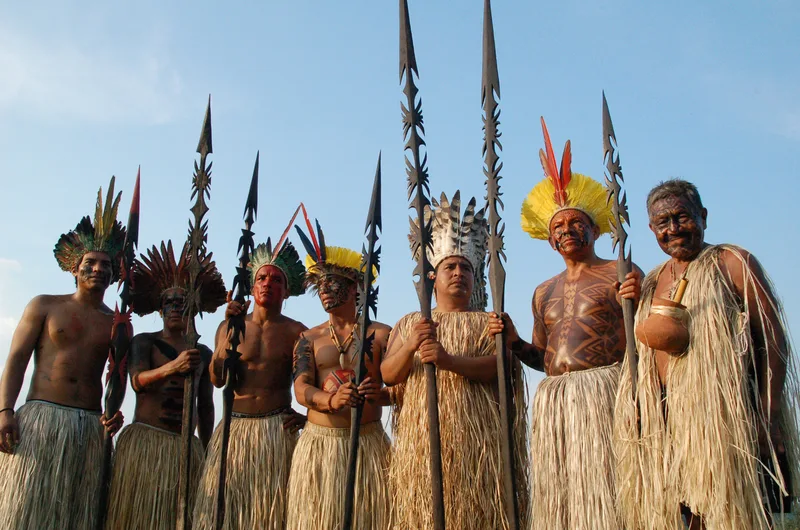
Yawanawa men in feather headdresses and straw skirts, holding carved spears.SeCom/Agência de Notícias do Acre · CC BY 2.5 br · Wikimedia Commons
Siona · the Putumayo
The present-day Siona descend from the some 18,000 western Tukanoans who occupied the Caquetá, Putumayo and Aguarico basins in Colombia, Ecuador and Peru (Langdon, Laffay and Maniguaje-Yaiguaje, 2023, p. 34). Langdon began fieldwork at Buenavista on the Putumayo in 1970, studying the relation between shamanic practice with yajé and the paths people take to treatment (Langdon, Laffay and Maniguaje-Yaiguaje, 2023, p. 34).
Jívaro · Shuar and Achuar
The Jivaroan peoples are spread over the lowlands of southeast Ecuador and northeast Peru. They comprise the Achuar, the Shuar proper, the Awajún and Wampis of the Marañón basin, and the Shiwiar of the middle Pastaza (Taylor, 2014, p. 96). Taylor’s fieldwork among the northern Achuar ran mainly from 1978 to 1981 (Taylor, 2014, p. 96).
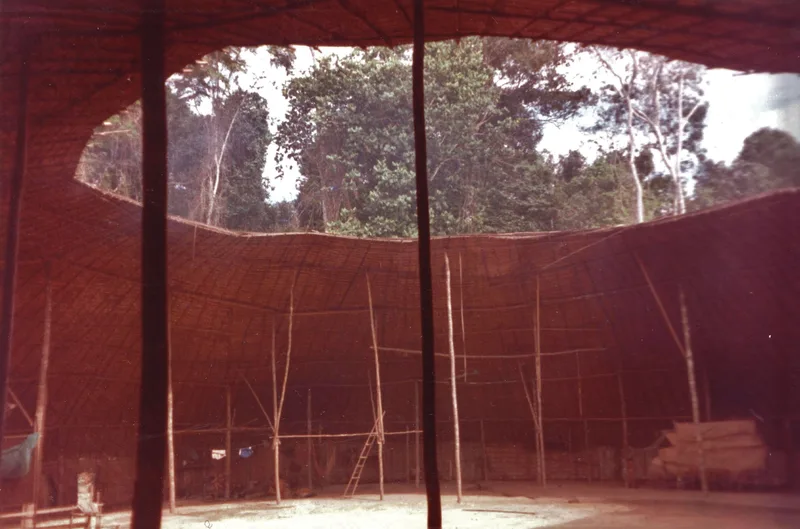
Inside a Yanomami shabono at Piau, 1998: the ring of thatched roof, each family’s section around a central open space.Cmacauley · CC BY-SA 4.0 · Wikimedia Commons
Yanomami · the Parima highlands and the lowlands around them
Albert writes of the Yanomam, one of the four adjacent groups that make up the Yanomami cultural and linguistic ensemble. Most groups of the Parima highlands remained isolated until the gold miners invaded in 1987. The others had been in varying degrees of contact with missions, government posts and settlers since the late 1960s (Albert, 1992, pp. 153–154). Davi Kopenawa, interviewed in 1990, was a young shaman of the village of Demini (Kopenawa Yanomami, 1990).
History and evidence
The mission record on the Ucayali concerns designs. In Lima in 1802 Alexander von Humboldt met the Franciscan Narciso Girbal, who had lived among the Shipibo and Shetebo since 1790. Girbal told him of Panoan “copy-books” of painted cotton cloth that the Indians said had been handed down by their forefathers. The one Girbal obtained was sent to the convent of Ocopa and never arrived (Gebhart-Sayer, 1985, pp. 153–154). People in Caimito in the early 1980s still remembered such a book, of minute red and black designs. In 1978 its owner’s son, an Adventist, had made him burn it because “it contained matters of the devil” (Gebhart-Sayer, 1985, p. 155).
Among the Shuar, the Salesian missionaries held the Indigenous reserve in trust under an agreement with the Ecuadorian state, renewed in 1944 and legally ended in 1969 (Rubenstein, 2005, p. 32). Rubenstein argues that each stage of evangelisation gave the Shuar new forms of agency. Its culmination was not a population of devout Catholics but the Shuar Federation, founded by 52 delegates meeting from 9 to 13 January 1964 (Rubenstein, 2005, pp. 27, 42).
Taylor sets the Jivaroan peoples beside the Quichua-speaking forest peoples who grew up next to them. The Canelos Quichua bordering northern Achuar territory, she writes, “came into being during the late seventeenth and early eighteenth centuries by absorbing former Shuar and Achuar people escaping from epidemics, attacks by colonists settled in the upper Upano valley, and heavily militarized, Jesuit-led missionary expeditions”. Through the nineteenth century and much of the twentieth they went on taking in Achuar fleeing threats to their lives, or drawn by the Quichua’s nearness to Western goods and their reputation as powerful shamans (Taylor, 2014, p. 109).
The Yanomam remember epidemics they can date between 1850 and 1920, and they interpreted them through their own theory of sorcery: enemies had burned malign substances near their houses, releasing a pathogenic “epidemia-fumaça”, epidemic smoke (Albert, 1992, p. 163). Direct contacts with forest collectors, explorers and the frontier commission followed between the 1910s and the 1940s, depending on the group. A Catholic mission was founded on the Catrimani in 1965, and the Perimetral Norte highway was opened in 1973–74. Gold miners came in from 1980 (Albert, 1992, pp. 165, 173, 176–177). Kopenawa’s account of the xawara, quoted below, extends the old theory of epidemic smoke to the smoke of gold.
At Buenavista the last Siona shaman-chief, Arsenio Yaiguaje, died in 1962. A ceremony held to see whether his younger brother had enough power to succeed him “sólo produjo malas visiones” for all who took part, and for fifteen years there was no shaman to lead the collective yajé rituals. The Siona drank instead with Kofán and Kichwa healers (Langdon, Laffay and Maniguaje-Yaiguaje, 2023, pp. 35–36). Langdon calls her fieldwork of the 1970s research in a context of “chamanismo sin chamanes”, shamanism without shamans (Langdon, Laffay and Maniguaje-Yaiguaje, 2023, p. 34).
The Siona tell their own history around the figure of the curaca. In a narrative of the conquest, all the tribes once lived in a great city full of gold, with statues of Christ, the Virgin and Saint Joseph: “Nuestra medicina yagé les enseñó a nuestros ancestros acerca de Dios y los santos, mucho antes de que llegaran los primeros sacerdotes” — our yagé medicine taught our ancestors about God and the saints long before the first priests came. After a great war, the chief and the curacas used the remedy of the great tree to make the city and its people invisible, and the Spaniards found only forest and fled in fear. The tribes then dispersed to their present rivers. When priests turned wicked, “los curacas han tomado yagé, y con la ayuda de los espíritus les han causado enfermedades y muertes” — the curacas took yagé and with the spirits’ help brought sickness and death on them (Mongua-Calderón, 2023, pp. 327–328). In the documentary record, the Franciscan missions reorganised the western Tukanoans into small villages around a plaza and chapel, a pattern they kept after the priests left at the end of the eighteenth century. A Jesuit, Laínez, who visited in 1847, was received with drum and panpipe (Mongua-Calderón, 2023, pp. 330–331).
The rubber trade connected these peoples to the wider world, and the connection ran both ways. Mestre Irineu, founder of the Santo Daime church (see Brazilian Ayahuasca–Jurema Syncretic Religions), and his followers were rubber tappers, most of them migrants from northeast Brazil. Lagrou writes that ayahuasca was transmitted to them by the Indigenous peoples of the region, among them the Huni Kuin of the Jordão, Envira and Tarauacá, and by mestizos, all of them working in rubber (Lagrou, 2018, p. 21).
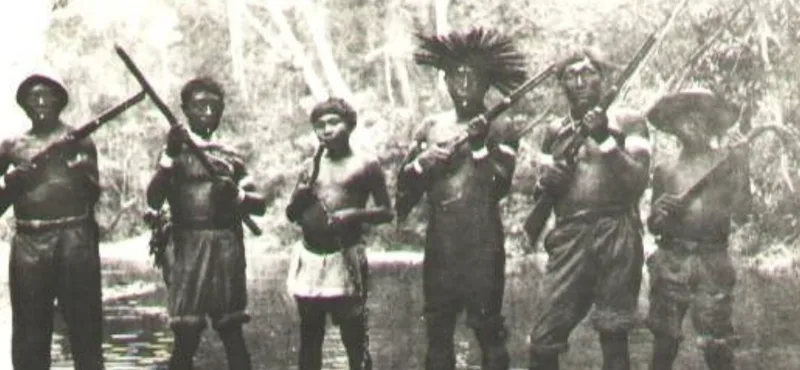
Kaxinawá (Huni Kuin) men on the upper Jordão River, early twentieth century — “apparently in the rubber plantation Revision”, as the source caption has it. Published in the 1931 report of a Brazilian special tribunal.Brasil. Tribunal Especial, 1931, Vol. 4 · CC BY-SA 4.0 · Wikimedia Commons
Ritual practice
An Achuar cure
Taylor describes the Achuar cure in outline. The shaman, uwishin, drinks natem and changes the felt environment of the session — the light, the flow of air, its smells and sounds. While scrutinising the patient’s body he whistles and hums, then sings, softly and then loudly, to summon his helper spirits and the store of magic darts, tsentsak, that he keeps in his saliva, pictured as an inner pond. His darts couple with the enemy shaman’s darts in the patient’s body. The hostile darts are sucked out, “tamed” and sent back to attack the shaman who sent them. Between bouts of singing the healer gives elliptic accounts of what he and his spirits see as they travel, and advice on diet (Taylor, 2014, pp. 100–101).
A Yawanawa prayer over manioc beer
Yawanawa healing prayers are sung at night, when the village is asleep, by one or several healers under ayahuasca, over a pot of fermented manioc drink, caiçuma, which the patient will drink afterwards. The patient is normally not present (Pérez-Gil, 2001, p. 337). The healing song mëka is sung differently, in daytime from a hammock, with no substance taken, for the patient to hear (Pérez-Gil, 2001, p. 337).
A Huni Kuin night of songs
The Huni Kuin specialist Sebirua told Lagrou that every nixi pae ritual follows the same order of songs: first the calling songs, then the stabilising songs, then the songs to see, and last the songs to send the visions away (Lagrou, 2018, p. 27). Ibã Huni Kuin, a master of the huni meka songs, describes three kinds: those that call the “force”, vision songs, and those that diminish the force (Mattos and Huni Kuin, 2017, p. 64).
A Siona-Secoya yahe night
Vickers and Plowman describe the ceremony in full. It is held about once a month, or sooner if the shaman has a purpose, such as asking the spirits to stop the rains so that fields can be burned. Two or three assistants, the “Banisteriopsis cooks”, carry the vine slowly and respectfully to a ceremonial house in the forest, the yahe wi’e, and cook it through the next day while rituals protect it from demons (Vickers and Plowman, 1984, p. 19). Drinking is communal: whole families take part, often more than twenty people, in their finest cotton tunics, with red face paint, strands of beads and fragrant plants bound to their arms. The shaman chants over the pot for nearly an hour, then serves each person, blowing over them and shaking a rattle of bound Pariana leaves to startle away lurking demons (Vickers and Plowman, 1984, p. 19).
Through the night the shaman sings in “a magical dialect which is only partially understood by the others present”. His soul is believed to rise to the heavenly realms and mingle with the ma’timo bai, the heavenly people — the plum-throated cotinga people, the heron people — whose world he describes in detail and interprets for the others. He may play a one-stringed musical bow, to which the heavenly people are said to dance. Others answer his songs in chorus from their hammocks, while he never lies down, blowing the smoke of beeswax over them against demons (Vickers and Plowman, 1984, pp. 19–20). At dawn he cures. He must reach the wati, the demon who is the helper of the sorcerer who caused the illness, learn the sorcerer’s identity and contract with the helper to end it, then sing curing songs and suck out the darts, thorns or pebbles causing the pain (Vickers and Plowman, 1984, p. 20).
A Shipibo-Conibo healing
Among the Shipibo-Conibo the setting is part of the cure. “Visible and invisible geometric designs, melodious singing, and the fragrance from herbs and tobacco smoke pervade the atmosphere”, and the patient is never left alone in his mosquito tent during the critical time of his illness (Gebhart-Sayer, 1985, p. 161). A healer generally needs three to five treatments of about five hours each (Gebhart-Sayer, 1985, p. 164).
People
Specialist
Main plant and rite
Source of power
Shipibo-Konibo
Healer who sings designs; legendary meraya (Illius, 1994, p. 185)
Ayahuasca; design-songs over the patient (Gebhart-Sayer, 1985, pp. 161–164)
Nishi Ibo and helper spirits; designs from the anaconda Ronin (Gebhart-Sayer, 1985, pp. 149, 162)
Huni Kuin
Master of huni meka songs (Lagrou, 2018, p. 22)
Nixi pae with dume snuff; sequence of songs (Lagrou, 2018, p. 27)
Becoming Yube, the anaconda (Lagrou, 2018, p. 29)
Yawanawa
Xinaya, “he who has thought”; niipuya, “he who has the leaves of the forest” (Pérez-Gil, 2001, pp. 335–336)
Ayahuasca, tobacco; prayers over manioc beer (Pérez-Gil, 2001, p. 337)
The apprentice’s own effort, diet and ordeals (Pérez-Gil, 2001, p. 341)
Siona
Curaca, now taita (Langdon, Laffay and Maniguaje-Yaiguaje, 2023, p. 34)
Yajé; songs and “pinta” (Langdon, Laffay and Maniguaje-Yaiguaje, 2023, p. 35)
Allied spirits and the owners of the “other side” (Langdon, Laffay and Maniguaje-Yaiguaje, 2023, p. 38)
Achuar
Uwishin (Taylor, 2014, p. 100)
Natem; sucking and returning darts (Taylor, 2014, p. 101)
Affinal spirits under the water; darts from other shamans (Taylor, 2014, pp. 99, 101)
Yanomami
Pajé and his hekurabë (Kopenawa Yanomami, 1990)
Yãkoana snuff (Kopenawa Yanomami, 1990)
Helper spirits, the shaman their “father” (Kopenawa Yanomami, 1990)
Mythology and cosmology
For the Yawanawa, almost every being — animals, plants, other people, stones, rivers, thunder — has a yuxin aspect beside its body. Yuxin is both a vital force that pervades all beings and a range of personified spirits: the souls that make up a person, the dead in the sky, the beings of stone, water and forest, and the representatives of certain animal species (Pérez-Gil, 2001, p. 335). In sleep the eye-soul leaves the body and wanders. A patient’s dreams are what the healer uses to diagnose who has attacked him and how (Pérez-Gil, 2001, p. 335).
The Shipibo-Conibo designs have a mythical donor, Ronin, the cosmic anaconda, whose skin bears every possible design and who showed them to an ancestral woman. The smallest and most powerful designs lie near the tip of its tail, the shama, “where all force culminates” (Gebhart-Sayer, 1985, pp. 149, 153). Illius describes ani ronin, the great boa, as the most respected and feared of the mythical beings, from whose mouth the fishes of the Ucayali were born (Illius, 1994, p. 190). A Huni Kuin calling song recalls xanka huni, the people who drank the vine and, with music and noise, rose slowly until the whole village went up to the sky. Only one young man, sent to fetch the next village, stayed behind and became the bird duxau (Lagrou, 2018, p. 32).
The same mythical figure runs through the Panoan peoples under different signs. Among the Yawanawa, Yuve is the character of the myth of Kapiyuveunini, who taught people to drink the brew and to sing the songs that treat disease. He is invoked in the healers’ prayers against the spirits that cause illness, and his name is tied to wisdom. Among the Huni Kuin, Yube is the owner of the water world, linked with the moon, the anaconda and the vine. Among the Shipibo-Conibo, the cognate names the sorcerer, the shaman who sends darts to cause sickness or death (Pérez Gil, 1999, pp. 34–35).
The Siona speak of two sides. “This side” is visible; “el otro lado”, yequë ca’nco, is usually invisible, peopled by the owners of the animals and the sacred places, who are also responsible for the seasons (Langdon, Laffay and Maniguaje-Yaiguaje, 2023, p. 38). Achuar myths place the aquatic spirits tsunki, the ultimate source of shamanic ability, in underwater cities full of machines, riding turtles that are seen as cars (Taylor, 2014, p. 103).
The Shuar note describes a layered world. Above the visible earth is the world of the waters, home of the tsunki. Beneath it is the land of Nunkui, who taught women to plant gardens and to make pottery. Below that is a world through which the souls of the dead pass (Delgado Súmar, 1986, p. 4). Tsunki is pictured as a woman who lives in the water and owns all its animals; the Achuar sing to her for good fishing. Nunkui lives under the gardens as a small black worm that the Achuar never kill, and women sing to her for a good harvest. Amasang, owner of the game, once lived in a family’s house as a coral snake and went hunting with the man in the form of a woman, until his jealous wife beat her and threw her into the forest (Delgado Súmar, 1986, p. 6).
Kopenawa told Albert that Omamë, creator of the Yanomami, had buried the xawara deep in the earth and forbidden anyone to touch it. The xawara is the substance of metal, “que vocês chamam ‘minério’”, which you call ore. When white men dig out the gold and burn it, its smoke becomes the epidemic smoke that kills the Yanomami, and the white people too. When the smoke reaches the chest of the sky, the sky falls ill (Kopenawa Yanomami, 1990). It is the shamans’ spirits that keep it up:
The book Kopenawa made with Albert, first published in French as La chute du ciel in 2010, renders a Yanomami concept, utupë, as “image”. Cesarino reads it as kin to the Panoan yochin and to the terms usually translated as “spirit”, “soul” or “double” elsewhere in Amazonia (Cesarino, 2014, pp. 289, 292). Kopenawa’s thinking about the white world, Cesarino notes, works through the shamanic spirits: “At night, I have often thought about those things of the underground that the white people so avidly covet. I asked myself: ‘how did they come into existence? What are they made of?’ Finally, the xapiri allowed me to see their origin in the time of dream” (Cesarino, 2014, p. 291).
São os hekurabë dos pajés que seguram o céu. Ele pode começar a rachar com muito barulho, mas eles conseguem consertá-lo e o fazem ficar silencioso de novo.Davi Kopenawa Yanomami, interviewed by Bruce Albert, 1990 — “It is the shamans’ hekurabë that hold up the sky. It may begin to crack with a great noise, but they manage to mend it and make it quiet again.”
Shamanism and healing
Taylor sets the Achuar shaman beside the warrior. Achuar men seek frightening, drug-induced encounters with arutam, the ghosts of dead prominent Jivaroans, which give the magnified selfhood of the kakaram, the powerful man (Taylor, 2014, p. 98). The shaman instead cultivates friendly, in-law relations with the beings that cause illness and control game. Typically these are aquatic animals such as otters, which appear to lone hunters as beautiful young women and draw them into an underwater world “pictured as an urban habitat of cement houses, cars, bars, and police or military garrisons” (Taylor, 2014, p. 99). The shaman is always suspect. As one of Perruchon’s informants put it, “There are bad uwishin and good uwishin, but they are all bad” (Taylor, 2014, p. 101).
A cure may fail. Because the enemy shaman is presumed to be a fellow Jivaroan, the victim is “eaten” by enemies while unable to take up the warrior’s stance such an attack calls for. Chronic illness, Taylor writes, “used to entail exiting from a Jivaroan identity for some period of time—sometimes for good—and adopting a Runa (forest Quichua) identity” (Taylor, 2014, p. 109). The sick person sought out ever more powerful distant shamans and drifted towards Quichua healers, often near white settlements, military bases, hospitals or missions. He might move into the curing shaman’s household, become his apprentice, or marry into his kin (Taylor, 2014, p. 110). To become Quichua was to learn their kind of history, a sequence of “times”: a wild time before contact, “times of slavery” or “of the bosses”, and present times of emancipation. That sequence maps onto the patient’s own path from illness to recovered strength (Taylor, 2014, pp. 110–111).
The Shuar note distinguishes three kinds of uwishin: those who cure the sick, those who bewitch, and diviners. It also names a person’s souls. The true soul accompanies a person from birth to death. The arutam soul is acquired, gives great courage and protects its owner from being killed; one may hold up to two, but not for ever. The avenging soul, muisak, rises in the head of a man who had an arutam and was killed by enemies, and tries to escape to take revenge (Delgado Súmar, 1986, pp. 4–5, 7).
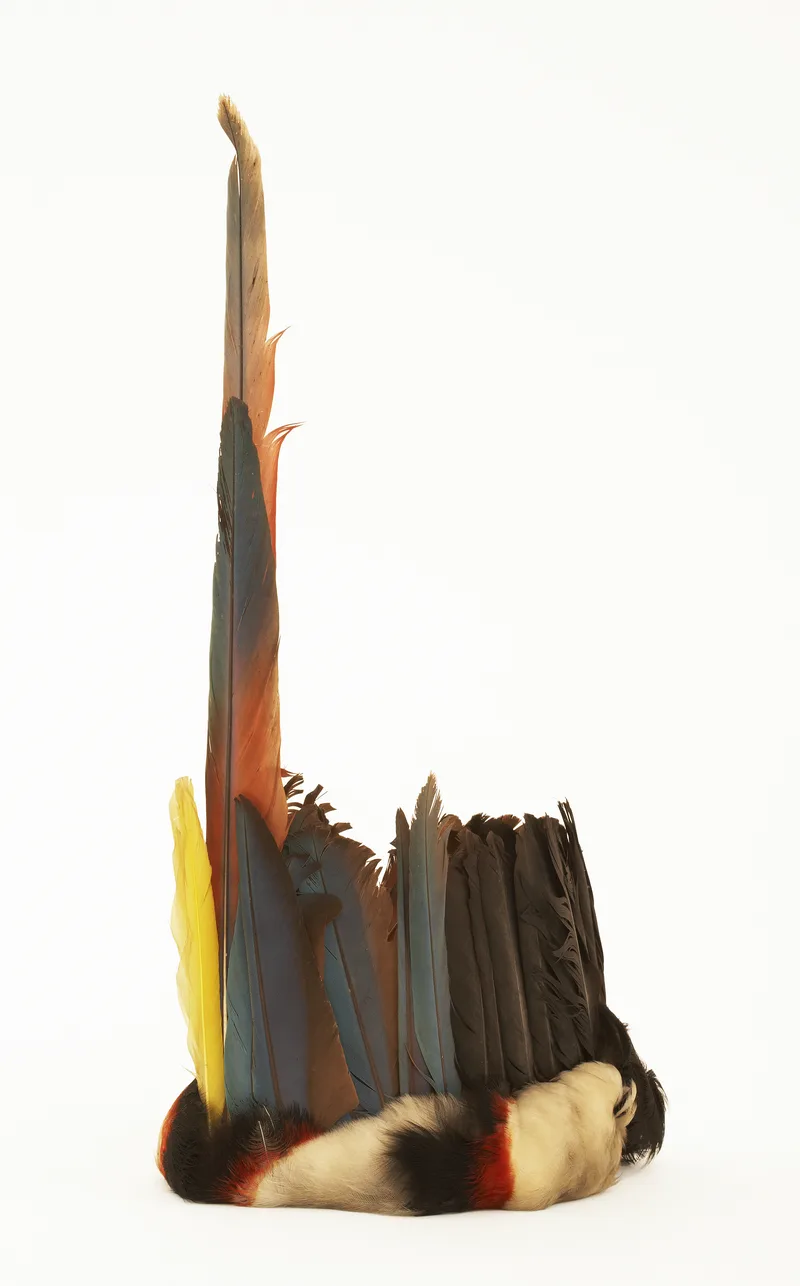
Headdress belonging to a Shuar shaman’s costume, dated by the museum to 1900–1967. MAS, Antwerp.Shuar · photograph MAS, Antwerp · CC0 · Wikimedia Commons
Among the Yawanawa, healing is divided among specialists. At the time of Pérez-Gil’s fieldwork seven people were recognised: five niipuya, who know the forest remedies, and two xinaya, who practise prayer. Other names mark further techniques — blowing, the healing song mëka, possession — and one man may hold several (Pérez-Gil, 2001, pp. 335–337). No one now practises possession, but the elders remember the sessions of an earlier yuvehu, João Grande, into whom the spirits came (Pérez-Gil, 2001, p. 336).
Gebhart-Sayer called Shipibo-Conibo therapy “a matter of visionary design application in connection with aura restoration”. Since everyone is treated from early childhood, every person “feels spiritually permeated and saturated with designs” (Gebhart-Sayer, 1985, pp. 144–145). As the network of light touches his lips, the healer sings melodies that correspond to it — “My song is a result of the design image” — and the song becomes a pattern. The hummingbird spirit, Pino, drops the pattern onto the patient’s body (Gebhart-Sayer, 1985, pp. 162–164).
At first, the sick body appears like a very messy design. After a few treatments, the design appears gradually. When the patient is cured, the design is clear, neat, and complete. In my visions, I watch Hummingbird hover above the patient. With each swish of his wings, a part of the design emerges.A Shipibo-Conibo healer, quoted in Gebhart-Sayer (1985), p. 164
A successful cure is “covered” with a protective finish, the pana; for this the patient’s whole body is “covered with songs” (Gebhart-Sayer, 1985, p. 165). Here too the healer is ambivalent, and the same helper spirit may cure or harm. Gebhart-Sayer cites Langdon’s 1979 study for the Siona shaman who sends the substance that caused a disease back to its source (Gebhart-Sayer, 1985, p. 166; Langdon, 1979).
The Yanomami shaman fights the epidemic itself. Kopenawa described the xawara as wrinkled and elastic, “como borracha”, like rubber. The shamans’ spirits cannot cut it with their weapons, and when it seizes them, their “fathers”, the shamans, die. Only by sending many more spirits can the captive ones be torn free and the shaman brought back to life (Kopenawa Yanomami, 1990).
Art and material culture
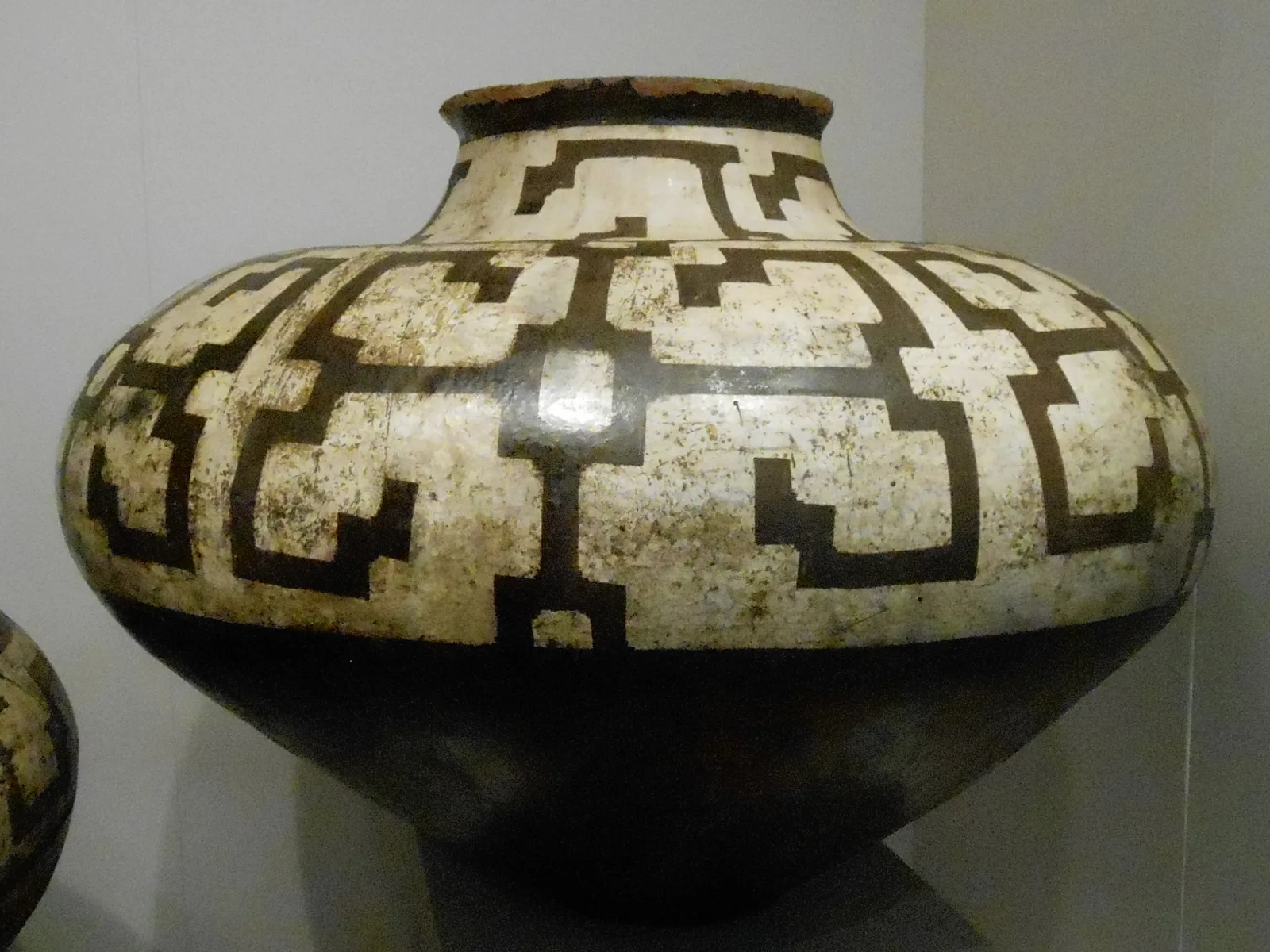
The Shipibo-Conibo style has two basic forms, Gebhart-Sayer wrote. Quene is a linear composition, curved or angular. Canoa is “a blocklike, angular composition in bold lattices”. Both rest on horror vacui, symmetry and the evasive direction of the line (Gebhart-Sayer, 1985, p. 147). Illius describes the designs as transmitted by the shaman, who perceives them in ayahuasca from the ancient meraya, from powerful mythic beings or from the aura of a person present (Illius, 1994, p. 185). Some of his informants said the spirits “sang” the designs, and the shaman learned them by whistling (Illius, 1994, p. 193).
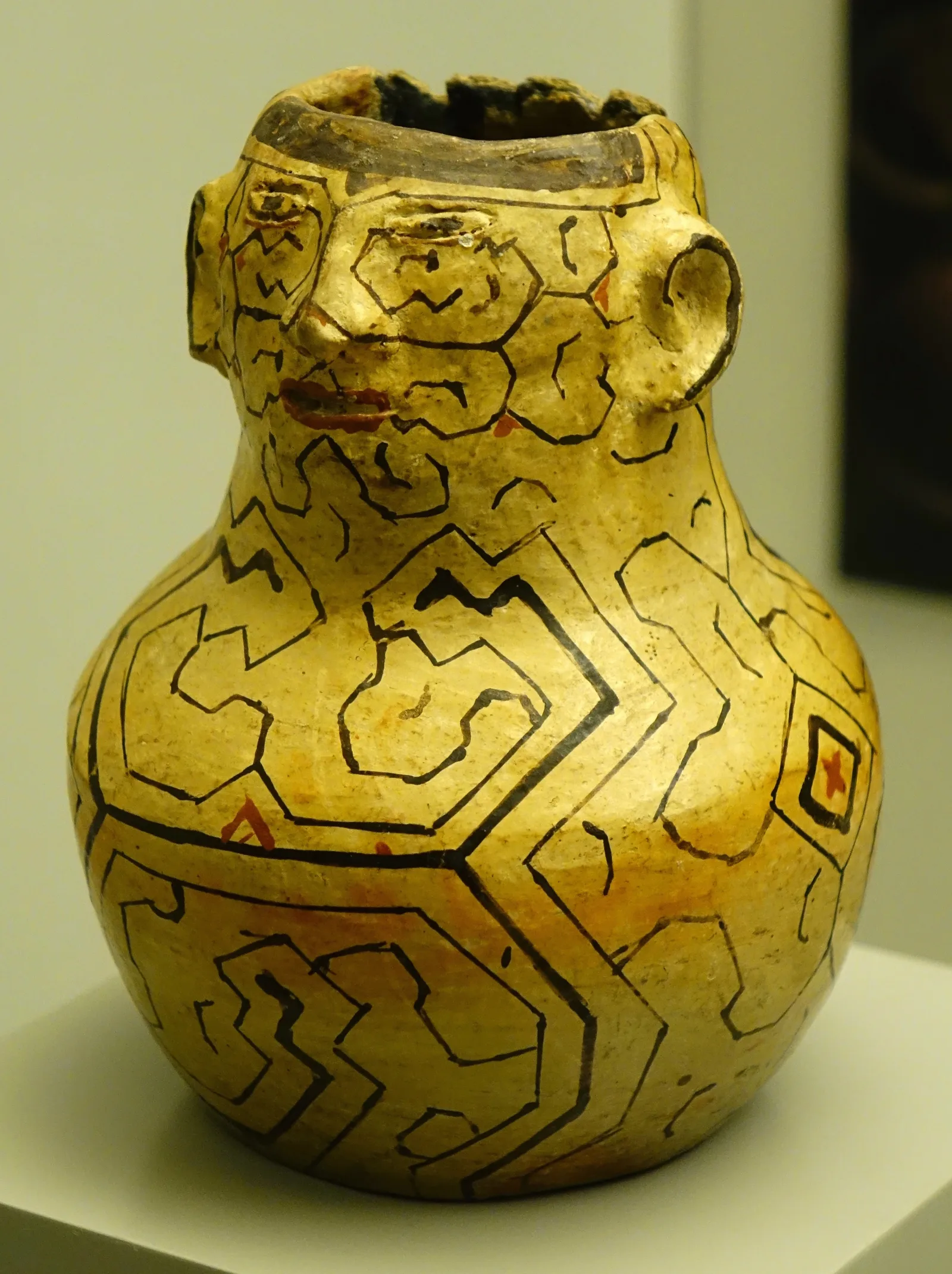
Plate 01 · Joni chomo · deep view
Joni chomo, Shipibo ceramic vessel with a modelled face, before 1986 · Museo de América, Madrid, 1986/04/078 · Outisnn · Attribution ↗
This account has been contested. Brabec de Mori and Laida Mori Silvano de Brabec — an ethnomusicologist and a Shipibo bilingual teacher — found that the designs “sirven para indicar identidad étnica, belleza y calidad”, mark ethnic identity, beauty and quality, but “no se encuentra evidencia alguna de un código”: there is no evidence of a code (Brabec de Mori and Mori Silvano de Brabec, 2009, pp. 105, 109). They accept the theory of “aesthetic therapy” to the extent that curing songs often refer to designs, and that most Shipibo healers work with invisible body designs, yora kené. They do not accept that designs correspond to musical structure (Brabec de Mori and Mori Silvano de Brabec, 2009, p. 119). On their reading, ayahuasca use is probably more recent than the designs, and the visions follow the culture rather than the reverse (Brabec de Mori and Mori Silvano de Brabec, 2009, p. 129).
Gebhart-Sayer recorded how the designs are spoken of in the shamans’ songs: a medicine may be called “my painted song”, “my voice, my little painted vessel”, “my words with those designs” or “my ringing pattern”. In earlier times, she was told, two women painted the two halves of a very large vessel at once, sitting opposite each other and unable to see the other’s side. By singing they reached such accord that the two halves harmonised. The exercise was called “the meeting of the souls” (Gebhart-Sayer, 1985, p. 170). The healers’ “song medicines”, she writes, are a stable corpus of some twenty or thirty melodies in about eight categories, while the words are improvised. In the masha dance, men and women holding hands drew squares, circles, loops and meanders in the dust with their footsteps; the dance was still occasionally performed at Caimito’s drinking feasts, but she thought the tradition practically extinct (Gebhart-Sayer, 1985, p. 171).
Fragrance belongs to the same aesthetic. The patient is rubbed with essences, and flowers float in a bowl of water for washing. Tobacco smoke “makes a path in the air leading the helpers to the patient”. Hostile spirits try to spoil the design being sung onto the body with evil-smelling anti-songs about gasoline, fish poison, dogs and menstrual blood. One Caimito healer who claimed to be chiefly a sorcerer was heard singing “stink songs” about faeces, kerosene and cheap soap (Gebhart-Sayer, 1985, p. 171). Gebhart-Sayer concludes that the healing system binds visual, auditory and olfactory perception into a “synaesthetic—and aesthetic—body of shamanic cognition” (Gebhart-Sayer, 1985, p. 172).
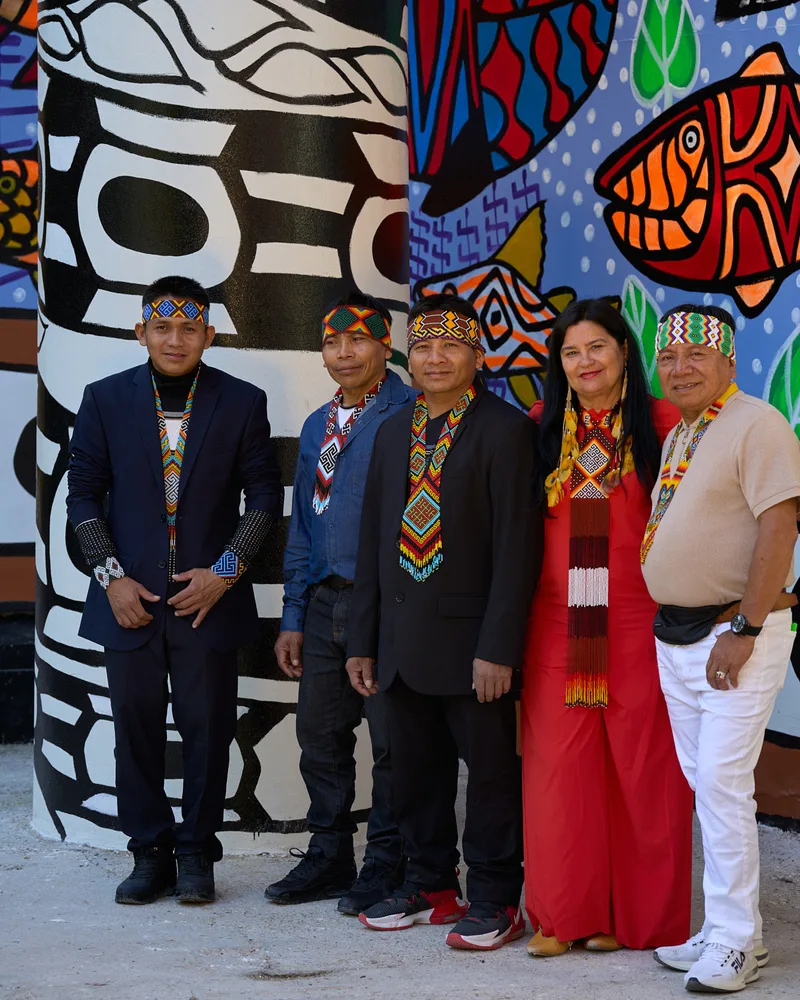
Among the Huni Kuin, song has become painting. Bane Huni Kuin, son of the song master Ibã, began drawing what he saw in vision because, as he put it, what was missing from his father’s written research was “what was being seen exactly in the vision” (Mattos and Huni Kuin, 2017, p. 63). From his work grew the MAHKU collective, founded in 2011 on the Jordão. Most of its figurative paintings refer to ayahuasca songs taught by Ibã, and the Fondation Cartier in Paris showed it in 2012 (Lagrou, 2018, p. 22; Mattos and Huni Kuin, 2017, p. 64).
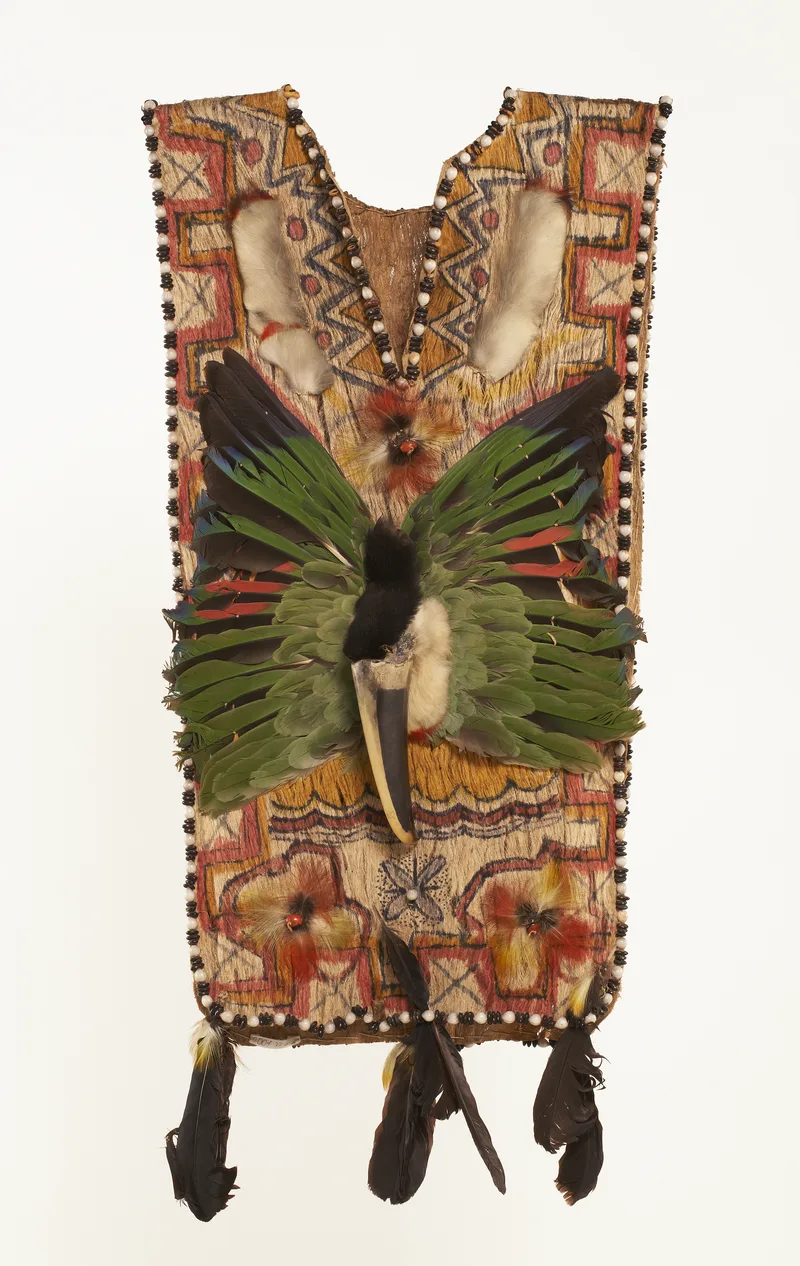
MAHKU artists before their painting at the 2024 Venice Biennale.Curador de Arte · CC BY 4.0 · Wikimedia CommonsA Shuar shaman’s tunic, dated by the museum to 1900–1967: painted bark cloth with green feathers, a toucan’s beak at the chest and black feathers at the hem. MAS, Antwerp.Shuar · photograph MAS, Antwerp · CC0 · Wikimedia Commons
Among the Achuar, the contrast between warrior and shaman shows in images. The warrior is figured in the shrunken-head trophies, tsantsa, of Shuar war ceremonies. The shaman is figured in the Jurijri, a being with a smiling human face in front and a monstrous predatory face hidden at the back under its hair, often portrayed by Quichua potters (Taylor, 2014, p. 100).
03Visionary phenomenology
Accounts
Taita Pablo Maniguaje · the jaguar and the cicada women
The morning after a yajé ceremony in August 2019, held for ten members of the Siona Indigenous Guard, Taita Pablo Maniguaje told them what he had seen. He sang to clear the space, then for “buenas pintas”, good visions. A crowned jaguar came and told him: “Yo vengo a abrir las puertas para que usted llegue al espacio de nosotros”, I have come to open the doors so that you may reach our space, to give strength to the guardians. A painted cloth, the jaguar’s skin, spread over them all and shook down drops of water on each of them. The Guard’s staffs were covered with the jaguar’s markings (Langdon, Laffay and Maniguaje-Yaiguaje, 2023, pp. 41–42). Then the cicada women came, sad, their wings drooping. Four low seats stood empty:
Los abuelos estaban sentados allí. Nosotros llegábamos y ellos nos recibían, y hoy los asientos están vacíos.Taita Pablo Maniguaje, 2019, in Langdon, Laffay and Maniguaje-Yaiguaje (2023), p. 43 — “The grandfathers were sitting there. We would arrive and they would receive us, and today the seats are empty.”
Four of the oldest and most knowledgeable Siona taitas had died between 2018 and 2019 (Langdon, Laffay and Maniguaje-Yaiguaje, 2023, p. 39). Taita Pablo sang to the cicada women until they lifted their wings.
Davi Kopenawa · learning to hear the xapiri
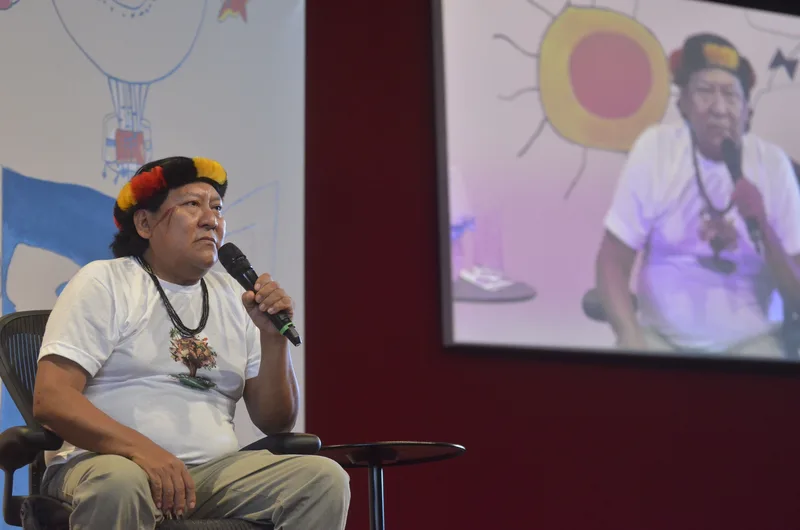
Davi Kopenawa speaking at the International Literary Festival of Paraty, 2014.Fernando Frazão/Agência Brasil · CC BY 3.0 br · Wikimedia Commons
In the book he made with Bruce Albert, Kopenawa tells his initiation more than once. Everything around him had to be silent. After days of fasting and of inhaling yãkoana, he still saw no xapiri and began to worry, and his father-in-law, crouching beside him, taught him to listen (Mullaney, 2019, p. 7):
Se você quer mesmo tornar-se xamã, deve responder à voz deles imitando seus cantos e falando com eles. É claro que no começo você não vai conseguir. Mas, aos poucos, eles vão lhe revelar suas palavras. Sua boca não deve ter medo!Kopenawa’s father-in-law, in Kopenawa and Albert, quoted in Mullaney (2019), pp. 7–8 — “If you really want to become a shaman, you must answer their voice by imitating their songs and talking with them. Of course at first you won’t manage it. But little by little they will reveal their words to you. Your mouth must not be afraid!”
“Eles trocaram minha língua e minha garganta pelas deles”, Kopenawa says — they exchanged my tongue and my throat for theirs — and little by little their songs became clear and he began to sing like them (Mullaney, 2019, p. 8). Without “virar outro”, becoming other, it would be impossible to see things as the spirits see them (Mullaney, 2019, p. 7). He once stopped Albert taking flash photographs of shamans in session: “Pare de pegar a imagem desses homens que estão virando espíritos! Os xapiri deles estão aqui, ainda que nem você nem eu possamos vê-los!” — stop taking the image of these men who are becoming spirits; their xapiri are here, even if neither you nor I can see them (Mullaney, 2019, p. 5).
Albert has written that Kopenawa asked him to set aside the usual frame of his ethnographic interviews “and to truly listen to what his xapiri spirits had to say about the collapse of the sky”, so that their words might reach as many open-minded foreigners as possible, to protect the Yanomami land-forest from the “earth eaters” who threatened it (Albert, 2014, p. 336). Writing in 2014, he added that Kopenawa, then about to turn sixty, faced “serious death threats from gold miners and ranchers who continue to invade Yanomami’s lands in northern Brazil” (Albert, 2014, pp. 336–337).
Ricardo Yaigüaje · the house of the jaguar people
Ricardo Yaigüaje, a Siona elder of about seventy and son of a powerful shaman, told Langdon more than a hundred stories of encounters with the hidden world. He never reached the status of master, or jaguar, because of repeated terrifying experiences in which, through other shamans’ malice, he lost control of his awareness and the power to deal with invisible beings (Langdon, 2013, pp. 140–141). In one story from his youth, he had been drinking yajé until dawn and came out of the ritual house chewing sugar cane. His father took him into the forest and told him to close his eyes (Langdon, 2013, pp. 141–142):
Yo los cerré y por eso apareció el otro mundo. Apareció, y en aquel lugar un caserío, un caserío grande había. Estando en ese lugar, “este es sitio de la gente jaguar”, mi papá dijo.Ricardo Yaigüaje, translated from Siona in Langdon (2013), p. 142 — “I closed them and so the other world appeared. It appeared, and in that place there was a settlement, a big settlement. Being in that place, ‘this is the place of the jaguar people’, my father said.”
The people of the house told them, “Somos los hijos de la gente jaguar”, we are the children of the jaguar people (Langdon, 2013, p. 142). What interests Langdon is that the visit happens awake, in the morning after the ritual, not under yajé or in a dream. Other initiated shamans told her of similar visits (Langdon, 2013, p. 141).
Dumink · a Napo shaman in a cement house
In 1979 the Achuar shaman Dumink, settled near Canelos Quichua territory, sang over a young man with chronic stomach pain about twenty minutes after drinking a cup of natem (Taylor, 2014, p. 103):
Being a tsunki person … I am resting on my stool … I rest in a cement house … My darkening tsentsak flock to me … Being a Napo shaman … My pasuk dons his metal helmet … They stand all in shiny armor around me … With their pistols with their motors they fly over there.Dumink, Achuar shaman, 1979, recorded by Taylor (2014), p. 103
The visions of shamans in this region are full of the white world’s things — towns, garrisons, uniforms, pens, motors, books. The Shuar shaman Tsakimp described his natem visions to Rubenstein: “It was like I was in a plane, above everything … I saw many people … figures passed back and forth: clowns, monkeys, a beautiful woman … thousands of beautiful women and a temple, a big structure passed by” (Taylor, 2014, pp. 102–103). Taylor reads these images as the cure’s way of translating the patient’s suffering into the history of relations with dominant outsiders (Taylor, 2014, pp. 95, 104).
Sebirua Huni Kuin · the song of the mirror of the sky
Because a powerful Huni Kuin singer has become Yube, Lagrou writes, his sweat is dangerous to his own wife and children until he has bathed after the ritual. When such a singer sings, “it is Yube, a multiplicity of Yube, who sing through/with him in a frightening sound that evokes mimetically all the beings and sounds of the forest” (Lagrou, 2018, p. 30). Sebirua told her how he found his first master as a teenager in Peru (Lagrou, 2018, p. 30):
“You take nixi pae? And how do you sing to take away the drunkenness?” (asked the master) “I don’t know.” “Ah! But nobody takes it without knowing how to sing!” And he sang. … When I took (nixi pae) and sang it, from the sky came that scintillating thing, really from the vision itself. … It sings the strings of cotton of different colors: it starts with white, red, blue and yellow, until it finishes with black: this force arrives. It speaks of the rainbow.Sebirua Huni Kuin, 2015, in Lagrou (2018), p. 30
The song he learned, the “song of the mirror of the sky”, asks: “Mirror of the sky? Mirror of the sky? Is your light coming in my direction?” (Lagrou, 2018, p. 31).
A Shipibo-Conibo healer · the book with blank pages
Gebhart-Sayer’s senior informant told of his initiation with shahuan-peco. The four masters of the plant appeared “in human disguise”, angry, and dashed him about between the four corners. Then the great jaguar carried him through the air to the clouds, where he met the tree spirits who help heal the sick (Gebhart-Sayer, 1985, pp. 167–168).
Then there appeared the master of shahuan-peco himself. He carried a book in his hands, the leaves of which were still new and blank. Before he gave it to me, Hummingbird painted very fine designs into it with its delicate beak. In a book like that, a shaman can read about the condition of his patient and the way to help him. I often use the book when I sing.A Shipibo-Conibo healer, quoted in Gebhart-Sayer (1985), p. 168
Yawanawa apprentices · the dead masters give a sign
Under the plants, Yawanawa apprentices say, they receive teaching from dead ancestors. A recurring vision is of watching a healing ritual performed by living or dead masters. On waking, the apprentice tries out what he has learned. At some point the masters give him an object in a dream — a spear, a headdress — as a sign that his effort is legitimate. If they say nothing and give nothing, the initiation will not end well. The gift is called a “revelação”, and from then on what has been learned cannot be forgotten: it stays “como uma tatuagem indelével no corpo”, like an indelible tattoo on the body (Pérez-Gil, 2001, p. 340).
Bane Huni Kuin · drawing the vision
When I had my first vision, I received this force in me to continue learning what my father was learning as well, principally singing. … I started the practice of drawing the visions. From there I started to sketch what I was seeing while inside the: yellow, green, each color inside the force, a message.Bane Huni Kuin, in Mattos and Huni Kuin (2017), p. 63
Duration, intensity and visionary descriptions
Lagrou describes how the Huni Kuin experience comes on. Shivering, cold, apprehension or fear and excitement, a racing heart, “the hearing of ruffling sounds like rushing water and the appearing of the first visual effects of rotating or serpentine patterns of design before the closed eyes”. At that moment those who know how must sing a calling song (Lagrou, 2018, p. 27). The songs, she argues, show the “transductions of bodily sensations and perceptions in vision, rhythm, song and sound”. The experience is a temporary becoming-other, in which to know means to see through the eyes of the other, and the ritual technique consists of “alternatingly producing and undoing temporary transformations through song” (Lagrou, 2018, p. 17).
Shipibo design visions are described as “overall, nonanalytical impressions of entire patterned ‘pages’ or ‘sheets’ flashed rapidly in front of the shaman’s inner eye and vanishing as soon as he tries to have a closer look” (Gebhart-Sayer, 1985, p. 161). They are “luminous phoshenic [sic] visions that cover everything within the shaman’s sight” (Gebhart-Sayer, 1985, p. 162). In a footnote Gebhart-Sayer compares them with Reichel-Dolmatoff’s Desana accounts of symmetric light patterns, zigzags, networks and chequers, and concludes that “the graphic perceptions are a phosphenic retina function triggered by the alkaloids of the drug” (Gebhart-Sayer, 1985, p. 161).
Bressloff, Cowan and colleagues gave the geometry of such visions a mathematical model. Klüver had sorted reported hallucinatory images into four “form constants”: gratings, lattices, fretworks, filigrees, honeycombs and chequer-boards; cobwebs; tunnels, funnels, alleys, cones and vessels; and spirals. The authors show that when the resting state of the primary visual cortex becomes unstable, “under the presumed action of hallucinogens or flickering lights”, the patterns that emerge, mapped back into the visual field, generate representatives of all the form constants (Bressloff et al., 2001, p. 299).
The model accounts for lattices. Style is another matter. Brabec de Mori and Mori Silvano de Brabec note that Benny Shanon’s extensive study of ayahuasca visions does not report Shipibo-style designs appearing across cultures. The Kukama, Asháninka, Kichwa and Siona, who also drink ayahuasca, make no such designs (Brabec de Mori and Mori Silvano de Brabec, 2009, p. 119). Langdon’s Siona work points the same way: shamanic narratives prepare novices to understand their experiences as journeys to invisible regions, and the title of her 1979 study names the problem — cultural patterns in visions (Langdon, 2013, pp. 133–134; Langdon, 1979).
04Contemporary transformations
Contemporary expressions and transformations
Panoan peoples — the Shipibo, Huni Kuin and Yawanawa — have been protagonists of the international spread of ayahuasca shamanism. Lagrou explains their role partly by their “remarkable openness and capacity of articulation with the outside world through shamanistic rituals and artistic exchange” (Lagrou, 2018, p. 20). In the last decade, she writes, eminent Huni Kuin families of the Jordão have woven a web of “guardians of the forest” across Europe, the United States and the large Brazilian cities. The same period saw ayahuasca taken up by Indigenous peoples who had used no visionary substance but tobacco (Lagrou, 2018, p. 21).
Among the Siona, revival came from below. After Langdon left Buenavista in 1974, two brothers began holding yajé ceremonies. One of them, Pacho, son-in-law of the last shaman-chief, came to lead yajé rituals with non-Indigenous people in Bogotá and other cities. In 1999 five Siona of Buenavista joined a new association of taitas of the Colombian Amazon (Langdon, Laffay and Maniguaje-Yaiguaje, 2023, p. 36). By 2000 several Siona taitas were leading ceremonies on the New Age circuit and leading the political and cultural revival at home, encouraged by the 1991 Colombian constitution’s recognition of Indigenous self-determination (Langdon, Laffay and Maniguaje-Yaiguaje, 2023, p. 37).
Evangelical churches pull the other way. Among the Huni Kuin of the Purus, the filmmaker Zezinho Yube found kin with more knowledge of songs and designs than in his own region, and at the same time a massive adhesion to evangelical cults that devalue the old rituals. Two brothers founded a village where no evangelical preacher may settle (Lagrou, 2018, pp. 26–27).
Cultural and biological threat / conservation
For forty years armed groups, legal and illegal, have invaded Siona territory. The government has sprayed the region’s coca crops with glyphosate since 1994, guerrillas have laid landmines on paths within the reserve, and oil exploration has come ever closer. In 2009 the Colombian Constitutional Court declared the Siona at risk of physical and cultural extermination (Langdon, Laffay and Maniguaje-Yaiguaje, 2023, pp. 37–38). In 2010 young leaders formed the Siona Indigenous Guard, “guardianes de la tierra”, to patrol the territory, and its members take part in yajé rituals to learn about the invisible world (Langdon, Laffay and Maniguaje-Yaiguaje, 2023, p. 39).
Entonces, por eso, en el territorio, en la selva hay muchos lugares que son muy sagrados, y mucha gente blanca no lo cree. En cambio, nosotros, después que uno toma mai ëco (yajé), uno se da cuenta de los lugares.Taita Pablo Maniguaje, June 2019, in Langdon, Laffay and Maniguaje-Yaiguaje (2023), p. 40 — “In the territory, in the forest, there are many places that are very sacred, and many white people don’t believe it. But we, after taking yajé, become aware of the places.”
For the Yanomami the threat was gold. Kopenawa, speaking in 1990 after the mining invasion, said that if the miners stayed, the Yanomami would truly come to an end: “Não vai haver pessoas para nos curar”, there will be no one left to cure us. Where they had once lived in great communal houses, people now lived in small shelters under plastic sheeting, too sick to hunt or plant (Kopenawa Yanomami, 1990).
Local and global economies
Objects covered in kené are in great demand in the Amazonian tourist market, and they give Shipibo-Konibo women a notable degree of economic independence (Belaunde, 2012, p. 124). Ayahuasca sessions, a predominantly male activity, have become an important economic resource for the families of healers as shamanic tourism has grown. The wish to see designs is one of the visitors’ motives (Belaunde, 2012, pp. 125–126). Brabec de Mori and Mori Silvano de Brabec see the link between kené and ayahuasca visions in Shipibo art for sale as a recent construction, made “con el fin de mejorar la posición en el mercado”, to improve its position in the market (Brabec de Mori and Mori Silvano de Brabec, 2009, p. 129). The Yawanawa, after 1984, entered a period of self-management and projects with national and foreign companies aimed at the village’s sustainable development (Pérez-Gil, 2001, p. 334).
Legality
On 8 April 2008, at the request of the Shipibo-Konibo artists’ collective Barin Bababo, Peru’s Instituto Nacional de Cultura declared the art of the kené designs cultural heritage of the nation, by Resolución Ministerial 540. Belaunde, who wrote the anthropological study submitted with the request, notes that the declaration for ayahuasca followed two months later, although the two processes were presented independently (Belaunde, 2012, pp. 124, 129). The kené text says that its making “dependerá de la habilidad de la autora de mimetizarse con la energía de las plantas maestras” — will depend on the maker’s ability to blend with the energy of the master plants (Belaunde, 2012, p. 129). The June declaration names as heritage “los conocimientos y usos tradicionales del Ayahuasca practicados por las comunidades nativas amazónicas, como garantía de continuidad cultural” (Instituto Nacional de Cultura, 2008, p. 231).
In Brazil, where the Huni Kuin and Yawanawa live, the national drug policy council authorised the ritual use of ayahuasca in 2010. Costa notes that the resolution offers no instruments for the protection of traditional uses, and that in 2011 the heritage institute IPHAN began research towards a possible declaration (Costa, 2014, pp. 227–228).
Patents, ownership and law
The Peruvian declarations are the nearest thing in this field to a claim of ownership. Belaunde notes that both texts accepted that designs and plant use change over time, and both avoided drawing up inventories or reifying knowledge and visionary practice (Belaunde, 2012, p. 123). Siona territorial rights are argued in court. The Siona Guard found that an oil company had breached the community’s refusal, given in the prior consultation of 2015, of exploitation within the reserve (Langdon, Laffay and Maniguaje-Yaiguaje, 2023, p. 39). No patent touching these traditions was found in the sources read for this page.
Scientific research: current frontier
Two lines of work meet here. Archaeological chemistry has begun to identify what was in ritual kits a thousand years ago. The Cueva del Chileno bundle is the first documented case combining harmine and DMT, though it lies far from the forest peoples on this page (Miller et al., 2019, p. 11207). Collaborative ethnography is putting Indigenous specialists among the authors. A Siona taita co-writes with Langdon, and Ibã Huni Kuin with Mattos (Langdon, Laffay and Maniguaje-Yaiguaje, 2023; Mattos and Huni Kuin, 2017). No neuroscientific study of these specific traditions was found in the sources read for this page.
One observational study follows outsiders through a Shipibo healing programme. Gonzalez and colleagues surveyed people who attended a centre where Shipibo healers led a series of ayahuasca ceremonies. Two hundred completed the baseline and post-programme assessments, and 94 the twelve-month follow-up. They report significant increases in well-being and quality of life at every time point, and a correlation between “decentering” and improved psychological well-being (r = 0.57). The authors conclude that Shipibo healing work with ayahuasca “has value to improve long-term well-being and quality of life for Westerners” (Gonzalez et al., 2021). The study measures the effect on visitors; the tradition as practised among the Shipibo lies outside it.
An unidentified parasitic plant, “macaw’s moulting”.
06Bibliography
27 sources in 5 threads · 27 with a working locator · Harvard (Cite Them Right) · status and kind are recorded per source, not assumed
How to read the labels on each source
Source type
What kind of work it is: journal article, book, legislation, patent application, database record and so on. A word after the dot (ethnography, protologue, primary source) keeps the genre the entry was first filed under. “Unclassified” means the citation does not say enough to tell.
Peer review
Recorded for each work separately, and only where it has been confirmed for that work. It is never inferred from a DOI, a publisher or a journal, since journals also publish editorials, letters and commentaries. Where it has not been confirmed, the entry records it as not established. It does not apply to legislation, court decisions, treaties, patents, datasets, database and collection records, historical texts, films, talks, press releases or web pages.
Check
What was checked when the entry was added. DOI checked: the DOI’s registry record (Crossref) matched the citation’s title, first author and year. Verified: the record itself was opened and matched the citation: a library catalogue record for a book, or the page itself for a database entry, law, patent or archive document. “Verified (abstract)” and “(summary)” mean only the abstract or a summary was read. Located: a record was found but not fully matched. Bibliographic record and Stable record (in essays): a catalogue or stable web record exists; what was checked against it is not recorded. Unverified: no check is recorded. No locator found: a search found no record. Secondary: read through another source.
What the labels do not say
None of them means the source supports a particular sentence. Where a sentence is graded, its evidence note names its sources and whether each supports it, disputes it or gives context. Dates and reviewers of checks are not recorded for each entry; the version note at the foot of a graded page dates its last review.
Archaeology & history
Albert, B. (1992) ‘A fumaça do metal: história e representações do contato entre os Yanomami’, Anuário Antropológico, 89, pp. 151–189.
VerifiedJournal articlePeer review not establishedOpen record ↗cited 3× in this record
Brabec de Mori, B. (2011) ‘Tracing hallucinations: contributing to a critical ethnohistory of ayahuasca usage in the Peruvian Amazon’, in Labate, B.C. and Jungaberle, H. (eds.) The Internationalization of Ayahuasca. Zürich: Lit Verlag, pp. 23–47.
VerifiedBook chapterPeer review not establishedOpen record ↗cited 1× in this record
Miller, M.J., Albarracin-Jordan, J., Moore, C. and Capriles, J.M. (2019) ‘Chemical evidence for the use of multiple psychotropic plants in a 1,000-year-old ritual bundle from South America’, Proceedings of the National Academy of Sciences, 116(23), pp. 11207–11212.
DOI checkedJournal articlePeer review not establishedOpen record ↗cited 2× in this record
Mongua-Calderón, C. (2023) ‘Historicidades, indígenas y narrativas, una aproximación a la historia de los tucanos occidentales del río Putumayo (siglos XVI y XIX)’, Anuario de Historia Regional y de las Fronteras, 28(2), pp. 317–335.
DOI checkedJournal articlePeer review not establishedOpen record ↗cited 2× in this record
Rubenstein, S. (2005) ‘La conversión de los shuar’, Íconos. Revista de Ciencias Sociales, 22, pp. 27–48.
DOI checkedJournal articlePeer review not establishedOpen record ↗cited 2× in this record
Ethnography, ritual & cosmology
Albert, B. (2014) ‘The falling sky: in lieu of a response’, HAU: Journal of Ethnographic Theory, 4(2), pp. 335–337.
DOI checkedJournal articlePeer review not establishedOpen record ↗cited 2× in this record
Cesarino, P. de N. (2014) ‘Ontological conflicts and shamanistic speculations in Davi Kopenawa’s The falling sky’, HAU: Journal of Ethnographic Theory, 4(2), pp. 289–295.
DOI checkedJournal articlePeer review not establishedOpen record ↗cited 2× in this record
Delgado Súmar, H.E. (1986) Cultura (cosmovisión) y salud entre los Shuar. Apuntes de Medicina Tradicional 59a. Lima: Instituto Nacional de Medicina Tradicional.
VerifiedBookPeer review not establishedOpen record ↗cited 4× in this record
Kopenawa Yanomami, D. (1990) Xawara: o ouro canibal e a queda do céu. Interview by B. Albert, Brasília, 9 March. São Paulo: CEDI; Instituto Socioambiental.
VerifiedInterview or oral testimony · primary sourcePeer review not applicableOpen record ↗cited 10× in this record
Langdon, E.J.M. (1979) ‘Yagé among the Siona: cultural patterns in visions’, in Browman, D.L. and Schwarz, R.A. (eds) Spirits, Shamans, and Stars. The Hague: Mouton, pp. 63–80.
VerifiedBook chapterPeer review not establishedOpen record ↗cited 2× in this record
Langdon, E.J. (2013) ‘“La visita a la casa de los tigres”: la contextualización en narrativas sobre experiencias extraordinarias’, Revista Colombiana de Antropología, 49(1), pp. 129–152.
DOI checkedJournal articlePeer review not establishedOpen record ↗cited 7× in this record
Langdon, E.J., Laffay, T. and Maniguaje-Yaiguaje, P. (2023) ‘Resistencias, re-existencias y prácticas chamánicas: las poéticas y políticas de una visión contemporánea’, Mundo Amazónico, 14(1), pp. 33–48.
DOI checkedJournal articlePeer review not establishedOpen record ↗cited 19× in this record
Lagrou, E. (2018) ‘Anaconda-becoming: Huni Kuin image-songs, an Amerindian relational aesthetics’, Horizontes Antropológicos, 24(51), pp. 17–49.
DOI checkedJournal articlePeer review not establishedOpen record ↗cited 23× in this record
Mullaney, W. (2019) ‘From morning to mourning: Yanomami listening practices in A Queda do céu’, Eutomia, 25(1), pp. 1–16.
DOI checkedJournal articlePeer review not establishedOpen record ↗cited 5× in this record
Pérez Gil, L. (1999) Pelos caminhos de Yuve: conhecimento, cura e poder no xamanismo yawanawa. Dissertação de Mestrado. Universidade Federal de Santa Catarina.
VerifiedThesis · ethnographyPeer review not establishedOpen record ↗cited 4× in this record
Pérez-Gil, L. (2001) ‘O sistema médico Yawanáwa e seus especialistas: cura, poder e iniciação xamânica’, Cadernos de Saúde Pública, 17(2), pp. 333–344.
DOI checkedJournal articlePeer review not establishedOpen record ↗cited 23× in this record
Taylor, A.-C. (2014) ‘Healing translations: moving between worlds in Achuar shamanism’, HAU: Journal of Ethnographic Theory, 4(2), pp. 95–118.
DOI checkedJournal articlePeer review not establishedOpen record ↗cited 23× in this record
Vickers, W.T. and Plowman, T. (1984) ‘Useful plants of the Siona and Secoya Indians of eastern Ecuador’, Fieldiana: Botany, new series 15, pp. 1–63.
VerifiedJournal articlePeer review not establishedOpen record ↗cited 8× in this record
Art, music & material culture
Belaunde, L.E. (2012) ‘Diseños materiales e inmateriales: la patrimonialización del kené shipibo-konibo y de la ayahuasca en el Perú’, Mundo Amazónico, 3, pp. 123–146.
VerifiedJournal articlePeer review not establishedOpen record ↗cited 6× in this record
Brabec de Mori, B. and Mori Silvano de Brabec, L. (2009) ‘La corona de la inspiración. Los diseños geométricos de los Shipibo-Konibo y sus relaciones con cosmovisión y música’, Indiana, 26, pp. 105–134.
DOI checkedJournal articlePeer review not establishedOpen record ↗cited 5× in this record
Gebhart-Sayer, A. (1985) ‘The geometric designs of the Shipibo-Conibo in ritual context’, Journal of Latin American Lore, 11(2), pp. 143–175.
VerifiedJournal articlePeer review not establishedOpen record ↗cited 25× in this record
Illius, B. (1994) ‘La “Gran Boa”: arte y cosmología de los Shipibo-Konibo’, Amazonía Peruana, 12(24), pp. 185–212.
VerifiedJournal articlePeer review not establishedOpen record ↗cited 5× in this record
Mattos, A.P. de and Huni Kuin, I. (2017) ‘Why MAHKU – Movimento dos Artistas Huni Kuin – sing?’, GIS – Gesture, Image and Sound – Anthropology Journal, 2(1), pp. 61–82.
DOI checkedJournal articlePeer review not establishedOpen record ↗cited 4× in this record
Clinical research & neuroscience
Bressloff, P.C., Cowan, J.D., Golubitsky, M., Thomas, P.J. and Wiener, M.C. (2001) ‘Geometric visual hallucinations, Euclidean symmetry and the functional architecture of striate cortex’, Philosophical Transactions of the Royal Society of London. Series B: Biological Sciences, 356(1407), pp. 299–330.
DOI checkedJournal articlePeer review not establishedOpen record ↗cited 1× in this record
Gonzalez, D., Cantillo, J., Perez, I., Carvalho, M., Aronovich, A., Farre, M., Feilding, A., Obiols, J.E. and Bouso, J.C. (2021) ‘The Shipibo ceremonial use of ayahuasca to promote well-being: an observational study’, Frontiers in Pharmacology, 12, 623923.
DOI checkedJournal articlePeer review not establishedOpen record ↗cited 1× in this record
Law, policy & patents
Costa, J.A.C. da (2014) ‘Apresentação à Resolução nº 836 do Instituto Nacional de Cultura do Peru, de 24 de junho de 2008’, Inter-Legere, 15, pp. 227–231.
VerifiedJournal articlePeer review not establishedOpen record ↗cited 1× in this record
Instituto Nacional de Cultura (2008) Resolución Directoral Nacional Nº 836/INC. Lima, 24 June. Reproduced in Costa, J.A.C. da (2014) Inter-Legere, 15, pp. 229–231.
VerifiedLegislation or regulationPeer review not applicableOpen record ↗cited 1× in this record