Introduction
Angel’s trumpet, Brugmansia suaveolens, is a tree datura of eastern Brazil now grown and naturalised through the tropics and subtropics; the IUCN lists it as Extinct in the Wild, with no verified native population. Its tropane alkaloids, chiefly scopolamine and hyoscyamine, block muscarinic acetylcholine receptors, and the characteristic state is antimuscarinic delirium. Tree daturas — toé, borrachero, huanduj — enter healing, divination and sorcery from the Kamsá and Inga of the Sibundoy Valley to the Shuar, the Matsigenka and northern Peruvian curanderos, though much of that record concerns the genus rather than this species. The species name was published in 1809.
All sections
| Botanical name | Brugmansia suaveolens |
|---|---|
| Taxa | Solanaceae · Solanales · Datureae |
| Traditional names | Toé · floripondio · borrachero · guanto · huanduj · maikua |
| Regions | Kew delimits the native range to eastern Brazil, from southern Bahia to northern Rio Grande do Sul, principally in seasonally dry tropical vegetation. |
| Ethnographic entheogenic use | Tree daturas — toé, borrachero, huanduj — enter healing, divination and sorcery among Andean and Amazonian peoples, from the Kamsá and Inga of the Sibundoy Valley to the Shuar, the Matsigenka and the curanderos of northern Peru. Much of the record concerns Brugmansia species and cultivars generally, with B. suaveolens one among them (Bristol, 1969; Lockwood, 1979; Bennett, 1992). |
01Ethnobotany of Brugmansia suaveolens
Botanical Info
| Accepted name | Brugmansia suaveolens (Humb. & Bonpl. ex Willd.) Sweet. Willdenow published the basionym Datura suaveolens in 1809; Robert Sweet made the accepted combination in Hortus Suburbanus Londinensis in 1818 (POWO, 2026). |
|---|---|
| Family | Solanaceae · subfamily Solanoideae · tribe Datureae. |
| Order | Solanales. |
| Native range | Kew delimits the native range to eastern Brazil, from southern Bahia to northern Rio Grande do Sul, principally in seasonally dry tropical vegetation. Plants now occur through tropical and subtropical cultivation and naturalisation on several continents; an occurrence outside the reconstructed Brazilian range is, by itself, no evidence of a surviving native population (POWO, 2026; Stinca, 2020). |
| Local names | Toé/toe, floripondio, trompeta, borrachero, borrachera, guanto, huanto/wantuk, huanduj, misha, maikua/maikoa/maikiua and angel’s trumpet. These names frequently designate other Brugmansia species, cultivated hybrids or local named clones; they are ethnobotanical categories, and identification of B. suaveolens needs a voucher (Bristol, 1969; Lockwood, 1979; Hay, Gottschalk and Holguín, 2012). |
| Conservation | Extinct in the Wild (EW). The assessment records no verified self-sustaining population within the native range, although cultivated and naturalised plants are widespread (Hay, 2014). |
| Principal synonym | Datura suaveolens Humb. & Bonpl. ex Willd. Older botanical, chemical and ethnographic literature often placed all tree daturas within Datura; searches confined to Brugmansia will miss foundational records. |
Territories
- 1Sibundoy Valley · tree daturas long domesticated by the Kamsá and Inga (Rojas et al., 2023)
- 2Puracé · Brugmansia vulcanicola, a species of the highlands around Puracé (Schultes and Bright, 1977)
- 3Eastern Brazil · the native range in Kew’s record (POWO, 2026); no verified self-sustaining wild population (Hay, 2014)
Deep Time
- 1809Datura suaveolens published from Brazilian material; transferred to Brugmansia in 1818.
- 2014IUCN assessment: Extinct in the Wild.
Pre-Hispanic attribution in Andean art is proposed, with no secure species-level archaeobotany; the page’s source for the Chavín residue study is not in its bibliography, so that sentence is not graded.
Morphology and life history
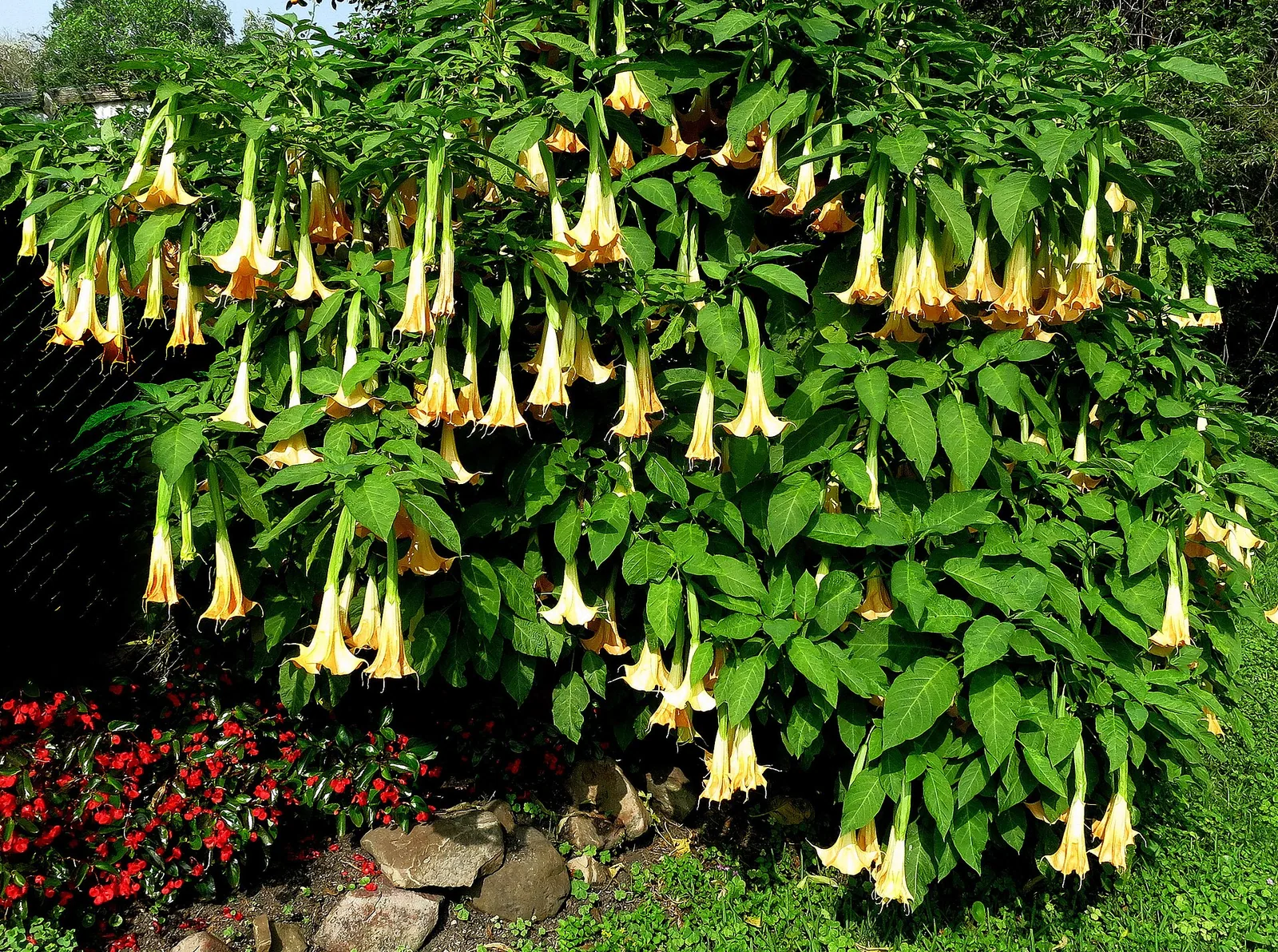
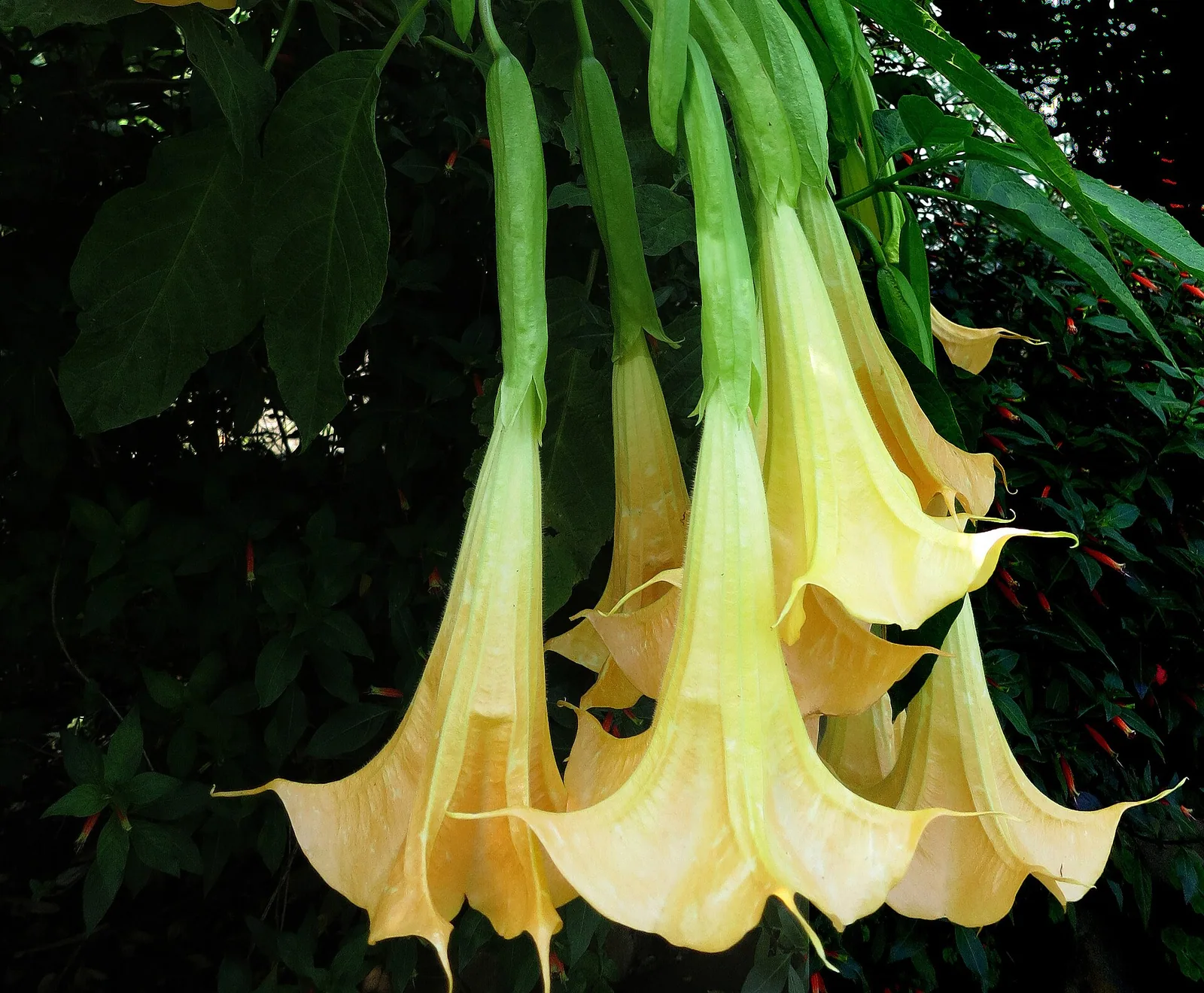
A soft-wooded, often multi-stemmed shrub or small tree, commonly 3–5 m but capable of reaching roughly 10 m in favourable conditions. Alternate leaves are large, simple, ovate to elliptic, often softly pubescent, with an asymmetric base and entire to shallowly toothed margins. Vegetative shoots eventually fork in a characteristic Y; flowers are produced above this transition in the mature flowering zone. The pendulous corolla is narrowly trumpet-shaped, commonly 24–32 cm long, white to cream in botanically typical material, strongly fragrant toward evening, and terminates in five short, recurved teeth. Cultivated hybrids extend the palette through yellow, peach and pink and include doubled corollas (Hay, Gottschalk and Holguín, 2012; Petricevich et al., 2020).
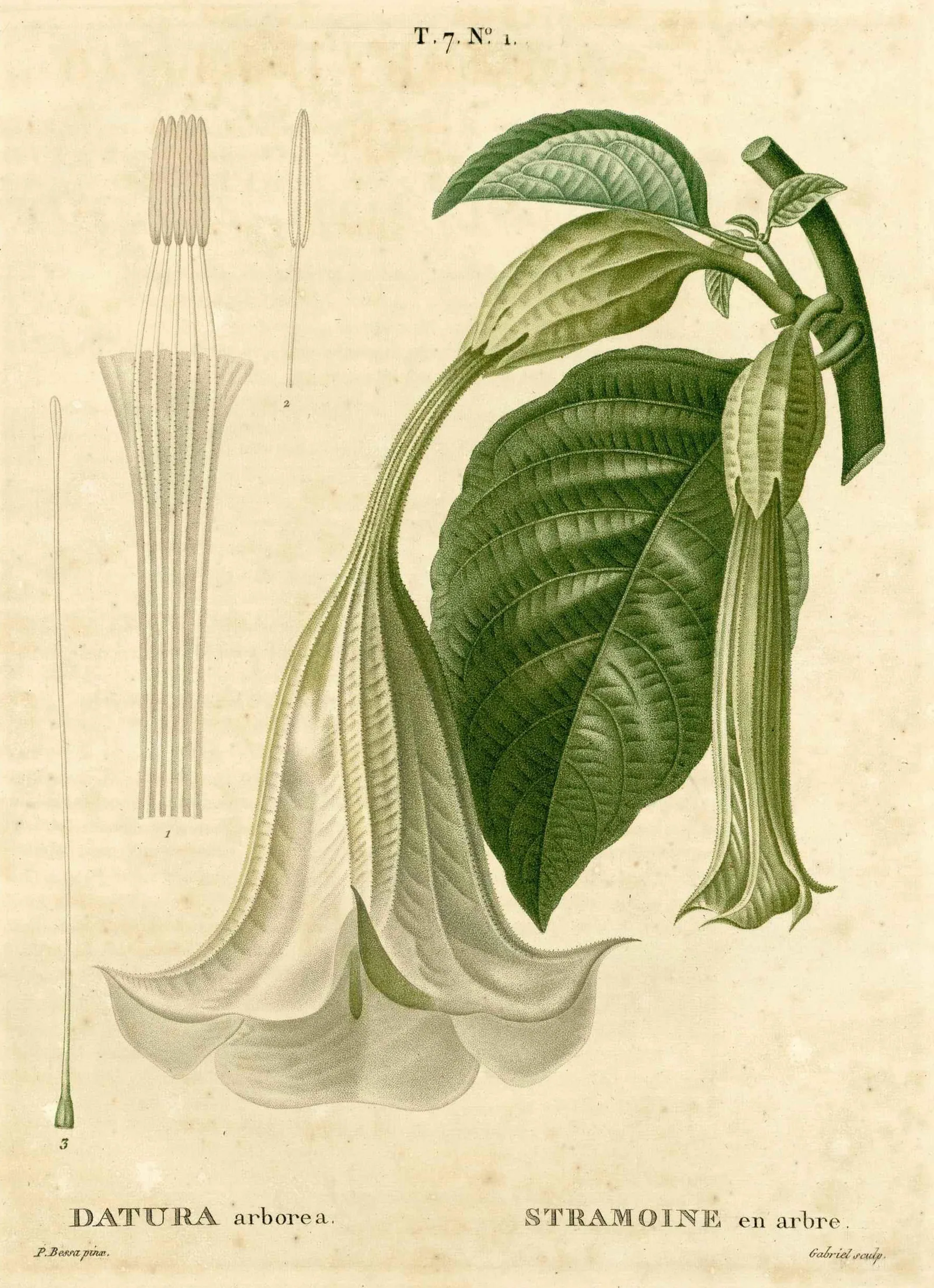
The fruit is smooth and unarmed, containing numerous seeds, in contrast to the usually erect flowers and spiny capsules of herbaceous Datura. Fragrance and nocturnal anthesis are consistent with moth visitation, while human propagation by cuttings has been decisive to the survival and global movement of the genus. Long-lived clones, ready hybridisation and horticultural selection make the cultivated plant simultaneously a botanical organism and an archive of human choices.
Taxonomic and evidential limits
- Generic status
Woodiness, pendulous flowers, unarmed indehiscent fruits and molecular phylogenetics support Brugmansia as a genus distinct from its sister Datura (Lockwood, 1973; Dupin et al., 2018).
- Cultivated identities
Many ornamentals and Indigenous named forms are hybrids or clones with complex ancestry. B. × candida, B. × cubensis and Sibundoy cultivars keep their own identities, whatever common names they share with B. suaveolens.
- Wild extinction
The genus may be a human-maintained remnant of an older dispersal ecology, sometimes linked hypothetically to extinct megafauna. No extinct disperser has been demonstrated for this species; the secure finding is the absence of verified native wild populations and the persistence of extensive cultivated lineages (Hay, 2014).
- Archaeological attribution
Trumpet-flower images in ancient Andean art have been interpreted as Brugmansia or Datura, but secure species-level macroremains or residues are lacking. The 2025 direct study at Chavín identified vilca and Nicotiana, and no Brugmansia (Rick et al., 2025).
02Chemistry
B. suaveolens produces tropane alkaloids throughout the plant. Scopolamine is frequently prominent; L-hyoscyamine, atropine, norhyoscyamine, norscopolamine, littorine, tropine, pseudotropine, apoatropine and minor ester alkaloids have also been reported. Concentrations differ among organs, individuals, growth stages, seasons and environments. The name of a cultivar or a flower colour therefore says little about quantity (Petricevich et al., 2020; Algradi et al., 2021; Rojas et al., 2023).
Scopolamine
L-Hyoscyamine
Atropine
Minor alkaloids
Biosynthesis and mechanism
Tropane biosynthesis begins from ornithine/putrescine metabolism, proceeds through N-methylputrescine and tropinone, and branches through esterification and hydroxylation steps. Hyoscyamine 6β-hydroxylase participates in the conversion of hyoscyamine toward scopolamine. At the receptor level, scopolamine and hyoscyamine competitively antagonise muscarinic acetylcholine receptors M1–M5. Central M1-rich networks involved in attention and memory are especially relevant to delirium and amnesia; peripheral blockade contributes mydriasis, dry mouth, tachycardia, reduced sweating and impaired gastrointestinal and bladder function (Kohnen-Johannsen and Kayser, 2019; Algradi et al., 2021).
Evidence boundaries
- Pharmacological class
The characteristic state is antimuscarinic delirium, pharmacologically distinct from 5-HT2A-mediated psychedelic perception. Fully embodied scenes and impaired reality-monitoring are pharmacologically coherent with cholinergic disruption.
- Ethnopharmacological selection
Named clones may encode accumulated selection and specialist knowledge, but morphology, folk taxonomy and alkaloid concentration correspond only loosely. A Colombian LC–MS preprint found organ and locality effects stronger than a simple taxonomic signature; peer review remains pending (Rojas et al., 2023).
- Extract research
Flower and leaf extracts show antinociceptive, anti-inflammatory and antimicrobial activity in laboratory models. The active principle is often unidentified, and traditional whole-plant treatments remain clinically untested (Parker et al., 2007; da Costa et al., 2023).
- Molecule / plant distinction
Purified scopolamine is a licensed medicine and a neuroscience probe for cholinergic memory impairment; research on the molecule—including rapid-antidepressant experiments—is separate from clinical research on B. suaveolens (Drevets and Furey, 2010).
03Tradition, ritual & cultural use
History and evidence
| Pre-Hispanic Andes | Iconographic proposal Trumpet-shaped flowers and transformational figures in Chavín, Moche and other Andean art have been associated with tree daturas. Identification is debated, and no image establishes B. suaveolens. Direct Chavín residue research currently supports vilca and tobacco instead (Rick et al., 2025). |
|---|---|
| Colonial period | Textual record Spanish chronicles and early natural histories record guanto/huantuc, intoxicating tree daturas and floripondio-like medicines. These sources document an Andean category of use, reconcilable with present species limits only in part (Lockwood, 1979; Hay, Gottschalk and Holguín, 2012). |
| 1809–1818 | Species history Datura suaveolens was formally published from Brazilian material in 1809 and transferred to Brugmansia in 1818. This is the beginning of the securely named species record; human relations with tree trumpets are far older (POWO, 2026). |
| 20th century | Voucher ethnobotany Field research by Bristol, Schultes, Lockwood and Indigenous collaborators documented the extraordinary cultivar system of the Sibundoy Valley; later work described Shuar, Matsigenka and northern Peruvian practices. Much of this evidence concerns Brugmansia spp. or hybrids, with B. suaveolens one among them (Bristol, 1969; Lockwood, 1979; Bennett, 1992; De Feo, 2004). |
Peoples, territories and preparations
Valley of Sibundoy
In this high basin of southern Colombia, Kamsá-speaking Sibundoy and three Inga-speaking groups have kept tree daturas — mostly the species Bristol called Datura candida, with D. sanguinea — as cultivars found nowhere else, used both as psychotropic and as medicinal preparations. One cultivar, 'Buyés', is common; most of the others are rare, and each proved genetically distinct (Bristol, 1969, pp. 165–168). The subject here is the genus, beyond B. suaveolens itself.
Matsigenka
For the Matsigenka of the Peruvian Amazon, different species, cultivars, admixtures and doses of psychoactive plants — most from the Rubiaceae, Solanaceae and Cyperaceae — give different intensities of experience. Shamans use the strongest to travel to the realm of spirits; hunters use others to purify their souls and improve their aim; milder ones help women concentrate in spinning and weaving, control grief and anger, shape dreams and calm frightened children (Shepard, 1998).
Colombia today
A 2023 preprint comparing Brugmansia species and hybrids across Colombia found tropane alkaloids accumulating in a leaf- and flower-specific way. The one significant difference lay between plants from the Sibundoy Valley, long domesticated there, and plants never used by people — which its authors attribute to growing environment rather than genetics (Rojas et al., 2023).
Specialists, healing and ambivalence
“Shamanism” is an analytic umbrella over distinct offices: Kamëntsá and Inga healers and knowledge holders, Shuar uwishin, Amazonian vegetalistas, and northern Peruvian curanderos working a mesa. Brugmansia can disclose causes of illness, test an apprentice, provide a guardian relation, facilitate extraction or locate lost persons; the same potency can be classified as aggressive, deceptive or socially dangerous. This ambivalence is already present in local distinctions between medicine and poison, curing and attack, knowledgeable and unmastered vision (Bristol, 1969; Shepard, 1998; De Feo, 2004).
Certain of the medicine-man’s secrets apparently are imparted only when the novitiate is under the protection of this narcotic. Schultes, quoted in Lockwood (1979, p. 157); translation and historical terminology retained
Vegetalismo and pajelança
In the practice of Don Emilio Andrade Gómez, the Iquitos vegetalista Luna worked with in 1981–1982, toé is added to the ayahuasca brew when the healer wants to see which sorcerer has sent the dart, the virote, lodged in a patient; he counted it among the strongest of his plants (Luna, 1984, p. 130). His practice is described in the Vegetalismo and Pajelança Healing Complex.
Indigenous Amazonian shamanisms
A 1986 note from Peru’s Institute of Traditional Medicine lists the floripondio, maikiua, among the plants in which the Shuar arutam, the ancestral power, may dwell, beside ayahuasca and tobacco; the note does not give a botanical species (Delgado Súmar, 1986, p. 6). Shuar shamanism is treated in the Indigenous Amazonian Shamanisms.
04Cosmology & key terms
Plant persons, vision and power
In Shuar accounts analysed by Rubenstein, plant-granted visions help constitute the person by mediating an encounter with power that may appear through ancestors, animals, meteorological force or other-than-human figures. Arutam is better understood as a consequential relation and acquired force than as a stable “god of maikua.” Maikua belongs to a repertoire that also includes tobacco and natem; the vision is shaped by kin, place, secrecy, narrative and subsequent action (Rubenstein, 2012).
In western Amazonian vegetalismo, a plant may be known through diet, dream, song, bodily effect and the agency attributed to its owner or mother. Toé is often characterised as forceful and difficult, and its teaching may be considered unusually exacting. In northern Peru, misha forms enter a Christian-Indigenous cosmos materialised through mesas, saints, lagoon waters, staffs, stones, swords, perfumes and opposing fields of power. These systems make the plant an actor within an assemblage, with an identity wider than its alkaloids or any isolated “myth” (Luna, 1986; De Feo, 2004).
- Arutam
- Shuar term for a power/vision relation important to personhood, courage and life trajectory. It is encountered through several plant and non-plant practices, Brugmansia among them (Rubenstein, 2012).
- Maikua
- Shuar/Jivaroan name applied to tree-trumpet medicines. Species mapping varies among sources and local cultivars.
- Misha
- Northern Peruvian folk category for named Brugmansia forms whose morphology, action and mythic associations organise specialist knowledge (De Feo, 2004).
- Borrachero
- Spanish-derived “intoxicating” plant-name used in Colombia for several Brugmansia forms and sometimes unrelated plants. In Sibundoy it belongs to an elaborate cultivated classification.
- Toé
- Western Amazonian vernacular term for Brugmansia medicines, teacher plants and occasional ayahuasca admixtures; it may cover several species.
Art, gardens and ritual objects
"Woman at the foot of a borrachero"
A drawing by the Guambiano artist Francisco Tumiñá Pillimue of Silvia, Cauca, published in 1949 in Nuestra Gente — Namuy Misag, shows a woman seated beneath a flowering tree whose name is given as yas. From its leaves, flowers and fruit, Schultes and Bright identified it as Brugmansia vulcanicola, a species of the highlands around Puracé (Schultes and Bright, 1977).
The garden tree
In the Valley of Sibundoy the tree daturas are planted for ornament in hedgerows, house yards and mixed gardens; their huge white flowers, appearing four times a year, make them the principal visual focus everywhere (Bristol, 1969, p. 168).
Cut down for honey
At the type locality of B. vulcanicola, where it had been used "in olden times" as a narcotic, residents were later found destroying the plants: a new bee-keeping industry feared that the toxic flowers would spoil the honey (Schultes and Bright, 1977).
05Visionary phenomenology
The recurrent experiential signature is a delirious dream enacted within waking space. Apparitions may be fully formed people, animals or objects; the experiencer may converse with them, handle absent things or undertake journeys without recognising the scene as hallucinatory. Attention fluctuates, sequences break, and later memory may be fragmentary or absent. Ethnographic descriptions of travel, instruction and encounter carry meanings that clinical symptom lists leave out, yet their unusually concrete and reality-like scenes are consistent with central antimuscarinic disruption (Lockwood, 1979; Shepard, 1998; Isbister et al., 2003; Doan et al., 2019).
Phenomenological profile
The profile lists effects the sources report, for each preparation separately, grouped by domain. Each row gives the grade, how often the sources say the effect occurs (only where they say so; most do not) and the kinds of source behind it. A chip naming a compound, such as “Trial · psilocybin”, means the evidence comes from studies of that compound rather than of the preparation itself; “partial” means the route, purity or dose differs from the traditional preparation, so the row cannot be graded above supported. The line under each preparation says which domains have evidence entered here. A domain with nothing entered has not yet been assessed in this profile; that is not a finding that the literature is silent, and the article may discuss it. Open a row for the note and the sources.
Flowers, leaves or teaswallowed
Evidence entered for 3 of 8 domains. Not yet entered: visual, other senses, self and unity, affect, states of consciousness. Discussed in the article above but not yet entered: visual, states of consciousness.
The clinical series describe the plant itself, at the doses people took; the ethnography describes the same plants used with intent. Tropane alkaloids act by blocking acetylcholine receptors, unlike the serotonergic visionary plants.
Body
Out-of-body flightLeaving the body, flying, or travelling to distant places.SupportedEthnography
Among the Matsigenka, strongly psychoactive plants are used by shamans to travel to the realm of spirits (Shepard, 1998).
Cognition
Delirium without insightConfusion with hallucinations taken for ordinary reality, often followed by patchy or absent memory.SupportedCharacteristicPharmacology
Delirium affected 88% of 33 Australian patients who had presumably taken angel’s trumpet, lasting 18 hours on average (Isbister et al., 2003); among 203 Datura and Brugmansia poisonings in Taiwan, confusion affected 40% and delirium 31% (Doan et al., 2019).
Relation to other beings
Autonomous entitiesBeings experienced as acting, communicating or observing independently of the experiencer’s will.SupportedEthnography
Psychoactive plants give the Matsigenka access to the otherwise remote, parallel world of spirits (Shepard, 1998). Read about the phenomenology of autonomous entities →
Recurrent motifs across records
Delirium that outlasts the night
In 33 Australian patients presumed to have taken Brugmansia, mostly young men taking a tea or flowers recreationally, every one had dilated pupils, lasting on average 29 hours, and 88 per cent were delirious, for an average of 18 hours; there were no deaths (Isbister et al., 2003).
Medicine taken without a healer
Of 203 Datura and Brugmansia poisonings reported to Taiwan's poison control centre over thirty years — 89 of them B. suaveolens — most followed medicinal use without a practitioner's advice; none were recreational. Dilated pupils, confusion, rapid heartbeat, dry mouth and dizziness were the commonest signs (Doan et al., 2019).
Vision and the self
Among the Shuar, Rubenstein reads plant-granted visions as part of how a person is formed, and argues for an ethnography that respects their secrecy and the ineffable (Rubenstein, 2012).
Accounts and comparison
Clinical series provide comparatively precise timing but occur in emergency settings; ethnographies preserve meaning and ritual structure but often omit dose, voucher or clock time. Jayawickreme et al. (2019) report a case whose delirium resolved over approximately 18 hours while mydriasis persisted longer. Isbister et al. (2003) found confusion, agitation, hallucinations and mydriasis prominent across presumed angel’s-trumpet poisonings. Traditional accounts may describe the same scene-form as travel or disclosure. These genres should be read alongside one another without treating either as a transparent substitute for the other.
The Shuar Imaginary begins with a plant-granted vision. Rubenstein (2012, p. 53)
06Contemporary status
Conservation and cultivated survival
| Red List status | Extinct in the Wild IUCN assessment e.T51247699A58913403. The species survives extensively in cultivation and in naturalised populations, but no verified native wild population is known (Hay, 2014). |
|---|---|
| Conservation unit | Counting ornamental trees leaves the diversity of species lineages, named Indigenous cultivars and associated knowledge unmeasured. Hybridisation, clonal duplication, misidentification and virus infection complicate ex situ inventories. |
| Pathogens | Brugmansia hosts several potyviruses. Colombian datura virus shows low diversity compatible with anthropogenic movement in cultivated material; 2025 work documented leaf deformation and host responses in medicinal cultivars (Chellemi et al., 2011; Hernández-Duarte et al., 2025). |
| Naturalisation | Cultivation escapes are recorded in warm regions worldwide. A 2020 record from continental Europe illustrates the species’ ability to naturalise locally while remaining extinct within the meaning of its native-range Red List assessment (Stinca, 2020). |
Economies, circulation and transformation
The largest contemporary economy is ornamental: specialist nurseries and collectors trade cuttings and cultivars selected for colour, fragrance, double flowers and compact form. A smaller medicinal and ceremonial circulation links household remedies, plant markets, retreat economies and global ethnobotanical horticulture. There is no reliable species-specific global market valuation. The key asymmetry is that horticultural abundance privileges conspicuous hybrids while rare named medicinal clones and their custodial histories may remain undocumented.
Urban “toé” discourse, internet experience reports and ayahuasca tourism have detached the name from voucher identity and from the apprenticeship systems described in ethnography. At the same time, Kamëntsá, Inga, Shuar and other Indigenous knowledge holders continue to publish, teach and govern plant relations in contemporary political settings. Transformation is therefore an encounter among Indigenous continuity, market horticulture, pharmacology, conservation and digital circulation.
Law and regulation
| Jurisdictional level | Status | Scope |
|---|---|---|
| International treaties | Absent from the 1961 and 1971 UN drug schedules as a plant | Scopolamine and atropine are established medicines, outside the international psychotropic schedules; pharmaceutical manufacture and trade are regulated through medicines law. |
| United States federal | No federal Controlled Substances Act listing for Brugmansia | Scopolamine products are FDA-regulated drugs. State, local, consumer-product and poisoning statutes may create additional rules. |
| United Kingdom | No named listing in the Misuse of Drugs Act schedules | Medicinal scopolamine and atropine are regulated as medicines; supply claims and harmful administration fall under other legal regimes. |
| National / local variation | Variable | Some jurisdictions regulate sale, cultivation for ingestion or particular preparations. Common-name listings may capture Datura and Brugmansia unevenly. |
Patents and research frontier
- USPP14817P2 · 2004 — plant patent for the variegated hybrid cultivar ‘Snowbank’; a claim over a clonally reproduced horticultural novelty, leaving B. suaveolens as a species and Indigenous knowledge outside it.
- US20100199395P1 · 2010 — application for the compact cultivar ‘Angel’s Summer Dream’, illustrating the ornamental focus of Brugmansia intellectual property.
- WO2020097635A1 · 2020 — extraction process for scopolamine-rich plant material. The claims concern industrial processing, with no specific hold on B. suaveolens.
- US11739084B2 · 2023 — synthetic routes to scopolamine and atropine, explicitly moving production beyond dependence on cultivated tropane crops.
- Metabolomics
Colombian LC–MS research compares organs, localities, species and hybrids, suggesting that environment and extraction method may explain more variation than folk or formal taxonomic labels alone. The current report is a bioRxiv preprint (Rojas et al., 2023).
- Plant virology
Recent genomic and inoculation work tracks viruses through cultivated medicinal plants, making pathogen-free living collections part of conservation as well as horticulture (Hernández-Duarte et al., 2025).
- Bioactivity
Reviews catalogue flavonoids, volatile compounds and extract activities beyond tropane alkaloids. Most results remain in vitro or animal studies, with inconsistent taxonomic authentication and extraction standards (Pundir et al., 2022; da Costa et al., 2023).
- Ethnobotanical priority
The strongest research need is paired documentation: vouchered plants and metabolomics alongside Indigenous names, custodianship, preparation categories and consent. A cultivar system is conserved by its people as well as its species lists.
Open questions on this entry
Safety and law
07Cross-correlations
| Banisteriopsis caapi | Species monograph: toé is an occasional admixture or separate teacher plant in some western Amazonian lineages, peripheral to ayahuasca. RITUAL ASSOCIATE |
|---|---|
| Echinopsis pachanoi | Species monograph: northern Peruvian misha may enter the wider huachuma–mesa pharmacopoeia while retaining distinct tropane pharmacology. ANDEAN CEREMONIAL ASSOCIATE |
| Nicotiana rustica | Species monograph: tobacco accompanies purification, diagnosis and vision-seeking in several Amazonian systems that also know Brugmansia. RITUAL ALLY |
| Brugmansia × candida | Hybrid complex central to Sibundoy named cultivars and much ornamental material; it is recorded under its own name, apart from B. suaveolens. CULTIVATED HYBRID / TAXONOMIC CAUTION |
| Brugmansia sanguinea | High-Andean red-flowered species with distinct morphology, ecology and ethnobotanical history. CONGENER / COMPARATIVE TRADITION |
| Datura spp. | Herbaceous sister genus sharing tropane chemistry but differing in habit, flower orientation and fruit. Older literature often joins both as “tree” and “herbaceous” daturas. PHYLOGENETIC SISTER / HISTORICAL CONFLATION |
| Andean Huachuma–Mesa Complex | Cultural complex page: northern Peruvian mesa, misha folk taxonomy, healing arts and material culture. INTERSECTING CEREMONIAL COMPLEX |
| Vegetalismo and Pajelança | Vegetalismo and Pajelança Healing Complex: toé, added by an Iquitos vegetalista to find the sorcerer who sent the dart. HEALING COMPLEX |
| Indigenous Amazonian Shamanisms | Indigenous Amazonian Shamanisms: the Shuar maikiua, one of the abodes of arutam. INDIGENOUS COMPLEX |
08Bibliography
How to read the labels on each source
- Source type
- What kind of work it is: journal article, book, legislation, patent application, database record and so on. A word after the dot (ethnography, protologue, primary source) keeps the genre the entry was first filed under. “Unclassified” means the citation does not say enough to tell.
- Peer review
- Recorded for each work separately, and only where it has been confirmed for that work. It is never inferred from a DOI, a publisher or a journal, since journals also publish editorials, letters and commentaries. Where it has not been confirmed, the entry records it as not established. It does not apply to legislation, court decisions, treaties, patents, datasets, database and collection records, historical texts, films, talks, press releases or web pages.
- Check
- What was checked when the entry was added. DOI checked: the DOI’s registry record (Crossref) matched the citation’s title, first author and year. Verified: the record itself was opened and matched the citation: a library catalogue record for a book, or the page itself for a database entry, law, patent or archive document. “Verified (abstract)” and “(summary)” mean only the abstract or a summary was read. Located: a record was found but not fully matched. Bibliographic record and Stable record (in essays): a catalogue or stable web record exists; what was checked against it is not recorded. Unverified: no check is recorded. No locator found: a search found no record. Secondary: read through another source.
- What the labels do not say
- None of them means the source supports a particular sentence. Where a sentence is graded, its evidence note names its sources and whether each supports it, disputes it or gives context. Dates and reviewers of checks are not recorded for each entry; the version note at the foot of a graded page dates its last review.