Mirante, D. (ed.) (2026) Vegetalismo and Pajelança Healing Complex. Entheocene, version 1.0. Available at: https://entheocene.com/complex-vegetalismo-pajelanca.html (Accessed: 17 October 2026).
DOI: not yet minted.
Introduction
Vegetalismo, in the Peruvian Amazon, and pajelança cabocla, in the Brazilian, are post-colonial medicines. They belong to the river towns and their hinterlands, to mestizo and caboclo people rather than to any single Indigenous nation, and they took shape in the world the conquest made: the mission settlements, the rubber camps, popular Catholicism, and the Spanish and Portuguese of the river trade. Both treat illness as a matter of relations with beings who are usually invisible. In vegetalismo these are the spirits of plants, which teach a healer who keeps a long and solitary diet. In pajelança they are the encantados, people who never died but were enchanted into the depths of the rivers, and who take over the body of the pajé in order to cure (Luna, 1984, p. 127; Maués, 2005, pp. 262–265).
Contents
The two have more in common than their geography suggests. Both work within popular Catholicism, both cure by singing, and both use tobacco. Both grew from Indigenous practice reworked in colonial society: vegetalismo, on Peter Gow’s hypothesis, in the missions and rubber camps of Maynas; pajelança, in Maués’s account, from Tupinambá practice mixed with Portuguese and African influence (Musalem Nazar, 2024, pp. 2, 4; Maués, 2005, p. 274). They part on one point that cross-cultural research has found consequential. The vegetalista learns from the plants and calls his helping spirits with song; the pajé is possessed, and says that the healing is done not by him but by the encantados who possess him (Maués, 2007, p. 15; Shaara and Strathern, 1992).
This page sets the two side by side. Indigenous traditions enter it as formative influences — the western Tukanoan peoples among whom ayahuasca use probably began, the Kukama and the Kichwa-speaking mission peoples through whom it spread, the Tupinambá behind the pajé; their own rites are treated in the Indigenous Amazonian Shamanisms complex. It follows the scholarly debate about how recent these practices are, the songs and objects they produced, what healers report seeing, what neuroscience has proposed about such visions, and the heritage law that now names them.
Colonial historyRefugees in the missions of Maynas · first two centuries of conquest→
HypothesisMestizo ayahuasca in Maynas · the last c. 300 years→
FieldworkThe pajé Ramiro, Itapuá, Pará · January 1976→
FieldworkDon Emilio Andrade, Iquitos · 1981–1982→
LawPeru declares ayahuasca knowledge national heritage · 2008
No archaeological record of vegetalismo or of pajelança as such was found for this page, and the question of age has to be asked of each element separately: of tobacco, of the ayahuasca brew, of the songs, of the beliefs about beings under the water. For ayahuasca the material evidence is thinner than is often said. Brabec de Mori points out that the “often quoted ‘archeological evidence’” of Naranjo shows only that people in the Ecuadorian forests made small ceramic vessels from about 2400 BC, “but there is no valid indication of ayahuasca use”. Harmine found in the hair of ancient mummies from the Azapa valley in Chile is evidence of preparations containing harmine, he argues, not of the brew as it is now made (Brabec de Mori, 2011, pp. 24–25).
Peter Gow’s hypothesis, as Musalem Nazar summarises it, places the formation of vegetalismo in the last three hundred years, in the urban and mestizo world of the old Spanish and Jesuit province of Maynas, and in two colonial experiences above all: the Catholic mission and the rubber camps. In that history a mestizo was, first of all, a Christian Indian, a survivor of nations such as the Maina, Omagua and Cocama that collapsed in the first two centuries of conquest and took refuge in the missions (Musalem Nazar, 2024, p. 4). Brabec de Mori, working from the Ucayali, reconstructs ayahuasca use spreading in phases. It passed from western Tukanoan peoples to the Kichwa-speaking groups that emerged from the Jesuit missions and to the Kukama, then through northern Peru, then up the Ucayali, “probably with the rubber workers”, and across the border into Acre. By his reckoning the use of ayahuasca in the Peruvian lowlands south of Iquitos is “probably less than 300 years old” (Brabec de Mori, 2011, pp. 24–25, 42–43).
Tobacco has the older written record. In 1578 Jean de Léry described Tupinambá specialists in Brazil, the caraïbes, blowing the smoke of petun over a dancing crowd (Léry, 1880, pp. 67–71). Maués traces pajelança cabocla to Tupinambá practice and belief, mixed with Portuguese and African influences in the colonial period, following Eduardo Galvão’s view that it is of Tupi origin, syncretised with Catholicism (Maués, 2005, p. 274; Maués, 2007, p. 13). In the Peruvian lowlands, Brabec de Mori notes that many of the names for the healing specialist are connected with the use of tobacco (Brabec de Mori, 2011, pp. 34–35).
01Ethnobotany
The plants of the cure
Four plants with monographs in the archive, each with the role the sources give it. The vegetalista’s pharmacopoeia is far larger; the pajé’s, as Maués records it, is tobacco, smoke and the remedies of the house and the pharmacy.
Don Emilio Andrade called tobacco “the king of all plants”, the one an initiate must know first; many healers around Iquitos never go beyond it (Luna, 1984, p. 129). Berlowitz and colleagues describe tobacco in the Peruvian Amazon, “especially Nicotiana rustica L.”, as a potent medicinal plant (Berlowitz et al., 2020). On the Pará coast the pajé’s assistant hands him lit cigarettes during the session (Maués, 2007, p. 14).
A plant-teacher in its own right. Don Emilio explained that, “because ayahuasca is a vine, it needs strong trees to cling to”: a healer who knows only ayahuasca is at the mercy of those who have dieted the trees (Luna, 1984, p. 130). A healer interviewed by Berlowitz and colleagues put its place in the cure plainly: “The visionary plant ayahuasca is also a master plant, but to have a good result you need plant diets” (Berlowitz et al., 2022, p. 11).
Cooked with the vine. Don Emilio insisted on it, since without it no visions appear: the chacruna, he said, is like the “mirror” of ayahuasca (Luna, 1984, p. 126).
An additive of diagnosis in sorcery cases. Don Emilio adds toé to the brew when he needs to see which sorcerer has sent the dart lodged in his patient, and counts it among the strongest plants he knows (Luna, 1984, p. 130).
The cards record what the sources say each plant does in the cure; they give no recipe. Luna’s voucher specimens, identified at the Field Museum in Chicago, also include tree barks added to the brew and plants taken alone. These appear under Linked species below (Luna, 1984, pp. 125, 131).
Plants as teachers
The concept that names vegetalismo is the plant that teaches. Luna, who worked with Don Emilio Andrade Gómez near Iquitos in 1981 and 1982, reports that ayahuasca and certain other plants belong to a class that Don Emilio and other healers call doctores, plant-teachers. Taking ayahuasca to be cured or to see visions is different from taking it “in order to learn medicine from it”. Either the person decides to learn, though the plant may reject them, or, as with Don Emilio at fourteen, the plant chooses them (Luna, 1984, p. 127).
The spirits of the plants will appear in his dreams to teach him “icaros”, magic songs, with the help of which he can perform different activities, such as curing specific diseases, reinforcing the action of medicinal plants, calling special guardian spirits to assist him, attracting game or fish, causing a rival shaman to fall sleep, or attracting the attention or love of a woman.Luna (1984), p. 127
The human teacher has a narrower role than the word suggests. “It is interesting to observe”, Luna writes, “that the function of the ‘maestro’ or older shaman is not that of teaching medicine, which is done by the plant itself, but that of protecting the novice and instructing him in the proper way of preparing and ingesting the magic plants” (Luna, 1984, p. 127). Knowledge is counted in plants and songs. Asked how much he knows, an ayahuasquero “will almost invariably answer: ‘I have dieted so long and I know so so many icaros’”. Don Emilio knew some sixty or seventy; Luna met healers who claimed more than two hundred (Luna, 1984, p. 130). The hierarchy runs from tobacco, through ayahuasca, to the paleros, who have dieted the strong trees, a level that, Luna notes, is often associated with sorcery, “because the temptation to use evil powers is stronger the more is learned” (Luna, 1984, pp. 129–130).
The idea outlived its fieldwork and became national law. Peru’s 2008 declaration describes the ayahuasca vine as known to the Amazonian Indigenous world “como una planta sabia o maestra que enseña a los iniciados los fundamentos mismos del mundo y sus componentes”: a wise or master plant that teaches initiates the very foundations of the world (Instituto Nacional de Cultura, 2008, p. 230).
The dieta
The plants teach only under the conditions of the dieta. Don Emilio spent three years living alone in the forest on plantains and fish, without salt, sugar, spices, pork, chicken, eggs or alcohol, and in complete sexual continence. Every vegetalista Luna met insisted on the diet, so much that “the best way they can claim the depth of their qualification is by expressing the duration of their diets” (Luna, 1984, p. 126). There were ritual rules as well: only the breast of fowl, and only its left half; food prepared by a girl or by a woman past menopause; leftovers disposed of so that no person or animal could eat them. Some plants are “jealous”, and break of the diet can harm or kill the dieter (Luna, 1984, pp. 127, 131).
Four decades later, Berlowitz and colleagues interviewed sixteen healers in Ucayali, San Martín and Loreto, of mestizo and Indigenous affiliations including Shipibo, Cocama, Yine, Asháninka, Awajún and Lamista. They describe the dieta as a retreat-like method: social, behavioural and alimentary restriction while the dieter takes specially prepared plants (Berlowitz et al., 2022, pp. 1, 3). “The diet is in isolation, away from contact with other people”, one healer told them; “some rules are nearly universal, such as the omission of salt and sugar”, said another. The healers presented the diet plant not as a substance but as an agent whose energy comes to “accommodate itself in the body” of the dieter, where “it can be called forth later using the icaros” (Berlowitz et al., 2022, pp. 4–5).
Tobacco, smoke and breath
Tobacco is the plant the two traditions share. Don Emilio describes it as a medicine in itself, taken orally or through the nose, applied to the body, smoked or as an enema. Blowing its smoke over any medicinal plant “will purify the environment and will build a shield against evil powers”. It helps make the arcana, the invisible armour that protects initiate and patient from sorcerers’ darts. The plant-teachers, he said, are “fond of” it (Luna, 1984, pp. 129–130). The healers interviewed by Berlowitz and colleagues described blowing tobacco over every remedy as a step without which the preparation is not complete: “It’s like when you want to prepare a juice, a lemonade, but if you don’t have lemon—it’s not lemonade” (Berlowitz et al., 2022, p. 6).
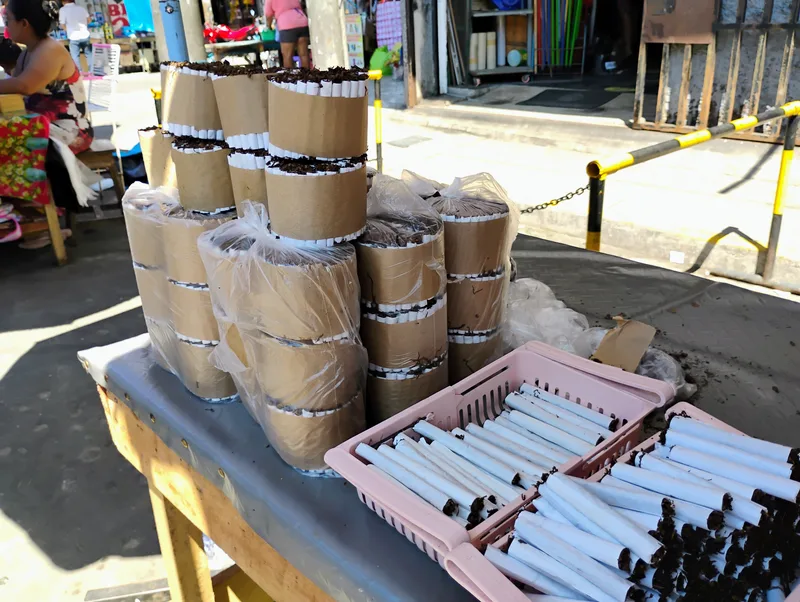
Mapacho cigarettes and paper-wrapped bundles of tobacco for sale in the Belén market, Iquitos, 2024.Carlo Brescia · CC BY-SA 4.0 · Wikimedia Commons
In the Pará pajelança, the pajé’s helper, the servente, lights the incense burner, serves teas and drinks, and hands the pajé lit cigarettes of tauari and of the packet kind. Smoking the patient with incense, defumação, is among the techniques of cure (Maués, 2007, p. 14). Léry’s Tupinambá caraïbes, four centuries earlier, used a cane four or five feet long with dried, lit petun at its end to blow smoke over the people (Léry, 1880, p. 71).
The remedies of the pajé
The pajé’s materia medica, as Maués records it on the Pará coast, is prescribed by the encantados through his mouth: baths, smokings, garrafadas (bottled infusions), teas — the “remédios da terra”, many of them now bought in shops — and medicines from the pharmacy as well (Maués, 2007, pp. 14–15). Visionary plants are absent from his descriptions of the session. Where vegetalismo is a pharmacology of teachers, pajelança cabocla is a medicine of possession, in which plants serve as remedies.
02Culture
Peoples and territories
Iquitos, Maynas and the Peruvian lowlands
When Luna went there in 1981, Iquitos was a city of 300,000 people on the left bank of the Amazon, “totally surrounded by jungle”, where it was “relatively easy to find mestizo practitioners who are experts in the use of ayahuasca and other plants, mostly for curing purposes” (Luna, 1984, pp. 124–125). Luna’s own criteria, as Musalem Nazar reads them, distinguish vegetalismo from Indigenous shamanism in three ways. It happens in a circulation between town and countryside; it belongs to a pan-Amazonian popular culture in which Catholicism is central; and it is carried on in Spanish. Even so, the healing songs, the ícaros, are almost all in Quechua, with passages in Cocama and Omagua (Musalem Nazar, 2024, p. 2).
The Salgado coast of Pará
Maués’s research covers Belém and the Salgado microregion on the Pará coast. He notes that the beliefs of pajelança cabocla are found across much of the Amazon: in Manaus, Coari and Tefé, along the middle and lower Amazon, on the island of Marajó and around Bragança (Maués, 2007, p. 12). It is practised mainly in rural areas and small towns, but also in the large cities. On the Salgado, where little but scattered secondary forest remains, the encantados of the forest count for little; what matters is the world of the waters — the rivers, the great bay of Marajó and the Atlantic (Maués, 2007, p. 13; Maués, 2005, p. 265).
Formative Indigenous traditions
Behind both medicines stand older Indigenous traditions, which this page treats only as influences. Many researchers, Brabec de Mori notes, place the discovery of the ayahuasca brew among western Tukanoan peoples. On his reconstruction it reached the Peruvian Amazon through the Kichwa-speaking groups formed in the Jesuit missions and through the Kukama, before travelling up the Ucayali (Brabec de Mori, 2011, pp. 42–43). Teaching crossed the line between Indigenous and mestizo: many Shipibo healers he worked with had been taught by Kukama or mestizo teachers, and the Kukama are perceived by the Shipibo as “very powerful and dangerous ayahuasqueros” (Brabec de Mori, 2011, pp. 28–31). Among the western Tukanoan Siona of the Putumayo, Esther Jean Langdon has followed the yagé tradition since the 1970s, from the cultural patterning of visions to the narratives in which shamans recount their journeys (Langdon, 1979; Langdon, 2013, pp. 129–130). On the Brazilian side, Maués traces pajelança cabocla to the Tupinambá (Maués, 2005, p. 274). The Indigenous rites themselves — Siona, Shipibo-Konibo, Huni Kuin, Yawanawa, Jívaro and Yanomami — are treated in the Indigenous Amazonian Shamanisms complex.
History and evidence
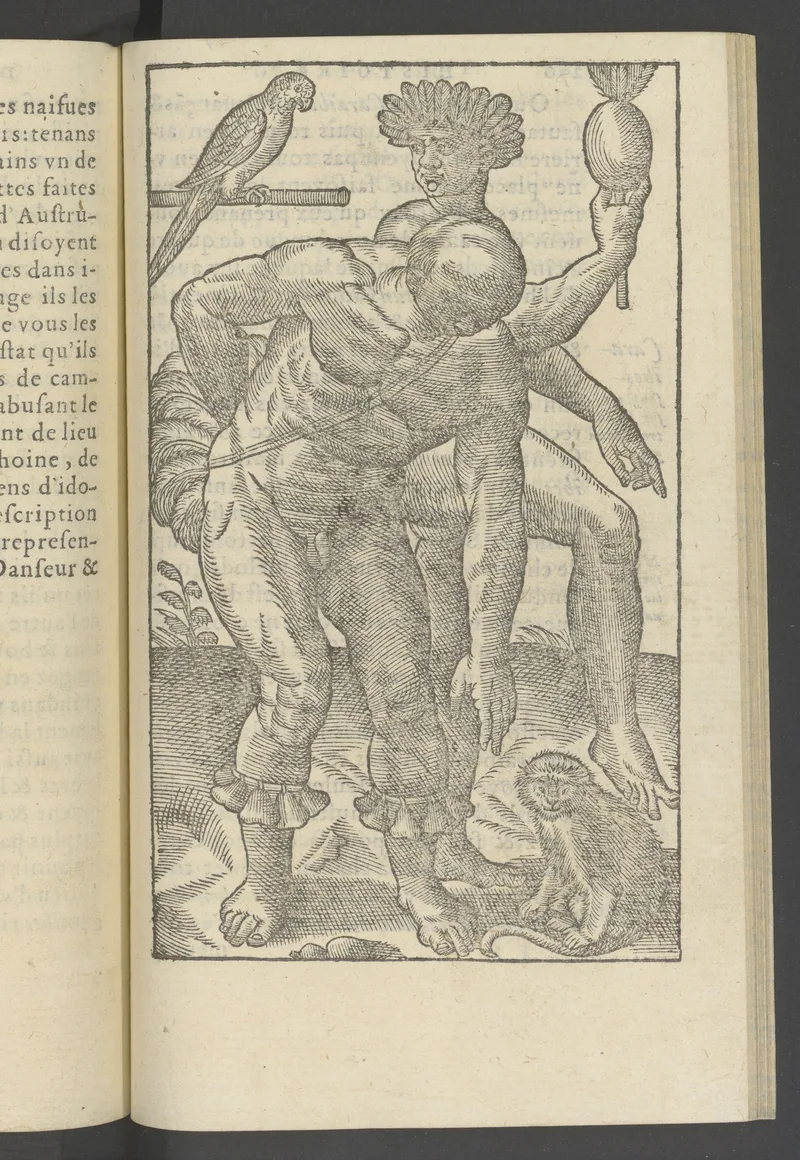
Léry’s woodcut of the “danseur” and the “sonneur de maraca”, 1578: a figure in a feather headdress raises the gourd rattle; a dancer with a feather bustle and leg rattles bends forward beside him.Jean de Léry · Public domain · Wikimedia Commons
Léry describes the caraïbes as men “allans & venans de village en village”, going from village to village, who persuade the people that by communicating with spirits they can give strength to whomever they please to overcome enemies in war, and that they make the great roots and fruits grow (Léry, 1880, p. 67). At a gathering of five or six hundred men dancing and singing, he watched them blowing smoke over the others from the cane of burning petun, saying:
A fin que vous surmontiez vos ennemis, recevez tous l’esprit de force.Léry (1880 [1578]), p. 71 — “So that you may overcome your enemies, receive, all of you, the spirit of strength.”
The words of vegetalismo carry its history. Luna derived ícaro from Quechua, but Brabec de Mori reports that Kukama speakers of the upper and central Ucayali told him independently that any song in Kukama is ikara, with a corresponding verb meaning to sing. He concludes that many ayahuasca terms used in the Peruvian south come from the north, and none used in the north come from the south. The predominance of Kichwa and, to a degree, Tupi-Kukama words points to where the practice came from (Brabec de Mori, 2011, pp. 34–35). The ayahuasca songs he recorded share a uniform structure throughout the Peruvian lowlands, which he calls “a unique phenomenon in the region’s musical landscape”. He reads that uniformity as a sign of relatively recent introduction (Brabec de Mori, 2011, pp. 42–43).
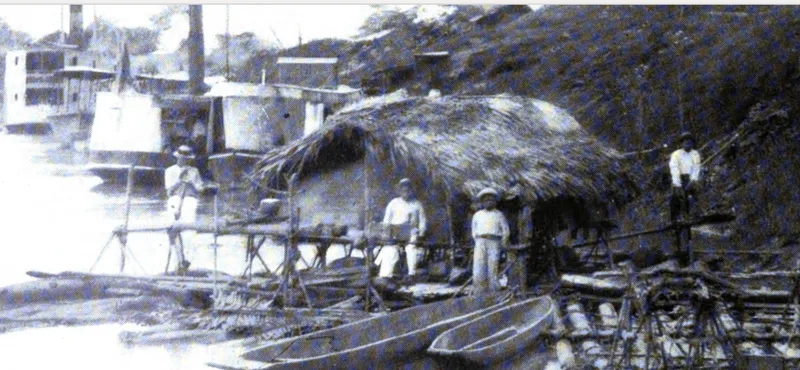
“Native raft and canoes used for rubber transport at Iquitos”: men on a thatched raft among dugout canoes, with river steamers behind. Published in 1913. Don Emilio, born in Iquitos five years later, would spend years working for rubber companies.Photograph provided by Sidney G. Paternoster · CC BY-SA 4.0 · Wikimedia Commons
Don Emilio’s own life shows the route. He was born in Iquitos in 1918, of a white father and a mother of strongly Indian appearance. He had three years of Christian schooling and was initiated into ayahuasca at fourteen. He spent years in the forest working for rubber companies, where he met Indian shamans and learned some Indian languages (Luna, 1984, p. 125). For pajelança cabocla, the anthropological record begins with Eduardo Galvão, whose Santos e visagens (1955), a study of religious life at Itá, Maués calls a landmark (Maués, 2005, p. 259).
Ritual practice
The pajé’s “trabalho”
Maués first attended a session in January 1976 at Itapuá, a fishing village in the municipality of Vigia, in the house of the pajé Ramiro. He describes Ramiro as “um homem muito pobre e cego”, a very poor and blind man, who lived by weaving baskets and on charity but had a reputation as a great healer. The Catholic saints were invoked, but the beings who came were the caruanas, who “tomavam o corpo do pajé”, took the pajé’s body. Ramiro alone entered trance. He alone sang, to the maracá, not Catholic hymns but the “doutrinas” of the encantados, and he alone danced. A helper, the servente, explained his words and actions to the small audience of guests and sick villagers, who neither sang nor danced. The sick were smoked with incense, massaged and given prescriptions (Maués, 2002, pp. 58–59). At later sessions he saw pajés dancing with the patient on their backs, walking barefoot on embers or broken glass, sucking illness from the body, and expelling bad caruanas that had seized someone (Maués, 2002, p. 59).
The session, called a trabalho, “work”, is held almost always at night and lasts many hours. The pajé works with “pena e maracá”, feather and rattle, and with sashes, cintas, passed over the body — the most evident symbols of what practitioners call their “art”. Of the many encantados who come into him, most do not cure; usually only one, the “mestre” of his correntes, does. The techniques include trance and possession, dance and song, pressure on the “cruzes” between the shoulder blades, cachaça, sucking, smoking, the sashes, blessing, and the passe, much as in Kardecism (Maués, 2007, p. 14).
The vegetalista’s cure
Don Emilio’s work, as Luna filmed it, centred on sorcery. A sorcerer’s dart, the virote, he described in physical terms, as “a sort of transparent phlegm in which a little piece of wood, a bone or a seed might be immersed”. Luna attended and filmed sessions in which Don Emilio extracted one; patients felt relief at once, but several sessions were needed to remove it all (Luna, 1984, p. 129). Much of his practice also went on baths of sacha-ajo (Mansoa alliacea) for saladera, a culture-bound syndrome of bad luck common in the towns of the Peruvian Amazon (Luna, 1984, p. 132).
Element
Vegetalismo (Peru)
Pajelança cabocla (Pará)
Practitioner
Vegetalista, or simply maestro (Luna, 1984, p. 123)
Pajé, a term felt locally as pejorative; practitioners prefer curador (Maués, 2002, p. 54)
Source of knowledge
Plant spirits, who teach in dreams during the diet (Luna, 1984, p. 127)
The encantados; the most powerful pajés travel to their dwellings under the waters to learn (Maués, 2007, pp. 12–13)
Becoming a healer
A long diet in isolation; the plant may choose the person (Luna, 1984, pp. 126–127)
An “attack” of caruanas, then the encruzamento, a symbolic death and rebirth (Maués, 2007, pp. 13–14)
Song
Ícaros, taught by the plants (Luna, 1984, p. 127)
The “doutrinas” of the encantados (Maués, 2007, p. 14)
The spirits
Helping spirits come when the proper melody is sung or whistled (Luna, 1984, p. 128)
The whole encantado, “spirit” and “matter”, enters the pajé (Maués, 2005, p. 266)
Who heals
The plant teaches the medicine (Luna, 1984, p. 127)
“Não é o pajé quem cura”, but the caruanas who possess him (Maués, 2007, p. 15)
Religion
A dualist cosmos ruled by Christ and Satan (Luna, 1984, p. 128)
All practitioners consider themselves Catholic (Maués, 2007, p. 13)
Mythology and cosmology
The encantados, Maués writes, are, unlike the saints, “seres humanos que não morreram, mas se ‘encantaram’”: human beings who did not die but were enchanted. He finds the belief European in origin, with the enchanted princes and princesses of children’s stories. It has been shaped by Indigenous ideas of places “no fundo”, beneath the surface, and probably by African conceptions such as the orixás, beings who are not the spirits of the dead (Maués, 2005, p. 262). People are enchanted because an encantado takes a liking to them and draws them to the encante, the underwater or underground city where they live. One who visits must not eat what is offered there, or will never return (Maués, 2005, p. 265).
Encantados appear in three guises, and have three names. As bichos do fundo they are snakes, fish, river dolphins and caimans in the rivers. As oiaras they take human form on beaches and in mangroves, often as a friend or relative, and try to lead people down. As caruanas, guides or cavalheiros, they remain invisible and enter the bodies of those born with the gift, of those they like, and of the pajés (Maués, 2005, p. 265). On the Salgado coast the king of all the encantados is King Sebastião, who lives on enchanted islands between Belém and São Luís. His daughter asks fishermen to disenchant her by cutting her snake-skin with a virgin knife, and they always flee (Maués, 2005, pp. 262–264). The beings are ambiguous by nature. “Não é a alma ou o espírito do caruana que se incorpora nos pajés, mas é o encantado por completo”: what comes into the pajé is not the caruana’s soul but the whole enchanted being (Maués, 2005, p. 266).
Don Emilio’s world is differently populated, though not wholly so. Plants and animals have for him a dual appearance, ordinary and supernatural. The plant-teachers show themselves as children, maidens or men, some ordinary, some headless or in rich and exotic garments. Over this host of beings, among them the sacha-runa, his basic cosmology is, in Luna’s words, “a dualistic one, divided into good and evil, and ruled over by Christ and Satan” (Luna, 1984, p. 128). One of his plant-teachers, the juice of raya balsa (Montrichardia, of the arum family), is said to give the power “of travelling through water to visit the people that live in the bottom of lakes and rivers” (Luna, 1984, p. 131). It is a close parallel to the underwater people whom the Pará pajé visits, reached here through a plant rather than through possession.
Shamanism and healing
Shaara and Strathern tested, across a cross-cultural sample, how altered states in healing relate to social structure. They found no association with gender stratification, but distinct correlates for healing by possession trance and healing by trance without possession. Patients’ own use of altered states as treatment was more likely in societies with possession trance. Trance healing without possession went with cognatic kinship (Shaara and Strathern, 1992, pp. 149, 153–154). The two Amazonian complexes fall on either side of that line. The comparison is this page’s, not theirs, but it shows why the difference matters.
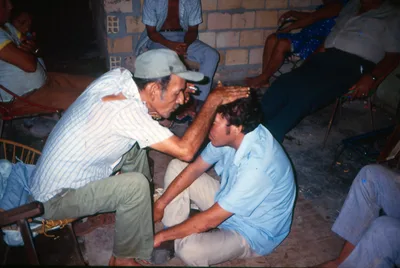
The curandero Solón Tello with a seated patient, his hand on the man’s head, 1987. Archive of the Centro Takiwasi, Tarapoto.Jaime Torres/Archivo Centro Takiwasi · CC BY-SA 4.0 · Wikimedia Commons
In Don Emilio’s account, illness is either accident, distraction and indolence, or the work of evil powers. Forest spirits may attack a stranger, and children taken to a new place are vulnerable. Most often a brujo has thrown a dart (Luna, 1984, p. 128). Protection of the body is central: the plants give the initiate “wisdom (‘sabiduría’) and at the same time … strength (‘fuerza’) to deal with the supernatural world”. Don Emilio would never suck out a dart sent by a stronger healer than himself, since he could not then protect his patient from the next attack (Luna, 1984, pp. 129–130).
The pajé’s vocation begins as an affliction. Caruanas attack a person they have chosen, either from birth — the gift shows when a child “cried” in the womb — or out of liking, which makes a lesser pajé. The chosen one, often from adolescence, suffers uncontrolled incorporations, sings the songs “of the deep”, retreats into the mangrove or throws himself into the water. An experienced pajé may suspend these correntes, but a true vocation cannot be escaped. It is completed by the encruzamento, in which the initiate dies symbolically to be reborn as a pajé. From then on, possessed by and possessing his caruanas, he serves the community as an act of “caridade”, charity (Maués, 2007, pp. 13–14). Only the pajé should be possessed, and only by caruanas. Spirits of the dead are never welcome, and a caruana entering anyone else is a sign of illness or of an unrecognised gift (Maués, 2007, p. 14).
Don Emilio said that he knew nothing of witchcraft, “because he has always been on the side of the Lord” (Luna, 1984, p. 128).
Art and material culture
The art of the vegetalista is first of all song. Knowledge is counted in ícaros, and some healers claim to know more than two hundred. Luna thought some of them could be “authentic repositories of Indian melodies, most of them having a clear compositional and melodic similarity to native music” (Luna, 1984, p. 130). The songs are mestizo in form. Brabec de Mori found that the ayahuasca songs he recorded share one structure throughout the Peruvian lowlands, unlike the region’s other music. Their words are mostly Quechua, with Cocama and Omagua passages, though healers work in Spanish (Brabec de Mori, 2011, pp. 42–43; Musalem Nazar, 2024, p. 2).
The pajé’s material culture is small and portable: the maracá, the feather, and the cintas passed over the body, which Maués calls the most evident symbols of the pajé’s “art”. What the pajé sings are the “doutrinas” of the encantados, not the hymns of the church (Maués, 2007, p. 14; Maués, 2002, p. 58). The rattle has a long written record on this coast: Léry added a figure of the dancer and the maraca player, he wrote, to show his readers what he had described (Léry, 1880, pp. 70–71).
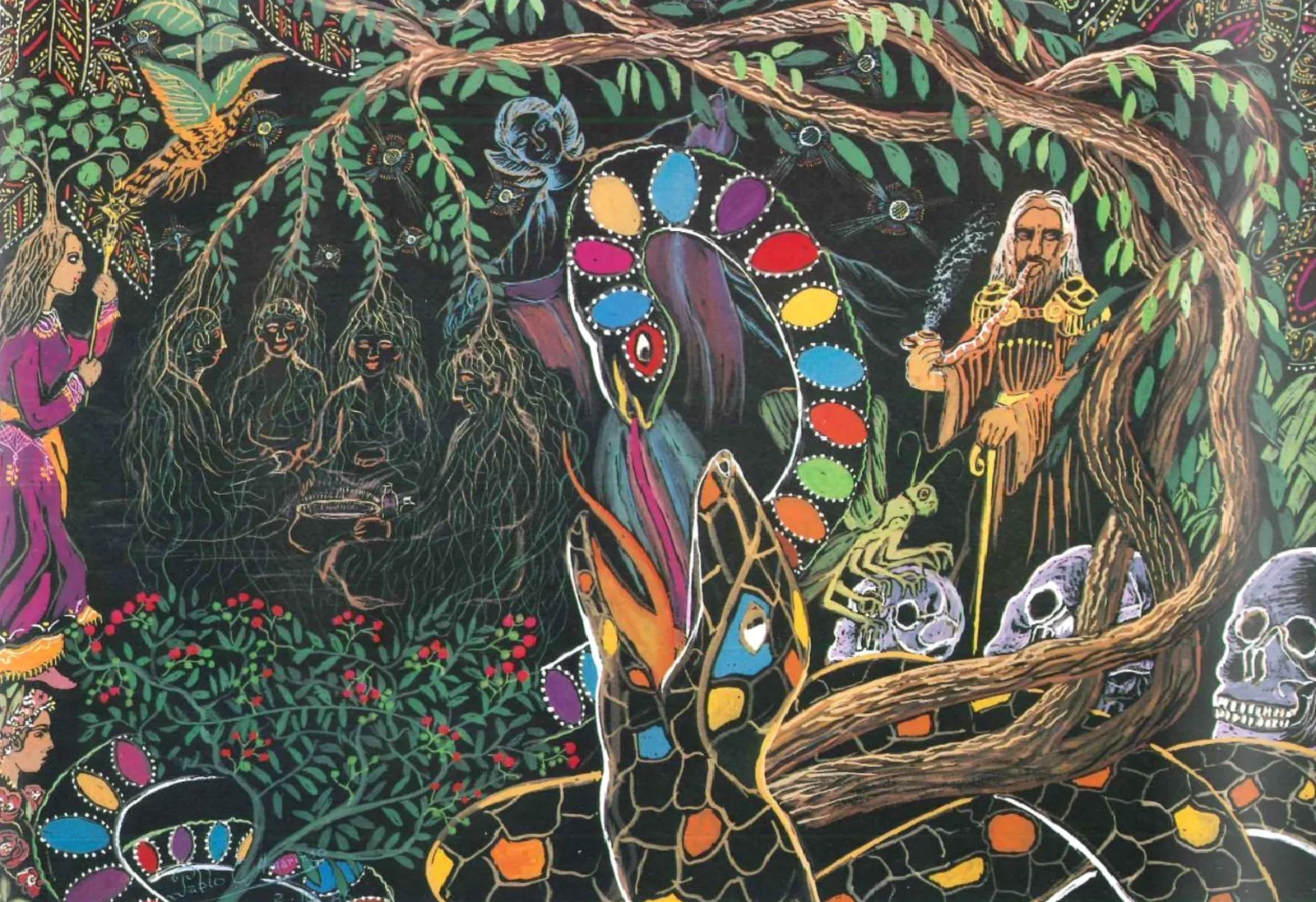
The visual arts that grew up around ayahuasca, among them the Shipibo-Konibo designs called kené and the paintings of Pablo Amaringo, belong to Indigenous and to more recent art histories. Kené is treated in the Indigenous Amazonian Shamanisms complex; Amaringo, whose painting opens this page, below.
Pablo Amaringo and the painting of visions
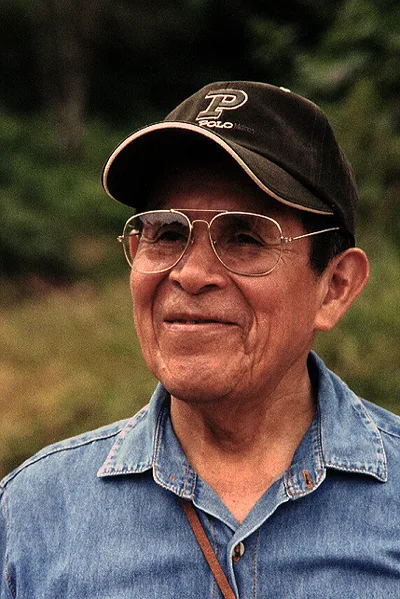
Pablo Amaringo in 2002, photographed during an ayahuasca retreat in the Brazilian Amazon.Jon Hanna · CC BY-SA 3.0 · Wikimedia Commons
The painter whose work opens this page came out of vegetalismo. Pablo Amaringo (1938–2009) presented himself above all as a riverine mestizo, though he recognised a Kechua Lamista origin and knew the Cocama and Shipibo-Konibo shamanism of the Ucayali well (Villalta, 2017, p. 1; Villalta, 2020, p. 134). He had practised as a vegetalista. When the anthropologist Luis Eduardo Luna and the ethnobiologist Dennis McKenna came to him wanting to know the master plants of the forest, he had given up the practice and could not show them. Seeing their disappointment, he told them he could paint everything the ayahuasca had taught him and made him see, because he had it in his memory. “Luna me dijo: ‘pinta, quiero ver’” — Luna said to me, paint, I want to see — and he painted two pictures, which they took away (Villalta, 2020, pp. 126–127).
The book he made with Luna, Ayahuasca Visions (1991), carried his work to an international public. Villalta places his rise in the mid-1980s, in the meeting ground between Indigenous art, riverine life with its vegetalismo, and Western interest in the forest’s pharmacopoeia, and in the shamanic tourism that began in those years (Villalta, 2020, pp. 125–126).
He worked from memory and from song. He concentrated until he could see an image whole and in detail, projected it onto the paper or canvas, and then, in his words, “the only thing I do is just add the colors”. While painting he would whistle the ícaros he had used in his sessions as a vegetalista, and the visions came back as clearly as if he were living them again. Luna reports that Amaringo believed he had acquired his power of visualisation and his knowledge of colour partly from the brew (Villalta, 2020, p. 127). Amaringo described the work as transcription: “En mi experiencia de chamán he logrado ver los idiomas. (…) Hay idiomas en los colores, en los sonidos, en las formas y motivos; mi trabajo es transcribir esos idiomas” — in my experience as a shaman I have managed to see languages; there are languages in colours, sounds, forms and motifs; my work is to transcribe them (Villalta, 2020, pp. 133–134).
The paintings set out the three realms of Amazonian cosmogony — water, earth and sky, each with its beings — together with the master plants and their owners and the spirits who teach designs to Indigenous women. They also show the skin of the boa, Western masters and angels. Amaringo did not regard them as ornament: they were meant to act on the viewer, making the ceremonies and their beings present (Villalta, 2020, p. 133). The plants of power he painted included tobacco, ayahuasca and toé (Villalta, 2020, pp. 134–135). Luna himself cautioned that the work cannot be taken as a portrait of Indigenous shamanism, or even of mestizo vegetalismo. In his reading it blends Amazonian cosmogony and folklore with European esotericism, modern metaphysics and collective archetypes, and is too eclectic to be representative of either (Villalta, 2020, p. 126).
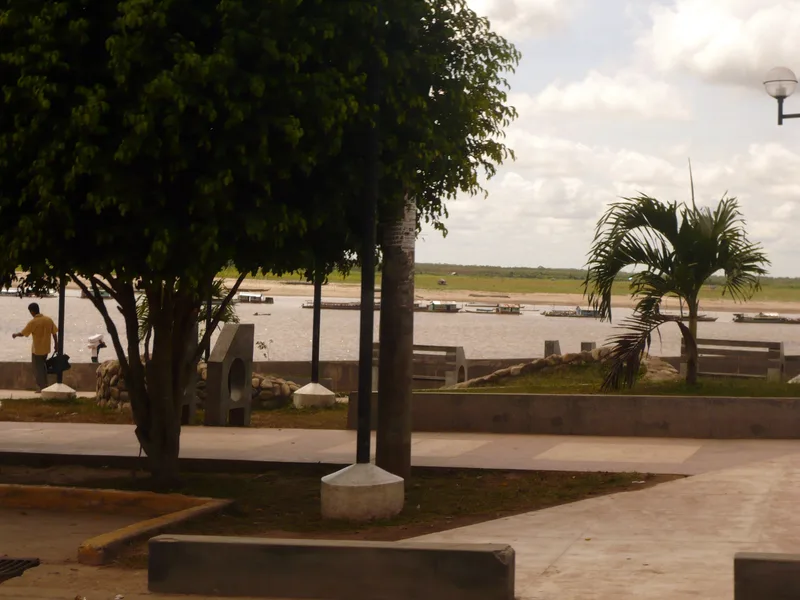
The Ucayali at Pucallpa from the Malecón Grau, 2010: riverboats moored at low water. Amaringo ran the Usko Ayar school in this city from 1988 until his death.DSan · CC BY-SA 4.0 · Wikimedia Commons
From 1988 until his death, Amaringo ran the Usko Ayar painting school in Pucallpa, for local and mainly mestizo students, who still carry his style (Villalta, 2020, p. 134). Its declared aim was to teach the visual arts and to promote among children and young people respect for nature, care for the environment and love of Amazonian culture (Villalta, 2017, p. 3). Among its pupils, Anderson Debernardi took the style to an international market. Casilda Pinche Sánchez founded her own art school, Purawa, at Puerto Miguel near Nauta. Paollo Del Águila says that in his first vision ayahuasca, in the body of an old woman, gave him brushes and a style of his own (Villalta, 2017, pp. 5–6).
The Iquitos painter Christian Bendayán sets this work in a longer history. Loreto had painted the colour and light of the forest and its people since the late nineteenth century; from the 1970s the Ucayali produced a painting of what lies beyond the visible. In his image, painting in Iquitos gave magic to waking reality, while painting in Pucallpa woke the magic of dreams into reality (Villalta, 2020, p. 128). Luisa Elvira Belaunde calls such shamanic painting “testimonial”, and therefore subversive. It asserts the truth of the scenes it shows, and so suggests that there may be other realities in which instruments of healing and illness are handled outside the hierarchies of official medicine (Villalta, 2020, p. 130).
03Visionary phenomenology
Accounts
Don Emilio · a bird, a bull and a winged Brazilian
Asked about his helping spirits, Don Emilio named three that he can call with the proper ícaro. A little bird that whistles a particular melody flies around his head to warn him of danger. A huge black bull puts the spirits of evil shamans to flight. A winged black Brazilian, “to whom he always communicates in Portuguese”, with six daggers at his belt and one in each hand, pursues the evil spirits to the Andes, forces them into dark tunnels and seals the entrance with a great black stone (Luna, 1984, p. 128). The spirit of ayahuasca itself may take a different form for each initiate — “an ant, a sparrow hawk or a little old man, as in the case of Don Emilio” (Luna, 1984, p. 130).
Peruvian healers today · the plant explains in dreams
The healers Berlowitz and colleagues interviewed described the diet as bringing teaching from “a conscious other—the plant’s spirit, as it is often framed”, most often in sleep. “The spirits come through dreams; they give us information”, one said; “almost all plants give you visions during sleep”, said another. These dreams were described as unlike ordinary dreams: “a dialogue, a direct communication between spirit” (Berlowitz et al., 2022, p. 7).
You take the remedy and in the dream the plant will explain things to you. […] If you drink a master plant from our Amazon forest, this master plant teaches you, it gives you knowledge, it offers you things. It shows you your past, or the way ahead—it makes you see.A Peruvian healer, quoted in Berlowitz et al. (2022), p. 7
A plant’s spirit, they said, “may present as a man or a woman”. Its teachings are often practical: “Primarily, I was given icaros. […] In the diets I have also received plant recipes. Or I have seen how to work with a rather complicated patient” (Berlowitz et al., 2022, p. 10).
The pajé · journeys “pelo fundo”
The best and most powerful pajés, Maués writes, have the power to travel “pelo fundo” of the waters to the dwelling of the encantados, where they learn or perfect their techniques of healing. He calls this a variant of the shamanic journey (Maués, 2007, pp. 12–13). The great pajés return from the deep as shamans; anyone who eats what is offered there is enchanted and cannot come back to the surface (Maués, 2005, p. 265). No informant, he adds, can explain how an encantado of flesh and blood comes into a pajé, and there is no use asking (Maués, 2005, p. 266).
Duration, intensity and visionary descriptions
“Ayahuasca will open to the initiate unthinkable horizons of beauty and terror”, Luna wrote of Don Emilio’s teaching (Luna, 1984, p. 130). The healers of the dieta study describe a state between sleep and waking. “I would enter into this, one could say, dream-like state, from the effect of the plant. One is not asleep, you are present, with the eyes open … but suddenly it creates an interlude, and a vision appears, or a perception, something like that.” Another plant gives “visions that are very, very clear, with a lot of affective content, but all the while you are with your eyes open” (Berlowitz et al., 2022, p. 7).
Neuroscience has worked mostly on another layer of visionary experience: its geometry. Bressloff, Cowan and colleagues took it up mathematically. Klüver had sorted reported hallucinatory images into four “form constants”: gratings, lattices, fretworks, filigrees, honeycombs and chequer-boards; cobwebs; tunnels, funnels, alleys, cones and vessels; and spirals. The authors model the primary visual cortex, V1, as a sheet of interconnected columns of neurons. They show that when its resting state becomes unstable, “under the presumed action of hallucinogens or flickering lights”, the patterns that emerge, once mapped back into the visual field, generate representatives of all the form constants (Bressloff et al., 2001, p. 299). They note that such patterns have been read in petroglyphs and cave paintings, and quote an early subject who watched a set of concentric rings recede “till the whole assumes the form of a deep tunnel of wire rings” (Bressloff et al., 2001, p. 300).
The accounts on this page are dominated by beings who teach, guard and heal, by journeys and by instruction, more than by pattern. A model of the visual cortex can explain why lattices, tunnels and spirals recur. What a vegetalista or a pajé makes of what he sees is a second question, and Langdon’s work among the Siona addresses it. Narratives told by experienced shamans prepare novices to understand their experiences as journeys to invisible regions, and the title of her 1979 study names the problem: cultural patterns in visions (Langdon, 2013, pp. 133–134; Langdon, 1979).
04Contemporary transformations
Contemporary expressions and transformations
On the Pará coast, the arrival of the Catholic Charismatic Renewal brought conflict. The pajés consider themselves good Catholics, but the charismatics tend to identify pajelança rituals as demonic (Maués, 2007, p. 11). Maués finds the two structurally alike. In each, only one kind of being may legitimately take over the believer’s body and mind: “Na pajelança, o caruana; na RCC, o espírito santo”. Any other is unwanted, and in the Renewal it is treated as demonic and exorcised (Maués, 2007, p. 21). He also records that some Catholic and Pentecostal clergy he interviewed in Belém and the interior now show a certain tolerance of pajelança, as a healing practice of the local culture (Maués, 2007, p. 13).
In Peru, the healers interviewed by Berlowitz and colleagues reported a sharp increase in foreign health-seekers. They described misunderstandings between healer and patient, and a profession that has attracted more commercially motivated practitioners, “resulting in a dilution of traditional knowledge” (Berlowitz et al., 2022, p. 11). Brabec de Mori observes that abroad ayahuasca “receives a new role in therapeutic and psychosocial processes which it never had in the western Amazon”, presented as a cure-all, while at home it is “but one small aspect of a highly developed system of medicine and conviviality” (Brabec de Mori, 2011, pp. 26–27).
Cultural and biological threat / conservation
Luna ended his 1984 paper on the humanity of people like Don Emilio, “whose knowledge seems to be destined to disappear forever because of the growing impact of the Western way of life” (Luna, 1984, p. 132). Forty years on, the risk the healers themselves name is not disappearance but dilution (Berlowitz et al., 2022, p. 11). No study of the conservation status of the plant-teachers was found for this page.
Local and global economies
Brabec de Mori writes that most people of the Ucayali he worked among do not consider ayahuasca necessary, “besides its key function in attracting tourists, researchers and development projects in present days” (Brabec de Mori, 2011, pp. 26–27).
Legality
On 24 June 2008, Peru’s Instituto Nacional de Cultura declared as cultural heritage of the nation “los conocimientos y usos tradicionales del Ayahuasca practicados por las comunidades nativas amazónicas, como garantía de continuidad cultural” — the traditional knowledge and uses of ayahuasca practised by native Amazonian communities, as a guarantee of cultural continuity. The declaration was made on a dossier prepared by Rosa Giove Nakazawa of the Centro Takiwasi in Tarapoto (Instituto Nacional de Cultura, 2008, pp. 229–231). It calls the practice of ayahuasca sessions one of “los pilares fundamentales de la identidad de los pueblos amazónicos” and states its aim as protection (Instituto Nacional de Cultura, 2008, p. 230):
Que, se busca la protección del uso tradicional y del carácter sagrado del ritual de Ayahuasca, diferenciándolo de los usos occidentales descontextualizados, consumistas y con propósitos comerciales.Instituto Nacional de Cultura (2008), p. 230
In Brazil, Costa notes, the Conselho Nacional de Políticas sobre Drogas (CONAD) authorised the ritual use of ayahuasca in 2010, after three decades of study and negotiation. The resolution set out principles for that use but, she writes, offers no instruments for protecting traditional uses. In 2011 the national heritage institute, IPHAN, began research towards a possible declaration of ayahuasca as intangible heritage (Costa, 2014, pp. 227–228). Pajelança cabocla, which as Maués describes it does not use ayahuasca, falls outside both instruments. The encantados themselves have crossed into the Brazilian ayahuasca churches: Lagrou notes the Barquinha’s “emphasis on the dance of the encantados” (Lagrou, 2018, p. 20), a tradition treated in the Brazilian Ayahuasca–Jurema Syncretic Religions complex.
Patents, ownership and law
Peru’s declaration is the nearest thing in these traditions to a claim of ownership. It attributes the knowledge to “las comunidades nativas amazónicas” and sets it against decontextualised commercial use (Instituto Nacional de Cultura, 2008, pp. 230–231). It names native communities, not the mestizo vegetalistas whose practice the ethnography of Iquitos describes. No patent touching these complexes was found in the sources read for this page.
Scientific research: current frontier
The dieta has become a research subject in its own right. Berlowitz and colleagues coded more than 500 segments of interviews with sixteen healers into seven themes, among them procedure, purposes, effects, safety, medical training and foreign health-seekers. The healers described a detailed risk assessment and safety measures, and stressed the training of the healer who administers the diet (Berlowitz et al., 2022, pp. 1, 3). A companion study followed the clinical practice of a single maestro tabaquero who works primarily with leaves of N. rustica (Berlowitz et al., 2020). On the side of perception, the cortical model of Bressloff and colleagues remains the most developed account of why geometric visions take the forms they do (Bressloff et al., 2001, p. 299). No comparable research on pajelança cabocla was found: its literature remains anthropological.
05Linked species
The four plants with monographs, and the further plant-teachers that Luna’s specimens, identified at the Field Museum, name for Don Emilio’s practice. Names follow Luna’s 1984 identifications; the unlinked cards have no page in the archive yet.
One of the most important plants in Don Emilio’s practice; teaches when the diet is kept.
Travel under water · raya balsa
Montrichardia arborescens
Araceae · gives the power to visit the people at the bottom of lakes and rivers.
Bark added to the brew · ayahuman
Couroupita guianensis
One of the tree barks added to ayahuasca.
Bark added to the brew · caupuri
Virola surinamensis
Myristicaceae, the genus of the Virola snuffs; here a bark additive.
Latex taken alone · catahua
Hura crepitans
A very powerful plant-teacher in Don Emilio’s estimation.
06Bibliography
18 sources in 4 threads · 18 with a working locator · Harvard (Cite Them Right) · status and kind are recorded per source, not assumed
How to read the labels on each source
Source type
What kind of work it is: journal article, book, legislation, patent application, database record and so on. A word after the dot (ethnography, protologue, primary source) keeps the genre the entry was first filed under. “Unclassified” means the citation does not say enough to tell.
Peer review
Recorded for each work separately, and only where it has been confirmed for that work. It is never inferred from a DOI, a publisher or a journal, since journals also publish editorials, letters and commentaries. Where it has not been confirmed, the entry records it as not established. It does not apply to legislation, court decisions, treaties, patents, datasets, database and collection records, historical texts, films, talks, press releases or web pages.
Check
What was checked when the entry was added. DOI checked: the DOI’s registry record (Crossref) matched the citation’s title, first author and year. Verified: the record itself was opened and matched the citation: a library catalogue record for a book, or the page itself for a database entry, law, patent or archive document. “Verified (abstract)” and “(summary)” mean only the abstract or a summary was read. Located: a record was found but not fully matched. Bibliographic record and Stable record (in essays): a catalogue or stable web record exists; what was checked against it is not recorded. Unverified: no check is recorded. No locator found: a search found no record. Secondary: read through another source.
What the labels do not say
None of them means the source supports a particular sentence. Where a sentence is graded, its evidence note names its sources and whether each supports it, disputes it or gives context. Dates and reviewers of checks are not recorded for each entry; the version note at the foot of a graded page dates its last review.
Archaeology & history
Brabec de Mori, B. (2011) ‘Tracing hallucinations: contributing to a critical ethnohistory of ayahuasca usage in the Peruvian Amazon’, in Labate, B.C. and Jungaberle, H. (eds.) The Internationalization of Ayahuasca. Zürich: Lit Verlag, pp. 23–47.
VerifiedBook chapterPeer review not establishedOpen record ↗cited 10× in this record
Léry, J. de (1880) Histoire d’un voyage faict en la terre du Brésil. Edited by P. Gaffarel. Vol. 2. Paris: A. Lemerre. First published 1578.
VerifiedHistorical textPeer review not applicableOpen record ↗cited 4× in this record
Musalem Nazar, P. (2024) ‘Para una historia crítica del yajé y el ayahuasca: la hipótesis de Gow a la luz del yajé’, Jangwa Pana, 23(1), pp. 1–18.
DOI checkedJournal articlePeer review not establishedOpen record ↗cited 4× in this record
Ethnography, ritual & cosmology
Berlowitz, I., Torres, E.G., Walt, H., Wolf, U., Maake, C. and Martin-Soelch, C. (2020) ‘“Tobacco is the chief medicinal plant in my work”: therapeutic uses of tobacco in Peruvian Amazonian medicine exemplified by the work of a maestro tabaquero’, Frontiers in Pharmacology, 11, 594591.
DOI checkedJournal articlePeer review not establishedOpen record ↗cited 2× in this record
Berlowitz, I., O’Shaughnessy, D.M., Heinrich, M., Wolf, U., Maake, C. and Martin-Soelch, C. (2022) ‘Teacher plants—Indigenous Peruvian-Amazonian dietary practices as a method for using psychoactives’, Journal of Ethnopharmacology, 286, 114910.
DOI checkedJournal articlePeer review not establishedOpen record ↗cited 10× in this record
Lagrou, E. (2018) ‘Anaconda-becoming: Huni Kuin image-songs, an Amerindian relational aesthetics’, Horizontes Antropológicos, 24(51), pp. 17–49.
DOI checkedJournal articlePeer review not establishedOpen record ↗cited 1× in this record
Langdon, E.J.M. (1979) ‘Yagé among the Siona: cultural patterns in visions’, in Browman, D.L. and Schwarz, R.A. (eds) Spirits, Shamans, and Stars. The Hague: Mouton, pp. 63–80.
VerifiedBook chapterPeer review not establishedOpen record ↗cited 2× in this record
Langdon, E.J. (2013) ‘“La visita a la casa de los tigres”: la contextualización en narrativas sobre experiencias extraordinarias’, Revista Colombiana de Antropología, 49(1), pp. 129–152.
DOI checkedJournal articlePeer review not establishedOpen record ↗cited 2× in this record
Luna, L.E. (1984) ‘The healing practices of a Peruvian shaman’, Journal of Ethnopharmacology, 11(2), pp. 123–133.
DOI checkedJournal articlePeer review not establishedOpen record ↗cited 34× in this record
Maués, R.H. (2002) ‘Catolicismo e xamanismo: comparação entre a cura no Movimento Carismático e na pajelança rural amazônica’, Ilha: Revista de Antropologia, 4(2), pp. 51–77.
VerifiedJournal articlePeer review not establishedOpen record ↗cited 4× in this record
Maués, R.H. (2005) ‘Um aspecto da diversidade cultural do caboclo amazônico: a religião’, Estudos Avançados, 19(53), pp. 259–274.
DOI checkedJournal articlePeer review not establishedOpen record ↗cited 14× in this record
Maués, R.H. (2007) ‘Catolicismo e xamanismo: reflexões sobre pajelança amazônica, renovação carismática e outros movimentos eclesiais’, Revista Pós Ciências Sociais, 4(8), pp. 11–30.
VerifiedJournal articlePeer review not establishedOpen record ↗cited 20× in this record
Shaara, L. and Strathern, A. (1992) ‘A preliminary analysis of the relationship between altered states of consciousness, healing, and social structure’, American Anthropologist, 94(1), pp. 145–160.
DOI checkedJournal articlePeer review not establishedOpen record ↗cited 2× in this record
Villalta, D. (2017) ‘Criatividade como uma dádiva do reino vegetal’, Revista Scientiarum Historia, 1(1), e166.
VerifiedJournal articlePeer review not establishedOpen record ↗cited 3× in this record
Villalta, D.C. (2020) ‘Arte amazônica, cosmologia e ação política’, Arte & Ensaios, 26(40), pp. 123–139.
DOI checkedJournal articlePeer review not establishedOpen record ↗cited 11× in this record
Clinical research & neuroscience
Bressloff, P.C., Cowan, J.D., Golubitsky, M., Thomas, P.J. and Wiener, M.C. (2001) ‘Geometric visual hallucinations, Euclidean symmetry and the functional architecture of striate cortex’, Philosophical Transactions of the Royal Society of London. Series B: Biological Sciences, 356(1407), pp. 299–330.
DOI checkedJournal articlePeer review not establishedOpen record ↗cited 3× in this record
Law, policy & patents
Costa, J.A.C. da (2014) ‘Apresentação à Resolução nº 836 do Instituto Nacional de Cultura do Peru, de 24 de junho de 2008’, Inter-Legere, 15, pp. 227–231.
VerifiedJournal articlePeer review not establishedOpen record ↗cited 1× in this record
Instituto Nacional de Cultura (2008) Resolución Directoral Nacional Nº 836/INC. Lima, 24 June. Reproduced in Costa, J.A.C. da (2014) Inter-Legere, 15, pp. 229–231.
VerifiedLegislation or regulationPeer review not applicableOpen record ↗cited 4× in this record