1.0: evidence grades, abstract, Deep Time timeline and safety box added.
Grades marked automatically follow the editor’s existing evidence labels and explicit wording. Contested, editorial, safety-critical and upgraded grades are reviewed by the editor. Automatic grades are audited by sample.
Mirante, D. (ed.) (2026) Ipomoea corymbosa. Entheocene, version 1.0. Available at: https://entheocene.com/plant-ipomoea-corymbosa.html (Accessed: 15 October 2026).
DOI: not yet minted.
Introduction
Ololiuhqui, the seed of the Mexican morning glory Ipomoea corymbosa, appears in sixteenth-century Nahua testimony as a seed of fearful visions and in seventeenth-century extirpation manuals as a divinatory medicine. Zapotec, Chinantec, Mazatec, Mixtec and Nahua communities have continued to consult it, as semilla de la Virgen, to learn why an illness began or where something is lost. Its ergot alkaloids, chiefly lysergic acid α-hydroxyethylamide and ergine, are made by a fungal symbiont, Periglandula turbinae, carried in the seed. Which compound accounts for the ceremonial effects is unresolved.
All sections
Botanical name
Ipomoea corymbosa
Taxa
Convolvulaceae · Solanales · Magnoliopsida
Traditional names
ololiuhqui · coaxihuitl · semilla de la Virgen · Christmas vine · formerly Turbina corymbosa
Regions
Native from Mexico and the Caribbean through Central America into tropical South America, including Colombia, Venezuela, Ecuador, Peru, Bolivia, Brazil and Paraguay.
Ethnographic entheogenic use
Ololiuhqui, the seed of a Mexican morning glory, appears in sixteenth-century Nahua testimony as a seed of fearful visions and in seventeenth-century extirpation manuals as a divinatory medicine. Zapotec, Chinantec, Mazatec, Mixtec and Nahua communities have continued to consult it, as semilla de la Virgen (Sahagún, 1950–1982; Ruiz de Alarcón, 1629/1984; Wasson, 1963; Fagetti, 2025).
01Ethnobotany of Ipomoea corymbosa
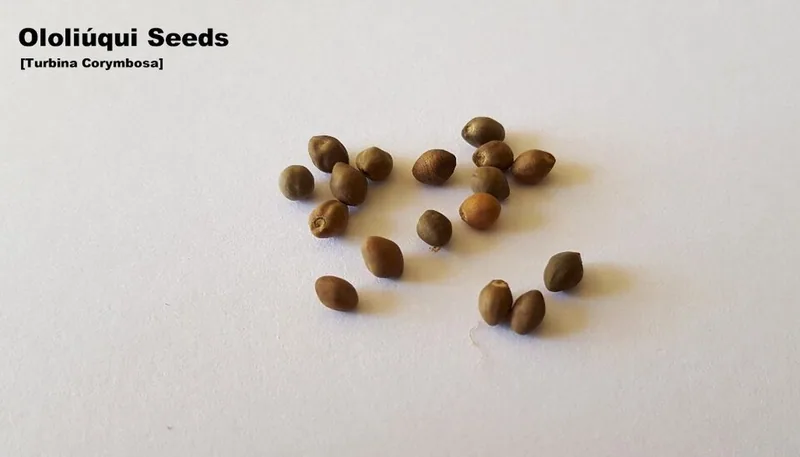
Plate 01 · specimen · deep view
Seeds presented as ololiuhqui · DMTrott, 2017/2022 · CC BY-SA 4.0 ↗
Botanical Info
Accepted name
Ipomoea corymbosa (L.) Roth. Linnaeus published the basionym Convolvulus corymbosus in 1759; Roth’s combination appeared in 1819. Current phylogenetic and global taxonomic treatments place the species within Ipomoea (Muñoz-Rodríguez et al., 2019; Wood et al., 2020; POWO, 2026).
Principal synonyms
Turbina corymbosa (L.) Raf.; Rivea corymbosa (L.) Hallier f.; Legendrea corymbosa (L.) Ooststr. These names are taxonomic synonyms for one species. “Turbina” persists because the one-seeded, indehiscent fruit once supported a segregate genus.
Family
Convolvulaceae, the morning-glory family.
Order
Solanales.
Geographic range
Native from Mexico and the Caribbean through Central America into tropical South America, including Colombia, Venezuela, Ecuador, Peru, Bolivia, Brazil and Paraguay. It is naturalised in Florida and other warm regions of the Americas, Macaronesia, Africa, South and Southeast Asia and Australia. The species grows principally as a liana in wet tropical forest margins, secondary vegetation, hedges and disturbed ground (Wood et al., 2020; POWO, 2026).
Local names
Ololiuhqui/ololiuqui primarily names the rounded seeds or drug in Nahuatl-language sources; the vine is described as coaxihuitl or coatl xoxouhqui. Spanish and regional names include semilla de la Virgen, manto de la Virgen, hiedra, bejuco, aguinaldo blanco and Christmas vine. Piule is a wider regional category covering several plants. Tlitliltzin, the “black little one”, generally denotes black angular morning-glory seeds associated with I. tricolor, though historical naming shifts (Schultes, 1941; Wasson, 1963; Fagetti, 2025).
Growth form
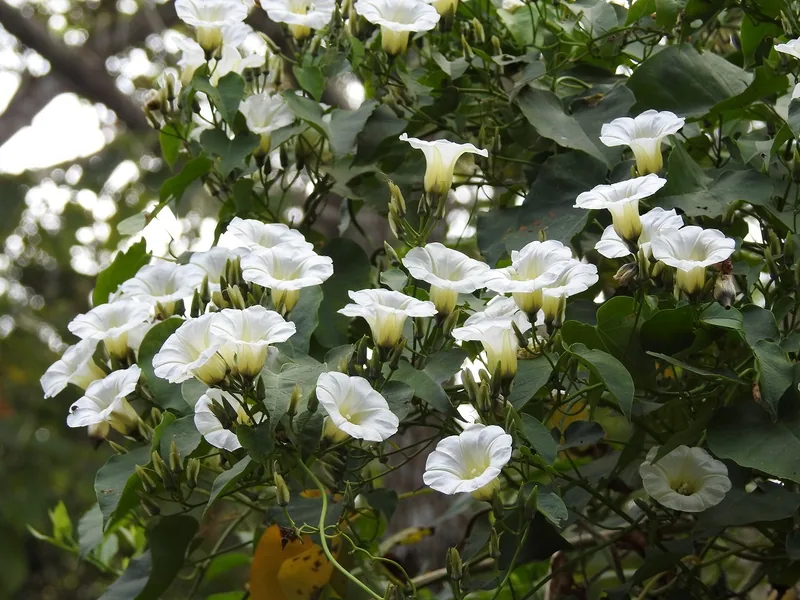
Long-lived, vigorous, woody twining vine, often several metres long, with slender glabrous or sparsely hairy stems. It climbs shrubs and trees and may form broad flowering masses in season.
Conservation
No global IUCN assessment. Its broad native range, ornamental cultivation and naturalisation suggest that the species as a whole is secure. Ritual seed lineages, local access, named knowledge and habitats are a separate question; in some introduced regions, conversely, the vine is managed as an environmental weed (CABI, 2026; POWO, 2026).
Territories
Territories · places named on this page · deep view
1Central Mexico · ololiuhqui in sixteenth-century Nahua texts (Sahagún, 1950–1982)
2Guerrero · the “Virgin Seed” among Mixtec, Nahua and Mazatec specialists in Guerrero, Oaxaca and Puebla (Fagetti, 2025)
3Oaxaca · seeds in use in almost every village, “an ever present help in time of trouble” (Wasson, 1963)
16th centurySahagún’s Nahua informants and Hernández describe ololiuhqui: the earliest securely identifiable record.Supported · Sahagún, 1950–1982
1629Ruiz de Alarcón’s Tratado records consultations and prayers while instructing clergy to suppress them.Supported · Ruiz de Alarcón, 1984
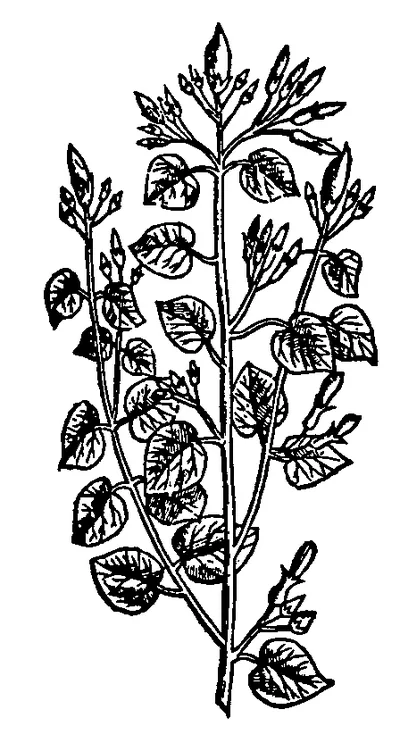
1651Hernández’s Thesaurus prints a woodcut of ololiuhqui.Supported · Hernández, 1651b
1759Linnaeus publishes Convolvulus corymbosus.Supported · Muñoz-Rodríguez et al., 2019
1963Wasson finds the seeds in use in almost every village of Oaxaca.Supported · Wasson, 1963
A pre-Conquest history is strongly inferred from Nahuatl names and early testimony, but no archaeobotanical seed assemblage fixes an earlier date.
Morphology and reproduction
Leaves are alternate, entire, broadly ovate to cordate, generally with an acute or acuminate tip and a deeply heart-shaped base. The inflorescences are conspicuous many-flowered cymes that can appear corymb-like, giving the species its epithet. The salverform to narrowly funnel-shaped corollas are white, sometimes greenish at the throat, with a long tube adapted to animal pollination. Sepals persist and enlarge around the developing fruit. The mature fruit is globose to ovoid, dry, woody and indehiscent, normally enclosing one smooth brown seed. That fruit differs from the dehiscent capsules common in many morning glories and drove the earlier classification in Turbina (Wood et al., 2020).
The vine produces abundant nectar and can be a significant honey plant. In the Yucatán, the Maya name xtabentún is associated with the flower and with a honey-based anise liqueur; in Cuba its winter flowering has contributed to the English name Christmas vine. Pollinator, ornamental and ritual economies therefore overlap without being identical. Seed-bearing plants also transmit the fungal partner that produces their characteristic ergoline chemistry.
Taxonomic and ethnobotanical boundaries
Accepted genus
Large-scale molecular and morphological studies dissolve Turbina into Ipomoea. Ipomoea corymbosa is consequently the accepted name, even where ethnographic and chemical studies retain Rivea corymbosa or Turbina corymbosa (Muñoz-Rodríguez et al., 2019; Wood et al., 2020).
Two seed traditions
Rounded tan-brown ololiuhqui and black angular tlitliltzin were differentiated in twentieth-century fieldwork. The latter is usually identified with Ipomoea tricolor; translations that call both simply “morning glory” obscure botanical and ceremonial distinctions (MacDougall, 1960; Wasson, 1963).
Historical extension
Colonial plant names were relational categories embedded in Nahua medicine, tribute, locality and ritual. No modern binomial should be projected onto every occurrence of ololiuhqui, piule or “seed of the Virgin” without a specimen, image or precise description.
Iconographic species
Morning-glory identifications proposed for the Tepantitla murals at Teotihuacan and for flowers on the Xochipilli statue are suggestive analogies. Secure species determination awaits archaeobotanical evidence (Furst, 1974).
02Chemistry
The seeds contain a variable mixture of clavine and lysergic-acid-derived ergot alkaloids. The central compounds are lysergic acid α-hydroxyethylamide (LAH/LSH), ergine (lysergic acid amide; LSA), isoergine, ergometrine/ergonovine, lysergol, chanoclavine-I and elymoclavine. Freshness, seed maturity, fungal chemotype, storage and extraction alter the measured profile. LAH is chemically labile and can hydrolyse to ergine, so an old analysis rich in “LSA” may describe aged material more than fresh ritual seed (Hofmann and Tscherter, 1960; Hofmann, 1963; Beaulieu et al., 2021).
Ergine · LSA
C₁₆H₁₇N₃O
D-lysergic acid amide · lysergamide
Serotonergic, adrenergic and dopaminergic receptor ligand
Lysergic acid α-hydroxyethylamide
C₁₈H₂₁N₃O₂
LAH / LSH · N-(1-hydroxyethyl)lysergamide
Labile principal alkaloid in some fresh chemotypes
Biosynthetic precursor within fungal ergot-alkaloid pathways
A fungal–plant pharmacological unit
The decisive modern revision is that the alkaloids come from a fungus. Periglandula turbinae, a clavicipitaceous fungus, lives epibiotically on young adaxial leaf surfaces of I. corymbosa in close association with secretory glands and is transmitted systemically through the seed. The relationship is macroscopically asymptomatic. Fungal genes encode ergot-alkaloid biosynthesis; infected seeds carry both the symbiont and its chemistry into the next plant generation (Steiner et al., 2011; Steiner and Leistner, 2012).
A survey of 210 morning-glory species found ergot alkaloids concentrated in four host clades and correlated their presence with larger seeds. Within species, alkaloid-positive and -negative accessions can coexist. This phylogenetic and chemotypic mosaic explains why a botanical name alone is a poor guide to chemical profile. Defensive benefit against seed predators, herbivores or nematodes is consistent with comparative data; experimental demonstration for each I. corymbosa population is still to come (Beaulieu et al., 2015; 2021).
Pharmacology and unresolved attribution
Polyreceptor ergolines
Ergine binds serotonin receptors including 5-HT₂A and also adrenergic and dopamine receptors, though generally with lower affinity and efficacy than LSD. Ergometrine and other co-occurring lysergamides add distinct vascular, visceral and central actions. The seed’s pharmacology is its own, distinct from “natural LSD” (Paulke et al., 2013; Steiner and Leistner, 2018).
Instability
LAH readily decomposes or hydrolyses, while epimerisation produces iso forms. Handling history can therefore transform the object under analysis. Modern LC–MS profiles and voucher-backed fungal tests are more interpretable than nominal “LSA content” detached from storage conditions (Beaulieu et al., 2021).
Experiential contributor
Controlled human work isolated ergine and isoergine; the fresh seed ensemble has yet to be reconstructed. Which compound, ratio or metabolite best accounts for ceremonial visionary effects remains unresolved; LAH is a leading candidate but lacks adequate human pharmacology (Isbell and Gorodetzky, 1965; Steiner and Leistner, 2018).
Symbiosis research
Recent microscopy and transcript work in other Ipomoea hosts maps fungal tissue distribution and pathway expression. The 2025 isolation of Periglandula clandestina from I. tricolor provides a comparative model; the symbiont of I. corymbosa is P. turbinae (Olaranont et al., 2022; Hazel et al., 2025).
03Tradition, ritual & cultural use
Oldest evidenced or proposed human use
Early colonial record
Sixteenth centurySahagún’s Nahua informants described ololiuhqui as a seed that intoxicated, disclosed fearful visions and entered medicinal practice. Francisco Hernández described the twining white-flowered plant and rounded coriander-like seed during his New Spain research of the 1570s; the illustration appeared in the 1651 Roman edition. These texts are the earliest securely identifiable records presently available (Sahagún, 1950–1982; Hernández, 1651; Schultes, 1941).
Extirpation archives
Seventeenth centuryRuiz de Alarcón’s 1629 Tratado and de la Serna’s 1656 manual recorded consultations, offerings, prayers and divinatory questions while instructing clergy to suppress them. Their density shows persistence under colonial rule; their categories—“superstition”, “devil” and “idolatry”—belong to the prosecution apparatus (Ruiz de Alarcón, 1629/1984; de la Serna, 1656/1953).
Pre-Conquest antiquity
Strongly inferred Nahuatl nomenclature, the breadth of early testimony and the practice’s entanglement with Indigenous medicine make a pre-Conquest history highly probable. There is, however, no securely published archaeobotanical I. corymbosa seed assemblage that fixes an earlier date. “Aztec drug” is thus historically meaningful but archaeologically less precise than is often assumed.
Iconographic proposals
ContestedPeter Furst proposed that a flowering vine in the Tepantitla mural complex at Teotihuacan represented ololiuhqui and linked it with a rain/fertility complex. Similar identifications have been made for the Xochipilli statue. Formal resemblance and later analogy are insufficient for species-level certainty; these are hypotheses about deep history (Furst, 1974).
Modern continuity
Twentieth–twenty-first centuriesField reports among Zapotec, Chinantec and Mazatec communities, and recent research among Mixtec, Nahua and Mazatec specialists in Guerrero, Oaxaca and Puebla, document continuing or remembered use of semilla de la Virgen, ololiuhqui and related morning-glory medicines (Schultes, 1941; Wasson, 1963; Fields, 1969; Fagetti, 2025).
Peoples and traditions
Oaxaca
In 1963 Wasson found the seeds in use in almost every village of Oaxaca, "an ever present help in time of trouble"; only among the Triqui of Copala did he find no familiarity with them (Wasson, 1963, pp. 175–176).
Zapotec badoh
In Zapotec, ololiuhqui is badoh; the long black seed of a second morning glory, Ipomoea violacea, used in the same way, is badoh negro or badungas. In some villages the black seed is called macho, male, and taken by men, while the round seed, hembra, female, is for women (Wasson, 1963, pp. 176–178).
Tlitliltzin
Pedro Ponce's colonial Breve relación names ololiuhqui, peyote and tlitliltzin together as distinct products; Wasson reads tlitliltzin, from the Nahuatl for "black" with a reverential suffix, as the classical name for the black seeds (Wasson, 1963, p. 177).
Ritual practice and divinatory technique
Historical and ethnographic accounts describe seeds ground and suspended in water before oral consumption, commonly in darkness or at night. Silence, fasting, sexual abstinence, clean space, candles, copal, flowers and prayer appear in different regional records; no single sequence is universal. What recurs is a tightly framed question. The medicine is approached to disclose why an illness began, whether sorcery or interpersonal conflict is involved, where a lost object lies, who committed a theft, whether a traveller will return, or what treatment should follow. Darkness reduces ordinary distraction and makes dreamlike imagery, voices and bodily signs available for interpretation (Schultes, 1941; Wasson, 1963; Fields, 1969).
Colonial descriptions emphasise ingestion by a ritual specialist, yet later field reports also include patients who receive the seed under supervision while a knowledgeable attendant listens to their speech and helps interpret it. Divination is thus distributed among plant/fungus, sufferer, healer, kin and ritual setting. The answer may arrive as scene, person, animal, voice, remembered event or felt certainty, often quietly. Diagnosis and cure are socially joined: revelation can identify an offended being, neglected obligation or damaged relationship that subsequent prayer, offering, herbal treatment or restitution must address.
Teotlaqualli: the priests' "food of god"
An early account of ololiuhqui inside a temple is the Dominican Diego Durán's description of a priestly ointment. The priests, he writes, painted themselves every day from head to foot with soot; but when they went to sacrifice, and to the dense forests, mountain summits and dark caves where they kept their idols, they anointed themselves with a different black paste, "que quiere decir comida de Dios" — "which means food of god": teotlaqualli. Boys of the temple schools collected venomous creatures for it — spiders, scorpions, centipedes, salamanders, vipers. The priests burned these in the god's brazier, ground the ashes in mortars with much picietl, a herb the Indians used "to deaden the flesh and not feel toil", with live scorpions, spiders and centipedes, and then added a ground seed "que llamauan ololiuhqui", which the Indians "la beben para solo ber bisiones" — drink only to see visions — together with hairy black worms whose hair alone is venomous. All was kneaded with soot and set before the god in pots and gourds as divine food (Durán, 1880, pp. 110–111). Anointed with it, the priests lost all fear: they killed in sacrifice with great daring and went alone at night to the mountains and caves, certain that lions, "tigers" and other wild beasts would flee from them (Durán, 1880, p. 111).
The same paste was a medicine. Called "medicina divina", it was smeared on sick people and children where they felt pain, and people came from every quarter to the temple's dignitaries to receive it. Durán, who calls it a diabolical ointment and likens it to the unguent of European witches, explained the relief it brought by the numbing power of picietl and ololiuhqui applied as a plaster (Durán, 1880, pp. 111–112). His account is a missionary's, written against the rite, and it is the only source read here for the ointment. It places ololiuhqui inside a priestly institution — compounded, offered to a god, worn on the body and applied as cure — as well as in the cup of a diviner.
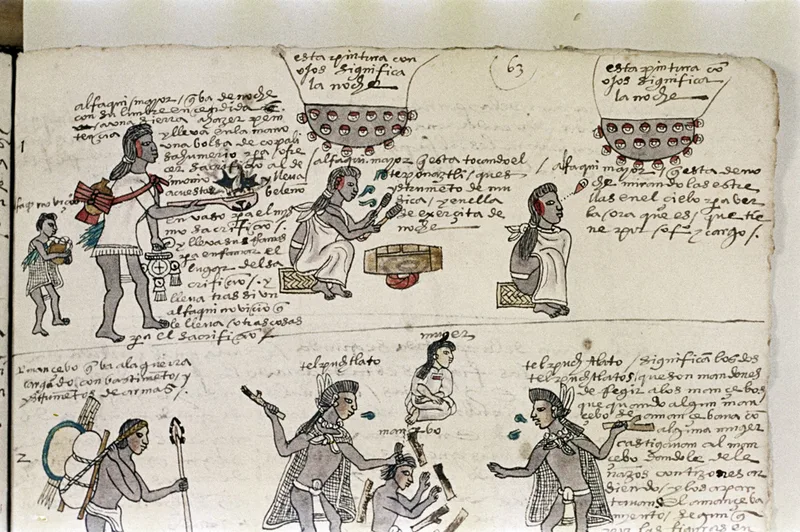
Plate 02 · Codex Mendoza, fol. 63r · deep view
Head priests' night-time duties: an incensing rite with a novice, drumming and singing, watching the stars; the priests' bodies are painted dark · Codex Mendoza, fol. 63r (detail), Bodleian Library, MS. Arch. Selden. A. 1 · CC BY 4.0 · Wikimedia Commons ↗
Colonial suppression and ritual endurance
The Spanish ecclesiastical campaign against ololiuhqui was unusually explicit. Confessional manuals asked about possession and consultation; extirpators destroyed seeds and punished practitioners. At the same time, colonial society continued to use Indigenous healers, and the documentary archive expanded because priests needed detailed descriptions of what they opposed. The later Catholic names left room for Indigenous cosmologies. “Seed of the Virgin” can position visionary agency within Marian protection while retaining local ideas of respect, reciprocity, offence and disclosure. The resulting tradition is syncretic in the historical sense of layered institutions and translations (Aguirre Beltrán, 1963; Fagetti, 2025).
04Cosmology & key terms
A seed that knows
In Nahua and Oaxacan practice, ololiuhqui is better described as a nonhuman knower than as a passive chemical key. Colonial sources repeatedly attribute speech, sight and punitive power to the seed: consultation requires correct address, and disrespect may itself produce affliction. Knowledge is a relation, established through prayer, abstinence, ingestion, darkness and interpretive discipline. This helps explain why the same pharmacological material can be used for diagnosis, moral adjudication and locating persons or objects (Ruiz de Alarcón, 1629/1984; Fagetti, 2025).
Teotlaqualli
"Food of god", in Durán's gloss: the black ointment of burnt venomous creatures, picietl and ground ololiuhqui with which priests anointed themselves before night rites, and which was applied to the sick as "medicina divina" (Durán, 1880, pp. 110–112). Also written teotlacualli (Mikulska and Hermann Lejarazu, 2021, p. 110).
Ololiuhqui
A Nahuatl term conventionally glossed from roundness and associated principally with the small round seeds/drug. Historical orthographies vary, and so does its reference.
Coaxihuitl
“Snake-plant” or “serpent herb”, the twining vine in early botanical description. The name connects visible growth habit and Indigenous classification; claims of a single fixed serpent mythology go beyond the sources.
Semilla de la Virgen
“Seed of the Virgin”, a Catholic-inflected name documented in Oaxacan and neighbouring traditions. Marian nomenclature may organise permission, protection and address, as well as concealing an older practice.
Tlitliltzin
“Black little one”, generally associated in modern ethnobotany with the black angular seeds of Ipomoea tricolor. It is pharmacologically related but botanically and ritually distinct from rounded ololiuhqui.
Piule
A mobile regional word applied to several divinatory plants and preparations. It indicates a functional category in some communities; species identification needs other evidence.
Virgin, serpent and revelatory personhood
Three figurations recur without forming one universal myth. The vine’s twining morphology supports the name “snake-plant”; the rounded seed gives ololiuhqui its material index; and the Virgin lends a Christian sacred person through whom the medicine may be named and approached. Contemporary accounts sometimes gender the medicine feminine and associate it with Mary, young female saints or a maternal healer. These identities are local and historically layered. Together they make no single all-Mesoamerican “morning-glory goddess”, and they have changed since Aztec theology (Fagetti, 2025).
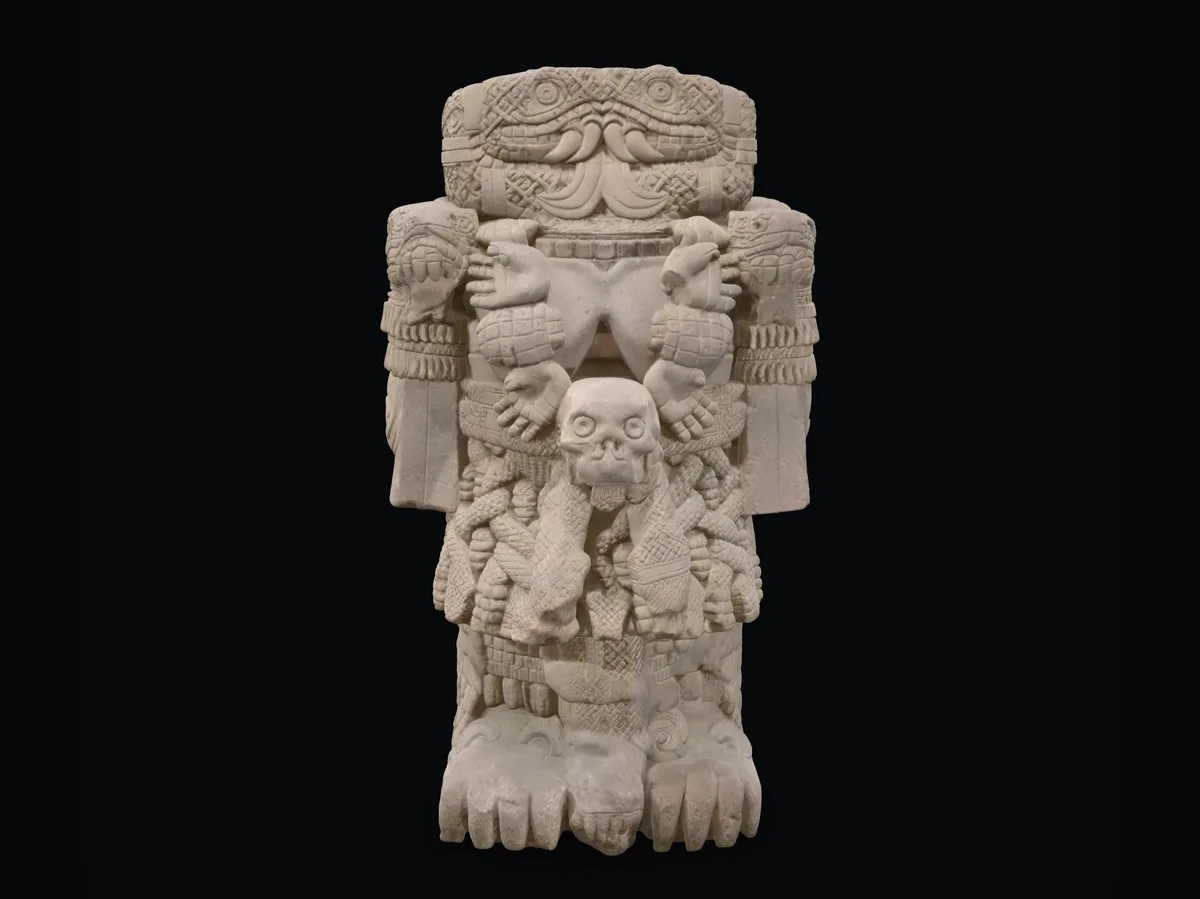
Plate 03 · Coatlicue · three-dimensional view
Drag to turn · scroll or pinch to magnify
About this model
Subject
The colossal stone sculpture of Coatlicue. Its collection and accession number are not recorded in this entry.
Made by
Daniel Mirante, 2026.
Method
Hand-modelled from assembled photographic references: an interpretive reconstruction, not photogrammetry or a measured scan. Which photographs were used is not recorded.
Fidelity
Proportions and surface detail are approximate. The model is for looking and comparison, not for measurement.
Rights
The model is Daniel Mirante’s work; no licence is stated. Rights in the reference photographs are not recorded.
Coatlicue, the colossal Aztec stone sculpture, shown here for comparison. The link to this plant is the editor’s, and it rests on a word, not on a recorded tradition: the vine’s Nahuatl names, coaxihuitl and coatl xoxouhqui, contain coatl, “snake”, as Coatlicue’s own name does. In the sources this entry cites, the name “snake-plant” follows the vine’s twining habit, and the seed’s sacred figures form no single serpent mythology or morning-glory goddess (Fagetti, 2025). No source cited here connects the plant with Coatlicue. 3D model by Daniel Mirante hand-modelled from assembled photographic references.
Art and material culture
Pots and gourds for a god
In Durán's account the priests' ointment of ololiuhqui, picietl and burnt creatures was put into small pots and gourds and set before the god as divine food (Durán, 1880, p. 111).
The grinding stone
Wasson records that the seeds are ground on the metate, the household grinding stone of Mesoamerica, which thus belongs to the material culture of the rite (Wasson, 1963, p. 178).
The first printed image
Francisco Hernández's Thesaurus of 1651 printed a woodcut of ololiuhqui among the plants of New Spain (Hernández, 1651).
Plate 04 · specimen · deep view
Ololiuhqui in Hernández's Rerum medicarum Novae Hispaniae thesaurus, 1651 · Public domain · Wikimedia Commons ↗
“Ololiuhqui, which some call coaxihuitl, or snake-plant, is a twining herb.”
Francisco Hernández, sixteenth-century description published in 1651; translation reproduced in Schultes (1941)
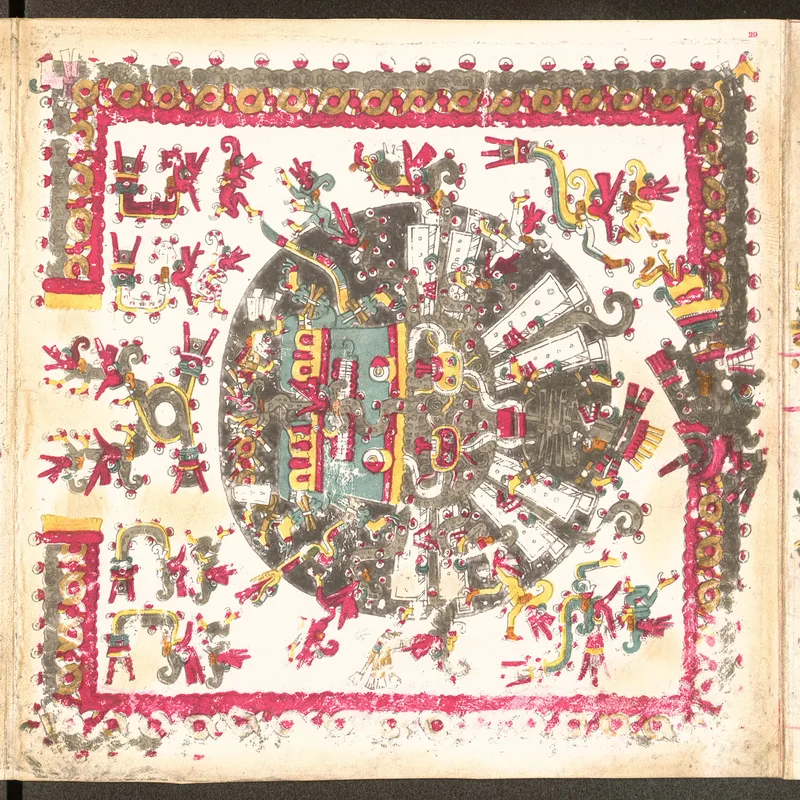
Durán's "food of god" has also been sought in the painted books. On the first page of the central section of the Codex Borgia, a frame encloses a black circle; above it stands a turquoise vessel crowned with banners, a black skeletal figure, and serpent beings around. Anders, Jansen and Reyes read the vessel's contents as "poción mágica, la unción alucinante, la comida de los dioses" — a magic potion, the hallucinatory unction, the food of the gods — which, through the skeletal figure's self-sacrifice, gathers force and sends all the priests present into trance. Mikulska and Hermann Lejarazu identify that reading with Durán's teotlacualli, set it beside Boone's view of the scene as a burst of primordial creative energy, and propose their own: the vessel, with its fleshless jaw, skeletal limbs and open, birth-giving posture, belongs to the realm of the dead or of the ancestors, and to creation (Mikulska and Hermann Lejarazu, 2021, pp. 110–111).
Contested
A reading. Nothing on the Borgia page names ololiuhqui or an ointment. The "food of the gods" is one of at least three interpretations recorded for the scene, and the authors who connect it with Durán propose a different one (Mikulska and Hermann Lejarazu, 2021).
Plate 05 · Codex Borgia, p. 29 · deep view
The first page of the central section: a black disc within a frame, with a turquoise vessel at its centre · Codex Borgia, p. 29, 1898 facsimile · Public domain · Wikimedia Commons ↗
05Visionary phenomenology
Onset
Commonly about 30–90 minutes after oral ingestion, but highly variable with the seed ensemble, bodily state and ceremonial context. Early phases may foreground heaviness, nausea, chills, warmth, changes in salivation and a drift toward inward attention.
Duration
Principal effects are often reported over roughly 5–8 hours, with the most absorptive or visionary phase within the first 2–4 hours and residual fatigue, dreaminess or reflective clarity extending beyond it. Historical experiments and whole-seed practice differ in their kinetics.
Intensity
Variable. Alkaloid-positive and -negative lineages, fungal chemotypes and degradation change potency. In ritual use, intensity also concerns the authority and intelligibility of disclosure as well as sensory magnitude.
Modal character
Dreamlike, hypnagogic and inwardly absorbed; slowed or discontinuous thought; closed-eye scenes, persons, animals and places; altered temporal sequence; auditory or verbal impressions; emotional revelation; and a felt transition between waking, sleep and vision.
Somatic field
Heaviness, fatigue, muscular relaxation or tension, gastric discomfort, vasoconstrictive coldness and uterine/visceral sensations can be phenomenologically prominent. The body may be read diagnostically.
Ritual cognition
A prior question organises ambiguous imagery into evidence. Faces may identify an offender; roads or houses locate an object; a voice names a medicine; animals or weather signal relational causes. Attendant interpretation and later verification complete the visionary event.
Phenomenological profile
The profile lists effects the sources report, for each preparation separately, grouped by domain. Each row gives the grade, how often the sources say the effect occurs (only where they say so; most do not) and the kinds of source behind it. A chip naming a compound, such as “Trial · psilocybin”, means the evidence comes from studies of that compound rather than of the preparation itself; “partial” means the route, purity or dose differs from the traditional preparation, so the row cannot be graded above supported. The line under each preparation says which domains have evidence entered here. A domain with nothing entered has not yet been assessed in this profile; that is not a finding that the literature is silent, and the article may discuss it. Open a row for the note and the sources.
Seeds, ground and drunkin divination
Evidence entered for 4 of 8 domains. Not yet entered: visual, self and unity, relation to other beings, states of consciousness. Discussed in the article above but not yet entered: visual, states of consciousness.
Lysergic acid amide (ergine) is the seeds’ principal alkaloid, and its concentration varies widely between batches (Castro et al., 2025). Given alone, ergine produced perceptual alteration and sedation; Hofmann’s self-observation recorded “fatigue, sedation, and sleep” (Isbell and Gorodetzky, 1965, p. 332). Colonial hostility, seed freshness, species and the questions put to the medicine all differ between the historical accounts (Sahagún, 1950–1982; Wasson, 1963).
Other senses
Intensified hearingHeightened acuity, salience or alteration of sound.SupportedSurvey · lsa, partial
Users’ reports of seeds of several morning glories and of Hawaiian baby woodrose describe visual and auditory distortions (Castro et al., 2025). Most of the cases reviewed took other seeds rich in LSA, chiefly Hawaiian baby woodrose, so this counts at partial weight.
Body
Nausea and purgingNausea, vomiting or diarrhoea during the acute state.SupportedPharmacology · lsa, partial
Nausea, vomiting and abdominal pain were among the commonest symptoms across 189 people whose intoxication was described (Castro et al., 2025). Most of the cases reviewed took other seeds rich in LSA, chiefly Hawaiian baby woodrose, so this counts at partial weight.
Tremor and motor slowingTrembling, impaired coordination or slowed movement.SupportedPharmacology · lsa, partial
Tremor, weakness and fatigue were recorded in a study stopped for its adverse effects, and ataxia among poison-centre cases (Castro et al., 2025). Most of the cases reviewed took other seeds rich in LSA, chiefly Hawaiian baby woodrose, so this counts at partial weight.
Raised blood pressureA measured rise in arterial blood pressure during the acute state.SupportedPharmacology · lsa, partial
Hypertension and tachycardia were among the commonest signs, and blood pressure rose in a study of a seed preparation (Castro et al., 2025). Most of the cases reviewed took other seeds rich in LSA, chiefly Hawaiian baby woodrose, so this counts at partial weight.
Affect
Fear and dreadFear, panic, chaos or a sense of threat during the experience.SupportedHistoryPharmacology · lsa, partial
Sahagún’s account emphasises frightening apparitions (Sahagún, 1950–1982). Anxiety and paranoid thoughts are among the reported effects of LSA-bearing seeds, and a quarter of users in one study had negative experiences (Castro et al., 2025). Most of the cases reviewed took other seeds rich in LSA, chiefly Hawaiian baby woodrose, so this counts at partial weight.
Bliss and euphoriaIntense joy, beauty, love or wellbeing.SupportedPharmacology · lsa, partial
Euphoria is among the reported effects (Castro et al., 2025). Most of the cases reviewed took other seeds rich in LSA, chiefly Hawaiian baby woodrose, so this counts at partial weight.
Cognition
NoesisThe felt disclosure of knowledge: understanding that seems to arrive with what is perceived.SupportedEthnography
Later Oaxacan reports describe a quieter, oracular state in which the source of an illness or the place of a missing object becomes visible; Zapotec reports foreground consultation in illness and misfortune (Wasson, 1963; Fields, 1969).
Loss of ordinary awarenessOrdinary sense, orientation or self-control is lost or overwhelmed.SupportedHistoryPharmacology · lsa, partial
Sahagún records the loss of ordinary judgement (Sahagún, 1950–1982); confusion and disorientation are recorded among modern cases (Castro et al., 2025). Most of the cases reviewed took other seeds rich in LSA, chiefly Hawaiian baby woodrose, so this counts at partial weight.
SupportedEthnographyIndigenous testimony and fieldworkHistoryhistorical sourcesSurveysurveys and field studiesPharmacologypharmacology and neuroscience
Ethnographic descriptions
Sahagún’s account emphasises frightening apparitions and loss of ordinary judgement, while later Oaxacan reports describe a quieter, more oracular state in which the source of illness or location of a missing object becomes visible. The two describe different situations. Colonial hostility, botanical species, seed freshness, ceremonial framing and the questions put to the medicine all differ. Accounts from Chinantec and Mazatec settings emphasise nighttime silence and the emergence of answer-like imagery; Zapotec reports foreground consultation in the treatment of illness and misfortune (Sahagún, 1950–1982; Wasson, 1963; Fields, 1969).
The common modern comparison with LSD is chemically intelligible but phenomenologically incomplete. Both involve lysergamides and serotonergic signalling, yet ololiuhqui reports are more often sedating, oneirogenic and somatically weighted than the prolonged bright wakefulness popularly associated with LSD. Isbell and Gorodetzky’s clinical work found ergine capable of perceptual alteration and sedation, but isolated-alkaloid experiments removed the prayer, darkness, question, whole-seed matrix and social interpretation that make divination a cultural practice (Isbell and Gorodetzky, 1965).
The answer-form
Visual scene
Images can unfold as dreamlike tableaux: a person performing an action, a road, dwelling, landscape, animal or hidden object. Their relevance depends on the question asked.
Voice and thought
The answer may be heard as words, arrive as an internally voiced name or appear as a sudden certainty. Ethnographic “speech of the seed” is as much heard as seen.
Somatic diagnosis
Pain, pressure, purging, coldness or movement in a particular bodily region may be read as information about affliction. The difficult body and the revelatory body are one phenomenological channel.
Retrospective verification
Reports of locating thieves, objects or causes are culturally important but rarely documented through prospective methods. Their evidential force within a community may rest on later events, social consensus and therapeutic change.
“fatigue, sedation, and sleep”
Summary of Hofmann’s ergine self-observation in Isbell and Gorodetzky (1965, p. 332); isolated ergine, not a ritual seed session
06Contemporary status
Conservation and biocultural continuity
Ipomoea corymbosa is geographically extensive and can become abundant in disturbed habitats. Its conservation issues lie elsewhere than species-level scarcity. More fragile are local fungal chemotypes, selectively maintained vines, access to uncontaminated ritual seed, Indigenous-language names, specialist protocols and the social legitimacy of divinatory healing. Biocultural conservation requires distinctions between protecting a taxon, maintaining a symbiosis and sustaining a practice. In introduced environments, those aims may conflict with weed management, because vigorous vines can smother native vegetation (CABI, 2026; Beaulieu et al., 2021).
Local and global economies
Ritual circulation
Ethnographic accounts more often describe small-scale cultivation, specialist custody and interpersonal exchange than a large public market. A single mature vine can produce substantial seed, making social control of knowledge and access more important than acreage.
Honey and ornament
The white flowers yield abundant nectar and the vine is grown ornamentally. Honey associated with xtabentún flowers supports a regional Yucatecan liqueur economy, while Caribbean Christmas flowering contributes to apiculture. These commodity chains are mostly separate from visionary seed use.
Online seed trade
International “ethnobotanical” and ornamental markets sell seeds under Rivea, Turbina and Ipomoea corymbosa. Misidentification with I. tricolor, Argyreia nervosa or non-alkaloid morning glories is recurrent; fungal infection and chemotype are seldom verified.
Research value
The vertically inherited Periglandula system is a model for plant–fungus coevolution, natural-product biosynthesis and defensive mutualism. Its pharmaceutical interest lies in pathway biology and ergoline diversity.
Law and regulation
The UN schedules name neither I. corymbosa nor ololiuhqui seeds. Regulation commonly attaches instead to particular alkaloids, preparations, intent, import rules or invasive-plant law. In the United States, lysergic acid amide is listed in Schedule III under federal controlled-substance regulations, while the living vine and untreated seed are unscheduled federally as such. The United Kingdom controls lysergide and named lysergamide derivatives through the Misuse of Drugs Act framework; exact treatment of a botanical specimen depends on composition and legal construction. Australia and some US states may additionally regulate particular morning glories as weeds or prohibited plants. Because categories differ sharply, “legal seeds” and “illegal plant” are both overgeneralisations (eCFR, 2026; Home Office, 2025; CABI, 2026).
Patents and knowledge governance
Patent searches retrieve broad claims involving Ipomoea extracts, glycoresins, anticancer ipomoeassins, herbicidal control and engineered ergot-alkaloid pathways. WO2015195535A2 claims fungal genetic systems for producing lysergic acid; WO2023096577A2 claims recombinant production using, among other sources, pathway genes from Periglandula ipomoeae. Other applications merely include Turbina corymbosa in long lists of possible botanical source materials. The historical ololiuhqui tradition is outside all of them, and no granted patent located in this review owns the species as such. The more relevant questions concern disclosure of genetic-resource origin, access to fungal strains, benefit-sharing and Indigenous knowledge as prior art. The 2024 WIPO treaty establishes a patent-disclosure framework for inventions materially based on genetic resources or associated traditional knowledge, though implementation remains national (WIPO, 2024).
Current research horizon
2021
comparative chemistry
Symbiosis across 210 morning glories
Beaulieu and colleagues mapped ergot alkaloids across a broad phylogeny, showing repeated evolutionary concentration, within-species variation and a positive relation between seed mass and alkaloid concentration. This replaces assumptions of uniform “LSA plants” with host–symbiont chemotypes (Beaulieu et al., 2021).
2022–2025
fungal localisation
Where Periglandula lives and expresses alkaloid genes
Microscopy and transcript studies in I. asarifolia trace fungus through young leaves, flowers and seeds and connect fungal presence with ergine-pathway expression. Comparative transfer to I. corymbosa remains a research task (Olaranont et al., 2022; 2025).
2025
new symbiont
Periglandula clandestina isolated from I. tricolor
The first isolation and genome-scale characterisation of the cryptic I. tricolor symbiont expands the comparative system. It clarifies why related morning-glory medicines can carry distinct fungi and chemistries (Hazel et al., 2025).
2025
ethnography
Virgin Seed across Guerrero, Oaxaca and Puebla
Fagetti’s synthesis places I. corymbosa and I. tricolor within Mixtec, Nahua and Mazatec healing, attending to Catholic sacred figures, local names and therapeutic practice. It is the most recent substantial regional treatment located for this monograph (Fagetti, 2025).
Research gap
Ritual phenomenology and voucher-linked chemistry
No modern study combines community-led ethnography, botanical voucher, verified P. turbinae status, fresh-seed metabolomics and systematic phenomenology. Without that conjunction, chemical and cultural literatures continue to describe partly different objects.
Research gap
Archaeobotanical antiquity
Direct residue, seed or microfossil evidence securely attributable to I. corymbosa remains sparse. Non-destructive reanalysis of museum collections and colonial-period vessels could test iconographic and historical hypotheses without presuming them true.
Open questions on this entry
Safety and law
07Cross-correlations
Mazatec Divinatory Medicine Complex
Ceremonial complex page: a plural diagnostic repertoire in which Virgin Seed traditions coexist with mushrooms, Salvia divinorum, cacao and other medicines without becoming interchangeable. PRIMARY CEREMONIAL COMPLEX
Ipomoea tricolor
Companion morning glory associated with tlitliltzin, badoh negro and other black-seed traditions; hosts a distinct symbiont now named Periglandula clandestina. SISTER DIVINATORY MEDICINE
Salvia divinorum
Species monograph: Mazatec ska María Pastora, a taxonomically and pharmacologically unrelated Virgin-associated divinatory medicine. REGIONAL RITUAL RELATION
Psilocybe spp.
Genus monograph: Mazatec ndi xi tjo and related mushroom medicines used in nocturnal consultation, cure and sacred speech, alongside parallel seed lineages. REGIONAL RITUAL RELATION
Argyreia nervosa
Asian-Pacific morning glory whose ergoline-bearing seeds became globally marketed as “Hawaiian baby woodrose”; chemically comparable, and outside the documented Mesoamerican ololiuhqui tradition. CHEMICAL COMPARATOR
Claviceps purpurea
Species monograph: pathogenic grass ergot and the historical source of ergot pharmacology; related fungal chemistry, radically different ecology and cultural history. FUNGAL COMPARATOR
Peyote traditions
Species monograph · ceremonial complex page: A distinct Mesoamerican/North American ceremonial complex whose colonial archive intersects with ololiuhqui in extirpation texts, while botany, chemistry, institutions and ritual geographies differ. HISTORICAL COMPARATOR
Heimia salicifolia
Species monograph: sinicuichi, read with ololiuhqui among the flowers carved on the Xochipilli statue. XOCHIPILLI STATUE
08Bibliography
43 sources in 6 threads · 42 with a working locator · Harvard (Cite Them Right) · status and kind are recorded per source, not assumed
How to read the labels on each source
Source type
What kind of work it is: journal article, book, legislation, patent application, database record and so on. A word after the dot (ethnography, protologue, primary source) keeps the genre the entry was first filed under. “Unclassified” means the citation does not say enough to tell.
Peer review
Recorded for each work separately, and only where it has been confirmed for that work. It is never inferred from a DOI, a publisher or a journal, since journals also publish editorials, letters and commentaries. Where it has not been confirmed, the entry records it as not established. It does not apply to legislation, court decisions, treaties, patents, datasets, database and collection records, historical texts, films, talks, press releases or web pages.
Check
What was checked when the entry was added. DOI checked: the DOI’s registry record (Crossref) matched the citation’s title, first author and year. Verified: the record itself was opened and matched the citation: a library catalogue record for a book, or the page itself for a database entry, law, patent or archive document. “Verified (abstract)” and “(summary)” mean only the abstract or a summary was read. Located: a record was found but not fully matched. Bibliographic record and Stable record (in essays): a catalogue or stable web record exists; what was checked against it is not recorded. Unverified: no check is recorded. No locator found: a search found no record. Secondary: read through another source.
What the labels do not say
None of them means the source supports a particular sentence. Where a sentence is graded, its evidence note names its sources and whether each supports it, disputes it or gives context. Dates and reviewers of checks are not recorded for each entry; the version note at the foot of a graded page dates its last review.
Taxonomy, phylogeny & botany
GBIF.org (2026) ‘Occurrence search: I. corymbosa, records with coordinates’, Global Biodiversity Information Facility, accessed 12 October 2026.
VerifiedDatasetPeer review not applicableOpen record ↗cited 1× in this record
Muñoz-Rodríguez, P., Carruthers, T., Wood, J.R.I. et al. (2019) ‘A taxonomic monograph of Ipomoea integrated across phylogenetic scales’, Nature Plants, 5, pp. 1136–1144. Available at: https://doi.org/10.1038/s41477-019-0535-4.
DOI checkedJournal articlePeer review not establishedOpen record ↗cited 2× in this record
Wood, J.R.I., Muñoz-Rodríguez, P., Williams, B.R.M. and Scotland, R.W. (2020) ‘A foundation monograph of Ipomoea (Convolvulaceae) in the New World’, PhytoKeys, 143, pp. 1–823. Available at: https://doi.org/10.3897/phytokeys.143.32821.
DOI checkedJournal articlePeer review not establishedOpen record ↗cited 4× in this record
Eserman, L.A., Tiley, G.P., Jarret, R.L., Leebens-Mack, J.H. and Miller, R.E. (2014) ‘Phylogenetics and diversification of morning glories (tribe Ipomoeeae, Convolvulaceae) based on whole plastome sequences’, American Journal of Botany, 101(1), pp. 92–103. Available at: https://doi.org/10.3732/ajb.1300207.
DOI checkedJournal articlePeer review not establishedOpen record ↗
Plants of the World Online (POWO) (2026) ‘Ipomoea corymbosa (L.) Roth’. Royal Botanic Gardens, Kew. Available at: powo.science.kew.org (Accessed: 7 August 2026).
UnverifiedDatabase recordPeer review not applicableOpen record ↗cited 3× in this record
Chemistry, pharmacology & fungal symbiosis
Beaulieu, W.T., Panaccione, D.G., Ryan, K.L., Kaonongbua, W. and Clay, K. (2015) ‘Phylogenetic and chemotypic diversity of Periglandula species in eight new morning glory hosts (Convolvulaceae)’, Mycologia, 107(4), pp. 667–678. Available at: https://doi.org/10.3852/14-239.
DOI checkedJournal articlePeer review not establishedOpen record ↗cited 1× in this record
Beaulieu, W.T., Panaccione, D.G., Quach, Q.N., Smoot, K.L. and Clay, K. (2021) ‘Diversification of ergot alkaloids and heritable fungal symbionts in morning glories’, Communications Biology, 4, 1362. Available at: https://doi.org/10.1038/s42003-021-02870-z.
DOI checkedJournal articlePeer review not establishedOpen record ↗cited 4× in this record
Castro, P.S.C.C. et al. (2025) ‘Lysergic acid amide (LSA), an LSD analog: systematic review of pharmacological effects, adverse outcomes, and therapeutic potentials’, Pharmacy, 13(4), 98.
VerifiedJournal articlePeer review not establishedOpen record ↗cited 8× in this record
Hazel, C.M. and Panaccione, D.G. (2025) ‘A new species of Periglandula symbiotic with the morning glory Ipomoea tricolor’, Mycologia, 117(4), pp. 602–614. Available at: https://doi.org/10.1080/00275514.2025.2483634.
DOI checkedJournal articlePeer review not establishedOpen record ↗cited 2× in this record
Hofmann, A. and Tscherter, H. (1960) ‘Isolierung von Lysergsäure-Alkaloiden aus der mexikanischen Zauberdroge Ololiuqui (Rivea corymbosa (L.) Hall. f.)’, Experientia, 16, p. 414. Available at: https://doi.org/10.1007/BF02178840.
DOI checkedJournal articlePeer review not establishedOpen record ↗cited 1× in this record
Hofmann, A. (1963) ‘The active principles of the seeds of Rivea corymbosa and Ipomoea violacea’, Botanical Museum Leaflets, Harvard University, 20(6), pp. 194–212.
DOI checkedJournal articlePeer review not establishedOpen record ↗cited 1× in this record
Isbell, H. and Gorodetzky, C.W. (1965) ‘Effect of alkaloids of ololiuqui in man’, Psychopharmacologia, 8, pp. 331–339. Available at: https://doi.org/10.1007/BF00453511.
DOI checkedJournal articlePeer review not establishedOpen record ↗cited 3× in this record
Olaranont, Y., Stewart, A.B., Songnuan, W. and Traiperm, P. (2022) ‘How and where Periglandula fungus interacts with different parts of Ipomoea asarifolia’, Journal of Fungi, 8(8), 823. Available at: https://doi.org/10.3390/jof8080823.
DOI checkedJournal articlePeer review not establishedOpen record ↗cited 2× in this record
Olaranont, Y., Stewart, A.B., Songnuan, W. and Traiperm, P. (2025) ‘Analysis of ergot alkaloid gene expression and ergine levels in different parts of Ipomoea asarifolia’, PeerJ, 13, e19692. Available at: https://doi.org/10.7717/peerj.19692.
DOI checkedJournal articlePeer review not establishedOpen record ↗cited 1× in this record
Paulke, A., Kremer, C., Wunder, C., Achenbach, J., Djahanschiri, B. and Elias, A. (2013) ‘Argyreia nervosa (Burm. f.): receptor profiling of lysergic acid amide and other potential psychedelic LSD-like compounds by computational and binding assay approaches’, Journal of Ethnopharmacology, 148(2), pp. 492–497. Available at: https://doi.org/10.1016/j.jep.2013.04.044.
DOI checkedJournal articlePeer review not establishedOpen record ↗cited 1× in this record
Steiner, U., Leibner, S., Schardl, C.L., Leuchtmann, A. and Leistner, E. (2011) ‘Periglandula, a new fungal genus within the Clavicipitaceae and its association with Convolvulaceae’, Mycologia, 103(5), pp. 1133–1145. Available at: https://doi.org/10.3852/11-031.
DOI checkedJournal articlePeer review not establishedOpen record ↗cited 1× in this record
Steiner, U. and Leistner, E. (2012) ‘Ergoline alkaloids in convolvulaceous host plants originate from epibiotic clavicipitaceous fungi of the genus Periglandula’, Fungal Ecology, 5(3), pp. 316–321. Available at: https://doi.org/10.1016/j.funeco.2011.04.004.
DOI checkedJournal articlePeer review not establishedOpen record ↗cited 1× in this record
Steiner, U. and Leistner, E. (2018) ‘Ergot alkaloids and their hallucinogenic potential in morning glories’, Planta Medica, 84(11), pp. 751–758. Available at: https://doi.org/10.1055/a-0577-8049.
DOI checkedJournal articlePeer review not establishedOpen record ↗cited 2× in this record
Colonial, historical & iconographic sources
Hernández, F. (1651) Rerum medicarum Novae Hispaniae thesaurus, seu plantarum, animalium, mineralium Mexicanorum historia. Rome: Vitalis Mascardi. [Research undertaken in New Spain, 1570–1577.]
VerifiedHistorical textPeer review not applicableOpen record ↗cited 1× in this record
Sahagún, B. de (1950–1982) Florentine Codex: General History of the Things of New Spain, trans. A.J.O. Anderson and C.E. Dibble, 13 vols. Santa Fe: School of American Research and University of Utah.
VerifiedBook · primary sourcePeer review not establishedOpen record ↗cited 7× in this record
Ruiz de Alarcón, H. (1984 [1629]) Treatise on the Heathen Superstitions That Today Live among the Indians Native to This New Spain, trans. and ed. J.R. Andrews and R. Hassig. Norman: University of Oklahoma Press.
VerifiedBook · primary sourcePeer review not establishedOpen record ↗cited 3× in this record
de la Serna, J. (1953 [1656]) ‘Manual de ministros de indios para el conocimiento de sus idolatrías y extirpación de ellas’, in Tratado de las idolatrías, supersticiones, dioses, ritos, hechicerías y otras costumbres gentílicas de las razas aborígenes de México, vol. 1. Mexico City: Ediciones Fuente Cultural.
VerifiedBook chapterPeer review not establishedOpen record ↗cited 1× in this record
Furst, P.T. (1974) ‘Morning glory and Mother Goddess at Tepantitla, Teotihuacán: iconography and analogy in pre-Columbian art’, in Hammond, N. (ed.) Mesoamerican Archaeology: New Approaches. Austin: University of Texas Press, pp. 187–215.
VerifiedBook chapterPeer review not establishedOpen record ↗cited 2× in this record
Aguirre Beltrán, G. (1963) Medicina y magia: el proceso de aculturación en la estructura colonial. Mexico City: Instituto Nacional Indigenista.
VerifiedBook · ethnographyPeer review not establishedOpen record ↗cited 1× in this record
Durán, D. (1880) Historia de las Indias de Nueva España y islas de Tierra Firme, vol. 2. México: Imprenta de Ignacio Escalante.
VerifiedHistorical textPeer review not applicableOpen record ↗cited 5× in this record
Mikulska, K. and Hermann Lejarazu, M.A. (2021) ‘Creando el mundo, creando el discurso: similitudes entre los códices Borgia y Vindobonensis’, Revista Española de Antropología Americana, 51, pp. 107–135.
DOI checkedJournal articlePeer review not establishedOpen record ↗cited 3× in this record
Ethnobotany, ritual & phenomenology
Schultes, R.E. (1941) A Contribution to Our Knowledge of Rivea corymbosa: The Narcotic Ololiuqui of the Aztecs. Cambridge, MA: Botanical Museum of Harvard University.
VerifiedBookPeer review not establishedOpen record ↗cited 4× in this record
Wasson, R.G. (1963) ‘Notes on the present status of ololiuhqui and the other hallucinogens of Mexico’, Botanical Museum Leaflets, Harvard University, 20(6), pp. 161–193.
DOI checkedJournal articlePeer review not establishedOpen record ↗cited 13× in this record
Fields, F.H. (1969) ‘Rivea corymbosa: notes on some Zapotecan customs’, Economic Botany, 23, pp. 206–209. Available at: https://doi.org/10.1007/BF02860452.
DOI checkedJournal articlePeer review not establishedOpen record ↗cited 4× in this record
MacDougall, T. (1960) ‘Ipomoea tricolor: a hallucinogenic plant of the Zapotecs’, Boletín del Centro de Investigaciones Antropológicas de México, 6(6), pp. 6–8.
No locator foundJournal articlePeer review not establishedcited 1× in this record
Hofmann, A. (1971) ‘Teonanácatl and ololiuqui, two ancient magic drugs of Mexico’, Bulletin on Narcotics, 23(1), pp. 3–14.
VerifiedJournal articlePeer review not establishedOpen record ↗
Fagetti, A. (2025) ‘Virgin Seed (Ipomoea corymbosa and Ipomoea tricolor) among Mixtec, Nahuas, and Mazatec of Guerrero, Oaxaca, and Puebla (Mexico)’, in Winkelman, M.J. (ed.) Handbook of Entheogenic Healing. Leiden: Brill, pp. 122–146.
DOI checkedBook chapter · ethnographyPeer review not establishedOpen record ↗cited 8× in this record
Geck, M.S., Lecca, D., Marchese, G., Casu, L. and Sanna, G. (2021) ‘Ethnomedicine and neuropsychopharmacology in Mesoamerica’, Journal of Ethnopharmacology, 278, 114243. Available at: https://doi.org/10.1016/j.jep.2021.114243.
DOI checkedJournal articlePeer review not establishedOpen record ↗
DOI checkedDatabase recordPeer review not applicableOpen record ↗cited 3× in this record
Electronic Code of Federal Regulations (eCFR) (2026) ‘21 CFR Part 1308: schedules of controlled substances’. Available at: ecfr.gov (Accessed: 7 August 2026).
VerifiedLegislation or regulationPeer review not applicableOpen record ↗cited 1× in this record
Home Office (2025) List of most commonly encountered drugs currently controlled under the misuse of drugs legislation. London: UK Government. Available at: gov.uk (Accessed: 2 October 2026).
VerifiedLegislation or regulationPeer review not applicableOpen record ↗cited 1× in this record
World Intellectual Property Organization (WIPO) (2024) WIPO Treaty on Intellectual Property, Genetic Resources and Associated Traditional Knowledge. Geneva: WIPO. Available at: wipo.int (Accessed: 7 August 2026).
VerifiedTreaty or conventionPeer review not applicableOpen record ↗cited 1× in this record
Panaccione, D.G. and Robinson, S.L. (2015) Production of lysergic acid by genetic modification of a fungus. International Patent WO2015195535A2 (applicant West Virginia University).
VerifiedPatent applicationPeer review not applicableOpen record ↗
Wong, W.J.G., Lim, L.R., Go, M.D.K., Yew, W.S., Freemont, P.S. and Bell, D.J. (2023) Production of d-lysergic acid. International Patent WO2023096577A2 (applicants Imperial College Innovations Ltd and National University of Singapore).
VerifiedPatent applicationPeer review not applicableOpen record ↗
Nomenclatural and image records
Roth, A.W. (1819) ‘Ipomoea corymbosa’, in Roemer, J.J. and Schultes, J.A., Systema Vegetabilium, ed. 15 bis, vol. 4, p. 232.
VerifiedHistorical text · protologuePeer review not applicableOpen record ↗
Ramírez Marcial, N. (2016) ‘Christmas vine’, photograph via iNaturalist and Wikimedia Commons. CC BY 4.0.
VerifiedImage or photographPeer review not applicableOpen record ↗
DMTrott (2017) ‘Oliluiqui seeds’, photograph via Wikimedia Commons. CC BY-SA 4.0.
VerifiedImage or photographPeer review not applicableOpen record ↗
Hernández, F. (1651) ‘Ololiuhqui’, botanical woodcut in Rerum medicarum Novae Hispaniae thesaurus, via Wikimedia Commons. Public domain.
VerifiedHistorical textPeer review not applicableOpen record ↗cited 1× in this record