Introduction
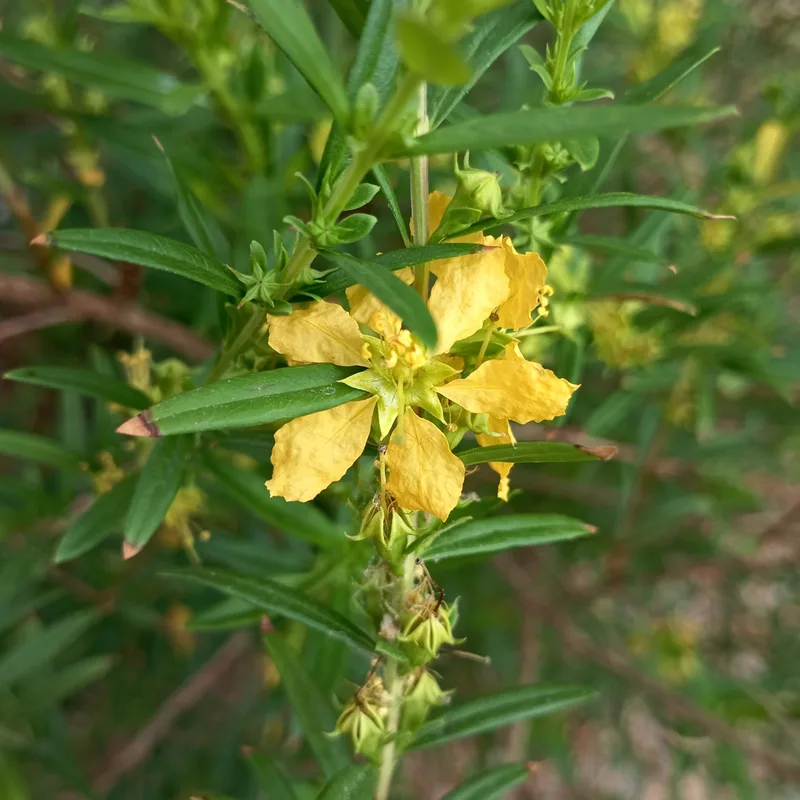
Sinicuichi, Heimia salicifolia, is a deciduous shrub of the highlands from Mexico to northern Argentina, named by Link in 1822. Only in Mexico is it valued as an intoxicant: its leaves are made into a fermented drink believed to bring back events of long ago, while elsewhere it is a medicine. Schultes described the drink as mildly intoxicating, its effects chiefly auditory. Its alkaloids are quinolizidines such as vertine and lythrine; whether they cause the drink’s effects is contested, because the purified alkaloids taken by mouth appeared inactive.
All sections
| Botanical name | Heimia salicifolia (Kunth) Link |
|---|---|
| Taxa | Lythraceae · Myrtales |
| Traditional names | Sinicuichi · sinicuiche (Mexico) · abre-o-sol, herva de la vida (Brazil) |
| Regions | The highlands from Mexico south to Uruguay, Paraguay and northern Argentina; the very closely allied H. myrtifolia may be no more than a geographical variant (Schultes, 1970). |
| Ethnographic entheogenic use | Only in Mexico, apparently, is sinicuichi valued as an intoxicant: in the highlands its leaves are made into a fermented drink believed to help recall events of long ago, while elsewhere across its range the plant is a medicine (Schultes, 1970). |
01Ethnobotany of Heimia salicifolia
Botanical Info
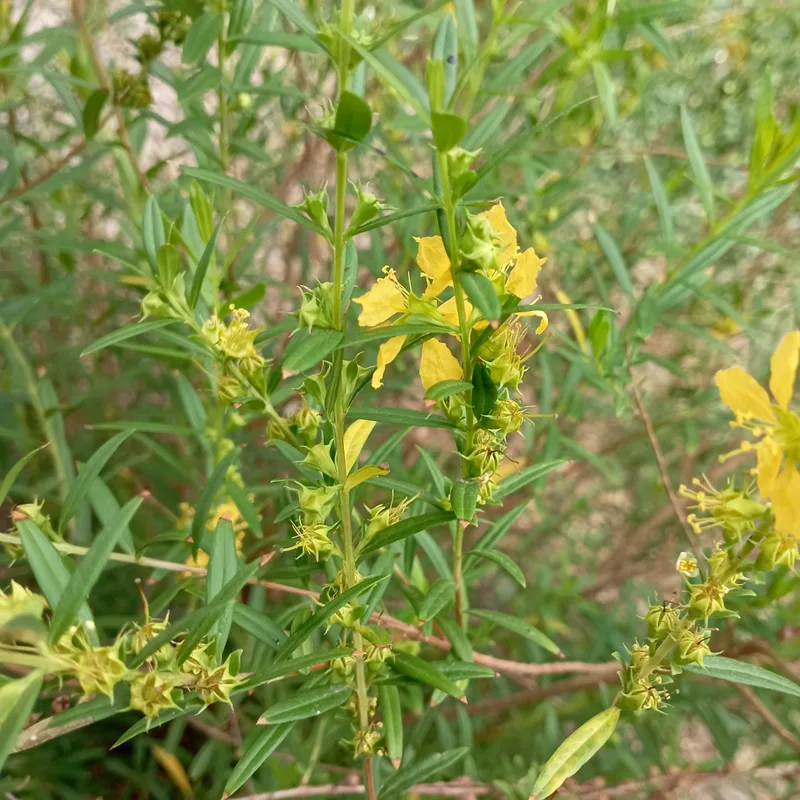
| Accepted name | Heimia salicifolia (Kunth) Link, Enumeratio Plantarum Horti Botanici Berolinensis 2: 3 (1822) (GBIF, 2026; IPNI, 2026a). Basionym Nesaea salicifolia Kunth, Nova Genera et Species Plantarum 6: 192, dated 1823 by IPNI (IPNI, 2026b). |
|---|---|
| Synonyms | Ginoria syphilitica Moc. & Sessé · Heimia syphilitica (Moc. & Sessé) DC. · Heimia grandiflora Hook. · Lythrum flavum Spreng. · Decodon salicifolius (Kunth) Kuntze (GBIF, 2026) |
| Genus | Heimia comprises three hardly distinguishable species, ranging from the southern United States to Argentina (Schultes and Farnsworth, 1980, p. 161) |
| Family | Lythraceae, the loosestrife family |
| Order | Myrtales |
| Geographic range | The highlands from Mexico south to Uruguay, Paraguay and northern Argentina; the very closely allied H. myrtifolia may be no more than a geographical variant (Schultes, 1970). Native to brushland from the far south of Texas through Mexico and Central America to Argentina (Qureshi, Jabeen and Chaachouay, 2025). |
| Local names | Mexico — sinicuichi, sinicuiche Brazil — abre-o-sol, “sun opener”; herva de la vida, “herb of life” (Schultes, 1970) Also erva-da-vida, yerba de la vida, escoba de arroyo, quiebra arado; in English shrubby yellowcrest (GBIF, 2026) |
| Alkaloids | Quinolizidine alkaloids, chiefly vertine (cryogenine), lyfoline, lythrine and nesodine (Malone and Rother, 1994) |
| Habit | A spreading deciduous shrub (Qureshi, Jabeen and Chaachouay, 2025) |
| Conservation | Not evaluated for the IUCN Red List (GBIF, 2026) |
Territories
- 1Mexico City · the Xochipilli statue, on which Schultes read a flower as H. salicifolia (Wasson, 1973); leaves sold at the Sonora Market (Guzmán-Hernández et al., 2018)
- 2Brazil · the names abre-o-sol, “sun opener”, and herva de la vida, “herb of life” (Schultes, 1970)
- 3Argentina · part of folk medicine (Pérez and Anesini, 1994)
Deep Time
- Late PostclassicA flower on the Xochipilli statue read by Schultes as H. salicifolia.
- 1822–1823Named by Link as Heimia salicifolia, and by Kunth as Nesaea salicifolia.
- 1958 or 1964Alkaloids first reported in the plant: Schultes gives 1958, Schultes and Farnsworth 1964.
No archaeological or pre-Hispanic evidence of use is found in the sources read.
A name shared among intoxicants
“Sinicuichi” is not this plant’s name alone. The word, and forms of it such as sinicuilche and sinicuil, refers in Mexico to other plants, all of them intoxicating in one way or another — species of Rhynchosia, Piscidia and Erythrina; only the sinicuiche of the Mexican highlands is Heimia salicifolia (Schultes, 1970). An older name carries a different reputation: the epithet of Ginoria syphilitica, Sessé and Mociño’s name for the plant, survives in the synonymy (GBIF, 2026), and an antisyphilitic use heads the plant’s folk reputation in the review literature (Malone and Rother, 1994).
02Chemistry
zidine
Vertine
zidine
Lythrine
zidine
Lyfoline
zidine
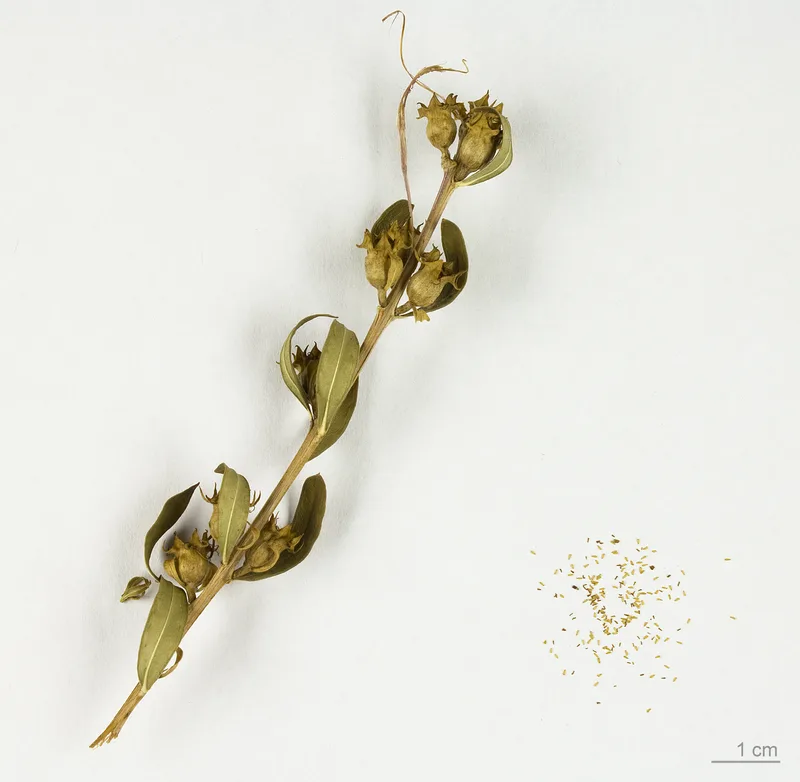
The plant’s alkaloids are quinolizidines, the best known of them biphenylquinolizidine lactones; the four most studied are vertine, lyfoline, lythrine and nesodine (Malone and Rother, 1994). Labelling work showed phenylalanine to be a precursor of vertine, then called cryogenine (Rother and Schwarting, 1972). Callus and suspension cultures made no detectable alkaloid, but shoots grown in vitro yielded vertine, lythrine and lyfoline, ester alkaloids and phenylquinolizidinols, and several minor alkaloids not previously found in the species (Rother, 1985). A 2008 study isolated two new alkaloids and seven known ones, confirming several structures by X-ray crystallography; vertine and epi-lyfoline showed moderate antimalarial activity (Rumalla et al., 2008).
Animal studies have concentrated on vertine’s tranquillising, anti-inflammatory and antispasmodic potential and on the diuretic action of lythrine. Vertine’s anti-inflammatory effect appears to depend partly on an intact pituitary–adrenal system and partly on inhibition of prostaglandin synthase; its antispasmodic action is largely on the muscle itself (Malone and Rother, 1994). In rats, vertine reduced oedema from a burn when given daily from two days before the injury, but not as a single dose an hour before (Malone and Trottier, 1973). A water extract of the aerial parts, from Argentine folk medicine, was among the more active of 132 samples tested against Salmonella typhi in vitro (Pérez and Anesini, 1994).
Vertine differs from the usual quinolizidines in having the quinolizidine as part of a larger system of rings, and it has been found only in the Lythraceae. Schultes and Farnsworth took it to be the plant’s major psychoactive alkaloid, and dated the first report of alkaloids in the plant to 1964 (Schultes and Farnsworth, 1980, pp. 160–161) — six years later than the date Schultes alone had given (Schultes, 1970).
Pharmacologists at the National Autonomous University of Mexico have tested two of the plant’s folk uses. Of the alkaloids separated from a leaf extract, lythrine was the most potent at relaxing blood vessels; the extract lowered blood pressure in normal rats and in rats with induced hypertension, and its relaxing effect was much reduced when the vessel lining had been removed (Guzmán-Hernández et al., 2018). Leaf extracts made the isolated uterus of oestrogen-treated rats contract, and the effect of one extract was blocked by indomethacin, an inhibitor of prostaglandin synthesis (Segura Cobos et al., 2019).
Pharmacological open questions
- Contested
What causes the effects. Schultes reported that vertine had been shown to “mimic qualitatively and semi-quantitatively the action of the total alkaloid extracts of Heimia salicifolia” (Schultes, 1970). Schultes and Farnsworth likewise named vertine as the major psychoactive alkaloid (Schultes and Farnsworth, 1980, p. 160). Preliminary clinical evaluation later indicated that vertine and lythrine taken by mouth appear to lack the psychoactive effects attributed to the native drinks (Malone and Rother, 1994). A 2025 compilation nonetheless attributes the effects to vertine acting on serotonin and dopamine systems (Qureshi, Jabeen and Chaachouay, 2025); the sources read here do not resolve the disagreement.
- Unresolved
The fermented drink. The Mexican preparation is a fermented drink of the leaves (Schultes, 1970). No analysis of the drink itself, as distinct from the plant, was found in the sources read.
03Tradition, ritual & cultural use
| Oldest evidenced use | No archaeological or pre-Hispanic evidence in the sources read. Schultes, writing in 1970, called sinicuichi “interesting and still poorly understood” (Schultes, 1970). |
|---|---|
| Where it is a visionary plant | Only in Mexico, apparently, is the shrub valued as an intoxicant; elsewhere across its range its uses are medicinal (Schultes, 1970). |
| Peoples | The sources read speak of the people of the Mexican highlands without naming communities, an ethnographic gap. |
Medicine across the range
The aerial parts have a wide folk reputation as antisyphilitic, sudorific, antipyretic, laxative and diuretic; they are used in post-partum baths and to help wounds heal (Malone and Rother, 1994). The leaves are also reported as a remedy for dysentery, uterine inflammation, bronchitis and other chest complaints (Qureshi, Jabeen and Chaachouay, 2025). In Argentina the plant is part of folk medicine (Pérez and Anesini, 1994).
Schultes and Farnsworth wrote that the plant “has been valued in Mexican folk medicine since early times” (Schultes and Farnsworth, 1980, p. 160). Its use in Mexican traditional medicine as an abortifacient is the starting point of a 2019 pharmacological study (Segura Cobos et al., 2019).
Memory as the sacred quality
In the Mexican highlands the leaves are made into a fermented drink. Schultes recorded that “the natives believe that sinicuichi has sacred or supernatural qualities, since they hold that it helps them recall events which took place many years earlier as if they had happened yesterday; others assert that they are able, with sinicuichi, to remember pre-natal events” (Schultes, 1970). He closed with a call that still stands for this record: “Much observation of an ethnobotanical nature must be carried out in Mexico to amplify our understanding of the possible use in native cultures of the psychotomimetic effects of Heimia salicifolia” (Schultes, 1970).
04Cosmology & key terms
What the sources record of meaning attaches to memory and light: a drink held sacred because it returns the past, and Brazilian names that call the plant a sun opener and an herb of life (Schultes, 1970).
Xochipilli listening
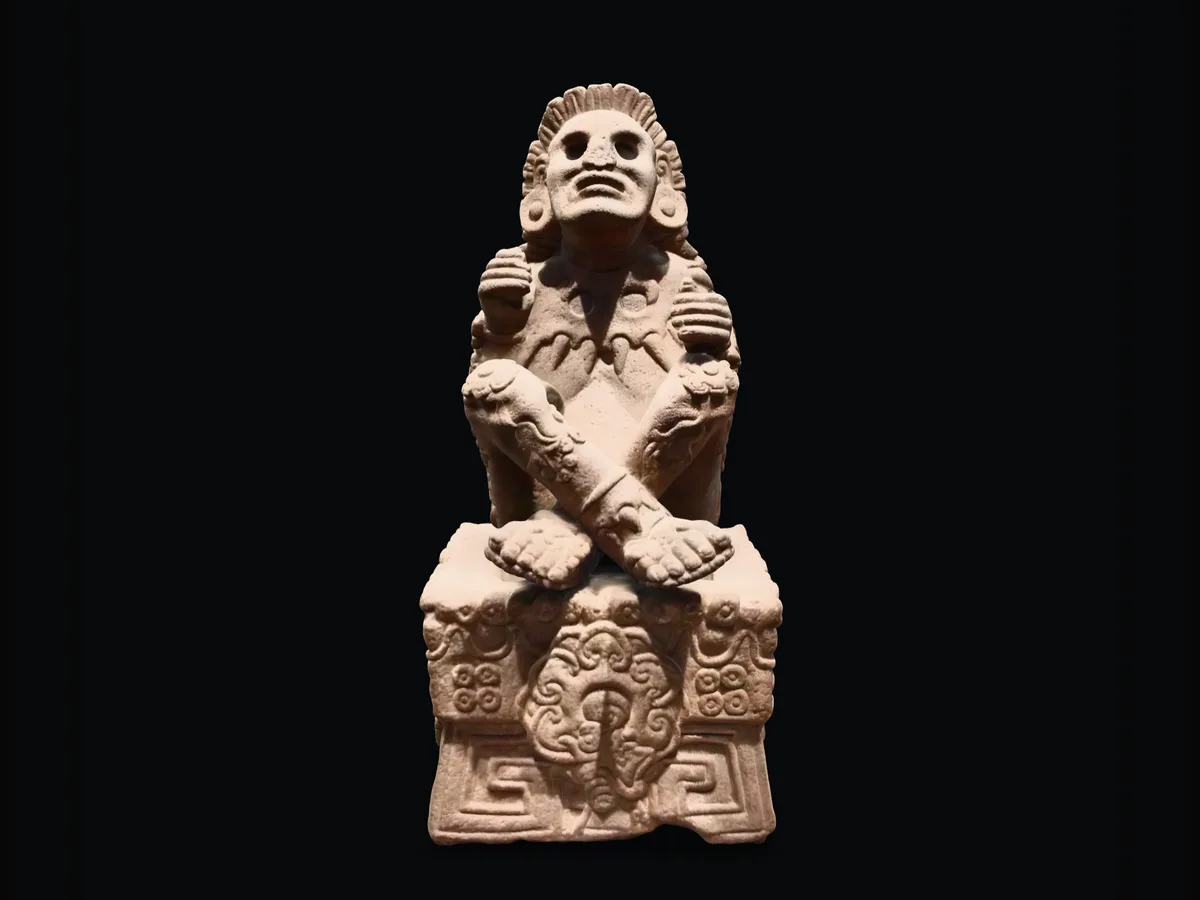
Editing the text of a mushroom velada sung by María Sabina, R. Gordon Wasson turned to the statue of Xochipilli in the Museo Nacional de Antropología in Mexico City (Wasson, 1973, p. 305). Schultes, he reports, was “quite certain” that the flower carved on the right leg below the knee is Heimia salicifolia, the sinicuichi of the Mexican highlands (Wasson, 1973, p. 319); and, “somewhat uncertain”, asked whether a flower carved where the left buttock meets the thigh, and again on the torso, could be a swollen bud of the same plant, just about to open (Wasson, 1973, p. 322). Quoting Schultes on sinicuichi’s distant sounds, Wasson added: “On contemplating the statue anew one is tempted to see in the tilt of the head and above all in the open mouth that Xochipilli is listening to the far-off voices of sinicuichi” (Wasson, 1973, p. 320).
- Interpretation
A reading of carved stone. Schultes was himself “somewhat uncertain” of the second flower, and Wasson offers the listening head as a temptation, not a finding (Wasson, 1973, pp. 320–322). Other readings of the same carvings are recorded on the Psilocybe page.
- Sinicuichi
- The Mexican name of the drink and the plant; also, with sinicuilche and sinicuil, of other intoxicating plants — Rhynchosia, Piscidia, Erythrina (Schultes, 1970).
- Abre-o-sol
- “Sun opener”, a Brazilian name (Schultes, 1970).
- Herva de la vida
- “Herb of life”, a Brazilian name (Schultes, 1970).
- syphilitica
- The epithet of Sessé and Mociño’s Ginoria syphilitica, recording a medicinal, not a visionary, reputation (GBIF, 2026; Malone and Rother, 1994).
05Visionary phenomenology
Phenomenological profile
The profile lists effects the sources report, for each preparation separately, grouped by domain. Each row gives the grade, how often the sources say the effect occurs (only where they say so; most do not) and the kinds of source behind it. A chip naming a compound, such as “Trial · psilocybin”, means the evidence comes from studies of that compound rather than of the preparation itself; “partial” means the route, purity or dose differs from the traditional preparation, so the row cannot be graded above supported. The line under each preparation says which domains have evidence entered here. A domain with nothing entered has not yet been assessed in this profile; that is not a finding that the literature is silent, and the article may discuss it. Open a row for the note and the sources.
The drinkleaves wilted, fermented or brewed
Evidence entered for 4 of 8 domains. Not yet entered: body, self and unity, relation to other beings, states of consciousness.
The descriptions concern the traditional drink, which Schultes called mildly intoxicating and usually without unpleasant after-effects (Schultes, 1970).
Visual
Cosmic and scalar visionThe world, the body or space seen at an altered scale: shrunk, enlarged, or opened to the immense.SupportedEthnography
The partaker’s surroundings darken, with “a great shrinking in size of the world around” (Schultes, 1970).
Other senses
Intensified hearingHeightened acuity, salience or alteration of sound.SupportedEthnography
Auditory hallucinations: “sounds seem to come distorted from a great distance”; Schultes held the plant an hallucinogen whose characteristics are auditory, not visual (Schultes, 1970).
Affect
Bliss and euphoriaIntense joy, beauty, love or wellbeing.SupportedEthnographyPharmacology
Giddiness gives way to “a drowsy euphoria” (Schultes, 1970); a forensic report summarises the tea’s effects as exhilaration with a pleasant faintness (Kempf et al., 2008).
Cognition
Time distortionTime felt to slow, stretch, stop or lose its ordinary order, or durations misjudged.SupportedEthnography
“An altered sense of time and place” (Schultes, 1970).
Loss of ordinary awarenessOrdinary sense, orientation or self-control is lost or overwhelmed.SupportedEthnography
“Forgetfulness and a removal from a state of reality” (Schultes, 1970).
Related compoundIsolated alkaloids. Vertine and lythrine given by mouth appeared to lack the psychoactive activity attributed to the native brews (Malone and Rother, 1994). Which constituents act in the drink is unknown; the disagreement is left open.
Accounts
Schultes described the drink as mildly intoxicating and usually without unpleasant after-effects: “a slight feeling of giddiness followed by a drowsy euphoria characterized by a darkening of the partaker’s surroundings, a great shrinking in size of the world around, auditory hallucinations, an altered sense of time and place, forgetfulness and a removal from a state of reality. Sounds seem to come distorted from a great distance.” For him the plant “typifies an hallucinogen of which the hallucinogenic characteristics are auditory, not visual” (Schultes, 1970).
A forensic report of 2008 summarises the effects attributed to the tea as exhilaration and an alteration of awareness, with a slowed heart, relaxed muscles and a pleasant faintness (Kempf et al., 2008).
Recurring motifs
- Giddiness, then drowsy euphoria
- The surroundings darkening, the world shrinking
- Sound distorted, as if from far away
- An altered sense of time and place
- The distant past recalled as if it were yesterday
- Contested
These descriptions concern the traditional drink; the purified alkaloids tested clinically by mouth did not reproduce such effects (Malone and Rother, 1994).
06Contemporary status
| Conservation | Not evaluated for the IUCN Red List (GBIF, 2026). |
|---|---|
| Trade | Sold through online shops, with Salvia divinorum and other herbs, as a legal alternative to controlled drugs (Kempf et al., 2008). In Mexico City the dried leaves are sold at the Sonora Market, a market for medicinal plants, where both recent pharmacological studies obtained theirs (Guzmán-Hernández et al., 2018; Segura Cobos et al., 2019). |
| A recorded case | A man was treated in hospital for muscle pain after drinking a fermented sinicuichi tea; five alkaloids found in the plant material were also detected in his serum, confirming the ingestion (Kempf et al., 2008). |
Legality
| Jurisdiction | Status |
|---|---|
| United States | Neither the plant nor its alkaloids is named in federal Schedule I, 21 CFR §1308.11 (Electronic Code of Federal Regulations, 2026). |
Open questions on this entry
Safety and law
07Cross-correlations
| Family | Lythraceae — no other Lythraceae in the archive |
|---|---|
| Compounds | Quinolizidine alkaloids — unique in the archive |
| Region | Mexican highlands — Salvia divinorum · Calea zacatechichi · Ipomoea corymbosa |
| Xochipilli statue | Flowers on the same carving read as Psilocybe aztecorum, Ipomoea corymbosa and Calea zacatechichi INTERPRETED ICONOGRAPHY |
| Shared name | Sinicuichi — also names species of Erythrina, Rhynchosia and Piscidia |
08Bibliography
How to read the labels on each source
- Source type
- What kind of work it is: journal article, book, legislation, patent application, database record and so on. A word after the dot (ethnography, protologue, primary source) keeps the genre the entry was first filed under. “Unclassified” means the citation does not say enough to tell.
- Peer review
- Recorded for each work separately, and only where it has been confirmed for that work. It is never inferred from a DOI, a publisher or a journal, since journals also publish editorials, letters and commentaries. Where it has not been confirmed, the entry records it as not established. It does not apply to legislation, court decisions, treaties, patents, datasets, database and collection records, historical texts, films, talks, press releases or web pages.
- Check
- What was checked when the entry was added. DOI checked: the DOI’s registry record (Crossref) matched the citation’s title, first author and year. Verified: the record itself was opened and matched the citation: a library catalogue record for a book, or the page itself for a database entry, law, patent or archive document. “Verified (abstract)” and “(summary)” mean only the abstract or a summary was read. Located: a record was found but not fully matched. Bibliographic record and Stable record (in essays): a catalogue or stable web record exists; what was checked against it is not recorded. Unverified: no check is recorded. No locator found: a search found no record. Secondary: read through another source.
- What the labels do not say
- None of them means the source supports a particular sentence. Where a sentence is graded, its evidence note names its sources and whether each supports it, disputes it or gives context. Dates and reviewers of checks are not recorded for each entry; the version note at the foot of a graded page dates its last review.