Introduction
Salvia divinorum, Ska María Pastora, is a sage of the Sierra Mazateca in Oaxaca, used by Mazatec healers for curing and divination. No unambiguously wild population is known, and the species is maintained mainly by cuttings. Its principal active, salvinorin A, isolated in 1982, is a potent agonist at the κ-opioid receptor and not at the 5-HT2A receptor of the classic psychedelics. The earliest secure record of its use is from 1939; Wasson’s proposal that it was the Nahua pipiltzintzintli remains unresolved.
All sections
| Botanical name | Salvia divinorum |
|---|---|
| Taxa | Lamiaceae · Lamiales · Angiosperms |
| Traditional names | Ska María Pastora · hojas de la Pastora · hierba María · diviner’s sage |
| Regions | Mexico, Oaxaca. |
| Ethnographic entheogenic use | Ska María Pastora is a Mazatec divinatory medicine of the Sierra Mazateca in Oaxaca, used for curing and divination; Wasson was told it was taken when mushrooms were not to be had (Valdés, Díaz and Paul, 1983; Wasson, 1962). |
01Ethnobotany of Salvia divinorum
Botanical Info
| Accepted name | Salvia divinorum Epling & Játiva. Carl Epling and Carlos D. Játiva-M. published the species in Botanical Museum Leaflets 20:75 in 1962; Kew accepts the name (Epling and Játiva-M., 1962; POWO, 2026). |
|---|---|
| Family | Lamiaceae · mint family. |
| Order | Lamiales. |
| Native range | Mexico, Oaxaca. Ethnobotanical and horticultural records centre on humid ravines and settlements of the Sierra Mazateca, especially around Huautla de Jiménez. Kew records the species as native to Oaxaca and primarily subtropical (POWO, 2026). |
| Habitat | Shaded, humid cloud-forest and evergreen-forest situations, frequently beside streams, paths, houses and gardens. Because known stands are closely associated with human propagation, “wild,” naturalised and cultivated distributions remain difficult to separate (Valdés, Díaz and Paul, 1983; Casselman et al., 2014). |
| Local names | Ska María Pastora or xka María Pastora in varying Mazatec orthographies; Spanish hojas de la Pastora, hierba/yerba María and hojas de la Virgen. English “diviner’s sage” translates the scientific and ritual association; it is an English coinage (Valdés, Díaz and Paul, 1983). |
| Taxonomic position | A New World Salvia of subgenus Calosphace. The species was historically assigned to section Dusenostachys, but molecular results did not support that placement or the proposed hybrid origin; S. venulosa was the closest sampled relative (Jenks, Walker and Kim, 2011). |
Territories
- 1Sierra Mazateca · a Mazatec divinatory medicine of the Sierra Mazateca (Valdés, Díaz and Paul, 1983); near Huautla, landowners enforcing their rights to the plants as a market grew (Wasson, 1962)
Deep Time
- Pre-Conquest?Wasson proposes the plant as the Nahua pipiltzintzintli of colonial sources; competing identifications leave it open.
- 1939Johnson records hierba María among Mazatec divinatory medicines in Huautla de Jiménez: the earliest secure text.
- 1962Epling and Játiva-M. name S. divinorum; Wasson publishes the companion ethnobotany.
- 1980–83Valdés, Díaz and Paul work with the healer Don Alejandro: the most detailed species-specific ethnography.
- 1982Ortega, Blount and Manchand isolate and name salvinorin.
Morphology and life history
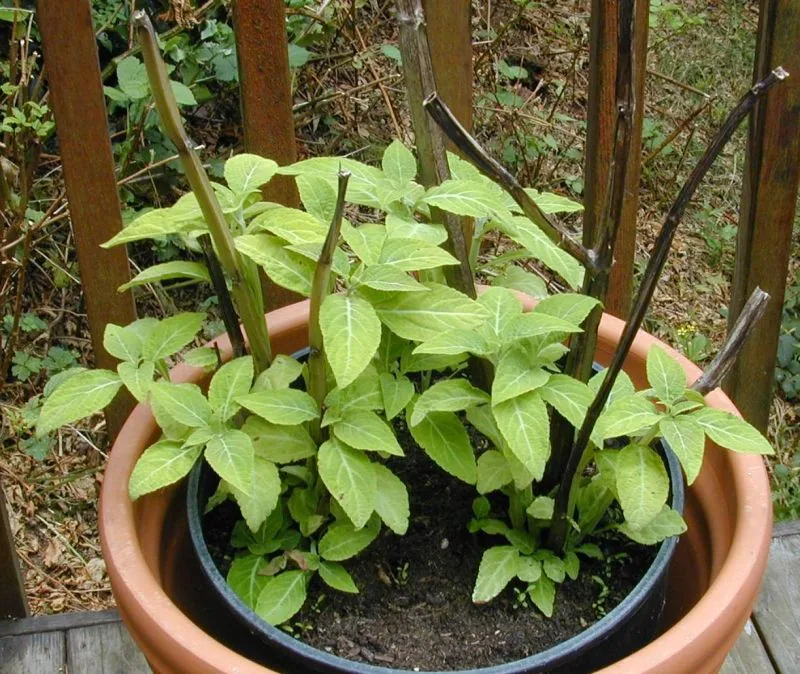
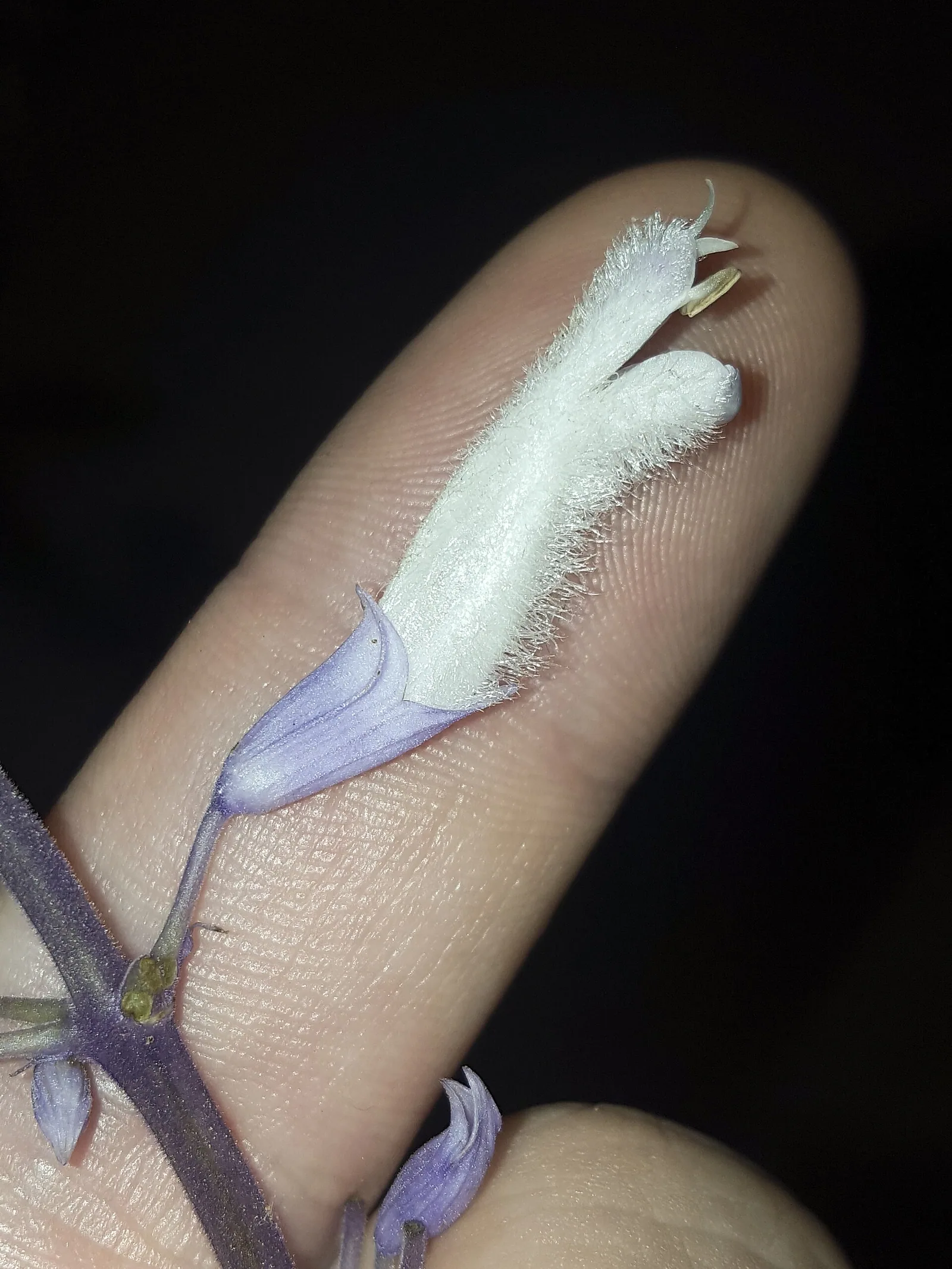
A soft-wooded perennial herb or subshrub, commonly 1–1.5 m tall but capable of becoming taller in sheltered cultivation. The stems are hollow, square in section and brittle; when they lodge on wet soil they root readily at nodes, producing new ramets. Leaves are opposite, thin, ovate to elliptic, usually about 10–25 cm long, with toothed margins, conspicuous venation and short petioles. Loose terminal panicles bear white, curved corollas emerging from persistent violet-purple calyces. Early reports of blue flowers confused the coloured calyx with the unopened white corolla (Reisfield, 1993; Casselman et al., 2014).
Flowering is irregular and seed set is poor. Pollen fertility is reduced, viable seed is uncommon and cultivated lineages are maintained mainly by cuttings. Glandular trichomes on aerial tissues synthesise and store the salvinorins. A 2024 chromosome-level assembly described a diploid genome of approximately 541 Mb with 2n = 22 and identified diterpene-associated gene clusters relevant to salvinorin-A biosynthesis (Ford et al., 2024).
Origin, clonality and identification
- Cultigen question
No unambiguously wild population has been demonstrated. The species may be a human-maintained cultigen, a once-wild endemic now known chiefly from anthropogenic stands, or the product of a more complex history; morphology alone leaves the question open (Casselman et al., 2014; Li et al., 2026).
- Clonal spread
Vegetative propagation explains the recurrent global circulation of named clones and the ease with which broken stems establish. Ex situ abundance can therefore coexist with narrow genetic diversity.
- Field distinction
Broad glabrous leaves, rooting square stems and the white-corolla/violet-calyx inflorescence distinguish flowering plants. Sterile Salvia material requires provenance or molecular authentication.
02Chemistry
S. divinorum contains a family of trans-neoclerodane diterpenoids: salvinorins A–J, divinatorins and related minor compounds. Salvinorin A is the established principal psychoactive constituent. Its absence of nitrogen separates it structurally from alkaloidal hallucinogens, while its high-efficacy agonism at the κ-opioid receptor (KOR) separates its primary mechanism from the 5-HT₂A agonism of psilocin, mescaline and DMT (Ortega, Blount and Manchand, 1982; Roth et al., 2002).
Salvinorin A
Salvinorin B
Salvinorin C
Salvinorins D–J
Isolation, distribution and metabolism
Ortega, Blount and Manchand isolated and named salvinorin in 1982; Valdés and colleagues independently characterised divinorins A and B, later regularised as salvinorins A and B. Daniel Siebert’s controlled self-experiments established salvinorin A as the active principle, and Roth and colleagues identified KOR as its principal molecular target in 2002 (Valdés et al., 1984; Siebert, 1994; Roth et al., 2002). Concentration varies among leaves, glands, clones, growth conditions and analytical methods; reported dry-leaf values are specimen ranges.
After absorption, esterases rapidly deacetylate salvinorin A to salvinorin B; further lactone opening and conjugation contribute to clearance. Fast brain entry and metabolism help explain the steep onset and short inhaled time course. The κ-opioid/dynorphin system participates in salience, interoception, stress, reward, pain and the integration of bodily and spatial signals, offering a pharmacological route to a state that overlaps with classical psychedelic phenomenology and departs from it (Cunningham, Rothman and Prisinzano, 2011; MacLean et al., 2013).
Receptors, brain dynamics and biosynthesis
- KOR
Salvinorin A is a potent, high-efficacy and comparatively selective KOR agonist. It lacks meaningful 5-HT₂A agonism at concentrations explaining its human effects, so “atypical dissociative hallucinogen” is pharmacologically more exact than treating it as a standard serotonergic psychedelic (Roth et al., 2002; MacLean et al., 2013).
- Human fMRI
In a placebo-controlled study, inhaled salvinorin A attenuated within-default-mode-network connectivity at peak and reduced brain-wide dynamic connectivity; its network profile partly converged with pharmacologically different hallucinogens (Doss et al., 2020).
- 2024–26 genomes
Chromosome-level and comparative genomes have narrowed candidate enzyme families and identified cytochrome-P450 and methyltransferase activities in the salvinorin pathway. The complete sequence is still being reconstructed, and biotechnological production is becoming experimentally tractable (Ford et al., 2024; Li et al., 2026).
- Translation
Analgesic, anti-inflammatory and neuroprotective signals are dominated by animal studies. A 2025 systematic review found heterogeneous preclinical outcomes, including no pooled antidepressant-like effect in the forced-swim test; no approved medicine is based on salvinorin A (Zürrer et al., 2025).
03Tradition, ritual & cultural use
Oldest evidenced or proposed human use
| Pre-Hispanic proposal | Unresolved R. Gordon Wasson proposed that S. divinorum might be the Nahua pipiltzintzintli (“noble little prince/princes”) mentioned in colonial sources. Competing identifications, uncertain descriptions and the absence of diagnostic archaeological remains prevent this from establishing pre-Conquest use (Wasson, 1963; Valdés, 2001). |
|---|---|
| 1939 | Earliest secure text Jean Basset Johnson recorded hierba María among Mazatec divinatory medicines in Huautla de Jiménez. The notice establishes use by the late 1930s; the tradition’s age and origin are unknown (Johnson, 1939). |
| 1950s | Ethnobotanical pursuit Roberto J. Weitlaner, R. Gordon Wasson and collaborators gathered further reports of yerba de María; Wasson and Albert Hofmann later obtained flowering material and living plants. |
| 1962 | Species named Epling and Játiva-M. described S. divinorum; Wasson published a companion ethnobotanical account. Botanical naming fixed a scientific referent for a medicine already embedded in Mazatec practice (Epling and Játiva-M., 1962; Wasson, 1962). |
| 1980–83 fieldwork | Detailed record Valdés, Díaz and Paul worked with Mazatec healer Don Alejandro and documented preparation, divination, curing, prayer, naming and vernacular therapeutics in the most detailed published species-specific ethnography (Valdés, Díaz and Paul, 1983). |
People, territory and medicine field
Sierra Mazateca
In 1962 Wasson found the plant familiar to virtually all Mazatecs. Many families keep a private supply, almost always planted in some remote ravine away from homes and trails, and few will show the spot; no Mazatec could tell him of its seeds, and it appeared to be a cultigen (Wasson, 1962, pp. 77–78).
Owners and markets
Once ignored, the plants gained value as a market grew for the region's mushrooms; near Huautla, landowners had begun enforcing their rights to them (Wasson, 1962, pp. 78–79).
Beyond the Mazatec
Blas Pablo Reko had earlier mentioned a "divination leaf" producing visions, named by Cuicatecs and Mazatecs in the districts of Cuicatlán and Teotitlán, which Wasson took to be probably the same plant (Wasson, 1962, pp. 79–80).
Traditional preparation and ritual sequence
- Fresh leaves
Ethnographic accounts emphasise fresh foliage. Leaves may be counted in pairs or bundles, crushed by hand or on a stone, mixed with water and strained for drinking. Mastication or prolonged oral holding is also reported. Counting is simultaneously practical measure and ritual ordering (Valdés, Díaz and Paul, 1983).
- Opening
Abstinence or dietary observance may precede a session. Prayer can invoke María Pastora, the Virgin, Christ, the Trinity, Saint Peter and other saints; the medicine is approached through relationship and address.
- Quiet and darkness
The room is darkened and external noise restricted. Silence increases the legibility of subtle bodily, visual and auditory events and is itself an ethnographic technique of attention: “La María … speaks with a quiet voice” (Reisfield, 1993, p. 349).
- Divinatory work
Questions include the origin and prognosis of illness, the location of lost or stolen objects, interpersonal conflict, suspected malice and choices about treatment. A vision needs interpreting: narrative, prayer, the patient’s condition and the healer’s diagnostic repertoire make it actionable.
- Vernacular medicine
Smaller preparations have been reported for diarrhoea, headache, rheumatism, anaemia and the swollen-abdomen syndrome termed panzón de borrego. These uses belong to a local therapeutic classification, separate from biomedical claims of efficacy (Valdés, Díaz and Paul, 1983).
Healer, patient and interpretation
The curer may drink with or for a patient, formulate the question, lead invocations and evaluate what emerges. The salient outcome is often knowledge—an aetiology, location, prognosis, relationship or prescribed response. In the documented practice Christian names and images are part of the language through which plant agency, personhood, morality and healing are related. At the same time, individual healers vary, and Mazatec communities have no single canonical “Salvia ceremony” in the literature (Johnson, 1939; Valdés, Díaz and Paul, 1983).
04Cosmology & key terms
María Pastora and plant personhood
Names place the plant in a feminine Christian field: Mary the Shepherdess, the Virgin’s leaves, Mary’s herb. In ritual speech the plant may be addressed as a presence capable of showing, speaking or guiding, while invocations locate that agency among saints and divine powers. The shepherdess figure carries introduced Catholic and pastoral vocabulary, yet its ceremonial life is locally Mazatec. Scholarly interpretation is strongest when it follows this historical composition, in which “Christian” and “Indigenous” each explain part (Valdés, Díaz and Paul, 1983; Díaz, 2013).
Vision, knowledge and moral causation
Leaves of the Shepherdess
Spanish-speaking Mazatecs call the plant hojas de la Pastora or hojas de María Pastora, "leaves of Mary the Shepherdess", which translates its Mazatec name. Wasson asked whether the Shepherdess preserves the pre-Christian "lord of the animals", a pagan association sanctified by the Virgin's name (Wasson, 1962, p. 79).
A family of plants
For the Mazatecs S. divinorum is the most important of several related plants: it is la hembra, the female; el macho, the male, is Coleus pumila; el nene, the child, and el ahijado, the godson, are forms of Coleus blumei, which some say are also psychotropic and others merely medicinal (Wasson, 1962, p. 79).
Divination and cure
Ska María Pastora is used by the Mazatecs for curing and divination, its effects compared with those of the morning glory and the psilocybin mushrooms (Valdés, Díaz and Paul, 1983); Wasson was told it was taken when mushrooms were not available, as a less desirable substitute (Wasson, 1962, p. 77).
Art and material culture
Unlike peyote pilgrimage or Bwiti initiation, S. divinorum has generated little in the way of portable specialist objects. Its material culture is largely vegetal, domestic and ephemeral: living clones in humid gardens; paired leaves; grinding stone or hands; bowls, cups and cloth strainers; candles and saints’ images; a mat, bed or darkened room. The arrangement of ordinary things creates the ritual chamber. Song is less consistently foregrounded than in Mazatec mushroom veladas; prayer, low speech, silence and attentive listening are better supported in species-specific accounts. Contemporary “salvia art,” online trip reports and branded extracts form a later visual economy, separate from Mazatec practice.
La María … speaks with a quiet voice. — Mazatec saying reported by Reisfield (1993, p. 349)
05Visionary phenomenology
Time course
Two preparations. The vaporised bands and the mark come from controlled studies of purified salvinorin A (Johnson et al., 2011; MacLean et al., 2013). The fresh-leaf bands are the ranges this entry gives for buccal use. Not charted: dried leaf and extracts, whose strength is unstated.
Phenomenological profile
The profile lists effects the sources report, for each preparation separately, grouped by domain. Each row gives the grade, how often the sources say the effect occurs (only where they say so; most do not) and the kinds of source behind it. A chip naming a compound, such as “Trial · psilocybin”, means the evidence comes from studies of that compound rather than of the preparation itself; “partial” means the route, purity or dose differs from the traditional preparation, so the row cannot be graded above supported. The line under each preparation says which domains have evidence entered here. A domain with nothing entered has not yet been assessed in this profile; that is not a finding that the literature is silent, and the article may discuss it. Open a row for the note and the sources.
Fresh leafMazatec medicine, held in the mouth or drunk
Evidence entered for 5 of 8 domains. Not yet entered: other senses, self and unity, affect.
Ethnographic accounts emphasise fresh foliage, counted in pairs, crushed, mixed with water or chewed (Valdés, Díaz and Paul, 1983). Salvinorin A is the principal active (Siebert, 1994; Roth et al., 2002); its trials used vapour, a different route.
Visual
Immersive realmsCoherent places or events that surround the experiencer, who seems to be located in them rather than looking at images.SupportedTrial · salvinorin-a, partial
Participants describe a conviction of belonging to another life or scene (MacLean et al., 2013). Measured with vaporised salvinorin A; the chewed leaf acts more slowly and less abruptly, so this counts at partial weight. Read about the phenomenology of immersive realms →
Body
Altered bodily sensationTingling, vibration, heat, cold, heaviness, pressure or internal movement felt in the body.SupportedTrial · salvinorin-a, partial
Changes in spatial orientation and pressure on the body (Johnson et al., 2011). Measured with vaporised salvinorin A; the chewed leaf acts more slowly and less abruptly, so this counts at partial weight.
Cognition
Autobiographical recallVivid re-experiencing or re-viewing of one’s own past, often recast from new positions.SupportedTrial · salvinorin-a, partial
Childhood memories recur across sessions (MacLean et al., 2013; Johnson et al., 2011). Measured with vaporised salvinorin A; the chewed leaf acts more slowly and less abruptly, so this counts at partial weight.
NoesisThe felt disclosure of knowledge: understanding that seems to arrive with what is perceived.SupportedEthnography
The salient outcome is often knowledge: an aetiology, location, prognosis, relationship or prescribed response, which the curer formulates the question for and evaluates (Johnson, 1939; Valdés, Díaz and Paul, 1983).
Relation to other beings
Autonomous entitiesBeings experienced as acting, communicating or observing independently of the experiencer’s will.SupportedEthnographyTrial · salvinorin-a, partial
In ritual speech the plant may be addressed as a presence capable of showing, speaking or guiding, among saints and divine powers (Valdés, Díaz and Paul, 1983; Díaz, 2013); a Mazatec saying holds that “La María … speaks with a quiet voice” (Reisfield, 1993, p. 349). Contact with entities also recurs in trials of vaporised salvinorin A (Johnson et al., 2011). Read about the phenomenology of autonomous entities →
States of consciousness
Dreamlike statesOneiric experience: dream formation, dreamlike sequences or a waking state resembling dreaming.SupportedTrial · salvinorin-a, partial
Participants compared salvinorin A more often to dreaming than to other drugs (Addy, 2012). Measured with vaporised salvinorin A; the chewed leaf acts more slowly and less abruptly, so this counts at partial weight.
Related compoundSublingual salvinorin A. Pure salvinorin A held under the tongue, up to 4 mg in solution, had no effect greater than placebo, and little reached the blood (Mendelson et al., 2011). Mazatec use of the chewed or drunk fresh leaf is effective, so the leaf’s activity is not explained by that formulation; the disagreement is left open.
Dried leaf and extracts, smokedoutside the tradition
Evidence entered for 6 of 8 domains. Not yet entered: other senses, affect.
Dried leaf and extracts of unstated strength, typically smoked; potency labels such as “10×” or “40×” have no analytical standard behind them (Casselman et al., 2014). Inhaled salvinorin A corresponds in full: the same molecule by the same route (Mendelson et al., 2011 contrasts it with “typical effects of smoked” salvia).
Visual
Immersive realmsCoherent places or events that surround the experiencer, who seems to be located in them rather than looking at images.SupportedTrial · salvinorin-a
Participants describe a loss of ordinary personal location and a conviction of belonging to another life or scene (MacLean et al., 2013). Read about the phenomenology of immersive realms →
Body
Altered bodily sensationTingling, vibration, heat, cold, heaviness, pressure or internal movement felt in the body.SupportedTrial · salvinorin-a
Narratives describe disruptions of vestibular and interoceptive signals: changes in spatial orientation and pressure on the body (Johnson et al., 2011).
Not establishedRaised blood pressure. Inhaled salvinorin A did not significantly raise heart rate or blood pressure (Johnson et al., 2011).
Self and unity
Unitive experienceThe sense that self and world, or all things, are one or interconnected.SupportedTrial · salvinorin-a
Scores on a scale of mystical-type experience rose with dose (Johnson et al., 2011).
Cognition
Autobiographical recallVivid re-experiencing or re-viewing of one’s own past, often recast from new positions.SupportedRecurrentTrial · salvinorin-a
Childhood rooms, family scenes and feelings of an earlier time recur across sessions (MacLean et al., 2013, pp. 389–390; Johnson et al., 2011).
Loss of ordinary awarenessOrdinary sense, orientation or self-control is lost or overwhelmed.SupportedTrial · salvinorin-aSurvey · salvinorin-a
At high doses participants often became unresponsive, with dose-related dissociative effects and impaired recall and recognition memory (MacLean et al., 2013); 154 users surveyed described mixed hallucinogenic and dissociative effects (Sumnall et al., 2011).
Relation to other beings
Autonomous entitiesBeings experienced as acting, communicating or observing independently of the experiencer’s will.SupportedRecurrentTrial · salvinorin-a
Contact with entities is among the unusual and sometimes recurring themes across sessions (Johnson et al., 2011). Read about the phenomenology of autonomous entities →
States of consciousness
Dreamlike statesOneiric experience: dream formation, dreamlike sequences or a waking state resembling dreaming.SupportedExperienceTrial · salvinorin-a
Participants in a controlled study compared salvinorin A more often to dreaming than to other drugs (Addy, 2012); large text analyses of published reports place salvia experiences unusually close to dreams (Sanz et al., 2018).
Phenomenology Discussion
The human literature contains three different archives: Mazatec reports of fresh-leaf medicine; naturalistic surveys of globally circulated leaf and extracts; and small controlled studies of purified, vaporised salvinorin A. They overlap, but route, concentration, setting, expectation and interpretive vocabulary strongly reshape both time course and report. Controlled samples remain small—four participants in Johnson et al. (2011), eight in MacLean et al. (2013), and twelve in the fMRI study of Doss et al. (2020).
Recurring structures of experience
- Vestibular force
Pulling, rotation, acceleration, gravity changing direction, pressure against the body and movement through or across surfaces. These are often primary spatial facts.
- Planar transformation
Flattening into sheets, splitting, folding, peeling, zipping, scrolling and conveyor-belt motion; the body may become an edge, object or segment of a larger mechanism.
- World replacement
The ordinary room may cease to be the governing environment and be replaced by another scene, landscape, household or theatrical space. Participants describe being elsewhere.
- Autobiographical return
Childhood rooms, family scenes, voices and feelings of an earlier time recur in controlled narratives. MacLean et al. note childhood-associated memories, cartoon-like imagery, auditory events and repeated content across sessions (2013, pp. 389–390).
- Presences
Entities, people, crowds, guides or an impersonal agency may operate the transition. In Mazatec contexts such presence can be interpreted through María Pastora and saintly address; global reports employ other cosmologies.
- Identity and time
Loss of ordinary personal location, conviction of belonging to another life or scene, and difficulty reconstructing the event after return. Memory impairment is a measured component as well as an anecdotal theme (MacLean et al., 2013).
Interpretive comparison
Participants in Addy’s controlled study compared salvinorin A more often to dreaming than to LSD, psilocybin, cannabis or dissociative drugs; MacLean and colleagues found partial overlap on standard hallucinogen scales but low overall similarity ratings and pronounced dissociation. Large text analyses likewise place salvinorin reports unusually close to dreams. The distinctive feature is a rapid reorganisation of embodiment, spatial ontology and autobiographical situation, beyond visual vividness (Addy, 2012; MacLean et al., 2013; Sanz et al., 2018).
Participants uniformly reported that salvinorin A produced unique effects. — MacLean et al. (2013, p. 383)
That laboratory sentence is salient but incomplete on its own. In Mazatec divination, experience is judged by whether the medicine discloses an intelligible cause, person, place or course of action, more than by its resemblance to other drugs. The contrast demonstrates how phenomenology is co-produced by molecule, route, setting, question and available interpretive practice.
06Contemporary status
Conservation and cultural continuity
S. divinorum has no published global IUCN Red List assessment. Kew’s 2024 automated Angiosperm Extinction Risk Prediction instead classifies it as “predicted threatened” with confident model confidence; that is a model output, distinct from an IUCN category (POWO, 2026; Bachman et al., 2024). The extremely restricted known range, uncertain wild status, low seed fertility and clonal propagation create vulnerabilities that the ease of growing a few global clones conceals. Cloud-forest degradation and the loss of locally held knowledge affect a biocultural population even when horticultural cuttings remain common abroad.
From clone exchange to extract market
Living specimens left Oaxaca through the Wasson–Hofmann collections and later horticultural exchanges. During the 1990s and 2000s, specialist mail order, headshops, online vendors, forums and video platforms transformed “salvia” into a globally branded short-acting hallucinogen. Dried leaf and concentrated extracts displaced the fresh paired leaf, and potency multipliers such as “10×” or “40×” became commercial genres with no analytical standard behind them. Reliable global market value and production data are absent; the documented economy is fragmented, partly informal and strongly shaped by jurisdiction (Casselman et al., 2014; EUDA, 2026).
Law and regulation
- International
The United Nations drug conventions schedule neither S. divinorum nor salvinorin A. National and subnational controls nevertheless vary widely (EUDA, 2026).
- United States
The plant and salvinorin A remain outside the federal Controlled Substances Act, while numerous states regulate the plant, the compound or both under different statutory models. “Legal in the US” is therefore inaccurate without state specification (DEA, 2026).
- United Kingdom
The Psychoactive Substances Act 2016 prohibits production, supply and import/export when intended for psychoactive consumption and creates custodial-possession offences; it regulates salvia through a general psychoactive-substance framework, and the Misuse of Drugs schedules do not name it (UK Parliament, 2016).
- Comparative
Australia, Canada and several European states place salvia or salvinorin A in controlled, prohibited or prescription categories. Because definitions and exemptions differ, current primary legislation is more reliable than static country lists.
Patents, neuroscience and biotechnology
| Derivative patents | US 7,629,475 B2 claims salvinorin compositions and therapeutic methods involving KOR-selective compounds; US 11,512,075 B2 covers 20-nor-salvinorin A and indicated KOR-modulating uses. These patents concern derivatives, compositions and methods; S. divinorum, naturally occurring salvinorin A and Mazatec knowledge lie outside them (Béguin et al., 2009; Shenvi et al., 2022). |
|---|---|
| Human neuroscience | The 2020 fMRI experiment remains the principal published human connectivity study. It found reduced within-DMN connectivity and reduced dynamic connectivity during the brief peak, with partial convergence across pharmacologically distinct altered states (Doss et al., 2020). |
| Medicinal chemistry | Research modifies the C-2 position and other parts of the scaffold to alter duration, receptor selectivity and signalling bias. KOR agonists, antagonists and μ-opioid-active derivatives can all emerge from salvinorin chemistry, so “salvinorin analogue” spans several pharmacological classes (Cunningham, Rothman and Prisinzano, 2011). |
| 2024 genome | Ford et al. produced a chromosome-level reference genome and mapped candidate enzyme clusters for the roughly twelve-step pathway (2024). |
| 2025 synthesis | A systematic review and meta-analysis found promising preclinical analgesic and neuroprotective signals alongside high heterogeneity, conflicting depression-model results and limited translational certainty (Zürrer et al., 2025). |
| 2026 biosynthesis | Comparative genomic work identified additional P450 and methyltransferase activities, advancing pathway reconstruction and the prospect of non-plant production while leaving several steps unresolved (Li et al., 2026). |
Open questions on this entry
Safety and law
07Cross-correlations
| Mazatec Divinatory Medicines | Ceremonial complex page: mushrooms, morning-glory seeds, S. divinorum, healing, divination, prayer and historical transformation. PRIMARY CULTURAL COMPLEX |
|---|---|
| Psilocybe spp. | P. caerulescens, P. mexicana and related mushrooms occupy overlapping but distinct places in Mazatec visionary medicine. SIBLING DIVINATORY MEDICINE |
| Turbina corymbosa | Ololiuhqui-associated morning-glory seeds form another Mazatec divinatory medicine with a deeper colonial documentary record. SIBLING DIVINATORY MEDICINE |
| Calea zacatechichi | A Mexican dream and divinatory herb associated chiefly with Chontal and other regional traditions; it appears near Salvia in popular lists, though it is neither a Mazatec synonym nor a salvinorin source. REGIONAL COMPARISON |
| Salvinorin A | The isolated KOR agonist links the leaf to modern human pharmacology, medicinal chemistry and biotechnology without exhausting the plant’s ethnographic identity. PRINCIPAL COMPOUND |
| Heimia salicifolia | Species monograph: sinicuichi, a Mexican highland shrub whose fermented drink is described as chiefly auditory. MEXICAN HIGHLAND COMPARATOR |
08Bibliography
How to read the labels on each source
- Source type
- What kind of work it is: journal article, book, legislation, patent application, database record and so on. A word after the dot (ethnography, protologue, primary source) keeps the genre the entry was first filed under. “Unclassified” means the citation does not say enough to tell.
- Peer review
- Recorded for each work separately, and only where it has been confirmed for that work. It is never inferred from a DOI, a publisher or a journal, since journals also publish editorials, letters and commentaries. Where it has not been confirmed, the entry records it as not established. It does not apply to legislation, court decisions, treaties, patents, datasets, database and collection records, historical texts, films, talks, press releases or web pages.
- Check
- What was checked when the entry was added. DOI checked: the DOI’s registry record (Crossref) matched the citation’s title, first author and year. Verified: the record itself was opened and matched the citation: a library catalogue record for a book, or the page itself for a database entry, law, patent or archive document. “Verified (abstract)” and “(summary)” mean only the abstract or a summary was read. Located: a record was found but not fully matched. Bibliographic record and Stable record (in essays): a catalogue or stable web record exists; what was checked against it is not recorded. Unverified: no check is recorded. No locator found: a search found no record. Secondary: read through another source.
- What the labels do not say
- None of them means the source supports a particular sentence. Where a sentence is graded, its evidence note names its sources and whether each supports it, disputes it or gives context. Dates and reviewers of checks are not recorded for each entry; the version note at the foot of a graded page dates its last review.