Mirante, D. (ed.) (2026) Wixárika Peyote–Pilgrimage–Nierika Complex. Entheocene, version 1.0. Available at: https://entheocene.com/complex-wixarika-peyote-pilgrimage-nierika.html (Accessed: 17 October 2026).
DOI: not yet minted.
Introduction
The Wixárika peyote tradition is organised through movement across a sacred geography. Pilgrimage from Sierra Madre communities to Wirikuta re-enacts ancestral travel and the birth of the sun; ceremonial cargo holders carry obligations between people and distant place-beings; hikuri is encountered through a hunt in which peyote, deer and maize become ritually convertible; and nierika names a capacity and medium of seeing as well as classes of votive and artistic objects. The complex therefore joins cactus, route, office, offering, song and image. Its history is wider than the chemistry of mescaline or any one classic ethnography: communities and ceremonial centres differ, journeys have adapted to roads and urban life, and commercial yarn painting has developed alongside older votive forms. This dossier follows those relations while marking the limits between archaeological evidence, Wixárika oral history, ethnographic interpretation and current political claims (Myerhoff, 1970; Myerhoff, 1974; Schaefer and Furst, 1996; Liffman, 2011; Neurath, 2015).
Contents
01Constituents & preparation
Deep Time
Regional archaeologyLower Pecos peyote · c. 4000 BCE→
No direct continuity claimWixárika ethnogenesis→
Ethnographynineteenth–twentieth centuries→
Living heritageUNESCO inscription · 2025
One cactus inside a many-part ceremonial system
Peyote is taken on its own here. The complex’s constituents are botanical, agricultural, hydrological, animal, social and representational.
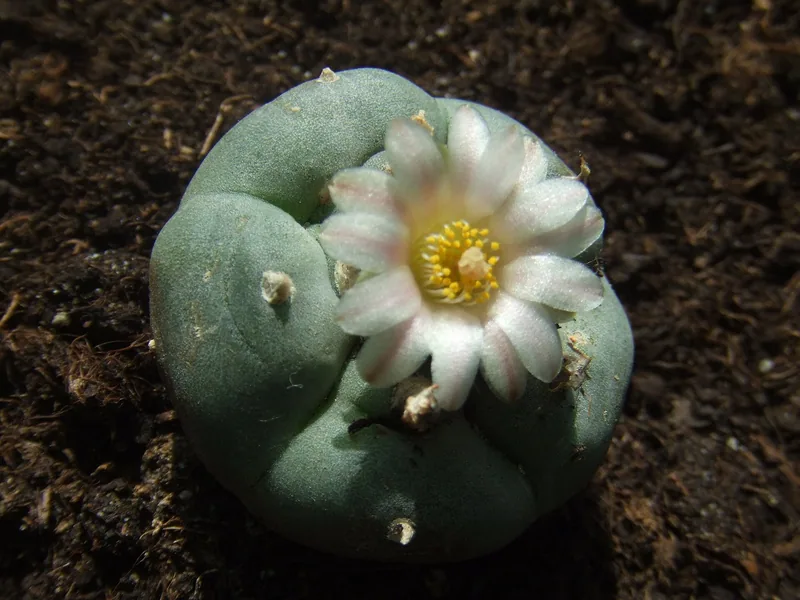
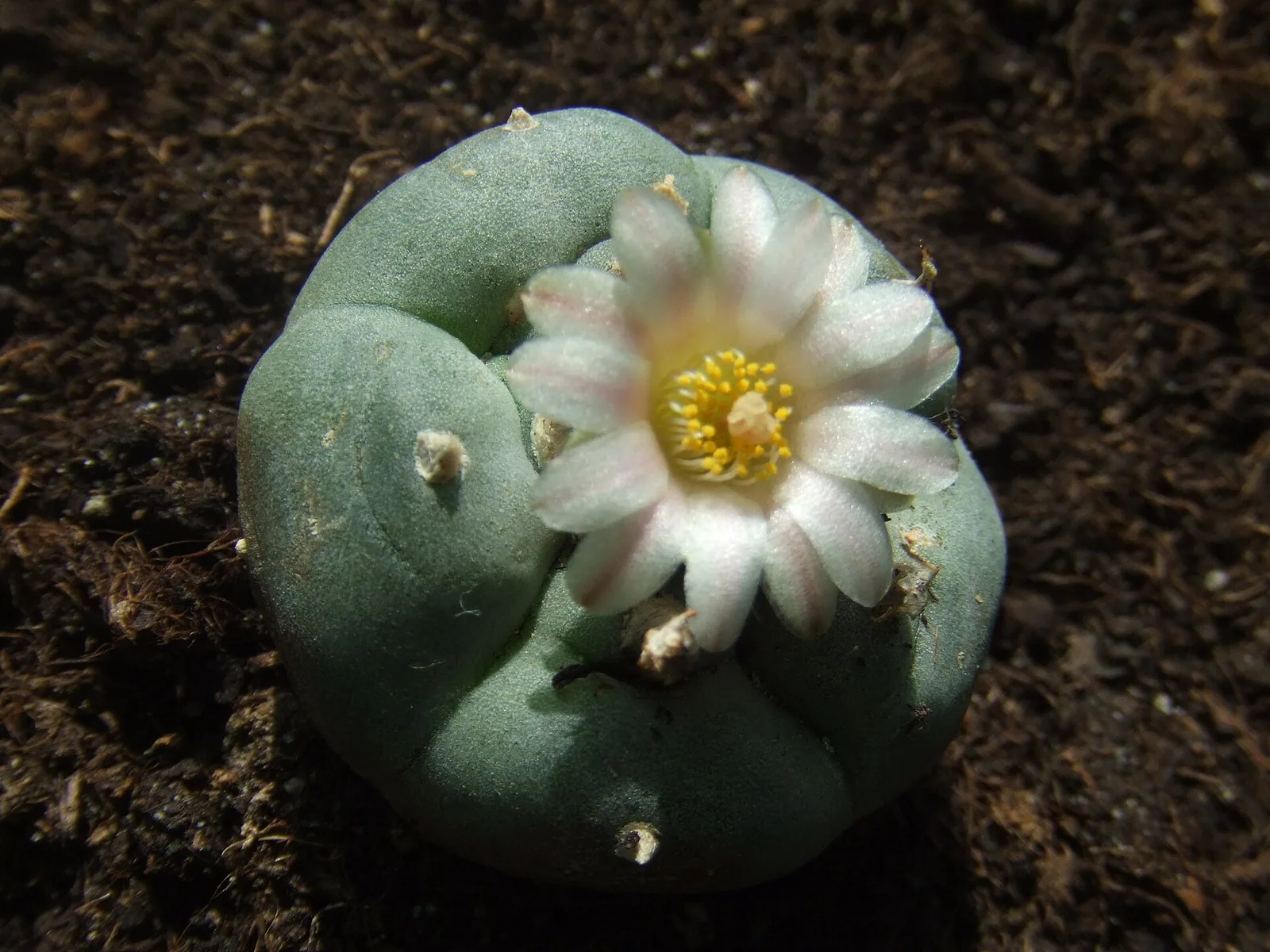
A small, spineless, depressed-globose cactus native from south-western and southern Texas into north-eastern and south-western Mexico, occurring discontinuously in Chihuahuan Desert and Tamaulipan thornscrub habitats, commonly on calcareous soils. Its subterranean stem and taproot support a low blue-green to grey-green crown divided into broad ribs and tubercles, with woolly areoles, small pinkish flowers and elongated pink-red fruits. Mescaline is its principal visionary alkaloid; the Wixárika relation to hikuri concerns a living ancestor and place-bound mediator (POWO, 2026; Terry, 2017; Doesburg-van Kleffens et al., 2023).
Accepted name
Lophophora williamsii (Lem. ex J.F.Cels) J.M.Coult.
Family / order
Cactaceae · Caryophyllales
Growth form
Slow-growing geophytic cactus; solitary or clustering crowns; substantial underground body
Principal compound
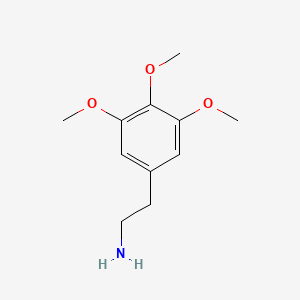
Mescaline (3,4,5-trimethoxyphenethylamine)
Ritual relations
Deer, maize, rain, sun, fire, springs, ancestors, healing, divination and ceremonial office
Tatehuarí Huajuyé · “the path of Grandfather Fire”
The route joins ceremonial centres in the Sierra Madre Occidental to springs, hills, caves and other sacred places, culminating in Wirikuta in San Luis Potosí. Its ritual efficacy is carried by offices, abstentions, offerings, songs, sacred water, fire, collective memory and repeated stopping. UNESCO’s 2025 inscription describes a serial cultural landscape of twenty components extending more than 500 km across five Mexican states (UNESCO World Heritage Centre, 2025a).
Eastern destination
Wirikuta and Paritek+a / Cerro Quemado, associated with the sun’s emergence
Ritual personnel
Mara’akate, xukuri’+kate or jicareros, elders, families, musicians and novices
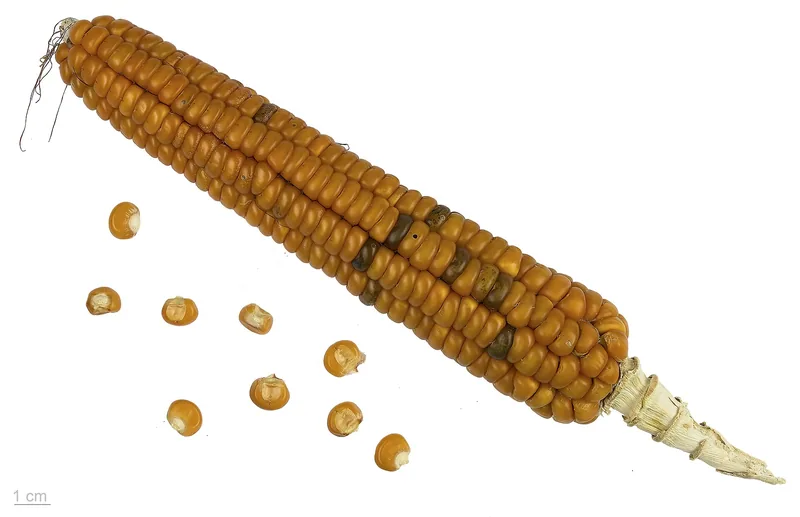
Maize is food, cultivated kin and a measure of successful relations with rain and ancestors. The classic deer–maize–peyote formulation describes transformations among domains (Myerhoff, 1970; Saumade, 2009).
Gourd bowls
Xukuri · offerings · cargo identity
Bowls carry water, maize, candles and other offerings; in some ceremonial systems they also give cargo holders their title. Their decorated interiors can act as miniature cosmograms and relational instruments (Kindl, 2003).
Sacred water
Springs · rain · return to the Sierra
Water gathered along the route is transported home and enters offerings, agricultural rites and community renewal. Its movement materially connects distant sites.
Arrows, feathers and candles
Petition · recognition · direction · fire
Arrows can mark and address peyote/deer, while feathered and wax-bearing objects carry petitions and ancestor relations. Their meanings vary by community and ritual episode.
Wax, yarn and beads
Nierika · tablas · chaquira
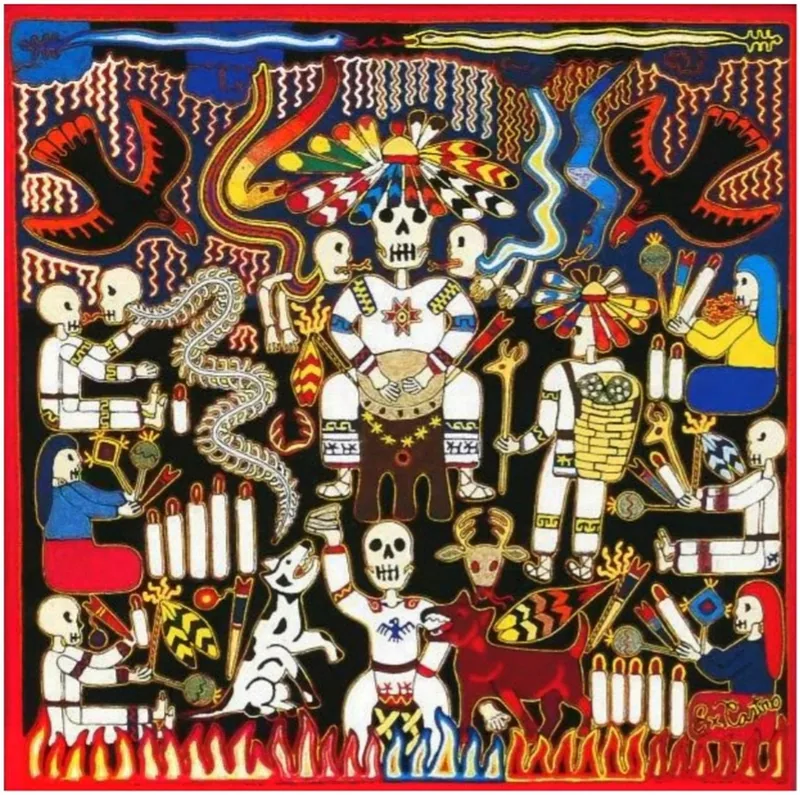
Beeswax-on-board yarn painting and bead-covered objects are modern and contemporary media grounded in older votive forms. They can narrate songs, journeys, dreams and place-beings (Negrín, 1975; Neurath, 2015).
Tobacco and other medicines
Smoking, blowing or offerings in some contexts
Tobacco occurs in wider northern and western Mexican ritual fields; its place alongside Wixárika peyote varies. Published accounts differ by community and period.
Safety and scope: ethnographies describe fresh and dried peyote, communal distribution and liquid preparations, but no recipe or quantity is reproduced here. Mescaline can produce nausea, prolonged wakefulness and cardiovascular stimulation; individual risk depends on health, medication and setting. Conservation and law also make wild collection consequential (Klaiber et al., 2024a; Terry et al., 2011).
Plate 01 · Lophophora williamsii (Lem. ex J.F.Cels) J.M.Coult. · deep view
Lophophora williamsii, cultivated crowns · Hans B., 2007 · CC BY-SA 3.0 ↗
Principal psychoactive phenethylamine in peyote; abundance varies among plants and tissues.
Acts primarily through serotonin 5-HT2A receptors, with contributions from other serotonergic targets; controlled work shows long-lasting perceptual, emotional and autonomic effects (Cassels and Sáez-Briones, 2018; Ley et al., 2023).
Pilgrimage office, sacred geography and the culturally organised recognition of place-beings lie outside mescaline pharmacology.
Pellotine
One of several non-mescaline peyote alkaloids.
Historically investigated as a sedative; pharmacology and concentration differ from mescaline.
Whole peyote remains a variable natural material, unstandardised.
Anhalonidine, anhalonine and related alkaloids
Minor tetrahydroisoquinoline and phenethylamine constituents, including lophophorine, hordenine and N-methylated congeners.
Contribute to the cactus’s phytochemical profile; many have limited human data (Doesburg-van Kleffens et al., 2023).
Claims of a defined “entourage effect” remain more speculative than mescaline’s established central role.
Whole-cactus variability
Genotype, age, environment, tissue and harvest history affect alkaloid composition.
Botanical material is less chemically uniform than pharmaceutical mescaline (Newbold, De Silva and Terry, 2020).
Variation is described here as botany; it gives no dosing or harvesting guidance.
Traditional preparation: transformation, not a single recipe
PREPARATORY SERVICE
In community-specific forms documented by Myerhoff and later ethnographers, pilgrimage is preceded by ceremonial cargo service, offerings, dietary or sexual restraint, purification and the reorganisation of ordinary relations. Confessional practices reported for one pilgrimage party became famous in anthropology; other Wixárika communities have their own forms (Myerhoff, 1974; Schaefer and Furst, 1996).
THE FIRST HIKURI
At Wirikuta the first peyote is tracked and recognised as deer, addressed with arrows and prayer, and ritually opened before wider gathering. The hunt establishes relation and permission (Myerhoff, 1970; Neurath, 2021).
CEREMONIAL USE
Accounts describe peyote eaten fresh or dried and sometimes prepared in water for communal rites. The relevant unit is the sequence of route, night, fire, song, social guidance and return. Practices and quantities vary, and published descriptions are historical observations.
TRANSLATION LIMIT
“Sacrament”, “entheogen”, “medicine” and “psychedelic” each foreground different relations. Hikuri can be spoken of as person, ancestor, deer, teacher and cactus. None of these terms alone exhausts what participants are doing.
02Culture
Peoples and territories
Sierra Madre Occidental
Wixaritari communities in Jalisco, Nayarit, Durango and Zacatecas
Community and ceremonial life is organised through agrarian territories, rancherías, family shrines and tukipa ceremonial centres. Major community names include Tatei Kié / San Andrés Cohamiata, Tuapurie / Santa Catarina Cuexcomatitlán and Waut+a / San Sebastián Teponahuaxtlán and Tuxpan de Bolaños. Spellings vary across Wixárika orthographies and Spanish records (Liffman, 2011).
Wirikuta, San Luis Potosí
Pilgrims, local mestizo residents and a dense field of sacred places
The eastern desert around Real de Catorce is simultaneously habitat, agricultural and mining region, pilgrimage destination, protected landscape and tourist economy. Wixárika accounts identify it with ancestral emergence and the sun’s birth (UNESCO World Heritage Centre, 2025a).
A 2023 federal decree recognises eastern, northern, western, southern and central sacred sites and the routes connecting them. Together they are figured as a tsikiri-like directional form, linking solar movement, rain and maize cycles to an extensive territorial field (Gobierno de México, 2023).
Cities and transnational circuits
Tepic · Guadalajara · Mexico City · US and international art networks
Wixárika life also includes wage labour, higher education, urban ritual organisations, political advocacy, museum work and international art markets. “Tradition” is maintained and contested through mobility and modern institutions (Liffman, 2007; Neurath and Reyes, 2024).
Cargo holders assume multi-year obligations to ancestors, sacred places and the ceremonial centre; the office involves labour, expenditure, travel and ritual discipline.
The mara’akame sings, dreams, divines, heals and negotiates with place-beings. “Shaman” is a comparative label; the local office has its own training, authority and community accountability.
Knowledge is distributed: women, men, children, musicians, cooks and sponsors sustain the pilgrimage and agricultural cycle, even when classic ethnographies foreground a male ritual leader.
Stops along the route are episodes of an ancestral history; offerings renew relations with hills, caves, waters and directional powers.
The journey temporarily reshapes identity and ordinary time. Pilgrims may receive ritual names, observe restrictions and re-enact the first people’s movement east.
Buses, trucks and roads have altered logistics while ritual force continues. The route is performed through prescribed stops and obligations, whatever the mode of transport.
Nierika and the life of images
Vision · face · mirror · opening · votive disk · yarn painting
Nierika is a multivalent Wixárika concept, much wider than the word for “yarn painting”. It can indicate a capacity or interface of seeing, a face or mirror, and particular ritual objects.
Older votive forms include disks, tablets, decorated gourd bowls, arrows and woven tsikiri. Their placement and exchange help make relations with ancestors effective.
Mid- and late-twentieth-century yarn paintings translated songs, myths and visions into portable tableaux for patrons, museums and markets while becoming an arena of individual authorship.
History and evidence
Ritual practice: an analytical sequence
Accepting cargo
A person or household undertakes ritual service within a ceremonial centre. The office binds agriculture, kinship, expenditure, learning and travel across more than one festival.
Preparing relations
Offerings are assembled; restrictions and purification may be observed; the pilgrimage party is organised under experienced leadership.
Following the ancestral road
Sacred stops turn geography into narrated history. Water, hills and crossings are addressed as agents and relatives.
Crossing into Wirikuta
Threshold rites and the gathering of water orient pilgrims to the eastern place where ancestral events and solar emergence remain ritually present.
Hunting the deer–peyote
The first hikuri is sighted, addressed and marked as deer. Recognition precedes collection; subsequent gathering occurs within the relation established by the first encounter.
Night, fire and song
Peyote, wakefulness, singing and fire organise attention. Visions are compared with inherited narratives and the needs of the group.
Sunrise and eastern ascent
The sun’s emergence at the eastern mountain joins personal perception to a cosmogonic event and the seasonal renewal of light, rain and maize.
Returning with substances and obligations
Peyote and sacred water travel back to the Sierra. Their efficacy unfolds in later agricultural ceremonies, healing, offerings and completion of cargo service.
Mythology and cosmology
Tatewari / Tatewarí, Grandfather Fire. Fire is remembered as an ancestral guide and paradigmatic ritual knower. The route’s name, Tatehuarí Huajuyé, places pilgrimage on his path. Fire at the centre of nocturnal rites is therefore simultaneously material, directional and ancestral.
Tamatsi Kauyumarie, the deer mediator. The deer leads ancestral people toward hikuri and makes the cactus available through transformation. Popular summaries call him the Blue Deer, but names, colours and attributes vary across stories and artists.
Deer–maize–peyote. Myerhoff described a symbolic complex in which hunting, agriculture and pilgrimage were condensed. Later work emphasises that these emblems are fluid: deer can be peyote, maize can emerge through sacrifice and cattle introduced after conquest can enter the same transformational field (Myerhoff, 1970; Saumade, 2009).
Sun, rain and the five directions. Wirikuta is associated with first light and the sun’s birth, while western Tatei Haramara is linked to primordial waters. The extended sacred geography joins apparently distant ecologies into a cycle of clouds, rain, maize and offerings (Gobierno de México, 2023).
Shamanism, healing and moral knowledge
The mara’akame is often described in English as a shaman, yet the term can conceal the specificity of an office learned through dreams, illness, apprenticeship, pilgrimage, song and service. Mara’akate diagnose by singing and divination, recover or negotiate with agentive causes of illness, guide ceremonies, protect travellers and interpret visionary events. Authority depends upon sustained obligations and recognition by other people and ancestors (Schaefer and Furst, 1996; Liffman, 2011).
Healing joins bodily, social, agricultural and territorial conditions. A crop failure, a neglected offering, conflict within a household and a bodily complaint may enter the same diagnostic field without becoming the same thing. Peyote can disclose a relation, but songs, offerings, confession, kinship repair and practical treatment are the means through which disclosure is acted upon.
Art and material culture
Form
Ritual or social action
Historical transformation
Nierika votive disks and tablets
Open or focus relations of seeing; address ancestors and sacred places; sometimes incorporate a central opening, mirror-like surface or directional design.
Many early examples entered museum collections through ethnographic exchange, purchase or removal, changing their audience and status (Lumholtz, 1900; Liffman, 2007).
Xukuri and tsikiri
Gourd bowls carry offerings and model relations; woven “God’s eyes” articulate directional form and protection.
Ritual forms also circulate as craft and national icon, where detached motifs may acquire new decorative readings.
Yarn paintings
Artists press coloured yarn into waxed boards to narrate visions, songs, myths, journeys and contemporary events.
Portable tableaux expanded in the mid-twentieth century through patronage and markets. Artists including José Benítez Sánchez and Tutukila Carrillo developed recognisable individual styles (Negrín, 1975; Neurath, 2015).
Beadwork and textiles
Clothing, bags, jewellery and sculptural surfaces compose colour, kinship, place and animal relations.
Sales support households and travel, while tourist demand can favour highly legible motifs such as deer, peyote and eagles. Makers also innovate beyond those expectations.
Song and choreography
Performance coordinates bodies and enables ancestral narratives to happen in ritual time.
Recording, festivals and stage presentation create new publics without converting every ceremonial song into public property.
03Visionary phenomenology
A pharmacological account begins too late and ends too early. The experiential field may develop across days of travel, restriction, fatigue, landscape attention, collective expectation and ceremonial service before mescaline’s acute effects begin; it continues through sunrise, return and later interpretation. Controlled mescaline studies establish a slowly developing and unusually long-lasting psychedelic state; a pilgrimage lasts far longer (Ley et al., 2023; Klaiber et al., 2024a; Mueller et al., 2025).
Ethnographic account
Ancestral recognition. Pilgrims report sacred places as locations where ancestral events can be encountered. Vision confirms or complicates inherited relations, and need produce no unprecedented imagery (Myerhoff, 1974; Neurath, 2021).
Artist’s account
Song becoming image. Yarn paintings can materialise episodes received in dreams, ritual singing and peyote vision. Their patterned density is composed through learned iconography, narrative skill, materials and the artist’s public (Negrín, 1975; Neurath, 2015).
Clinical comparator
Visual and affective alteration. Contemporary studies report changes in visual perception, time, emotion, self-boundaries and meaning, often with nausea and prolonged stimulation. These measures are useful comparators for nierika and Wirikuta, and no more (Ley et al., 2023; Klaiber et al., 2024a).
Duration, intensity and visionary grammar
Before acute effects · anticipatory transformation
Cargo obligations, abstentions, road fatigue, joking, confession or purification, sacred stops and the expectation of meeting ancestors alter attention before ingestion. Intensity is already social.
Onset · bodily threshold
Laboratory work places the onset near the first hour on average, with gradual intensification. Nausea, bodily heaviness or stimulation may accompany perceptual brightening; ceremonial attention frames discomfort as part of a passage (Mueller et al., 2025).
Acute field · long-form vision
Mescaline effects can persist for much of a day or night. Saturated colour, patterned or flower-like imagery, motion in surfaces, altered scale and distance, synaesthetic correspondences and powerful affect are recurrent, but content remains shaped by biography and ritual language (Klaiber et al., 2024a).
Relational seeing · nierika
Vision may concern the disclosure of deer, fire, maize, water, ancestors or place-beings and the ability to see one’s obligations. Nierika is therefore better approached as cultivated relational visibility than as a synonym for hallucination.
Collective calibration · song and narration
Experienced participants help name events, protect the sequence and distinguish consequential vision from confusion. A report gains authority through later fit with community relations.
Afterward · return and obligation
Acute effects recede, but sacred water, gathered hikuri, changed ritual status and remembered imagery remain. The criterion of a successful journey is communal and agricultural renewal.
You can’t really get to Wirikuta until you die.Ethnographic formulation discussed by Neurath (2021, p. 57). The statement condenses pilgrimage as an approach to ancestral alterity; it is not a literal rule shared identically by every Wixárika speaker.
What visionary descriptions can and cannot establish
CONVERGENCE
Clinical and ethnographic sources converge on long duration, visual patterning, intensified colour, bodily challenge and the possibility of powerful autobiographical or spiritual salience.
NON-EQUIVALENCE
A laboratory rating of “visual alteration” and a Wixárika account of seeing an ancestor describe different objects. The latter includes an ontology, a history of places and a criterion of social verification.
ICONOGRAPHIC CAUTION
It is tempting to read every zigzag, flower and radial motif as a direct copy of entoptic imagery. Wixárika visual forms also emerge from weaving, gourd decoration, directional cosmology, song and artistic convention.
SET AND SETTING, EXTENDED
The relevant “setting” is a territorial route, cargo system, historical memory, agricultural calendar and network of reciprocal obligations, as well as a room and guide.
04Contemporary transformations
Contemporary expressions and transformations
Field
Transformation
Scholarly question
Pilgrimage logistics
Motor vehicles, wage schedules, border regimes, permits and digital coordination coexist with ritual stopping and cargo obligations.
Continuity lies in maintained relations and sequences, whatever has changed in the journey since roads.
Urban Wixárika life
Students, artists, workers and ritual specialists organise between Sierra communities and cities; ceremonies and advocacy move through social media and NGOs.
Urbanisation may redistribute authority and access while producing new forms of collective continuity.
Art markets
Yarn paintings, beadwork and textiles circulate from household sales to major exhibitions and luxury commissions.
Ritual object, autonomous art and tourist commodity are overlapping but non-identical categories; value and authorship should be traced case by case.
Psychedelic tourism
Real de Catorce and Wirikuta attract non-Wixárika seekers, retreats and informal collectors.
External demand can support local economies while intensifying peyote extraction, trespass and the conversion of sacred place into consumable “experience”.
Political heritage
Wixárika authorities use courts, federal decrees, environmental alliances, archives and UNESCO mechanisms.
Heritage recognition can strengthen territorial claims, but implementation depends on water, land-use and concession governance.
Cultural and biological threat / conservation
Peyote populations
IUCN Vulnerable · decreasing
Lophophora williamsii is assessed as Vulnerable globally. Habitat conversion, ranching and agriculture, roads, illegal collecting and repeated harvest pressure affect discontinuous populations. Whole-plant removal prevents regrowth; even non-lethal harvesting at short intervals can reduce crown size and survival (Terry, 2017; Terry et al., 2011).
Mexican and international protection
NOM-059 · CITES Appendix II
Mexico’s verified NOM-059-SEMARNAT-2010 status places peyote under “special protection” (Pr). Cactaceae are generally regulated under CITES Appendix II. These instruments govern species risk and international trade; Indigenous access and sacred-land rights are settled elsewhere (SEMARNAT, 2010; CITES, 2026).
Water and industrial agriculture
Aquifer pressure · greenhouse farms · land conversion
Wirikuta’s integrity depends on springs, groundwater and desert vegetation. Wixárika defenders identify aquifer overexploitation and intensive agriculture alongside mining as threats to the material conditions of pilgrimage (Consejo Regional Wixárika, 2026).
Conservation governance
Wixárika authority · local residents · scientists · state agencies
Biological conservation intersects with access, livelihood and jurisdiction. Community-led dialogue projects and territorial protection seek to align peyote persistence with Wixárika ceremonial continuity while addressing demand from tourism and international psychedelic networks (Bonilla and Nájera, 2021).
Sacred-land law and the 2025–2026 turning point
Law: cactus, compound and ceremony are regulated differently
Jurisdiction / instrument
Current position
Limit
Mexico
Mescaline and peyote are controlled within federal health and criminal-law frameworks; peyote is also a protected species. Indigenous ceremonial practice and sacred-place recognition interact with these rules in legally complex ways.
This is not a general authorisation for collection, possession, sale or tourist use. Local legal advice is required.
2023 sacred-sites decree
Recognises routes and places of four Indigenous peoples and imposes federal safeguarding duties.
Recognition requires implementation across multiple agencies, and pre-existing concessions and land conflicts may survive it.
CITES
International commercial movement of covered cactus specimens is controlled through Appendix II rules.
CITES regulates trade; peyote’s cultural and domestic legal status lie outside it.
United States comparison
Federal law provides a specific religious-use framework for members of federally recognised tribes through the Native American Church context.
This is a distinct Plains/Native American Church peyote complex; Wixárika practice in Mexico falls outside it.
Randomised comparisons place mescaline within classic serotonergic psychedelic pharmacology while distinguishing its long duration and slower onset (Ley et al., 2023).
Dose-ranging work showed graded subjective and autonomic effects, and ketanserin attenuation supported a central 5-HT2A mechanism (Klaiber et al., 2024a).
Population pharmacokinetic analysis reported dose-proportional exposure and a mean terminal half-life around 3.5 hours, while subjective duration was substantially longer (Mueller et al., 2025).
From comparative human networks to a rat mescaline map
Human mega-analysis · preclinical cerebellar findings
A 2026 mega-analysis combined eleven resting-state fMRI datasets across psilocybin, LSD, DMT/ayahuasca and mescaline, finding increased coupling between transmodal and sensory-motor systems (Girn et al., 2026).
An awake-rat study reported acute cerebellar BOLD suppression alongside increased global connectivity and altered sensory gating (Cavallaro et al., 2026).
The rat result is preclinical; Wixárika vision, nierika and the meaning of pilgrimage are outside its reach.
Recent applications claim treatment methods, effect-defined administration and mescaline/scaline analogues, including US20220265582A1 and US20230000799A1.
Journey Colab’s international application WO2022251690 concerns synthetic mescaline formulations for substance-use disorders; prior-art organisations have challenged claim breadth.
Peyote as a species, Wirikuta and Wixárika ritual knowledge lie outside these records. They nonetheless raise questions about who captures value when a culturally prominent molecule enters pharmaceutical development.
Current evidential balance
ESTABLISHED
Mescaline is a long-acting serotonergic psychedelic; controlled human studies now characterise its acute effects, safety parameters and pharmacokinetics more precisely than a decade ago.
EMERGING
Cross-drug neuroimaging identifies shared network reconfiguration, but mescaline-specific human imaging remains limited and sample sizes are smaller than those for psilocybin or LSD.
NOT DEMONSTRATED
No neural signature validates one cosmology, reduces nierika to cortical geometry or transfers Wixárika ceremonial authority into a clinic.
Maize as cultivated person, offering and seasonal anchor within the deer–maize–peyote transformations.
Comparative North American complex
Native American Church peyote traditions
Plains and pan-Indigenous all-night peyote rites with distinct histories, road forms, legal regimes and theologies.
Comparative mescaline complex
Andean Huachuma–Mesa Complex
A different cactus-centred ceremonial history organised through curing mesas, coastal and highland archaeology, Catholic transformations and regional specialist lineages.
Visual / material culture index
Nierika, yarn painting and Wixárika votive arts
A dedicated art page can distinguish ritual objects, named artists, museum histories, tourist markets and contemporary commissions.
Territorial complex
Gran Nayar sacred-geography traditions
Relations and contrasts among Wixárika, Náayeri, O’dam/Au’dam and neighbouring peoples across western Mexico.
Cross-index
Ayahuasca complex
Both join plant, route, song, healing and contemporary international circulation; ayahuasca is usually a multi-plant preparation, whereas this complex has one primary cactus and an extensive pilgrimage geography. RITUAL SYSTEM
Bwiti–Iboga
Visionary plant embedded in durable office, initiation and art; differs in forest ecology, ancestor institutions and the relation between one major initiation and repeated pilgrimage cycles. PLANT + INSTITUTION
Soma–Haoma
Sacred plant, journey, liturgy and contested historical reconstruction; unlike Soma, hikuri is botanically identified and the Wixárika tradition is living and extensively documented. EVIDENTIAL CONTRAST
Mescaline
The compound page should hold receptor pharmacology, pharmacokinetics and clinical studies without substituting molecule for cactus, route or people. COMPOUND INDEX
06Bibliography
39 sources in 5 threads · 37 with a working locator · Harvard (Cite Them Right) · status and kind are recorded per source, not assumed
How to read the labels on each source
Source type
What kind of work it is: journal article, book, legislation, patent application, database record and so on. A word after the dot (ethnography, protologue, primary source) keeps the genre the entry was first filed under. “Unclassified” means the citation does not say enough to tell.
Peer review
Recorded for each work separately, and only where it has been confirmed for that work. It is never inferred from a DOI, a publisher or a journal, since journals also publish editorials, letters and commentaries. Where it has not been confirmed, the entry records it as not established. It does not apply to legislation, court decisions, treaties, patents, datasets, database and collection records, historical texts, films, talks, press releases or web pages.
Check
What was checked when the entry was added. DOI checked: the DOI’s registry record (Crossref) matched the citation’s title, first author and year. Verified: the record itself was opened and matched the citation: a library catalogue record for a book, or the page itself for a database entry, law, patent or archive document. “Verified (abstract)” and “(summary)” mean only the abstract or a summary was read. Located: a record was found but not fully matched. Bibliographic record and Stable record (in essays): a catalogue or stable web record exists; what was checked against it is not recorded. Unverified: no check is recorded. No locator found: a search found no record. Secondary: read through another source.
What the labels do not say
None of them means the source supports a particular sentence. Where a sentence is graded, its evidence note names its sources and whether each supports it, disputes it or gives context. Dates and reviewers of checks are not recorded for each entry; the version note at the foot of a graded page dates its last review.
Ethnography & history
Lumholtz, C. (1900) Symbolism of the Huichol Indians. New York: American Museum of Natural History. Available at: Internet Archive.
UnverifiedHistorical textPeer review not applicableOpen record ↗cited 1× in this record
Myerhoff, B.G. (1970) ‘The deer-maize-peyote symbol complex among the Huichol Indians of Mexico’, Anthropological Quarterly, 43(2), pp. 64–78. Available at: https://doi.org/10.2307/3316599.
DOI checkedJournal articlePeer review not establishedOpen record ↗cited 3× in this record
Myerhoff, B.G. (1974) Peyote Hunt: The Sacred Journey of the Huichol Indians. Ithaca, NY: Cornell University Press. Available at: Cornell University Press.
UnverifiedBook · ethnographyPeer review not establishedOpen record ↗cited 2× in this record
Schaefer, S.B. and Furst, P.T. (eds) (1996) People of the Peyote: Huichol Indian History, Religion, and Survival. Albuquerque, NM: University of New Mexico Press.
UnverifiedBook · ethnographyPeer review not establishedcited 2× in this record
Liffman, P.M. (2011) Huichol Territory and the Mexican Nation: Indigenous Ritual, Land Conflict, and Sovereignty Claims. Tucson, AZ: University of Arizona Press. Available at: JSTOR.
UnverifiedBookPeer review not establishedOpen record ↗cited 2× in this record
Williams, K. (2022) ‘Indigenous philosophies and the “psychedelic renaissance”’, Anthropology of Consciousness, 33(2), pp. 506–527. Available at: https://doi.org/10.1111/anoc.12161.
DOI checkedJournal articlePeer review not establishedOpen record ↗
Ritual, art & territory
Negrín, J. (1975) The Huichol Creation of the World: Yarn Tablas by José Benítez Sánchez and Tutukila Carrillo. Sacramento, CA: E.B. Crocker Art Gallery.
UnverifiedBookPeer review not establishedcited 3× in this record
Kindl, O. (2003) La jícara huichola: un microcosmos mesoamericano. Mexico City and Guadalajara: Instituto Nacional de Antropología e Historia and Universidad de Guadalajara.
VerifiedBook · ethnographyPeer review not establishedOpen record ↗cited 1× in this record
Liffman, P.M. (2007) ‘Museums and Mexican Indigenous territoriality’, Museum Anthropology, 30(2), pp. 141–160. Available at: https://doi.org/10.1525/mua.2007.30.2.141.
DOI checkedJournal articlePeer review not establishedOpen record ↗cited 2× in this record
Saumade, F. (2009) ‘Taureau, cerf, maïs, peyotl: le quadrant de la culture wixárika (huichol)’, L’Homme, 189, pp. 191–228. Available at: https://doi.org/10.4000/lhomme.22035.
DOI checkedJournal articlePeer review not establishedOpen record ↗cited 2× in this record
Neurath, J. (2015) ‘Shifting ontologies in Huichol ritual and art’, Anthropology and Humanism, 40(1), pp. 58–71. Available at: https://doi.org/10.1111/anhu.12068.
DOI checkedJournal articlePeer review not establishedOpen record ↗cited 3× in this record
Neurath, J. (2021) ‘Becoming peyote, or the flowers of Wirikuta’, in Mathiowetz, M.D. and Turner, A.D. (eds) Flower Worlds: Religion, Aesthetics, and Ideology in Mesoamerica and the American Southwest. Tucson, AZ: University of Arizona Press, pp. 53–69. Available at: https://doi.org/10.2307/j.ctv1khdqp3.7.
DOI checkedBook chapterPeer review not establishedOpen record ↗cited 2× in this record
Neurath, J. and Reyes, A. (2024) ‘Cataloguing the untranslatable: cosmopolitics, digitisation and place-beings in Mexico’s Gran Nayar region’, Anthropology in Action, 31(3), pp. 30–39. Available at: https://doi.org/10.3167/aia.2024.310304.
DOI checkedJournal articlePeer review not establishedOpen record ↗cited 1× in this record
Botany, chemistry & archaeology
Plants of the World Online (POWO) (2026) ‘Lophophora williamsii (Lem. ex J.F.Cels) J.M.Coult.’ Royal Botanic Gardens, Kew. Available at: powo.science.kew.org (Accessed: 29 July 2026).
UnverifiedDatabase recordPeer review not applicableOpen record ↗cited 1× in this record
Bruhn, J.G., De Smet, P.A.G.M., El-Seedi, H.R. and Beck, O. (2002) ‘Mescaline use for 5700 years’, The Lancet, 359(9320), p. 1866. Available at: https://doi.org/10.1016/S0140-6736(02)08701-9.
DOI checkedJournal articlePeer review not establishedOpen record ↗
El-Seedi, H.R., De Smet, P.A.G.M., Beck, O. and Possnert, G. (2005) ‘Prehistoric peyote use: alkaloid analysis and radiocarbon dating of archaeological specimens of Lophophora from Texas’, Journal of Ethnopharmacology, 101(1–3), pp. 238–242. Available at: https://doi.org/10.1016/j.jep.2005.04.022.
DOI checkedJournal articlePeer review not establishedOpen record ↗
Terry, M., Steelman, K.L., Guilderson, T., Dering, P. and Rowe, M.W. (2006) ‘Lower Pecos and Coahuila peyote: new radiocarbon dates’, Journal of Archaeological Science, 33(7), pp. 1017–1021. Available at: https://doi.org/10.1016/j.jas.2005.11.008.
DOI checkedJournal articlePeer review not establishedOpen record ↗
Cassels, B.K. and Sáez-Briones, P. (2018) ‘Dark classics in chemical neuroscience: mescaline’, ACS Chemical Neuroscience, 9(10), pp. 2448–2458. Available at: https://doi.org/10.1021/acschemneuro.8b00215.
DOI checkedJournal articlePeer review not establishedOpen record ↗cited 1× in this record
Newbold, R.W., De Silva, S. and Terry, M. (2020) ‘Correlation of mescaline concentrations in Lophophora williamsii with rib number and diameter’, Journal of the Botanical Research Institute of Texas, 14(1), pp. 103–120. Available at: https://doi.org/10.17348/jbrit.v14.i1.901.
DOI checkedJournal articlePeer review not establishedOpen record ↗cited 1× in this record
Doesburg-van Kleffens, M., Zimmermann-Klemd, A.M. and Gründemann, C. (2023) ‘An overview on the hallucinogenic peyote and its alkaloid mescaline: the importance of context, ceremony and culture’, Molecules, 28(24), 7942. Available at: https://doi.org/10.3390/molecules28247942.
DOI checkedJournal articlePeer review not establishedOpen record ↗
Phenomenology, pharmacology & neuroscience
Agin-Liebes, G., Haas, T.F., Lancelotta, R. et al. (2021) ‘Naturalistic use of mescaline is associated with self-reported psychiatric improvements and enduring positive life changes’, ACS Pharmacology & Translational Science, 4(2), pp. 543–552. Available at: https://doi.org/10.1021/acsptsci.1c00018.
DOI checkedJournal articlePeer review not establishedOpen record ↗
Ley, L., Holze, F., Arikci, D. et al. (2023) ‘Comparative acute effects of mescaline, lysergic acid diethylamide, and psilocybin in a randomized, double-blind, placebo-controlled cross-over study in healthy participants’, Neuropsychopharmacology, 48, pp. 1659–1667. Available at: https://doi.org/10.1038/s41386-023-01607-2.
DOI checkedJournal articlePeer review not establishedOpen record ↗cited 4× in this record
Klaiber, A., Kolaczynska, K.E., Duthaler, U. et al. (2024a) ‘Acute dose-dependent effects of mescaline in a double-blind placebo-controlled study in healthy subjects’, Translational Psychiatry, 14, 395. Available at: https://doi.org/10.1038/s41398-024-03116-2.
DOI checkedJournal articlePeer review not establishedOpen record ↗
Klaiber, A., Humbert-Droz, M., Ley, L., Schmid, Y. and Liechti, M.E. (2024b) ‘Safety pharmacology of acute mescaline administration in healthy participants’, British Journal of Clinical Pharmacology, pp. 1–12. Available at: https://doi.org/10.1111/bcp.16349.
DOI checkedJournal articlePeer review not establishedOpen record ↗
Mueller, L., Klaiber, A., Ley, L. et al. (2025) ‘Pharmacokinetics, pharmacodynamics, and urinary recovery of oral mescaline hydrochloride in healthy participants’, Clinical Pharmacokinetics, 64(10), pp. 1495–1506. Available at: https://doi.org/10.1007/s40262-025-01544-x.
DOI checkedJournal articlePeer review not establishedOpen record ↗cited 3× in this record
Girn, M., Doss, M.K., Roseman, L. et al. (2026) ‘An international mega-analysis of psychedelic drug effects on brain circuit function’, Nature Medicine, 32. Available at: https://doi.org/10.1038/s41591-026-04287-9.
DOI checkedJournal articlePeer review not establishedOpen record ↗cited 1× in this record
Cavallaro, N., Rai, P., Akins, D. et al. (2026) ‘Mescaline alters cerebellar function, global connectivity, and frequency-selective acoustic gating: a BOLD fMRI study in awake rats’, Neuroscience Bulletin. Available at: https://doi.org/10.1007/s12264-026-01632-3.
DOI checkedJournal articlePeer review not establishedOpen record ↗cited 1× in this record
Conservation, law, heritage & patents
Terry, M., Trout, K., Williams, B., Herrera, T. and Fowler, N. (2011) ‘Limitations to natural production of Lophophora williamsii (Cactaceae). I. Regrowth and survivorship two years post harvest in a South Texas population’, Journal of the Botanical Research Institute of Texas, 5(2), pp. 661–675. Available at: JSTOR.
UnverifiedJournal articlePeer review not establishedOpen record ↗cited 2× in this record
DOI checkedDatabase recordPeer review not applicableOpen record ↗cited 2× in this record
Secretaría de Medio Ambiente y Recursos Naturales (SEMARNAT) (2010) NOM-059-SEMARNAT-2010: Protección ambiental—especies nativas de México de flora y fauna silvestres. Available at: PROFEPA (Accessed: 29 July 2026).
UnverifiedLegislation or regulationPeer review not applicableOpen record ↗cited 1× in this record
Convention on International Trade in Endangered Species of Wild Fauna and Flora (CITES) (2026) ‘The CITES Appendices’. Available at: cites.org (Accessed: 29 July 2026).
UnverifiedLegislation or regulationPeer review not applicableOpen record ↗
Gobierno de México (2023) ‘Decreto por el que se reconocen, protegen, preservan y salvaguardan los lugares y sitios sagrados y las rutas de peregrinación de los pueblos indígenas Wixárika, Náayeri, O’dam o Au’dam y Mexikan’, Diario Oficial de la Federación, 9 August. Available at: sidof.segob.gob.mx (Accessed: 29 July 2026).
UnverifiedLegislation or regulationPeer review not applicableOpen record ↗
UNESCO World Heritage Centre (2025a) ‘Wixárika Route through Sacred Sites to Wirikuta (Tatehuarí Huajuyé)’. Available at: whc.unesco.org (Accessed: 29 July 2026).
UnverifiedLegislation or regulationPeer review not applicableOpen record ↗
UNESCO (2025b) ‘The Wixárika Route in Mexico joins the UNESCO World Heritage List’, 12 July. Available at: unesco.org (Accessed: 29 July 2026).
UnverifiedLegislation or regulationPeer review not applicableOpen record ↗
Unión Wixárika de Centros Ceremoniales de Jalisco, Durango y Nayarit (2026) ‘Statement regarding the judicial ruling in favor of the sacred site of Wirikuta’, 18 April. Available at: Wixárika Research Center (Accessed: 29 July 2026).
UnverifiedPress release or statementPeer review not applicableOpen record ↗
Consejo Regional Wixárika para la Defensa de Wirikuta (2026) ‘Revision of sentence demanded against mining concessions in the sacred place of Wirikuta’, 20 April. Available at: Wixárika Research Center (Accessed: 29 July 2026).
UnverifiedPress release or statementPeer review not applicableOpen record ↗
Bonilla, L. and Nájera, P. (2021) ‘Let’s talk about hikuri: a peyote conservation project by the Wixárika’, Chacruna, 28 January. Available at: chacruna.net (Accessed: 29 July 2026).
UnverifiedJournal articlePeer review not establishedOpen record ↗cited 1× in this record
Liechti, M.E. et al. (2022) ‘Effects of mescaline and of mescaline analogs (scalines) to assist psychotherapy’, US Patent Application US20220265582A1, published 25 August. Available at: Google Patents (Accessed: 29 July 2026).
UnverifiedPatent applicationPeer review not applicableOpen record ↗
Journey Colab Corp. (2022) ‘Mescaline for the treatment of substance use disorders’, International Patent Application WO2022251690A1, published 1 December. Available at: WIPO Patentscope (Accessed: 29 July 2026).
UnverifiedPatent applicationPeer review not applicableOpen record ↗