Introduction
The opium poppy, Papaver somniferum, is an annual herb named by Linnaeus in 1753, whose capsules yield the latex that dries to opium. Its remains are directly dated at La Marmotta in central Italy to about 5620–5480 cal BCE, and the plant spread with Early Neolithic farmers north and west beyond its native range. Its record is medical, funerary and devotional more than visionary: a sealed Cypriot juglet has yielded opium alkaloids, and Greek sources set the poppy beside sleep, death, healing and Demeter. Morphine, the most abundant of its more than forty alkaloids, is the main source of opium’s narcotic effects.
All sections
| Botanical name | Papaver somniferum |
|---|---|
| Taxa | Papaveraceae · Ranunculales |
| Traditional names | Opium poppy |
| Regions | An ancient domesticate probably derived in the western Mediterranean; cultivated worldwide. |
| Ethnographic entheogenic use | The opium poppy’s record is medical, funerary and devotional more than visionary. Capsules at La Marmotta in central Italy are directly dated to about 5620–5480 cal BCE; a sealed Late Bronze Age Cypriot juglet has yielded opium alkaloids; and Greek sources set the poppy beside sleep, death, healing and Demeter, while a Minoan goddess from Gazi wears three poppy capsules in her crown (Salavert et al., 2020; Smith et al., 2018; Kritikos and Papadaki, 1967a). |
01Ethnobotany of Papaver somniferum
Botanical Info
| Accepted name | Papaver somniferum L. |
|---|---|
| Family | Papaveraceae |
| Order | Ranunculales |
| Geographic range | An ancient domesticate probably derived in the western Mediterranean; cultivated worldwide. |
| Local names | Opium poppy |
| Entheogenic compounds | Morphine · Codeine · Thebaine |
| Protologue | Papaver somniferum L., Species Plantarum 1: 508 (1753) (IPNI, 2026a); accepted in the GBIF Backbone Taxonomy (GBIF Secretariat, 2026). |
| Wild relative | P. somniferum subsp. setigerum (DC.) Arcang., Comp. Fl. Ital. 25 (1882) (IPNI, 2026b); spontaneous in the central and western Mediterranean (Salavert et al., 2020). Whether it is a subspecies of the opium poppy or a species in its own right is still debated (Jesus et al., 2021). |
| Habit | An annual herb 30–150 cm high, self-pollinated; most cultivars are diploid (Jesus et al., 2021). |
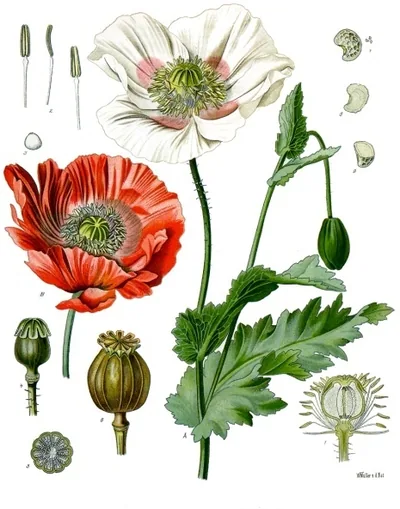
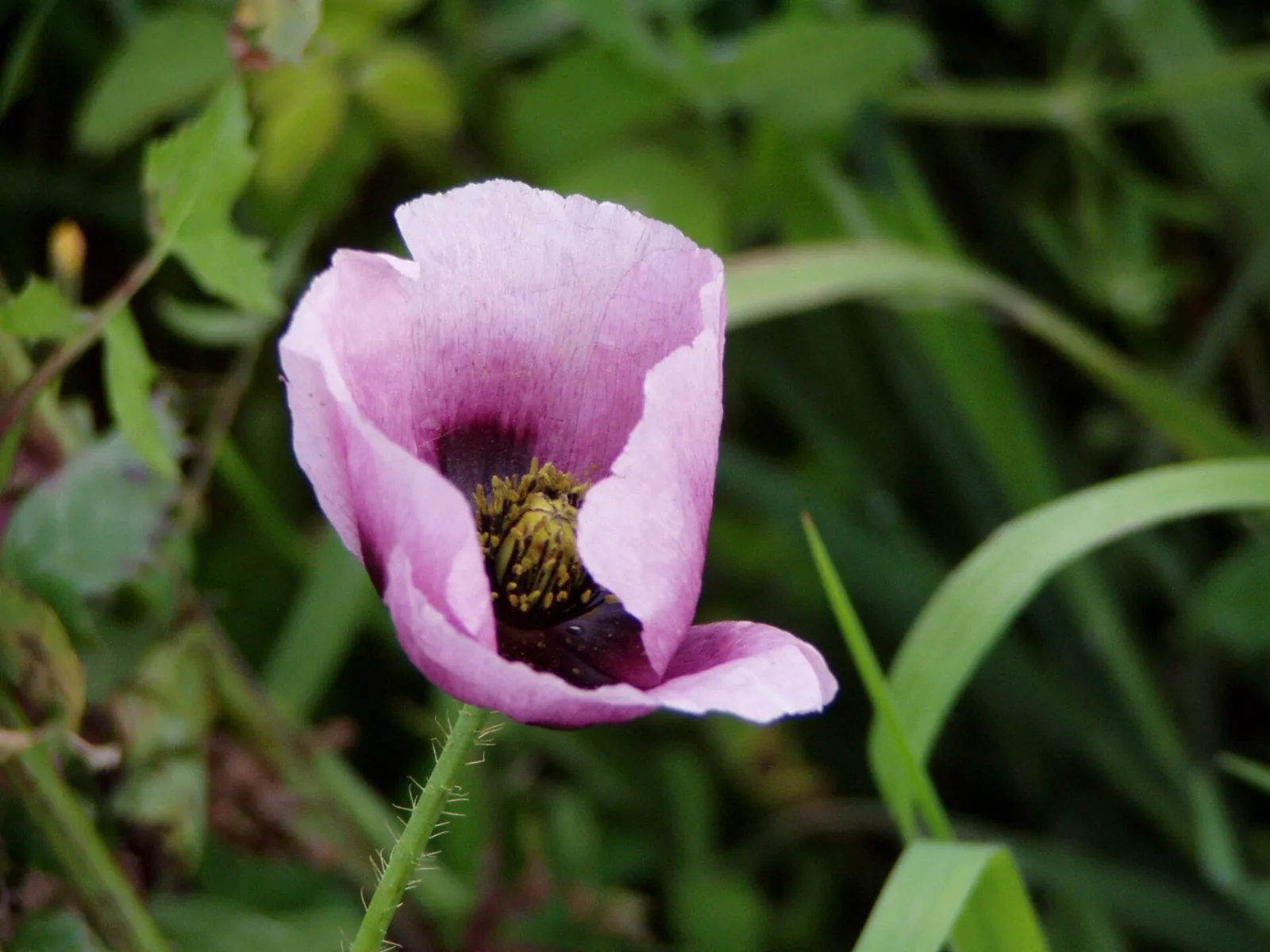
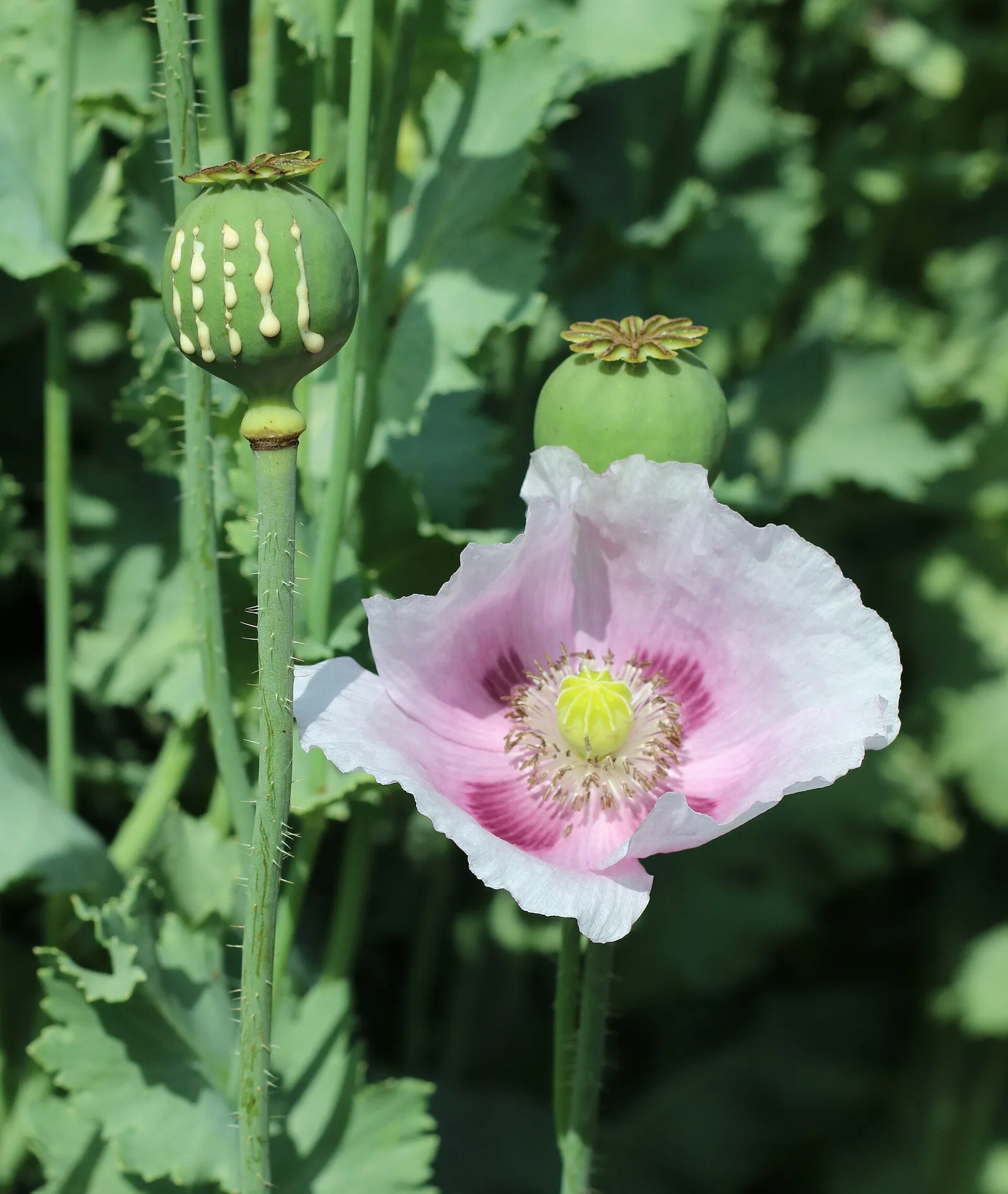
| Morphology | A glaucous annual with clasping blue-green leaves, large four-petalled flowers of variable colour and a distinctive spherical capsule crowned by a radiating stigmatic disc. Latex exudes from the green capsule when incised.
|
Territories
- 1La Marmotta, central Italy · charred capsules of about 5620–5480 cal BCE, the oldest of eleven directly dated Neolithic sites (Salavert et al., 2020)
- 2La Gillière 2, western Alps · the earliest opium poppy in the western Alps, 5000–4850 cal BCE (Salavert et al., 2020)
- 3Zurich-Parkhaus Opéra · waterlogged seeds of about 3170 BC, 18 wild-type and 15 domestic-type (Jesus et al., 2021)
- 4Mekonê, near Corinth · Hesiod’s Mekonê, “Poppy-town”, later Sikyon (Kritikos and Papadaki, 1967a)
- 5Gazi, Crete · the goddess Marinatos called “The Poppy Goddess, Patroness of Healing” (Kritikos and Papadaki, 1967a)
- 6Cyprus · base-ring juglets, linked to opium by their shape; papaverine and thebaine in a sealed example (Smith et al., 2018)
Deep Time
- c. 5620–5480 cal BCECharred capsules at La Marmotta, central Italy: the oldest of eleven directly dated Neolithic sites.
- c. 5300–4800 cal BCECarried north beyond its native range, reaching the western Alps about 5000–4800 cal BCE.
- c. 3170 BCWaterlogged seeds at Zurich-Parkhaus Opéra, wild and domestic types together.
- Late Bronze AgePapaverine and thebaine in a sealed Cypriot base-ring juglet.
- 1753Named by Linnaeus.
Domestication
Where the poppy was first brought into cultivation is not settled, but recent work points west. Its putative wild relative, P. somniferum subsp. setigerum, grows spontaneously in the central and western Mediterranean, though its taxonomy and phylogeny “have not been entirely resolved”, and the seeds of the wild and cultivated forms cannot be told apart by size, shape or surface (Salavert et al., 2020). Only two Pre-Pottery Neolithic sites in the Near East and Anatolia have yielded poppy seeds, and these may have fallen from later layers: wild opium poppy does not grow there today, and no remains are known along the route of Neolithic farming into Europe before 5300 cal BCE. Salavert and colleagues therefore take as the best-argued hypothesis that the opium poppy “could be the only crop to have been domesticated in western Europe” (Salavert et al., 2020).
Dating the seeds and capsules themselves, they find the plant in central Italy from the middle of the sixth millennium BCE, carried north beyond its native range from about 5300–5200 cal BCE, and reaching the western Alps about 5000–4800 cal BCE; the pile-dwellings of the Swiss Plateau, between 4300 and 2600 cal BCE, hold the largest quantities of opium poppy remains known in Europe. At one German site the poppy is tied to a single group of households, which they read as “a particular know-how” attached to a crop with several uses: food, the oil in its seed, and “the psychoactive properties of the latex exuded by the capsules” (Salavert et al., 2020).
Counting the cells of the seed coat and tracing seed outlines separates seven Papaver taxa, and the two subspecies, in modern seed. Applied to 33 waterlogged seeds from Zurich-Parkhaus Opéra, about 3170 BC, the method assigned 18 to the wild subspecies and 15 to the cultivated one: either a population midway through domestication, or a domestic crop with wild plants persisting as weeds. After some 1,100–1,200 years of cultivation in the Alpine Foreland the plant still appears to be in the process of domestication, which the authors read as a protracted process, as with other Neolithic crops (Jesus et al., 2021).
02Chemistry
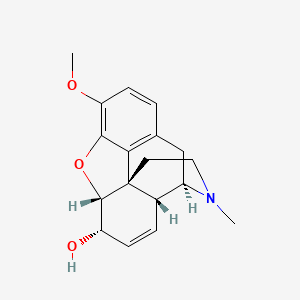
The latex of the unripe capsule carries the opium alkaloids: morphine and codeine act at opioid receptors, thebaine is a precursor rather than an analgesic in its own right, and papaverine and noscapine are benzylisoquinolines with no opioid action at all. The proportions vary by cultivar, climate and the moment the capsule is scored.
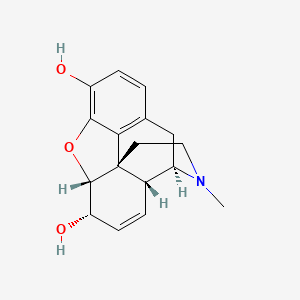
Morphine
Codeine

Thebaine
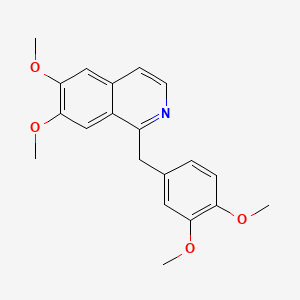
Papaverine

Noscapine
The plant makes more than forty alkaloids, five of them primary: morphine, codeine, thebaine, papaverine and noscapine. Morphine is the most abundant and the main source of opium’s narcotic effects (Smith et al., 2018).
Biosynthesis and the genome
To make morphine the plant must convert (S)-reticuline to its mirror form, (R)-reticuline. One gene, STORR, does this. It encodes a single protein with two modules: a cytochrome P450, which turns (S)-reticuline into 1,2-dehydroreticuline, and an oxidoreductase, which turns that into (R)-reticuline. The fusion of the two, the authors suggest, reflects selection for passing the intermediate directly from one step to the next (Winzer et al., 2015).
The draft genome, 2.72 gigabases in eleven chromosomes, shows how the machinery arose: a whole-genome duplication about 7.8 million years ago; a cluster of fifteen genes for the noscapine and morphinan branches of the plant’s benzylisoquinoline alkaloids; and the P450 and oxidoreductase genes that combined to form STORR. Gene duplication, rearrangement and fusion, the authors conclude, produced the plant’s specialised alkaloids (Guo et al., 2018).
Morphine does not keep. In artificial ageing of opium, papaverine and thebaine proved the most stable alkaloids while morphine degraded rapidly, which is why archaeological chemistry now looks for them rather than for morphine (Smith et al., 2018).
03Tradition, ritual & cultural use
Oldest evidenced or proposed human use
Neolithic European finds indicate early cultivation, while unambiguous evidence for opium extraction appears later; Bronze Age imagery and containers remain debated.
The oldest directly dated remains are the charred capsules of La Marmotta in central Italy, about 5620–5480 cal BCE, and seeds turn up widely among Early Neolithic farmers, at some fifty sites between 5900 and 4700 cal BCE (Salavert et al., 2020). What those farmers did with the plant is not recorded; Salavert and colleagues name food, seed oil and the latex as its uses (Salavert et al., 2020).
Bronze Age vessels
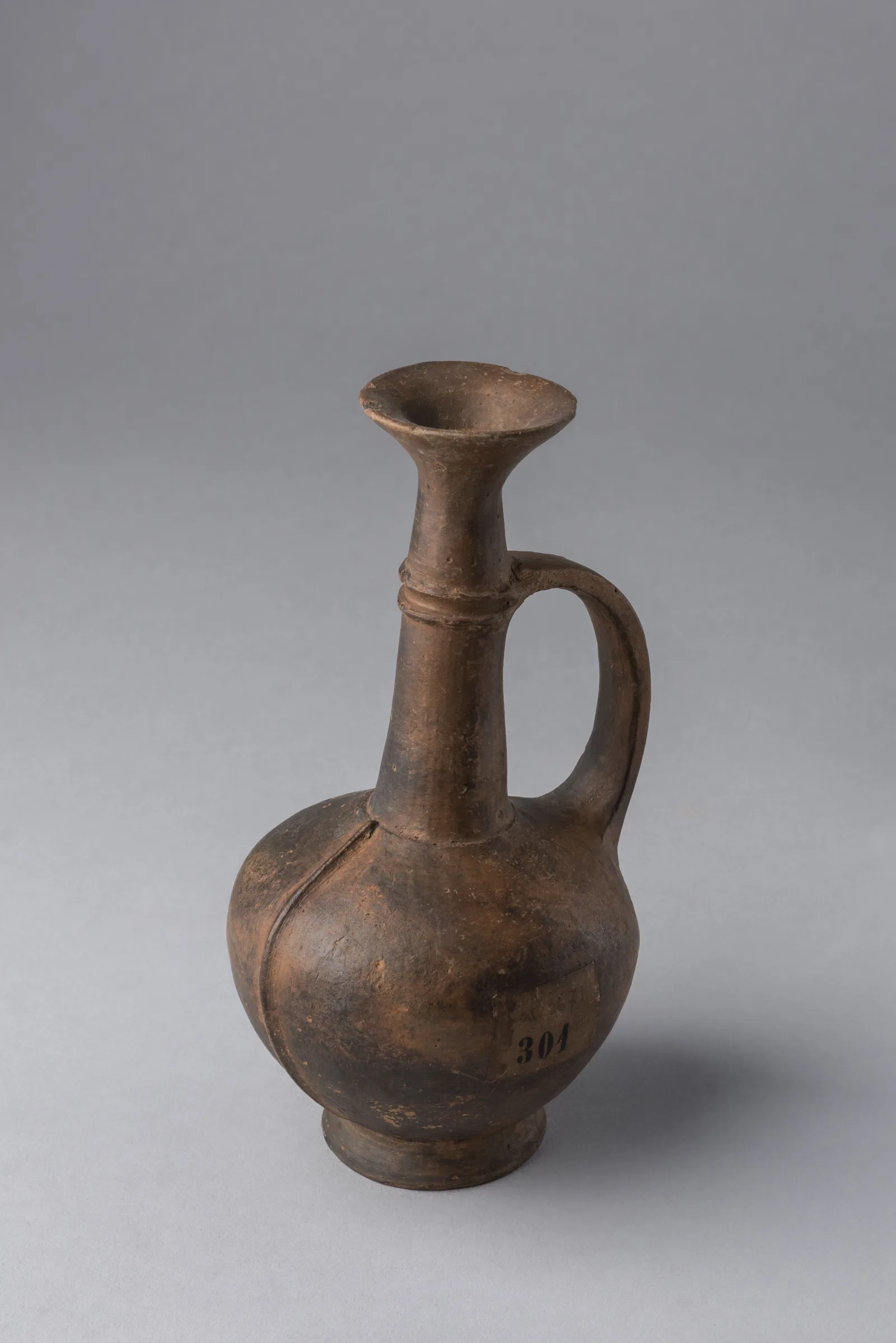
Base-ring juglets, thin-walled Cypriot flasks traded widely around the eastern Mediterranean in the Late Bronze Age (about 1650–1350 BC), were linked to opium by Merrillees in 1962: turned upside down, the vessel resembles a poppy capsule, and striped decoration on some was read as the scoring of the capsule (Smith et al., 2018). For decades chemistry could not settle the matter. The only earlier positive result, from a juglet found in Egypt and published in 1996, reported morphine, codeine and noscapine, the alkaloids least likely to survive (Smith et al., 2018).
A sealed juglet in the British Museum (1981,1218.53) allowed a closer test. Its contents were a degraded plant oil, for which poppyseed is a plausible source, and in them the analysts found papaverine and thebaine, “the first rigorous chemical evidence to support a link between this vessel type and opium, or at least poppies”. The levels were very low, and an oil suits a pourable liquid rather than solid opium, so the purpose of the commodity remains an open question (Smith et al., 2018).
Greek testimony
In Greek letters the poppy appears first in Hesiod, who names a city near Corinth Mekonê, “Poppy-town”; commentators said it was named for the poppy grown around it, or because Demeter first found the poppy’s fruit there (Kritikos and Papadaki, 1967a). Homer uses the plant for a dying warrior in the Iliad, “as a poppy which in the garden is weighed down by fruit and vernal showers, droops its head on one side”, and in the Odyssey gives Helen nepenthes, a drug from Egypt “to lull all pain and anger, and bring forgetfulness of every sorrow” (Kritikos and Papadaki, 1967a; Kritikos and Papadaki, 1967b).
The medical writers are plainer. Hippocrates distinguishes white, fire-red and black poppies, and Theophrastus records the Mantineian root-doctor Thrasyas, who wrote that the juices of poppy and hemlock gave “an easy and painless death” (Kritikos and Papadaki, 1967a).
- Contested
Nepenthes. Homer names no plant. Theophrastus held that drugs of this kind “appear to be inventions of the poets”, and other ancient writers took nepenthes as an allegory of Helen’s charms; its identification with opium is an inference (Kritikos and Papadaki, 1967a).
Peoples & traditions
Used across ancient Mediterranean and Near Eastern societies and later Islamic, South Asian, East Asian and global medical and social histories.
Role in shamanism
Its record is more strongly medical, funerary, devotional and oracular than conventionally shamanic; claims should be located in particular societies.
Role in physical healing
A foundational analgesic and sedative whose alkaloids gave rise to morphine, codeine and modern opioid medicine, alongside dependence and overdose crises.
04Cosmology & key terms
Sleep and death were imagined beside the poppy. Nencini (1997), classical Mediterranean traditions
Greek art put the poppy in the hands of the gods of sleep, night and death: Hypnos, Nyx and Thanatos were shown wreathed with poppies or holding them, and statues of Apollo, Asklepios, Pluto, Demeter, Aphrodite, Kybele and Isis carried them too, sometimes bound with ears of corn (Kritikos and Papadaki, 1967a). Demeter’s bond with the plant was told as myth. Grieving for Persephone, she ate poppies to sleep and forget, and she gave poppies to Triptolemus to bring him sleep; on a basket at Eleusis the poppy is shown with ears of corn (Kritikos and Papadaki, 1967a).
Kritikos and Papadaki argued that the capsule’s meaning changed with the god who held it, and named four associations: “life or wealth by reason of the oil taken from its multitude of seeds”; “healing, because of its narcotic, hypnotic, and general curative properties”; “euphoria, voluptuous ecstasy, and increased fertility”; and “sleep and death, which can be induced by the plant”. In Demeter’s hands, beside the wheat-ear, they read the capsule as health rather than plenty, the two together marking her as protectress of life and of health (Kritikos and Papadaki, 1967b).
The goddess of Gazi
At Gazi, near Heraklion, S. Marinatos excavated five terracotta figures of the Minoan goddess with upraised hands. The largest wears three movable pins in the likeness of poppy heads, and Marinatos called her “The Poppy Goddess, Patroness of Healing” (Kritikos and Papadaki, 1967a).
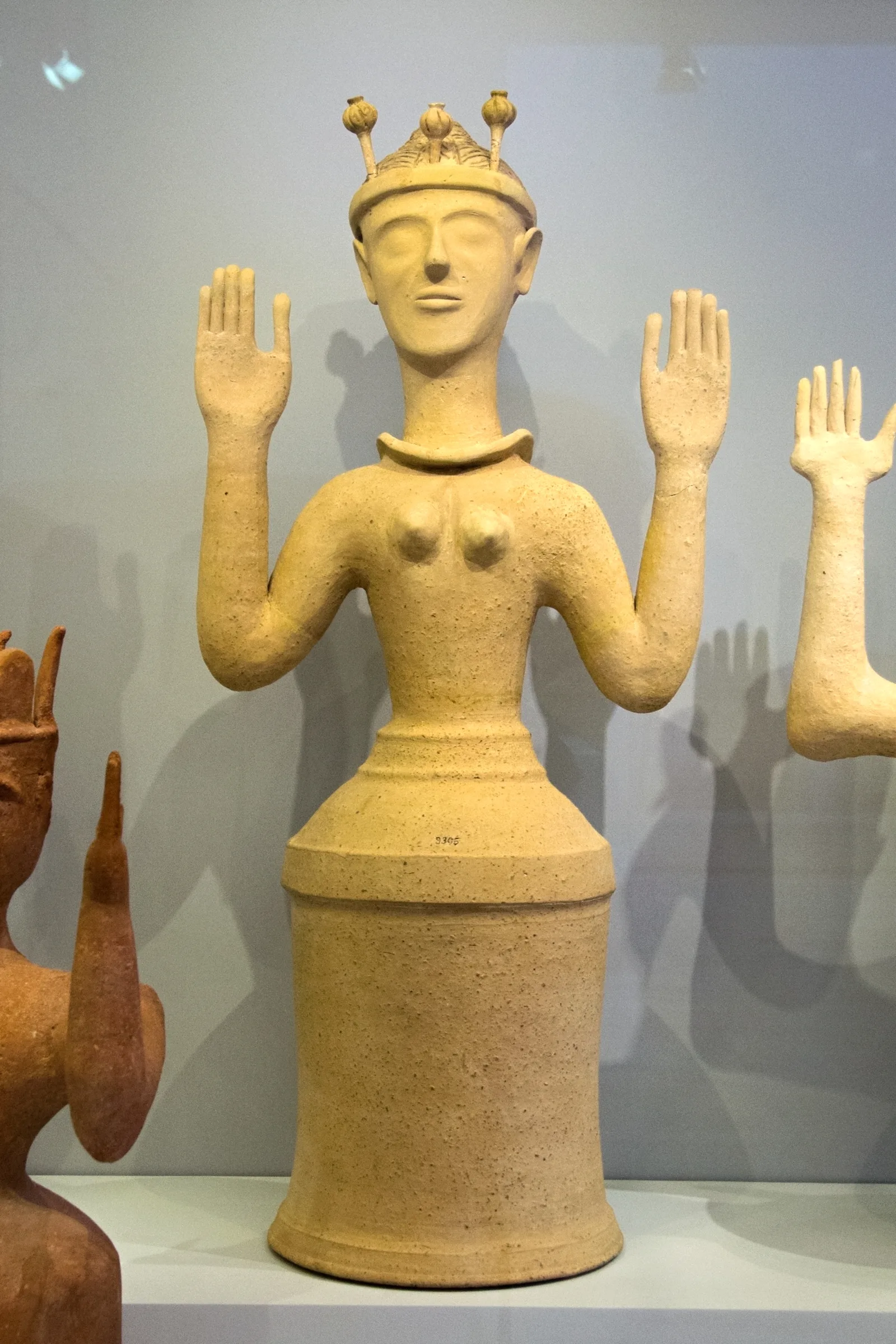
Examining the figure in 1959, Kritikos read the pins as opium poppy capsules with vertical notches, coloured like the dried juice of the poppy; he saw her eyes as closed “as though asleep” and her face as one of pleasure. From a tubular vessel and the remains of charcoal found with her, in a doorless and windowless room, he inferred that opium was inhaled as vapour, and proposed that she be called “the goddess of ecstasy” (Kritikos and Papadaki, 1967a).
- Interpretation
A reading of a figure. The capsules on the pins are plain to see. That the goddess is intoxicated, and that opium was inhaled at Gazi, are Kritikos’s inferences from her face and from a vessel he compared with Javanese vases for inhaling opium (Kritikos and Papadaki, 1967a). Marinatos took the poppy as a sign of healing, and Mylonas likewise read it as a medicinal symbol and the figure as a goddess of cures (Kritikos and Papadaki, 1967b).
- Mekon
- The Greek name of the poppy (Doric makon); its etymology is uncertain (Kritikos and Papadaki, 1967b).
- Mekonion
- A substance flowing or pressed from the poppy; Latin meconium (Kritikos and Papadaki, 1967b).
- Opion
- Opium; the word first appears in works of the first century AD, from Greek opos, “juice” (Kritikos and Papadaki, 1967b).
- Papaver
- The Latin name, found chiefly in Latin authors such as Cato, Pliny the Elder and Celsus (Kritikos and Papadaki, 1967b).
- Nepenthes
- The grief-dispelling drug Helen gives in the Odyssey (Kritikos and Papadaki, 1967a).
05Visionary phenomenology
A dreamlike withdrawal from pain and ordinary urgency. Booth (1996), historical testimony
Phenomenological profile
The profile lists effects the sources report, for each preparation separately, grouped by domain. Each row gives the grade, how often the sources say the effect occurs (only where they say so; most do not) and the kinds of source behind it. A chip naming a compound, such as “Trial · psilocybin”, means the evidence comes from studies of that compound rather than of the preparation itself; “partial” means the route, purity or dose differs from the traditional preparation, so the row cannot be graded above supported. The line under each preparation says which domains have evidence entered here. A domain with nothing entered has not yet been assessed in this profile; that is not a finding that the literature is silent, and the article may discuss it. Open a row for the note and the sources.
Opiumeaten or drunk as laudanum
Evidence entered for 4 of 8 domains. Not yet entered: other senses, body, self and unity, relation to other beings.
The fullest early record from the inside is literary (De Quincey, 1821). Clinical studies of morphine have not yet been read for this record.
Visual
Cosmic and scalar visionThe world, the body or space seen at an altered scale: shrunk, enlarged, or opened to the immense.SupportedSingle reportExperience
“Space swelled, and was amplified to an extent of unutterable infinity” (De Quincey, 1821). One writer’s literary record.
Affect
Bliss and euphoriaIntense joy, beauty, love or wellbeing.SupportedSingle reportExperience
“Thou hast the keys of Paradise, oh, just, subtle, and mighty opium!” (De Quincey, 1821). One writer’s literary record.
Fear and dreadFear, panic, chaos or a sense of threat during the experience.SupportedSingle reportExperience
A nightly descent “into chasms and sunless abysses”, with “deep-seated anxiety and gloomy melancholy” (De Quincey, 1821). One writer’s literary record.
Cognition
Autobiographical recallVivid re-experiencing or re-viewing of one’s own past, often recast from new positions.SupportedSingle reportExperience
Forgotten scenes of childhood returned, recognised at once (De Quincey, 1821). One writer’s literary record.
Time distortionTime felt to slow, stretch, stop or lose its ordinary order, or durations misjudged.SupportedSingle reportExperience
“I sometimes seemed to have lived for 70 or 100 years in one night” (De Quincey, 1821). One writer’s literary record.
States of consciousness
Dreamlike statesOneiric experience: dream formation, dreamlike sequences or a waking state resembling dreaming.SupportedSingle reportExperience
Images called up in the dark passed into dreams: “a theatre seemed suddenly opened and lighted up within my brain” (De Quincey, 1821). One writer’s literary record.
Accounts
The fullest early record from the inside is literary. Thomas De Quincey’s Confessions of an English Opium-Eater, published in the London Magazine in 1821, addresses the drug directly in its section on the pleasures of opium: “thou buildest upon the bosom of darkness, out of the fantastic imagery of the brain, cities and temples beyond the art of Phidias and Praxiteles … Thou only givest these gifts to man; and thou hast the keys of Paradise, oh, just, subtle, and mighty opium!” (De Quincey, 1821).
In the section on its pains he sets out how his dreams changed: “a theatre seemed suddenly opened and lighted up within my brain, which presented nightly spectacles of more than earthly splendour”. He lists four changes: images called up in the dark passing into dreams; a nightly descent “into chasms and sunless abysses”; the swelling of space and time; and the return of forgotten scenes of childhood. Of the third he writes, “Space swelled, and was amplified to an extent of unutterable infinity … I sometimes seemed to have lived for 70 or 100 years in one night” (De Quincey, 1821).
Recurring motifs
- Cities, temples and processions on a vast scale
- Space amplified, time expanded
- Forgotten scenes of childhood recognised at once
- Descent into abysses, and gloom
- Images called up in the dark passing into dreams
- Unresolved
One writer’s record. De Quincey’s is a literary confession, and he sets its splendour beside “deep-seated anxiety and gloomy melancholy, such as are wholly incommunicable by words” (De Quincey, 1821).
06Contemporary status
Cultivation is internationally controlled but remains central to pharmaceutical opioids and illicit economies. Scientific work spans analgesia, dependence and biosynthesis; policy is inseparable from colonial opium regimes, contemporary public-health crises and farmers’ livelihoods.
| Conservation | Not evaluated for the IUCN Red List (GBIF Secretariat, 2026). |
|---|---|
| International control | The 1961 Single Convention defines opium as “the coagulated juice of the opium poppy” and the opium poppy as “the plant of the species Papaver somniferum L.” A party that permits cultivation for opium must keep a national opium agency, which designates the plots, licenses the cultivators and takes delivery of the whole crop; where a party judges prohibition the most suitable way to protect public health and prevent diversion, it must prohibit cultivation (United Nations, 1961). |
| Traditional use | Article 49 let parties permit the quasi-medical use of opium and opium smoking only temporarily, where these were traditional and permitted on 1 January 1961; quasi-medical use was to be abolished within fifteen years of the Convention coming into force (United Nations, 1961). |
Legality
| Jurisdiction | Status |
|---|---|
| United States | Opium poppy and poppy straw are in Schedule II, with opium and opiates and concentrate of poppy straw, 21 CFR §1308.12(b) (Electronic Code of Federal Regulations, 2026). |
Open questions on this entry
Safety and law
07Cross-correlations
| Claviceps purpurea | Species monograph: ergot, the fungus at the centre of the modern psychoactive hypothesis for the Eleusinian kykeon; the poppy enters the same debate through Demeter imagery, with opiate rather than ergoline pharmacology. ELEUSINIAN COMPARATOR |
|---|---|
| Mitragyna speciosa | Species monograph: kratom, the archive’s other plant whose alkaloids act at μ-opioid receptors; mitragynine and 7-hydroxymitragynine differ from morphine in structure, efficacy and signalling. OPIOID-RECEPTOR COMPARATOR |
| Erythroxylum coca | Species monograph: the 1961 Single Convention applies the licensing system it sets for the opium poppy to any permitted cultivation of the coca bush, and its Article 49 set traditional uses of both, opium smoking and coca-leaf chewing, on a path to abolition (United Nations, 1961). SINGLE CONVENTION PLANT |
| Cultural complex | Eleusinian Kykeon–Mystery Complex — where the poppy and ergot hypotheses are weighed together |
08Bibliography
How to read the labels on each source
- Source type
- What kind of work it is: journal article, book, legislation, patent application, database record and so on. A word after the dot (ethnography, protologue, primary source) keeps the genre the entry was first filed under. “Unclassified” means the citation does not say enough to tell.
- Peer review
- Recorded for each work separately, and only where it has been confirmed for that work. It is never inferred from a DOI, a publisher or a journal, since journals also publish editorials, letters and commentaries. Where it has not been confirmed, the entry records it as not established. It does not apply to legislation, court decisions, treaties, patents, datasets, database and collection records, historical texts, films, talks, press releases or web pages.
- Check
- What was checked when the entry was added. DOI checked: the DOI’s registry record (Crossref) matched the citation’s title, first author and year. Verified: the record itself was opened and matched the citation: a library catalogue record for a book, or the page itself for a database entry, law, patent or archive document. “Verified (abstract)” and “(summary)” mean only the abstract or a summary was read. Located: a record was found but not fully matched. Bibliographic record and Stable record (in essays): a catalogue or stable web record exists; what was checked against it is not recorded. Unverified: no check is recorded. No locator found: a search found no record. Secondary: read through another source.
- What the labels do not say
- None of them means the source supports a particular sentence. Where a sentence is graded, its evidence note names its sources and whether each supports it, disputes it or gives context. Dates and reviewers of checks are not recorded for each entry; the version note at the foot of a graded page dates its last review.