01Culture
Clinical territories
Saskatchewan · Prague · Britain · Maryland
1950s–1970s
Hospital psychiatry, alcoholism treatment, psycholytic therapy and Spring Grove/Maryland research developed the room, music and high-dose “psychedelic therapy” forms that still shape current protocols (Dyck, 2005; Oram, 2016).
Menlo Park · IFAS
1961–1965
Myron Stolaroff’s International Foundation for Advanced Study joined engineering culture, creativity research and guided LSD/mescaline sessions. Willis Harman, James Fadiman, Robert Mogar and others worked within its orbit (Oram, 2016).
Underground therapy · California · Russia
1970s–1990s
Leo Zeff transmitted MDMA and other methods through informal therapist networks; Stolaroff later recorded this lineage. In Leningrad/St Petersburg, Evgeny Krupitsky and Andrei Grinenko developed ketamine psychedelic therapy for addiction from the late 1980s (Stolaroff, 2004; Krupitsky and Grinenko, 1997).
Johns Hopkins · Imperial · Zürich · academic centres
2000s–present
Modern psilocybin research rebuilt controlled trials, safety standards, neuroimaging and mystical-experience measurement around academically acceptable indications (Griffiths et al., 2006; Johnson, Richards and Griffiths, 2008).
MAPS network · multinational trial sites
1990s–present
MAPS, founded by Rick Doblin in 1986, coordinated a long campaign to move MDMA from underground therapy into clinical development. Michael and Annie Mithoefer, Marcela Ot’alora, Jennifer Mitchell and many site teams translated that project into manuals and trials.
Infusion clinic · KAP practice · telehealth · REMS centre
2000s–present
Ketamine expanded through multiple economies: generic off-label treatment, psychotherapy practice, venture-funded clinic chains, at-home compounded products and Johnson & Johnson’s proprietary esketamine system (Drabiak, 2025).
History and evidence
Explanatory cosmologies
Psychodynamic / transpersonal: Grof’s cartography organised sessions through biographical, perinatal and transpersonal domains and treated intensified experience as a process with its own direction. This model remains influential among practitioners, outside the neuroscientific consensus (Grof, 1980).
Peak and mystical experience: Pahnke’s categories—unity, transcendence of time and space, sacredness, deeply felt positive mood, paradoxicality and ineffability—were revised into modern mystical-experience scales. Correlations between such scores and outcome are important; a single causal mechanism needs further proof (MacLean et al., 2012).
Trauma processing and social safety: MDMA protocols describe an “inner healing intelligence” while research also examines fear extinction, autobiographical memory, affiliation and therapeutic alliance. The manual’s organismic language coexists with biomedical and psychotherapeutic models (Mithoefer, 2017; Mitchell et al., 2021).
Neuroplasticity and critical periods: Contemporary neuroscience frames psychedelic and entactogenic treatments through network dynamics, synaptic plasticity, reopening of learning windows and context-sensitive updating. These mechanisms remain differentiated by compound, and distinct from subjective meaning.
Ketamine’s plural models: The infusion clinic emphasises NMDA blockade, glutamatergic cascades and rapid symptom reduction. KAP adds loosened defences, dissociation, imagery and therapeutic relationship. Krupitsky’s KPT deliberately used an immersive altered state within addiction psychotherapy. Lilly’s “metaprogramming” imagined the mind as a self-modifying biocomputer; it is historically influential in technological psychedelic culture, though unvalidated as a treatment mechanism (Krupitsky and Grinenko, 1997; Williams, 2019).
02Ritual
The clinical sequence
Referral, diagnosis and selection
The person becomes a candidate through a diagnosis, inclusion/exclusion criteria, medication review, risk assessment and consent. This gateway is simultaneously clinical, ethical and administrative.
Preparation and alliance
Meetings establish biography, intention, expected effects, touch boundaries, emergency procedures and a response to fear. Expectancy is an active element of the treatment setting (Hartogsohn, 2017).
Threshold and administration
A capsule, infusion, injection, lozenge or nasal device marks the transition into an altered-state interval. Baseline scores and vital signs establish a before-state against which change will be judged.
Inward attention and accompaniment
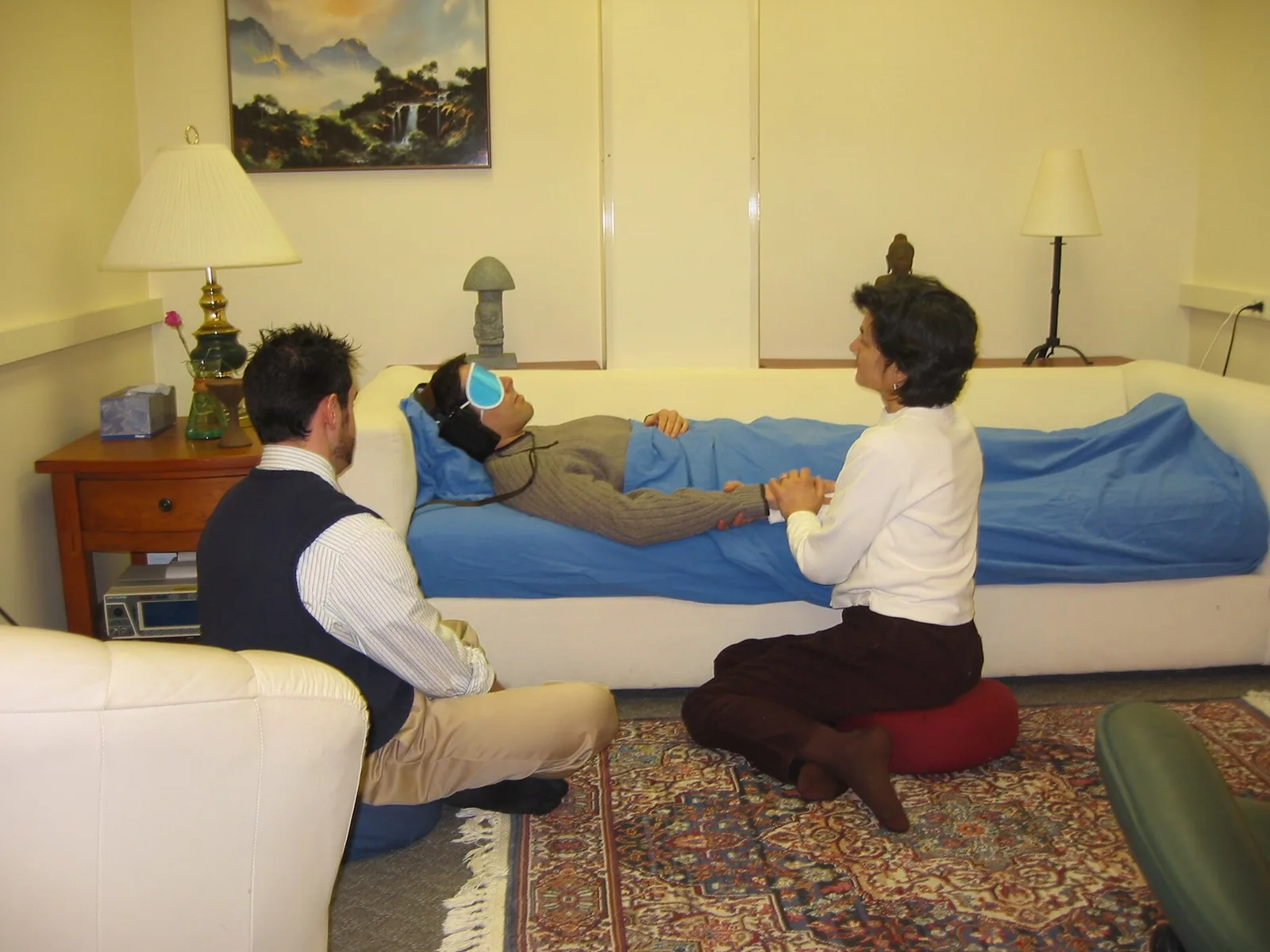
Eyeshades, headphones, posture and the attendants’ restrained presence support experiential unfolding. MDMA protocols alternate inward attention with dialogue; medical ketamine sessions may be comparatively procedural.
Return and observation
Food, conversation, repeated vital signs, mobility checks and discharge criteria restore ordinary social and bodily orientation. A support person or transport plan often mediates return beyond the clinic.
Narration, scoring and follow-up
The event becomes a case through integration talk, symptom scales, adverse-event reports and scheduled reassessment. Durable benefit, relapse and retreatment are produced as temporal clinical questions.
Healers, witnesses and authorities
Therapist / guide
Relational authority. Maintains attention, interprets cautiously, manages boundaries and helps connect experience to the person’s life. Training, licensure and role definition vary across trials and jurisdictions.
Physician / nurse / anaesthesia competence
Medical authority. Selects, prescribes or administers; monitors cardiovascular, respiratory, psychiatric and medication risks; and acts when acute support is needed. This role is especially visible in ketamine and esketamine care.
Protocol / manual
Procedural authority. Converts tacit craft into trainable and auditable actions. Manuals stabilise a treatment across sites while leaving unresolved how much benefit belongs to drug, therapist, expectancy or their interaction.
Psychometrician / rater
Epistemic authority. Interviews and scales make symptoms and extraordinary experiences countable. Independent raters can reduce allegiance effects, but functional unblinding remains difficult in psychoactive-drug trials.
Sponsor / manufacturer
Product authority. Produces the investigational drug, finances trials, owns data and IP, and proposes the final use to regulators. Corporate form therefore enters the therapeutic apparatus.
Regulator / ethics committee
Public authority. Defines acceptable evidence, manufacturing quality, risk controls, therapist conduct and market access. Approval of a molecule leaves any surrounding psychotherapy to separate approval.
Art and material culture
The room is a designed instrument. Soft furniture, low light, flowers, textiles, landscape or abstract art and an absence of conventional medical clutter domesticise the laboratory. Eyeshades and headphones restrict external input while a playlist supplies a changing emotional landscape. At the same time, the infusion pump, blood-pressure cuff, pulse oximeter, locked drug cabinet, nasal-spray device, therapist manual, adverse-event form and rating tablet display the clinic’s technical and legal obligations. These objects jointly stage intimacy and auditability (Dumit and Sanabria, 2022).
Music is the most developed art form within the protocol. Bonny and Pahnke mapped selections to pre-onset, onset, building, peak, re-entry and return phases. Modern playlists preserve this dramatic arc, but cultural familiarity, lyric content, patient choice and the power of the curator remain active research questions. Kaelen and colleagues’ description of music as a “hidden therapist” captures its perceived agency, and shows why playlist design is itself part of the treatment (Bonny and Pahnke, 1972; Kaelen et al., 2018).
Psychometric liturgy: what the clinic counts
| Domain | Examples | What becomes legible | Limit |
|---|
| Depression | MADRS · HAM-D · QIDS · PHQ-9 | Clinician-rated or self-reported symptom change, response and remission | Can miss existential, relational and functional changes; repeated scores may shape expectation |
| Trauma | CAPS-5 · PCL-5 · Sheehan Disability Scale | PTSD severity and functional impairment | Drug effects can reveal treatment allocation; rater and expectancy controls remain central |
| Mystical-type experience | MEQ30 | Unity, transcendence, sacredness, positive mood and ineffability | A historical construct derived from particular religious-psychological categories |
| Altered consciousness | 5D/11D-ASC · 3D-ASC revised | Oceanic boundlessness, visionary restructuralisation and anxious ego dissolution | Factor structures vary by drug, population and translation |
| Process | EDI · EBI · CEQ · IES/EIS | Ego dissolution, emotional breakthrough, challenging experience and integration | Retrospective reports are sensitive to narrative framing and demand characteristics |
| Dissociation | CADSS · clinician observation | Depersonalisation, derealisation and amnesia, frequently used in ketamine research | Dissociation can be coded as side effect, mediator, therapeutic material or all three |
03Visionary phenomenology
Clinical phenomenology is produced by compound, intensity, route, biography, music, expectations and the explanatory language available afterward. The same event may enter a case report as “dissociation,” an integration session as “distance from depression,” and a participant’s account as death, encounter or revelation. The descriptions below distinguish recurring patterns without treating them as inevitable (Hartogsohn, 2017; Gukasyan and Nayak, 2022).
Psilocybin · visual, affective and unitive
Onset · approximately 20–60 minutes
Bodily energy, yawning, nausea, anxiety and sensory intensification may accompany the passage from ordinary attention. Music becomes spatial and emotionally commanding.
Visual restructuring
Closed-eye geometry, saturated colour, organic pattern, faces, landscapes and rapidly transforming symbolic scenes are common. With eyes open, surfaces may breathe or acquire intensified significance.
Biographical and affective depth
Memories can become vivid, embodied and morally charged. Grief, tenderness, shame, terror and gratitude may arrive in sequences that participants later narrate as emotional release or insight.
Unity and sacredness
Boundary-softening, timelessness, unity, noetic conviction and ineffability form the “mystical-type” cluster measured by the MEQ30. High scores correlate with some outcomes; they are absent in some who benefit, and insufficient alone (MacLean et al., 2012).
MDMA · affiliative, somatic and trauma-facing
Onset · approximately 30–60 minutes
Warmth, activation, jaw tension, nausea or apprehension may precede a marked sense of openness. Cardiovascular and temperature effects give the experience a visible medical dimension.
Relational safety
Participants often describe trust, closeness and reduced fear of judgment. The therapist may feel unusually accessible; this intensification makes boundaries and power especially consequential.
Traumatic memory with dual attention
Memories can be revisited while retaining contact with present safety. Alternation between eyeshaded inward work and spoken narration allows image, body sensation and autobiographical meaning to interact.
Vision and aftermath
MDMA is less consistently visual than psilocybin, but dreamlike imagery, symbolic scenes and somatic reliving occur. Fatigue, sleep disruption or low mood may follow; a serene “afterglow” is also reported.
Ketamine · dissociative, spatial and ontologically intense
Psycholytic distance
At lighter intensities, associations loosen, habitual rumination recedes and the body may feel buoyant or remote. A participant can observe emotions with less defensive urgency, allowing dialogue during or soon after the acute phase.
Altered embodiment
Floating, rotation, weightlessness, expansion or contraction of body scale and an observer perspective are characteristic. Touch, gravity and the boundary between body and furniture may become ambiguous.
Spatial and architectural vision
Dark voids, tunnels, chambers, grids, immense machines, cities, landscapes and ecological or cosmic systems can unfold with a compelling three-dimensional logic. Vision may feel travelled through.
Time collapse and world-loss
Clock time may fragment, loop or disappear. At immersive intensity, ordinary body and room can vanish; some accounts resemble near-death, death–rebirth or disembodied consciousness. These states can be peaceful, terrifying or emotionally neutral.
Return, memory and after-effect
Re-entry may be abrupt or gradual, with dizziness, nausea, confusion and incomplete recall. Rapid relief can precede any articulated insight; in KAP, later narration converts image and dissociation into therapeutic material.
Clinical ambiguity
The same dissociation can be measured as an adverse effect, investigated as a possible mediator and valued as a visionary opening. Current evidence supports ketamine’s rapid antidepressant action more strongly than it supports any single phenomenological mechanism.
In the province of the mind, what one believes to be true either is true or becomes true within certain limits.John C. Lilly, Programming and Metaprogramming in the Human Biocomputer (1972). A statement of the experimental constructivism that shaped his isolation-tank and ketamine work; not a clinical efficacy claim.
Salient clinical accounts
Grof lineage · experiential sequence
The session as unfolding process. Biographical scenes may give way to birth/death imagery and transpersonal identification. Grof treated this sequence as an autonomous tendency of the psyche; later protocols retain “trust, let go, be open” while often suspending his full cartography (Grof, 1980).
MDMA trauma work · tolerable approach
Fear and contact coexist. The person can approach traumatic material while retaining affiliative connection to the therapist and present room. This phenomenology underlies the proposed PTSD treatment model, which needs its own validation (Mitchell et al., 2023; FDA, 2024a).
Ketamine KPT/KAP · dissociative passage
Vision can be spatial before it is narrative. A world of voids, structures and altered embodiment may be followed by emotional release or rapid mood change. Russian KPT deliberately organised high-intensity dissociation as psychotherapeutic experience; contemporary KAP is more heterogeneous (Krupitsky and Grinenko, 1997; Simpson et al., 2026).
04Contemporary transformations
Evidence in 2026
establishedKetamine’s rapid antidepressant action: replicated controlled studies support rapid short-term reductions in depressive symptoms, including in treatment-resistant populations. Questions concern durability, maintenance, long-term safety and selection. Generic ketamine’s psychiatric prescribing remains off-label in the USA (Berman et al., 2000; Zarate et al., 2006).
developingKetamine-assisted psychotherapy: practice models combine ketamine and therapy in markedly different ways. A 2026 systematic review found reported improvement across eleven studies but high heterogeneity and low overall evidence quality; the three controlled studies found no significant between-group advantages. Ketamine’s pharmacological efficacy stands; the additive effect and optimal form of psychotherapy remain unresolved (Simpson et al., 2026).
phase 3Psilocybin for treatment-resistant depression: peer-reviewed Phase 2 studies showed a rapid effect with adverse events and relapse requiring attention. COMPASS reported that both pivotal COMP360 Phase 3 trials met their primary endpoints in 2025 and 2026; the 2026 results and six-month data were corporate topline disclosures at this page’s review date and require peer-reviewed appraisal (Goodwin et al., 2022; COMPASS Pathways, 2026a; 2026b).
regulatory failureMDMA for PTSD: two Phase 3 trials reported substantial benefit under a manualised therapy model (Mitchell et al., 2021; 2023). In August 2024 the FDA issued a Complete Response Letter, citing problems with how the treatment should be used, durability and supporting evidence, and requested an additional study. Advisory review also exposed functional unblinding, expectancy, therapist conduct and data-integrity concerns (FDA, 2024a; 2024b).
Regulatory authority and access
| Jurisdiction / system | Current position | Ritual consequence |
|---|
| United States · ketamine | Ketamine is Schedule III and FDA-approved as an anaesthetic; racemic psychiatric use is off-label. Compounded forms are not FDA-approved for psychiatric treatment. | Prescribers can build divergent infusion and KAP practices without a single federally approved psychotherapy protocol. FDA warned in 2023 about compounded and at-home products, including sedation, dissociation, blood-pressure, respiratory and abuse risks where monitoring is inadequate (FDA, 2023). |
| United States · esketamine | Spravato is approved for treatment-resistant depression, including monotherapy under the 2025 label, and for depressive symptoms in adults with MDD with acute suicidal ideation or behaviour in conjunction with an oral antidepressant. | REMS requires certified settings, supervised administration and at least two hours of observation. The approved ceremony is repeated, medicalised and product-specific; psychotherapy is optional (FDA, 2025; 2019). |
| United States · MDMA | Schedule I; no approved medical use. FDA’s 2024 Complete Response Letter for NDA 215455 requested further study. | The regulator had to assess a drug-plus-therapy package while its drug jurisdiction and psychotherapy oversight fit imperfectly together. |
| United States · psilocybin | Schedule I federally; investigational drug development continues. Oregon operates a state-licensed adult service system. | Oregon requires preparation, supervised administration and offers integration through licensed facilitators at licensed centres; it requires no prescription or medical referral, and is a separate route from FDA-approved treatment (OHA, 2023). |
| Australia | Since July 2023, authorised psychiatrists may access MDMA for PTSD and psilocybine for treatment-resistant depression under the Authorised Prescriber system; products remain unapproved therapeutic goods and safeguards were revised in 2026. | Psychiatric specialist authority, human-research ethics review, controlled supply and reporting requirements define access; costs are generally borne privately because products are not PBS-listed (TGA, 2026). |
Clinic economies
Ketamine makes the contemporary economy especially visible. An inexpensive, off-patent generic molecule supports fee-for-service infusion clinics and psychotherapy practices; proprietary esketamine supports a reimbursable product with certification and repeated monitoring; telehealth firms have marketed compounded oral ketamine for home use. These models distribute cost, clinical attention and liability differently. The infusion model can minimise psychotherapy; KAP sells extended professional time; the esketamine model ties access to a branded device and REMS-certified site. Long-term maintenance may turn an acute intervention into recurring clinic attendance (Drabiak, 2025; FDA, 2023).
Psilocybin and MDMA development is labour-intensive because the session occupies most of a working day and may require two professionals plus preparation and follow-up. Developers therefore experiment with group preparation, digital monitoring, shortened compounds, specialist centres and therapist-training franchises. The resulting economics can restrict access even when the active molecule is inexpensive. Australia explicitly warns that its unapproved MDMA and psilocybine treatments are outside PBS funding; Oregon service prices are similarly separated from ordinary insurance medicine (TGA, 2026; OHA, 2023).
Patents, proprietary protocols and prior art
Psilocybin: COMPASS Pathways has obtained patents concerning crystalline forms of synthetic psilocybin and sought claims over treatment environments and methods. Critics and prior-art projects argue that features such as soft furniture, music, eyeshades and supportive attendants were documented in older clinical and underground practice. The dispute concerns novelty and control over a protocol as much as ownership of a molecule (Gerber et al., 2021; Marks, 2021).
Ketamine: racemic ketamine is generic, while esketamine, nasal delivery, formulations and indication-specific methods support newer intellectual property and regulatory exclusivity. The market therefore stratifies one chemical lineage into cheap generic, compounded and branded products with different evidence and oversight.
MDMA: MDMA itself is an old compound and long past any new monopoly. Commercial value accumulates around manufacture, formulation, therapeutic methods, data, training, trademarks and regulatory exclusivity. MAPS’ non-profit campaign and its public-benefit/corporate successors demonstrate how movement infrastructure can become a pharmaceutical development organisation.
Ethics, labour and contested authority
boundaryTouch and intimacy: altered suggestibility, dependency and affiliative intensity make informed consent and boundary governance central. Touch policies should be specific, revocable and documented; evidence that supportive touch improves outcome remains limited (Bender et al., 2025).
methodBlinding and expectancy: obvious psychoactive effects can reveal allocation to participants and staff. Active placebos, independent raters and expectancy measures reduce this problem, which remains (Muthukumaraswamy et al., 2021).
translationRitual borrowing: some clinics adopt Indigenous language, music or plant-medicine aesthetics while operating through proprietary, biomedical systems. Scholarship asks who is credited, compensated and authorised, and whether “set and setting” is being detached from the communities that sustained it (Gukasyan and Nayak, 2022).
safetyAdverse experience and aftercare: acute fear, hypertension, nausea, dissociation, suicidality, manic or psychotic destabilisation, exploitation and delayed distress require compound-specific screening and longitudinal support. Clinical governance carries this work; a comforting room is only part of it.
Linked species and complexes
Linked species page
Psilocybe spp.
Fungal ecology, psilocybin chemistry and ceremonial histories beyond the synthetic clinical product.
Linked neo-psychedelic page
Ketamine
Anaesthetic history, trace natural occurrence claims, Lilly’s technological phenomenology, KPT, KAP and clinic culture.
Linked compound page
MDMA
Entactogenic pharmacology, dance cultures, underground therapy and pharmaceutical development.
Comparative complex
Ayahuasca and neo-shamanic clinics
Alternative relations among sacrament, guide, music, community, diagnosis and law.
Comparative complex
Bwiti–Iboga and ibogaine treatment
Initiatory religion, detoxification clinics and the contested translation of visionary ordeal into treatment.
Comparative framework
Neo-Psychedelics
Synthetic compounds acquiring sacramental, therapeutic and self-technological status in modern institutions.